






BuildPrompt
BuildPrompt – makes AI prompt commands work more efficiently and simply.
Tags:AI prompt instructionsWhat is BuildPrompt?
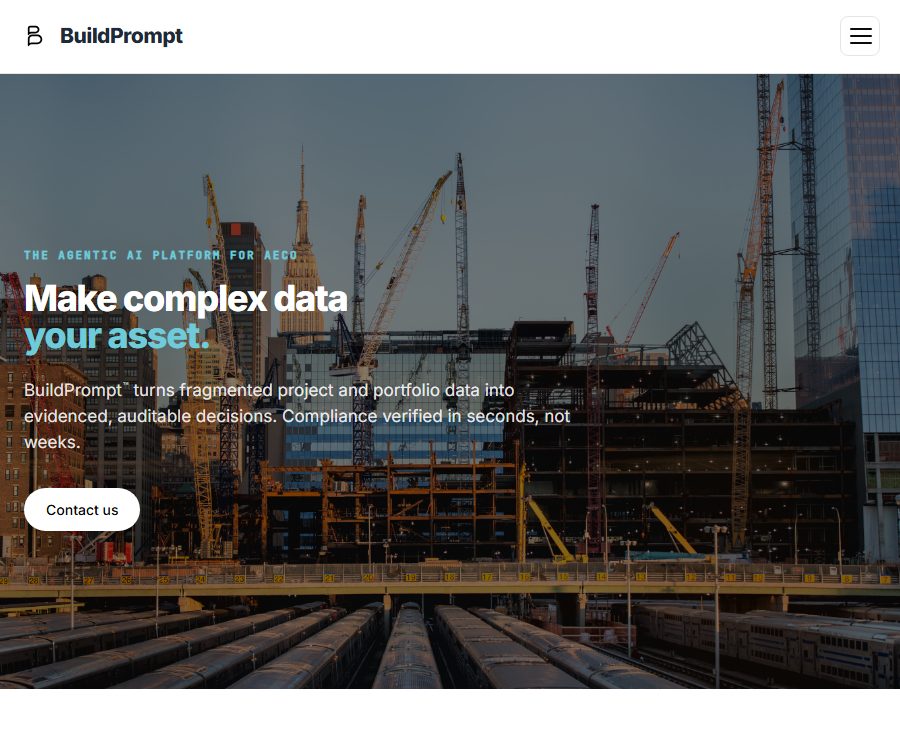
BuildPrompt is an enterprise-grade Agentic AI platform developed by BuildScan Limited; it currently serves the construction, engineering, building, and operation industries. It transforms data scattered across project documents, business systems, and asset records into decision outcomes that include evidence-based references and can be verified.
The core of this product isn’t single-document conversations, but rather the creation of repeatable, multi-step workflows using PromptStack. This platform is suitable for organizations that need to handle large amounts of drawings, tables, contracts, inspection records, and compliance-related documents.
Current enterprise platform and older version of Document Assistant
BuildPrompt in the current enterprise platforms and app stores, as well as BuildPrompt – AI for Documents, are not the same product. It is necessary to verify the channel, features, and terms of service associated with the account before making a purchase or trying out the product.
| Product format | Main positioning | Use the entrance | Billing information | It is necessary to pay attention. |
|---|---|---|---|---|
| Current AECO enterprise platform | Project and asset data workflows, compliance analysis, and evidence-based decision-making | Enterprise deployment or web workspace | Contact sales for a customized quote. | Functions, deployment, and usage are subject to the order and the main service agreement. |
| Old version of Mobile Document Assistant | After uploading the file, conduct Q&A and content extraction. | Apple and Google App Stores | Free download available; there are also in-app prompt packs. | The updates listed on the store page were primarily made at the end of 2024, and this does not reflect the benefits offered by the corporate platform. |
How PromptStack handles engineering data
- The data reader connects project files to enterprise systems, and it is capable of identifying documents, drawings, tables, database records, as well as scanned images.
- The unified data processing layer organizes fields and entities, establishing connections between requirements, terms, drawings, inspection items, and business records.
- PromptStack breaks down complex tasks into specialized sub-tasks such as classification, table extraction, deviation detection, and evidence retrieval.
- Key sub-tasks can be processed in parallel by multiple models; when conflicts arise, the process moves to an escalation or manual review stage.
- The platform generates dashboards, reports, alerts, or natural-language responses, and allows users to return to the file’s pages, terms, rows, or cells to verify the relevant information.
Evidence tracing
- Answers include references to specific files and page numbers, which reduces the occurrence of situations where only conclusions are provided without any possibility of verification.
- The results in the table can be traced back to the original rows or cells, making them suitable for verifying quantities, costs, and inspection records.
- Rule and requirement assessments can be linked to relevant clauses, drawings, and records, facilitating audits and approvals.
- The workflow retains the processing chain and human feedback, facilitating the team’s review of the model’s decision-making process.
Multi-model validation and human intervention
The platform routes models based on tasks, domain, and complexity, rather than assigning all tasks to a single model. If the results of key sub-tasks differ, the system can initiate a review process instead of silently selecting one answer.
This mechanism is suitable for high-risk inspections, but it cannot eliminate identification errors, missing materials, or improper rule settings. Final signing, compliance assessments, and on-site decisions should still be handled by authorized personnel.
Supported inputs, connections, and outputs
| Category | The content has been verified. | Typical uses |
|---|---|---|
| Documents and images | PDF, DOC, DOCX, scanned documents, and images | Contract review, lease extraction, checklist preparation, and historical record identification |
| Engineering and model files | DWG, IFC, and drawings | Linking requirements, design information, and on-site records |
| Tables and structured files | XLS, CSV, JSON | Analysis of costs, plans, risk registers, and quality records |
| Database | SQL data | Connect existing business records to create a unified view. |
| Enterprise data connection | SharePoint, Microsoft Fabric, Box, Databricks, enterprise APIs, and cloud storage | Reduce manual handling by running workflows within the existing data environment. |
| Results | Responses, dashboards, reports, alerts, cost plans, schedule plans, risk register, and compliance reports | Querying, reporting, anomaly monitoring, and audit review |
Main functions and practical value
Cross-document question answering and extraction
Users can pose natural language questions related to multiple files; the system retrieves relevant information and generates answers along with the locations of the supporting evidence. It can also extract tables, clauses, dates, responsible parties, and any abnormalities, thereby reducing the need to search page by page.
Knowledge correlation and unified data layer
The platform can organize dispersed records into a consistent data structure, and it uses entity relationships to link requirements, drawings, inspections, defects, and assets. As a result, teams can search for similar issues across different projects without having to open each file individually.
Composable workflows
The team can organize tasks such as classification, extraction, comparison, verification, upgrading, and reporting into a repeating process. The same rules can be applied to new files or projects, making them suitable for standardized quality checks and compliance audits.
Dashboard, reports, and alerts
The processing results can be combined into project or asset views that display risks, performance, trends, and pending tasks. Users can drill down from the aggregated metrics to the underlying evidence records and continue their inquiries using the updated data.
Text recognition and digitization of historical documents
The platform can handle scanned files, copies, and complex forms, making it suitable for organizing paper archives that have been accumulated over time. The quality of recognition is influenced by the clarity of the scans, the layout, and any handwritten content; therefore, it is still necessary to inspect important fields manually.
Typical usage process
- First, identify a verifiable business issue, such as requirement compliance, trends in quality defects, or the extraction of lease obligations.
- Organize files, databases, and storage locations to determine access rights, sensitivity levels, and responsible persons.
- The BuildPrompt team or administrators configure the connectors, field mappings, evidence rules, and PromptStack workflows.
- Run tests using representative historical data, and examine item by item the extraction results, the locations of the evidence, and any abnormal escalations.
- Set up manual approval steps, role permissions, and acceptance criteria, then extend the process to more projects.
- Utilize the dashboard, reports, or alerts to view the results, and continuously keep track of misclassifications, omissions, and rule changes.
Suitable for users and scenarios
- Project delivery team: Verify requirements, deliverables, and engineering records to produce traceable review results.
- Quality management team: Aggregates inspections and non-conformities, identifies recurring defects, assigns responsibilities, and tracks trends in corrective actions.
- Health and Safety Team: Identifies risks from on-site records and inspection materials, and generates alerts as well as summary views.
- Business and Contracts Team: Extracts information on terms, obligations, dates, and costs to assist in the review of contracts and leases.
- Asset management team: Links historical records with current data for maintenance, compliance, and portfolio analysis.
- Regulated organizations: Require workflows for evidence tracking, permission control, processing chains, and manual approval.
How should the results of the case be interpreted?
BuildPrompt presents examples of large-scale infrastructure projects, quality management initiatives, and real estate data processing. The figures provided describe the materials, processes, and outcomes of specific projects; they do not constitute any guarantee of similar results for other clients.
| Case studies | Processing range | Disclosure of results | Method of adoption |
|---|---|---|---|
| HS2 requirement verification | 37,983 requirement objects, 19 regions, and 89 modules | The verification time has been reduced from up to 2 weeks to 35 seconds, with savings of around 5 million pounds estimated. | Customized validation processes, multi-agent workflows, and human oversight |
| Quality record analysis | Over 30,000 records, 14 work packages | The analysis time has been reduced from 3 days to less than 1 minute, and 9 types of recurring defect patterns have been identified. | Integration of quality documents, knowledge relationships, and traceable queries |
| Review of real estate leases | 40 years of scanned archives, thousands of assets, and millions of pages of documents | The review period has been reduced from 6 weeks to less than a day, with annual savings of around £2 million identified. | Text recognition, clause extraction, standardized structure, and reminders |
Prices, trials, and in-app purchases
Enterprise platform
At present, the AECO enterprise platform does not have any publicly specified fixed subscription prices, uniform free usage limits, or standard refund policies. The pricing options vary depending on factors such as the volume of data, connectors used, workflows involved, deployment methods, required permissions, and level of support needed.
| Package or version | Price | Billing cycle | Core benefits or quota | Suitable for users |
|---|---|---|---|---|
| AECO Enterprise Platform | Contact sales for a customized quote. | Subject to the order. | Data connections, PromptStack workflows, evidence tracking, dashboards, governance, and enterprise support; no unified quota specified on the public page | Construction, engineering, building, operation, and regulated organizations |
Old version Apple app prompt package
The Apple Store still lists the following one-time in-app purchases, but they belong to the older version of the Mobile Documents Assistant. Region, taxes, and store accounts can affect the actual amount charged, so they cannot be used to estimate the price on the Enterprise platform.
| Package or version | Price | Billing cycle | Core benefits or quota | Suitable for users |
|---|---|---|---|---|
| 25 additional hints | 7.99 dollars | One-time use | Add 25 prompts | Low-frequency mobile document Q&A |
| 50 additional hints | 12.99 dollars | One-time use | Add 50 hints | Light users |
| 100 additional hints | 19.99 dollars | One-time use | Add 100 hints | Moderate usage |
| 250 additional hints | 39.99 dollars | One-time use | Add 250 prompts | Higher usage level |
| 500 additional hints | 59.99 dollars | One-time use | Add 500 prompts | High-frequency mobile document Q&A |
Purchases, cancellations, and refunds for older versions of applications are handled in accordance with the account policies and rules of the respective app store. Cancellations, renewals, service levels, minimum contract periods, and refund conditions for the enterprise platform are specified in the order details and the main service agreement.
Platform, integration, and openness capabilities
| Project | Current status | Explanation |
|---|---|---|
| Corporate web platform | Support | Used to configure workflows, query data, and view dashboards and reports. |
| Apple mobile app | There are old versions of the Document Assistant page. | Supported on iPhone and iPad; the features and pricing do not reflect those of the current enterprise platform. |
| Android mobile apps | There are old versions of the Document Assistant page. | The store page can still be searched; the update status should be determined separately from that of the enterprise platform. |
| Enterprise connection | Support | Including SharePoint, Microsoft Fabric, Box, Databricks, enterprise APIs, and cloud storage |
| Publicly available API documentation | Not yet made public | The scope of interface access, authentication methods, and call limits must be confirmed with the sales team. |
| Official SDK | Not confirmed yet | No verifiable public SDK or version documentation was found. |
| Official GitHub | Not confirmed yet | No official code organization or example repository with a verifiable affiliation was found. |
| Open-source status of the product | Products with closed-source code | The product’s source code and open-source license are not made public; therefore, the presence of a connector cannot be considered as an indication of being open source. |
Privacy, Security, and Data Governance
- The data, suggestions, and responses uploaded by customers remain the property of those customers; they are not used to train the underlying models or to improve services provided to other customers.
- The platform specifies that customer environments are isolated from one another, and third-party models are subject to constraints regarding not being stored, shared, or trained.
- Companies can choose internal models or other large-scale models; the specific model, location, and method of deployment should be specified in the contract.
- Personal information may include contact details, web addresses, as well as browser and usage data; prompts and responses are recorded to provide the service.
- Data is retained only for as long as it is necessary to provide services, fulfill legal obligations, or resolve disputes; however, the public policy does not specify a uniform number of days for all types of data.
- The certifications disclosed by the company include ISO 27001:2022, ISO 9001:2015, ISO 14001:2015, and Cyber Essentials Plus.
- No technical or managerial measure can eliminate risk entirely; customers still need to apply the principle of minimum privileges, classify sensitive data, and conduct manual reviews.
Privacy differences between older mobile applications
The privacy labels in app stores are submitted by developers; they may include tracking information as well as data related to location, contact details, user-generated content, search history, identifiers, and diagnostic information associated with an individual’s identity. These labels apply to older versions of mobile applications, and enterprise clients should follow the data processing protocols in place for their actual deployments.
Copyright, contracts, and usage boundaries
- The website content, brand, and platform technology belong to their respective owners, and no permission is granted for their copying, resale, or redistribution.
- The scope of commercial use of the enterprise platform is determined by the main service agreement, the order and data processing agreements; the terms of the marketing website do not constitute a complete purchase contract.
- Before uploading contracts, drawings, personal information, or customer records, it is necessary to ensure that the organization has the necessary permissions and legal authority to do so.
- The content generated by the model may omit context or misinterpret terms; it should not replace engineering signatures, legal advice, or statutory inspections.
- Data retention periods, deletion timelines, backup procedures, incident notification mechanisms, audit rights, and subcontractors must all be confirmed individually during the procurement phase.
Summary
BuildPrompt is suitable for companies that wish to convert complex AECO data into traceable workflows and decision-making views. Its advantages include support for multiple file formats, the ability to locate relevant evidence, multi-model validation, and the capability to create combinable processes. It is not a generic chat product with fixed pricing; before purchasing it, it is necessary to test its accuracy using actual samples, and the deployment details, usage limits, data management practices, service levels, and exit conditions must be specified in the order.
Tools similar to BuildPrompt




 Guigong Network Security Registration No. 45132202000164