






Everyprompt
Everyprompt makes AI prompt commands work more efficiently and simply.
Tags:AI prompt instructionsWhat is Everyprompt?
Everyprompt is a browser-based platform for working with large language models, developed by Everyprompt, Inc.; it focuses on allowing users to test prompts, adjust parameters, and deploy APIs all within the same workspace.
It is aimed at developers and AI teams that need to quickly verify text generation logic, rather than being a simple database of ready-made prompt templates.
The current operating status needs to be confirmed first.
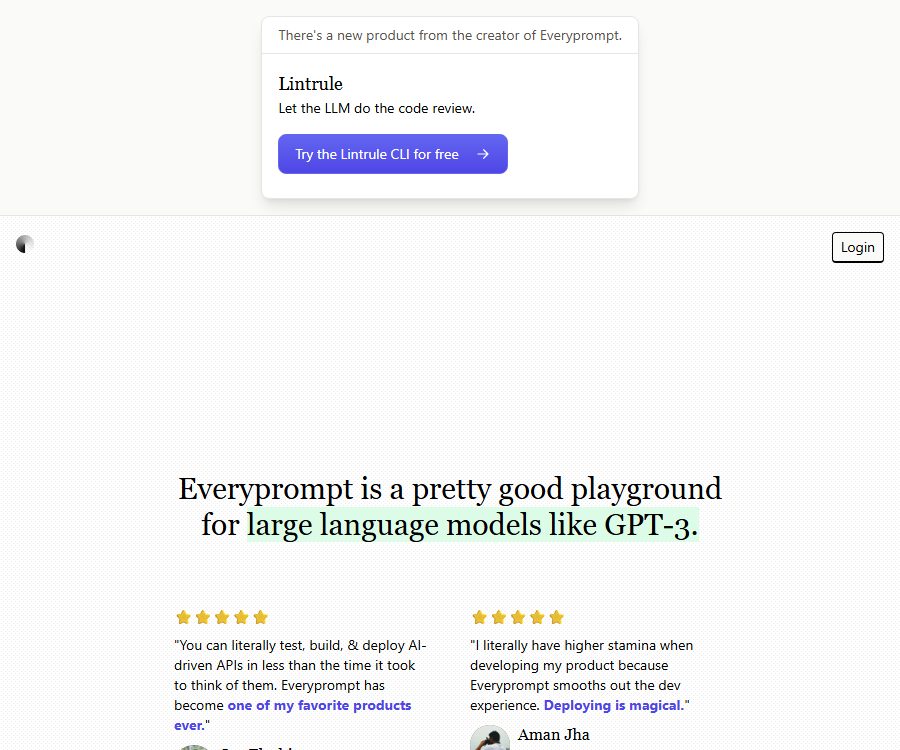
The product overview page is still accessible and continues to show information about GPT-3, API access, and the three different subscription plans; however, the footer dates back to 2023, while the terms of service and privacy policy were last updated in 2022.
At the top of the page, there are suggestions aimed at guiding users to discover the creator’s new products; therefore, just because the page is online does not mean that the old model, account system, inference services, and payment mechanisms are all functioning properly.
- It can be confirmed that the product positioning, the editor interface displayed publicly, the function descriptions, and the text related to the packages are still present.
- It has not yet been confirmed whether new users can complete registration, whether existing accounts can log in properly, and whether GPT-3-related models are still available for use.
- It has not yet been confirmed whether the Team version can be purchased, whether corporate sales are still available, and whether existing installations will continue to function.
- Usage suggestions: First, complete the login process using a non-sensitive example, generate something once and conduct a test deployment; only then consider migrating to the official workflow or opting for a paid version.
Main functions
Prompt editing and variable testing
The editor example uses double curly braces for variables, allowing dynamic inputs such as query content to be inserted into fixed prompts. Users can keep the structure of the instructions unchanged and only replace the variable values in order to test different requests.
- Input: Natural language commands, variable placeholders, and the values of those variables for each execution.
- Processing: The variable is combined with the prompt and sent to the selected language model.
- Output: The text generated by the model, which can be used to verify whether the instructions adequately cover the intended task.
- Applicable tasks: text explanation, classification, rewriting, summarization, and converting structured input into natural language.
Model parameter configuration
The public interface displays settings such as model selection, Temperature, and the stopping sequence; it also provides suggestions for the temperature value, ranging from conservative to creative options. Developers can compare different generation behaviors without having to rewrite the entire prompt.
- Lower temperatures are usually used for tasks where format stability is important and the solutions tend to converge more readily.
- Higher temperatures are suitable for creative generation that requires diverse expressions, but the consistency of the output may decrease.
- The stop sequence is used to tell the model to end at a specified marker, thereby reducing unnecessary subsequent text.
- The page shows the earlier version of GPT-3; it cannot be used to conclude that subsequent versions are now supported.
Deploy API from the playground
The main advantage of Everyprompt is that it allows the prompt phrases that have been tested in playground environments to be turned into callable interfaces, with version management handled through deployment and restoration operations. This reduces the need for repetitive work involved in copying configurations from prototypes to backend code.
- During the development phase, it is possible to adjust the prompts and parameters via a visual interface.
- After deployment, the application submits the variable values to the interface and receives the generated text.
- Prompt updates can be released as part of the deployment process; the page describes this capability as production-oriented CI/CD.
- The public API documentation, authentication format, rate limits, error codes, and availability commitments have not been verified yet; these details need to be checked within the account before establishing a connection.
Team and corporate capabilities
The team package highlights team support and unlimited API access, while the enterprise package lists options for fine-tuning, dataset management, and dedicated support. The page does not provide information regarding member permissions, audit logs, service levels, or the limits on fair usage.
Input and output
| Stage | Verifiable content | Use value | Precautions |
|---|---|---|---|
| Prompt input | Natural language commands and variable placeholders | Reuse the same task template | Do not submit data for which you do not have permission to process. |
| Running Settings | Model, temperature, stop sequence | Control randomness and end position | The page model may be outdated. |
| Generate output | The text returned by the language model | Verify the effectiveness of the prompt | Manual inspection is required to verify accuracy and compliance. |
| Deployment output | APIs available for application invocation | Integrate the prototype into the product. | The current document, rate limiting, and stability have not been confirmed yet. |
Basic usage process
- Open the product page and first verify that the login or registration option allows for account verification.
- Create or open a prompt, enter the task instructions in the editing area, and use variables to represent elements that will change during execution.
- Select the model that is currently available for the account, set the temperature and stopping sequence, and then enter test variables that do not contain sensitive information.
- Run multiple sets of representative samples to compare accuracy, format stability, handling of abnormal inputs, and token consumption.
- After confirming the results, check the deployment features and verify the authentication methods, call quotas, error handling, and version recovery capabilities.
- First, integrate the API in the testing environment; only after passing quality, cost, and security checks is it decided whether to use it in production.
Which users are it suitable for
- Independent developers: Quickly package the prompt prototype into an interface that can be called by applications.
- Product team: Verify the text generation interaction before developing the complete backend service.
- Advice for engineers: Focus on comparing the impact of variables, model parameters, and stopping conditions on the results.
- AI startups: It is necessary to link the testing configuration with the deployment process, but it is acceptable to first check the status of the existing platform.
- Enterprise exploration team: They have a need for fine-tuning and dataset management, and are willing to first confirm with the service provider the current scope of support.
Typical scenarios
- Submit the SQL query as a variable, so that the model can generate explanations that are easy for business users to understand.
- Inject customer service questions, articles, or product fields into fixed prompts to generate classification, summaries, or structured drafts.
- Compare the temperature and shutdown sequences on the same sample to determine a more stable production configuration.
- The validated prompt is deployed as an interface for use by web pages, internal tools, or automated processes.
- After modifying the prompt, a new deployment is released; in case of errors, the system can revert to the previous configuration thanks to its recovery capabilities.
Product advantages
- Testing is closely integrated with deployment, which helps to reduce the need for manual transfer of data between the park’s configuration settings and the application code.
- Variable prompt templates are easy to reuse and are more suitable for creating test sets that cover both normal and edge cases.
- The parameter names are displayed directly, making it easier to understand the impact of temperature and stop conditions on the output.
- It simultaneously presents individual, team, and corporate pathways, covering various stages from prototype validation to organizational collaboration.
Capacity limits and risks
- The product information hasn’t been updated in a long time, so the old models listed on the page and the unlimited benefits cannot be considered as current commitments that are enforceable.
- The generated content may be inaccurate, incomplete, or biased; it must be reviewed by professionals when used in high-risk areas such as medicine, law, and finance.
- Public information does not specify the context length, rate limits, concurrency level, service level, backup and recovery time, or deployment location.
- Regarding the so-called unlimited and undisclosed fair use policy, the team must obtain a clear written explanation before designing the cost model.
- Without verifying the public status page, recent update logs, or maintenance commitments, it is not advisable to deploy critical services directly without conducting tests first.
Price packages
The table below shows the prices and benefits currently displayed on the product page; it does not necessarily mean that the item is still available for purchase through the settlement system. Taxes, exchange rates, regional differences, and the actual benefits available in the account should be based on what is shown before making the payment.
| Package or version | Price | Billing cycle | Core benefits or quota | Suitable for users |
|---|---|---|---|---|
| Personal | Free | Monthly limit | Up to 100,000 tokens per month, GPT-3 support, API access | Personal experiments and small prototypes |
| Team | 10 dollars per user | Monthly | The page claims unlimited tokens, unlimited API accesses, and team support. | Multi-person development team |
| Business | Custom quote | Contact sales | Fine-tuning, dataset management, dedicated support, and more controls | Organizations with needs for customization and support |
The terms allow the use of third-party payment processors, and it is indicated that taxes, exchange fees, or regional price differences may apply. At present, there are no clear specifications regarding the deadline for refunds, the conditions for refunds, or the rules for automatic renewal; therefore, a written confirmation should be obtained before making a payment.
Platform, API, and open-source status
| Project | Verify status | Explanation |
|---|---|---|
| Web version | Confirmed | The product overview page and login portal are still available. |
| Native mobile apps | Not confirmed yet | No verifiable official app store page was found. |
| API | It is clearly displayed on the page. | Both the individual and team versions list API access options; however, the current documentation and the ability to call these APIs require login verification. |
| SDK | Not yet made public | No official Python, JavaScript, or other public SDKs have been confirmed. |
| GitHub | Not confirmed yet | The official code organization associated with the product’s identity has not been confirmed. |
| Open-source status | Open source has not been confirmed. | The availability of an API does not mean that the hosting platform or the server-side code is open source. |
Privacy, security, and content rights
- Account and access data: It may handle names, email addresses, phone numbers, mailing addresses, IP addresses, device access information, operation logs, as well as traffic and location data.
- Purpose of use: To provide and improve services, offer customer support, send notifications, conduct analyses, carry out security investigations, and prevent fraud.
- Sharing scope: The policy states that personal data will not be sold or shared with advertisers, but it may be disclosed due to legal requirements, processing by affiliated parties, mergers and acquisitions, or external processing.
- Cross-border processing: Data may be processed outside the user’s country; for data transfers to specific countries, standard contract clauses may be used.
- Retention period: Data is retained in accordance with legitimate business requirements or legal obligations; as long as the data remains stored, it is considered to be in use, and there may be a delay between deletion and the removal of backups.
- User rights: Users can request access, correction, deletion, and export of data; in some regions, they can also object to or restrict such processing.
- Safety instructions: The policy outlines access restrictions, confidentiality obligations, and incident response procedures, but it does not disclose specific authentication methods, the scope of encryption, or independent audit reports.
Content, copyright, and commercial usage notes
The terms state that users retain ownership of the content they submit, and they are required to ensure that they have the legitimate rights to such content as well as to the personal data contained within it. The platform’s interface, software, and content are still protected by intellectual property laws.
- Do not upload protected health information or biometric data that is subject to Illinois’ biometric privacy regulations.
- Do not include client secrets, access keys, or unauthorized personal information in prompts and test variables.
- Whether the model’s outputs can be used for commercial purposes depends on the underlying model, the input materials, third-party rights, and the specific contract; it cannot be determined merely by having an Everyprompt account.
- The services are provided as they are; the platform does not guarantee that the content is accurate, appropriate, or continuously available. Production applications should include mechanisms for manual verification, logging, and fallback solutions.
Checklist before selection
- It has been confirmed that the processes for registration, logging in, password recovery, and account deletion can all be completed successfully.
- View the actual list of models available in the account; do not rely on the old GPT-3 model listed on the page to determine the current range of supported models.
- Confirm with the service provider the API documentation, authentication methods, rate limiting, concurrency limits, error codes, service levels, and data areas.
- Before making the payment, take a screenshot of the package details, taxes, renewal options, cancellation and refund policies, and check whether unlimited usage is subject to fair use restrictions.
- End-to-end testing is carried out using non-sensitive data to verify prompt editing, generation, deployment, invocation, and recovery.
- Prepare alternative solutions before integrating critical services, in order to avoid service disruptions due to the cessation of maintenance for the old platform.
Frequently Asked Questions
Can Everyprompt still be used properly?
The product overview page is still available online and includes a login link; however, the page and its policies have not been updated for a long time. The current status regarding registration, inference, deployment, and billing should be verified by the users through actual testing.
Is Everyprompt a free tool?
The page still shows the free Personal plan, which provides up to 100,000 tokens per month along with API access; whether this quota and the available models are still in effect depends on the details shown in the account.
Can it deploy prompt words as an API?
The product clearly demonstrates the capability to deploy AI interfaces in amusement parks, as well as the ability to carry out and restore activities; however, the public API documentation and the current status of operations have not yet been confirmed.
Which models does Everyprompt support?
The page focuses on GPT-3 and shows the names of earlier models; there is not enough evidence to determine whether it supports the current mainstream models, so the actual list of models available should be taken as a reference after logging in.
Is Everyprompt open source?
It has not yet been confirmed that the managed product is open source, and no official code repository or license with a clear owner has been found; providing API access does not mean that the product’s source code is made available.
Can it handle sensitive or customer data?
It is not recommended to submit sensitive information before the contract is finalized, the data areas are defined, retention periods are established, and security assessments are carried out; the terms also explicitly prohibit the uploading of certain health and biometric data.
Summary
The design of Everyprompt is aimed at enabling developers to carry out tests on variable prompts, make parameter adjustments, and deploy APIs all within a single interface; it serves as a useful tool for understanding the development process of early LLM applications.
Given that public information remains available for a long time, the first step when choosing this option is not to migrate the production system immediately, but rather to verify whether the accounts, models, interfaces, pricing, and support channels are still functional.
Tools similar to Everyprompt




 Guigong Network Security Registration No. 45132202000164