






Krut AI
Krut AI, an intelligent tool focused on AI prompts
Tags:AI prompt instructionsA one-sentence summary
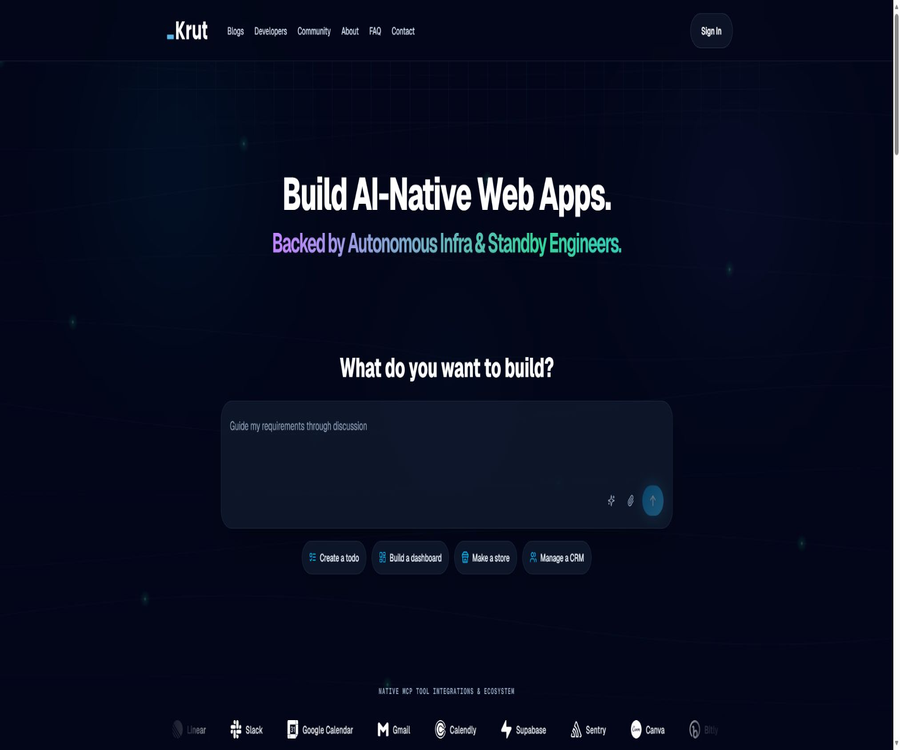
Krut AI is a conversational full-stack application development platform; once a user describes their requirements, the system generates the front-end, back-end, database, AI components, and deployment environment, and it also provides assistance from human engineers for complex issues.
Tool Introduction
Krut AI is now positioned as a platform for AI-native applications and infrastructure; it is no longer the tool focused on generating e-commerce images as described in earlier documents. It is suitable for developing OCR document processing systems, voice applications, business backends, CRM systems, stores, as well as Web applications that incorporate Agent logic.
The platform integrates code generation, container images, databases, caching, asynchronous queues, and hosting within the same workspace. Users still need to define their requirements, test the outputs, and assess the risks associated with production deployment; automating the build process does not mean that software engineering is no longer necessary.
Three core competencies
| Core competencies | Included content | Primary value | Key constraints |
|---|---|---|---|
| AI-native engine | OCR, text-to-speech, speech-to-text, real-time speech, and LLM logic | Rapid combination of multimodal applications | Accuracy, latency, and model costs need to be tested. |
| Automated infrastructure | Docker images, PostgreSQL, Redis, queues, Workers, and hosting | Reduce manual cloud configuration | Architecture, scaling, and fault recovery still need to be validated. |
| Assistance from human engineers | View logs, resolve errors related to duplicate builds, and handle complex boundaries. | Keep moving forward even when the AI gets stuck | The scope, response time, and delivery standards are not publicly specified in quantitative terms. |
Main functions
Full-stack application for natural language generation
Users can describe functions, pages, data, and workflows in plain language, and Krut uses this information to create applications. The platform not only provides code snippets but also offers a workspace, real-time preview, hosted deployment, as well as optional integration with third-party services.
OCR and document parsing
Krut can add OCR extraction for PDFs and scanned documents to an application, and feed the results into subsequent business processes. Tables, handwritten text, low-resolution images, and complex layouts still require testing using actual documents.
Voice input and output
The platform supports text-to-speech, speech-to-text, as well as real-time speech-to-speech conversion; it can be used in voice assistants, customer service, and accessibility applications. Noise, accent, latency, interruptions, and call disruptions can affect the quality of the experience.
Multi-model LLM logic
Applications can integrate visual elements, voice input, and various LLMs into business processes, enabling communication between the front end and the back end. The model names, routing methods, usage levels, and details related to BYOK are not fully listed on the public pages.
Docker image building
The system generates custom Docker images based on the project’s dependencies, eliminating the need for users to create container configurations from scratch. When generating an image, it is still necessary to check the base image, software packages, vulnerabilities, the user account used for execution, and ensure reproducibility in the build process.
Databases and migration
The platform allows for the creation of isolated PostgreSQL databases, and it handles connection pooling, persistence, and schema migration. When dealing with production data, it is necessary to verify backup and recovery processes, as well as indexing, concurrency, and rollback mechanisms.
Redis and asynchronous queues
For tasks that involve long-duration AI processing, audio/video processing, or email sending, these operations can be routed to Redis and BullMQ queues, where they are handled by separate worker pools. Such queues require features such as idempotency, retry mechanisms, dead letter handling, timeout settings, and concurrency limits.
Hosting and automatic scaling
The generated applications can be published at real-time addresses, with container hosting enabling scaling based on load. The available information does not list in detail the regions, SLAs, sleep modes, bandwidth limits, domain names, and resource quotas.
MCP integration with third parties
The product showcase includes Notion, Linear, Slack, Google Calendar, Gmail, Supabase, Sentry, GitHub, Stripe, as well as various development services. The actual usage, permissions, and maturity level of each integration need to be verified individually within the project.
Human engineers act as a backup.
When container construction fails repeatedly or the requirements are unclear, human engineers can examine the workspace and fix any related issues. Human access means that the project code and data can be viewed by authorized personnel; for sensitive projects, access approvals and confidentiality measures must first be in place.
Applications suitable for development
- An OCR tool for extracting fields from invoices, contracts, or scanned forms.
- An application with voice input, transcription, playback, and real-time conversation.
- An internal agent that connects the LLM to business rules.
- A business backend with users, permissions, forms, and dashboards.
- A store prototype with product, order, and payment integration.
- A CRM that uses PostgreSQL to store structured data.
- A processing platform that requires background workers to carry out long-running tasks.
- Automation for connecting calendars, emails, collaboration, or monitoring systems.
- A full-stack prototype that requires containerized deployment and database migration.
Applications that should not be launched directly after being created.
- Payment, financial, and money transfer systems that lack security reviews.
- There are no medical diagnosis or treatment decision tools that involve professional review.
- Systems that handle highly sensitive identities, child data, or biometric data.
- An enterprise production backend without access control and auditing.
- Applications that use AI to make direct decisions regarding hiring, lending, or legal matters.
- Real-time services with high concurrency, without stress testing.
- Systems that rely on unverified third-party interfaces to carry out critical transactions.
- Voice or document processing tools that do not have authorization for recording and using the content.
The process from requirement to launch
- Identify the target users, core issues, and minimum viable functions.
- List the pages, roles, data entities, external integrations, and security requirements.
- Describe the first minor version in natural language; not all features need to be included at once.
- Check the interface, data structures, and business processes generated by Krut.
- Upload anonymous test data to evaluate OCR, speech, or LLM capabilities.
- Verify container dependencies, database migration, queue, and Worker configurations.
- Grant only the minimum permissions when connecting to third-party services.
- Test errors, permissions, concurrency, and exception recovery in the preview environment.
- Let human engineers handle the boundary issues that the platform cannot resolve.
- It will be made publicly available only after passing security, privacy, performance, and business acceptance tests.
- After going live, monitor logs, costs, model quality, and user feedback.
How to write good requirements
Krut can start with a single sentence, but for production applications more specific acceptance criteria are required. High-quality requirements should define user roles, key operations, data rules, behavior in the event of failures, and actions that cannot be performed.
| Demand section | It should be clearly stated what. | Example direction |
|---|---|---|
| User | Roles, login methods, and permission boundaries | Administrators can import data, while regular members can only view it. |
| Enter | Files, fields, language, size, and validation | PDF and images: page limits apply, and executable files are not allowed. |
| Processing | Order of OCR, speech, models, and business rules | First extract the fields, then verify them manually, and finally save them to the database. |
| Output | Pages, downloads, notifications, and structural format | Generate an editable table while preserving the original position. |
| Data | Table structure, retention, deletion, and export | Clean up projects and attachments after the account is deleted. |
| Anomaly | Timeout, failure, retry, and fallback | If OCR fails, the task is transferred to a human operator; no duplicate charges are applied. |
| Safety | Authentication, authorization, auditing, and keys | Sensitive operations require secondary confirmation and are recorded. |
| Acceptance | Accuracy, latency, and success criteria | The accuracy rate of the fields in the sample set meets the specified threshold. |
Precautions for using OCR applications
- Use real samples with different scanning qualities, rotations, and lighting conditions.
- Test printed text, handwritten text, and multilingual text separately.
- Test tables, stamps, signatures, and multi-column layouts separately.
- Keeping the original image in its original location facilitates manual review.
- Fields with low confidence levels must undergo manual verification.
- Do not use OCR results directly for payments or legal conclusions.
- Sensitive documents should have a short retention period and access logs.
- Verify whether the third-party visual model retains the document.
Precautions for voice applications
- Clarify the recording prompts and participants’ consent.
- Tests Mandarin, dialects, accents, and technical terms.
- Conduct stress tests on noise, echoes, and network jitter.
- Design for handling speech interruptions, muting, and timeouts.
- Align the transcription with the original audio for review.
- Clear identity indication is provided when AI voice is broadcast to external audiences.
- Do not execute high-risk voice commands without manual confirmation.
- Set rules for audio retention, downloading, and deletion.
Background tasks and queues
Audio and video conversion, batch processing of documents, email handling, and long-duration model executions are not suitable for blocking web requests; Krut can be used to create queues and workers for such tasks. The queue architecture still needs to be designed with regard to failures and repeated executions.
| Queue items | Configuration is required. | Common risks |
|---|---|---|
| Task ID | Globally unique and with queryable status | Repeated submissions and confused results |
| idempotence | The same business request generates only one valid result. | Retrying results in duplicate emails or charges. |
| Retry | Number of attempts, interval, and retryable errors | Infinite loops and out-of-control costs |
| Timeout | Single-task limit and overall process limit | Worker remains occupied for a long time |
| Concurrency | Number of Workers for each type of task | Overload of databases, models, or external interfaces |
| Dead letter | Tasks that fail repeatedly are saved separately. | Errors are silently discarded. |
| Monitoring | Queue length, success rate, and cost | The backlog went unnoticed for a long time. |
| Cancel | Allows users to terminate unfinished or stoppable tasks. | Continue to consume resources and points. |
Databases and persistence
Automated database creation can reduce the time required to develop prototypes, but once table structures and data migrations are used to store actual user data, engineering oversight is necessary. The generated schema should be checked for primary keys, foreign keys, unique constraints, indexes, and time zones.
- Distinguish between development, testing, and production databases.
- Automatically back up before migration and verify recovery.
- Set constraints and audit fields for critical tables.
- Database accounts should use the minimum required permissions.
- Restrict direct access to databases by public applications.
- Set tasks for deleting and retaining personal data.
- Monitor connection pools, slow queries, capacity, and locks.
- Verify data integrity and encoding before exporting.
Support from human engineers
Human engineers are described as a safety net for dealing with repeated compilation errors, vague requirements, and complex boundaries. The public pages do not provide information on the number of hours worked per account, response times, the number of modifications made, the time zones supported, or the costs associated with upgrades.
| Confirmation is needed. | Why is it important? |
|---|---|
| Trigger conditions | Identify when to switch from automated AI processes to manual handling. |
| Response time | Determine whether the project can meet the release deadline. |
| Includes working hours | Avoid mistaking assistance for unlimited development services. |
| Access scope | Engineers may examine code, logs, and project data. |
| Code review | Verify whether the modifications have been checked and tested by a second person. |
| Delivery standards | Define what constitutes completion, availability, or readiness for production. |
| Subsequent maintenance | One repair does not equate to ongoing maintenance. |
| Confidentiality and intellectual property rights | Protect customer code and business requirements |
The page uses phrases such as “guaranteed delivery,” but the terms of service state that AI-generated content may be incorrect or incomplete; the service is provided as is, without any guarantee of continuity. When placing an order, it is necessary to specify the scope of delivery and the acceptance criteria in a separate contract, rather than relying solely on promotional text.
Publishing and Hosting
The generated application can be published at a public address, and the content published there will be visible to visitors. Before going live, it is necessary to check whether environment variables, debugging pages, default accounts, database ports, error stacks, and test data are exposed.
- Create a preview environment that is separate from the production environment.
- Remove sample users, test keys, and debugging interfaces.
- Enable authentication, authorization, input validation, and request throttling.
- Scan container images, dependencies, and exposed ports.
- Conduct backup and recovery drills on the database.
- Configure logs, metrics, error alerts, and shift handover procedures.
- Test peak traffic, Worker backlogs, and external interface failures.
- Check the privacy policy, terms of service, and any required consent.
- Gradually introduce real users and prepare for a rollback.
MCP and integration
| Integrated categories | Representative tool | Common uses | Main risks |
|---|---|---|---|
| Collaboration | Notion, Linear, and Slack | Documents, tasks, and notifications | Unauthorized reading and erroneous writing |
| Google services | Calendar and Gmail | Schedule and email automation | Broad OAuth permissions and sensitive content |
| Data | Supabase, PostgreSQL, and Redis | Accounts, data, and cache | Database exposure and permission configuration |
| Development | GitHub, Docker, and Vercel | Code, images, and deployment | Generating keys, supply chains, and automatic deployment |
| Monitoring | Sentry | Error and performance tracking | The logs contain personal or sensitive data. |
| Design | Canva and Figma | Material and interface collaboration | Copyright and file access permissions |
| AI models | Anthropic and OpenAI | Text, visuals, and Agent logic | Token fees, retention, and output errors |
| Payment | Stripe | Orders and subscriptions | Fund transactions, PCI, and Webhook security |
The presence of icons in a product ecosystem does not mean that full two-way functionality is available for every feature; users should verify the authentication methods, available actions, error handling, and package limitations in the actual application.
Price and points
The price information was verified on August 23, 2026; the actual amounts, taxes, exchange rates, and discounts may vary, and the final figures will be those displayed on the settlement page.
Krut uses prepaid credits; there is no fixed periodic subscription fee, nor are there any automatic subscriptions that need to be canceled. Credits are consumed when AI applications are generated, containers are run, and existing applications are maintained.
| Project | Current price or rules | Billing method | Precautions |
|---|---|---|---|
| Account registration | Fees are not yet publicly available. | Create an account | Whether initial points are provided depends on the account. |
| Recharge via points | The specific gear levels have not been made public yet. | Prepayment via Razorpay | Settlement may incur additional taxes such as India’s GST. |
| Generated by AI applications | Consumed based on points | Used for generation and modification | The rates associated with different models and task complexities are not publicly available. |
| Container operation | Consumed based on points | Continue to use it during operation. | The resource specifications, sleep mode, and unit rates are not disclosed. |
| Published apps | Consumed based on points | Keep the application online. | It is necessary to determine whether low-flow applications should enter sleep mode. |
| Assistance from artificial engineering | A separate price has not been made public yet. | Arranged by platform or project | Working hours and additional costs need to be confirmed. |
| Third-party services | Decided by each provider. | Models, emails, payments, or external APIs | May not be included in the Krut integral |
The public page does not show the amount of money spent on top-ups, the number of points, the pricing for models, the specifications of containers, bandwidth, database resources, storage capacity, or the hours worked by engineers. The budget can only be determined on the Billing page after logging in or through discussions with sales representatives; it is not possible to assume that the cost of use is low just because there is no subscription.
Refund rules
- Points that have been used cannot be refunded.
- Unused purchase points can be refunded within 7 days after the purchase.
- Approving a refund will deduct the non-recoverable payment fees and taxes.
- Promotional offers or free points have no cash value and are non-refundable.
- A full refund can be requested for repeated deductions.
- If the payment is successful but the funds are not credited within 24 hours, you can request additional points or a full refund.
- Failed payments are usually refunded by the bank or Razorpay within 5 to 7 business days.
- Approved refunds usually take 5 to 7 business days to be credited.
- The refund request should be submitted from the registered email address, including the payment reference number, date, and reason.
Ownership and Commercial Use
The user retains ownership of the prompts, data, and files submitted, as well as of the application generated within the limits permitted by law. The user authorizes Krut to host, process, and display the project content in order to operate and improve the service.
- The generated code may be similar to that of other users.
- The user is responsible for checking the licensing of third-party code, materials, and model outputs.
- Applications published must comply with laws and third-party rights.
- The creation of malware, phishing pages, and spamming tools is prohibited.
- The Krut services may not be resold or relicensed without written consent.
- Before commercial use, it is necessary to check the license requirements and the rights regarding the generated materials.
- Critical business applications require separate code auditing and testing.
Privacy and data processing
Krut handles account information, prompts, uploaded files, application code, project data, transaction information, usage logs, and device information. When connecting to services such as Gmail or Calendar, it also saves the OAuth tokens and the minimum amount of data required for integration.
The project content is sent to third-party AI model providers such as Google in order to generate code and applications. Krut states that the content will not be sold, nor will it be used to train its own models. Whether the third-party models retain or use that content depends on the specific terms of the service chosen.
| Data items | Public handling method | Usage suggestions |
|---|---|---|
| Prompt words and files | Used for AI generation and project execution | Do not upload confidential or personal data for which you do not have permission to handle. |
| Generate applications and code | Saved in the project workspace | Clean up secrets, test data, and logs before deployment. |
| Model processing | Send the necessary content to third-party models as requested. | Confirm the model, region, retention, and training policies |
| Integrated token | Save according to the authorized scope | Minimum permissions, periodic revocation, and anomaly checking |
| Payment | The complete payment credentials are processed by Razorpay. | Krut saves the amount, status, and transaction identifier. |
| Public applications | The publication address can be viewed by any visitor. | It must not contain internal keys or confidential data. |
| Accounts and Projects | To be retained during the valid period of the account or as long as the service is needed. | Deletion requests may be subject to legal obligation exceptions. |
| International transmission | The provider may be located in another country. | Sensitive enterprises need to evaluate DPA and data regions. |
Safety inspection
- Use a separate, strong password and secure login for the Krut account.
- Third-party integrations are granted only the permissions required by the project.
- All keys are stored in environment variables or a managed key service.
- Do not include real keys in prompts, code repositories, or frontend embedments.
- Set authentication, rate limiting, and input validation for public interfaces.
- Scanning identifies dependencies and vulnerabilities in container images.
- Limits the types, sizes of uploaded files, as well as the resources used for parsing them.
- Payment Webhooks require signature verification and idempotency.
- The production database prohibits the use of default passwords and public ports.
- Review the access scope and operation records of human engineers.
- Export the project regularly and test exiting the migration.
APIs, SDKs, and GitHub
The navigation includes developer documentation and API entry points, but the developer page clearly states that the API references and SDK guides are still in preparation. It is therefore not possible to claim that stable, publicly available development interfaces with version commitments already exist.
| Project | Current status | Correct understanding |
|---|---|---|
| Developer documentation | Preparing | There is no complete public interface documentation available yet. |
| API Reference | Preparing | Authentication, rate limiting, and version commitments are not disclosed. |
| SDK | Preparing | Unverified installation packages or code examples cannot be provided. |
| MCP ecosystem | Product display support | Specific servers, actions, and permissions need to be verified within the project. |
| Official core GitHub | Not verified. | It cannot be marked as an open-source application development platform. |
| Generate project code | It can be generated within the user’s workspace. | The available project code is not identical to the open-source version on the Krut platform. |
| Self-hosted platform | Not yet made public | The construction of Docker applications does not mean that Krut itself can be made private. |
Which users are it suitable for
- Entrepreneurs who wish to quickly create full-stack prototypes using natural language.
- Product teams that need a combination of OCR, speech, and LLM technologies.
- Users who do not want to configure Docker, databases, and task queues manually.
- Web application teams that need backend Workers to handle long-running tasks.
- Customers who hope to receive assistance from human engineers when the AI gets stuck.
- Teams that are willing to top up based on usage and can manage production inspection.
- Companies that need to quickly test their internal tools, CRM systems, and business backends.
Product advantages
- From natural language requirements to front-end, back-end, and hosting.
- Integrates OCR, speech, and LLM business logic natively.
- Automatically creates Docker images and container runtime environments.
- Automatically configure PostgreSQL, Redis, and asynchronous workers.
- Long-term tasks and multi-modal applications perform better than simple page generators.
- Human engineers can handle repeated failures and complex boundaries.
- It supports various services, development, AI, and payment integrations.
- There is no fixed subscription; points purchased in advance are used for access.
- Users retain the right to the project content and to create applications.
Main limitations
- The public page does not provide information on the options for topping up points or the full list of rates.
- The quotas for models, containers, storage, bandwidth, and databases are not transparent.
- Human engineers have unquantified labor hours and response times.
- The promotion of delivery guarantees and services under the as-is terms requires contract clarification.
- Code generated by AI may contain errors, incompleteness, or security flaws.
- Multimodal capabilities rely on third-party models and external services.
- The developer API and SDK documentation are still in preparation.
- No official open-source core platform or self-hosted version has been identified.
- There is limited publicly available information regarding the maturity of connectors and their specific permissions.
- Public applications may inadvertently expose project data and keys.
- Prepaid points are also continuously consumed as part of the hosting service.
- Production applications still require testing, monitoring, backup, and maintenance.
Pre-launch inspection checklist
- Break down the requirements into verifiable pages, data, and business rules.
- Test AI-native functions using real but anonymized data.
- Check all user roles and unauthorized access paths.
- Auditing generates code, dependencies, images, and public interfaces.
- Verify database migration, backup, restoration, and deletion.
- Test queue idempotency, retry, timeout, and backlogging.
- Verify model, integration, and human engineer data access.
- Test third-party interface failures, rate limiting, and cost limits.
- Obtain the full integration rate and monthly budget estimate.
- Confirm that the domain name, data, and code can be exported for migration.
- Prepare a privacy policy, terms of service, and support procedures for the application.
- Publish in small volumes and maintain a rapid rollback solution.
Frequently Asked Questions
What is Krut AI doing mainly these days?
It is now a conversational full-stack application development platform that focuses on AI-driven capabilities, automated container infrastructure, and assistance from human engineers; its primary purpose is no longer the generation of e-commerce images.
Is Krut AI a no-code tool?
Users can start by using natural language, but the platform generates a complete application that includes code, databases, and containers. For actual use, it is still necessary to understand the requirements, conduct testing, ensure security, and handle maintenance.
What AI capabilities does Krut AI support?
The capabilities listed publicly include OCR document processing, text-to-speech conversion, speech-to-text conversion, real-time voice-to-voice communication, as well as business logic based on multiple LLM models. The specific models and pricing details need to be checked in the account.
How does Krut AI charge?
Instead of a fixed subscription, prepaid credits are used; creating applications and running hosted containers consumes these credits. The specific pricing tiers and unit rates are not made public.
Can a refund be obtained if points have not been used?
A refund for unused points can be requested within 7 days of purchase; once approved, the non-refundable fees and taxes will be deducted. Points that have already been used or those obtained as part of promotions are not eligible for a refund.
Will a human engineer help me finish writing the application?
The platform states that engineers can handle repeated build failures and complex edge cases, but the costs, response times, and delivery standards are not disclosed. For important projects, the scope of services should be confirmed in writing before payment is made.
Is Krut AI open source?
No official public source code or open-source license for the core platform has been identified. Users can create their own project code, but this does not mean that the Krut application deployment service itself is open source.
Are APIs and SDKs provided?
The developer portal is available, but the API reference and SDK guidelines for this page are still in preparation. Projects that require stable interfaces should wait for the official documentation or obtain a written commitment from the team.
Summary
Krut AI is suitable for teams that wish to rapidly develop full-stack applications involving OCR, speech recognition, LLMs, and background tasks through dialogue. With automated Docker setup, PostgreSQL, Redis queues, workers, and human engineers available for assistance, its capabilities go far beyond simply generating web pages.
The main sources of uncertainty are the pricing structure for integration, the available computing resources, the scope of manual services, the development interfaces, and the lack of transparency regarding the open-source status. Before it can be put into use, the generated code, data flows, costs associated with ongoing hosting, third-party models, and procedures for withdrawing it from service must all be thoroughly evaluated.
Tools similar to Krut AI




 Guigong Network Security Registration No. 45132202000164