






Artreviewgenerator
Artreviewgenerator, an intelligent tool focused on AI prompts
Tags:AI prompt instructionsWhat is the Art Review Generator?
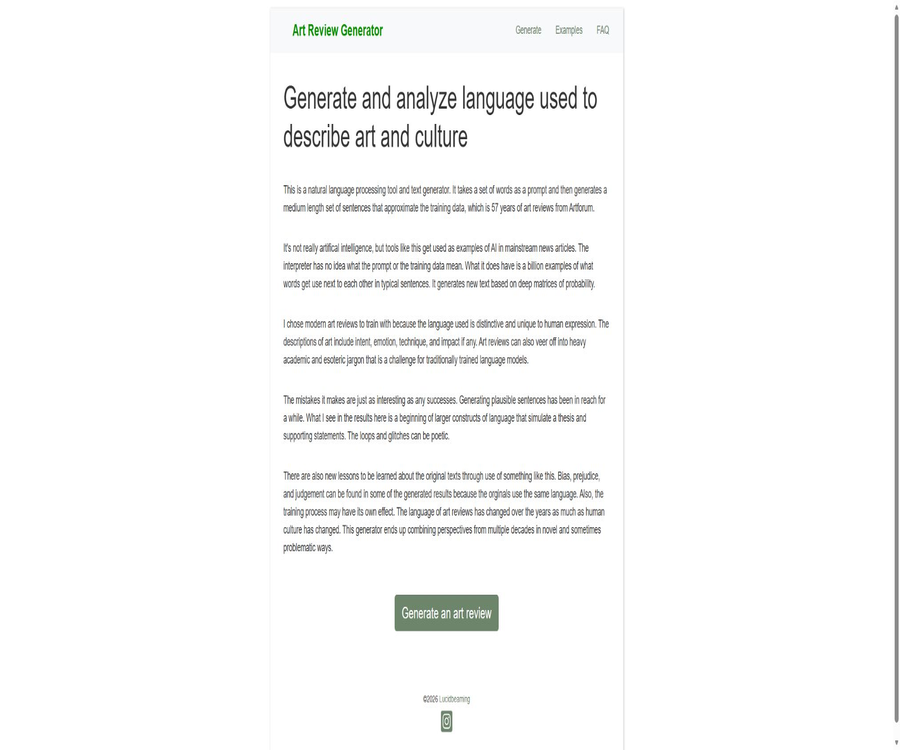
Art Review Generator is an experimental text-generation project aimed at studying the language used in art reviews; it was created by artist Joshua Curry under the name Lucidbeaming.
It generates texts of moderate length in a style similar to that of contemporary art criticism, based on the English words or unfinished sentences entered by the user; however, it does not actually view, understand, or evaluate any art work.
Current operating status
| Project | Current situation | Explanation |
|---|---|---|
| Official website | It is accessible. | You can read project introductions, FAQs, and historical results. |
| Comment generator | Paused | The generated page clearly shows that it is currently paused. |
| Historical Reviews | It is still possible to browse. | The results page displays the previously generated text. |
| Registration and payment | Not provided | The project is not a commercial subscription product. |
| API | Not provided | There is no public developer interface. |
Working principle
The creators used GPT-2 as the base model and fine-tuned it with 21,000+ art reviews from Artforum over a period of 57 years, so that the model could learn the common combinations of words and phrases found in art reviews.
- The user enters an English prompt or an unfinished sentence.
- The model predicts subsequent text based on the probability relationships in the training corpus.
- The system generates five candidate reviews based on different random outcomes.
- Generating a task originally took about 2 to 15 minutes.
- The results will be sent via email after completion.
The model possesses a large number of statistical patterns of adjacent words, but it lacks knowledge of art history, visual understanding, or genuine aesthetic judgment.
Core functions
- Continue the art review based on the English keywords.
- Imitate the tone of modern and contemporary art criticism.
- Generate five different versions at once
- It features academic, abstract, and obscure expressions.
- Retain faults, repetitions, and semantic jumps.
- Make some of the historical generation results public.
- Used to identify cultural biases in corpora.
What use cases are suitable?
- Study the linguistic patterns of art criticism.
- Classroom discussions on generative text and authorship
- Observing the early generation capabilities of GPT-2
- Seeking unexpected word combinations for artistic writing
- Analyze biases and identity expressions in training corpora
- Case Studies in Curating, Digital Art, and Media Studies
- Compare the differences between human reviews and probabilistic texts
Main advantages
- The project objectives and the descriptions of the training data are quite clear.
- The scope of the corpus is specifically long-term art criticism.
- The generated style exhibits distinct characteristics of artistic criticism.
- Do not present the text as reliable, professional conclusions.
- Intentionally retain errors to demonstrate the model’s limitations
- It can be used in the study of bias, language, and culture.
- Historical results make it easy to observe the impact of different cues.
Usage restrictions and risks
- The online generator is currently on pause.
- Suitable only for English prompts and English output.
- The model cannot view or understand artistic works.
- The results may be repetitive, contradictory, or illogical.
- Information about fictional artists, exhibitions, and artworks may be included.
- It may reproduce the biases and offensive language present in the training materials.
- Not suitable for direct use in academic citations or formal reviews.
- Public submissions may appear on the public results page.
- The capabilities of the early GPT-2 were significantly weaker than those of modern large models.
- The email-based generation process lacks real-time interaction.
Prompt writing format
The proposal suggests using the third person, the artist’s name, the medium, and a description of the artwork, while leaving the sentences in a format that allows for further completion.
| Hint method | Example structure | Expected outcome |
|---|---|---|
| Incomplete sentence | An artist created a series of paintings that… | The model continues to develop from the end of the sentence. |
| Keyword combination | Artists, sculptures, Shanghai, satire, the Internet | Generate comments around multiple concepts. |
| Replacement of identity words | Replace artistic adjectives with identity labels. | Observing biases and judgments in language corpora |
| Third-person narration | A certain artist created several works, and… | A commentary tone that is closer to that of the training corpus |
Historical usage tutorials
The following steps are used to understand the original generation process; when the current generator is paused, it is not guaranteed that tasks can be submitted.
- Write down the artist, medium, and theme in English.
- Use the third person and retain incomplete sentences.
- Avoid leaving the verification of factual truths to models.
- Enter the email address required to receive the results.
- After submission, wait for about 2 to 15 minutes.
- Compare the repetitions and differences among the five generated versions.
- Verify all names, exhibition, and artwork details.
- Use only the results as material for experiments or inspiration for writing.
How to conduct research during a pause
- Read the explanations on the model and training data on the home page.
- Open the FAQ to learn about the creator’s objectives for the experiment.
- Browse the input methods in Examples.
- Select a few historically generated reviews.
- Mark repeated, broken, and fictional content.
- Analyze identity, region, and artistic value assessment.
- Make a structural comparison with genuine art reviews.
- Record the sentences that seem plausible but have no factual basis.
How to determine the generated content
- Check whether the artist and the work actually exist.
- Verify the date, location, and title of the exhibition.
- Look for repetitions of the same sentence pattern or paragraph.
- Distinguish between descriptive observations and vague terms.
- Identifying biases related to identity, region, and gender
- Determine whether there is evidence from works to support the conclusion.
- Don’t assume that the content is correct just because it’s related to linguistics.
Pricing and Business Model
| Project | Price | Explanation |
|---|---|---|
| Website browsing | Free | You can view the introduction and historical reviews. |
| History Generation Service | No charge | Experimental projects rather than commercial products |
| Subscription plans | None | No members or multiple plans available |
| Enterprise authorization | No public plan available. | There is no option for commercial purchases. |
The project creators have made it clear that the goal is not to create a commercial product for mass consumption; therefore, there is no need to invent packages, points, or corporate pricing for it.
Bias and content safety
The training data comes from long-term art reviews, and biases, judgments, and cultural changes present in the original texts can all make their way into the generated results; moreover, the model training process itself may amplify such tendencies.
- Entering offensive language may lead to offensive consequences.
- Identity labels can trigger stereotypes.
- The real names of people may be associated with fictional actions.
- The generated text does not represent the views of Artforum or the artists involved.
- Manual editing and fact-checking should be carried out before public use.
GitHub and open source
As of the time of verification, no official GitHub repository corresponding to this website was found; the creator provided information on the training approach and the tools used, but did not supply the complete source code of the website or the weights of the models.
The entries in the catalog should be marked as not being open-source; repositories with similar names that contain art reviews, paper reviews, or art analyses cannot be included under this project.
Basic information
| Project | Content |
|---|---|
| Tool name | Art Review Generator |
| Creator | Joshua Curry |
| Artist’s name | Lucidbeaming |
| Tool type | Experimental art criticism text generator |
| Base model | GPT-2 |
| Training data | In 57 years, over 21,000 reviews in Artforum |
| Input language | English |
| Original creation time | About 2 to 15 minutes |
| Price pattern | Free experimental projects |
| Current status | Generator paused |
| Is it open source? | No official open-source repository was found. |
Recommendation score
Its comprehensive recommendation score is 3.4 out of 5 points. It is valuable as a case study for exploring artistic language, biases, and early generation models; however, it is currently inactive and cannot be used to provide an accurate evaluation of works, making it unsuitable as a tool for regular art criticism.
Frequently Asked Questions
Can it view art works?
No, it generates text only based on textual cues and the probability relationships in the training data.
Can it write reliable art reviews?
No, the result may appear professional, but it can contain fictional, repetitive, and illogical elements.
What model was used?
The project uses GPT-2, which has been fine-tuned with artistic review data.
Where does the training data come from?
Over 21,000 Artforum art reviews from 1957.
Why keep the error?
The creators believe that failures, repetitions, and jumps are themselves important elements of this artistic and linguistic experiment.
Can it still be generated now?
The page currently shows clearly that the service is suspended.
Is it necessary to pay?
There are no subscription or paid plans, and the project is not intended as a commercial product.
Could the generated content be biased?
Yes, biases present in the training feedback and during the model development process can be reflected in the results.
Is the project open source?
No official, complete open-source repository that corresponds exactly to the official website was found.
Tools similar to Artreviewgenerator




 Guigong Network Security Registration No. 45132202000164