






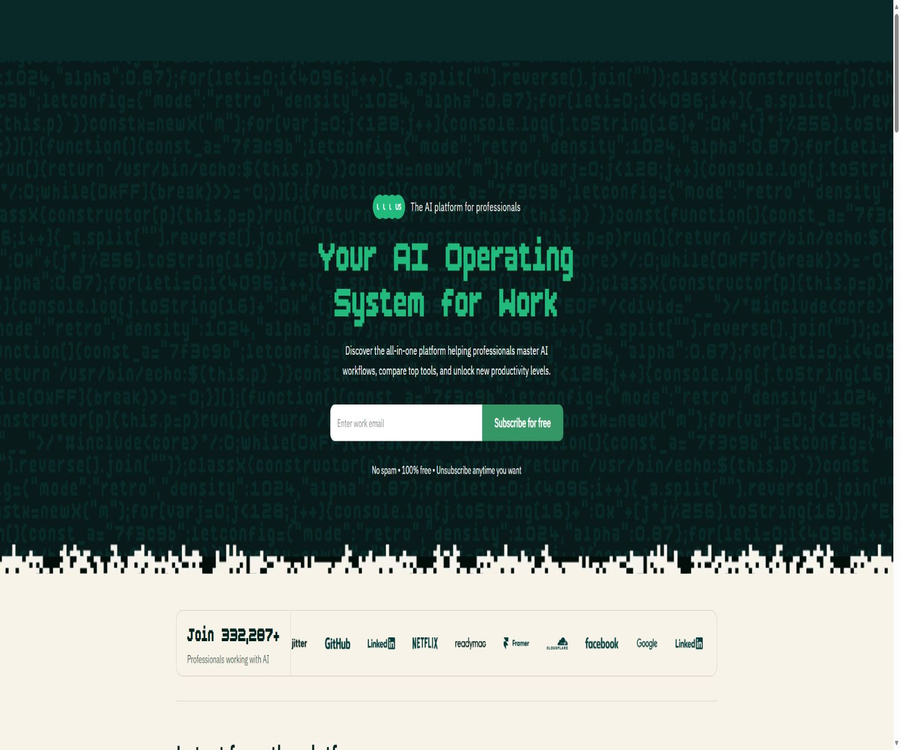
AI for Work
AI for Work: an intelligent tool focused on AI prompts
Tags:AI prompt instructionsWhat is AI for Work?
AI for Work is a platform designed for professionals, offering AI prompt templates, a catalog of tools, learning materials, and resources related to work processes. It organizes the common tasks associated with different job roles into searchable prompt templates, and provides tools for comparison, guides, courses, industry use cases, news, as well as enterprise automation services.
It is not an independent large language model, nor is it a chatbot that can directly replace ChatGPT, Claude, or Gemini. Users usually select prompts or workflows on the platform, and then use the corresponding third-party AI tools to carry out tasks such as generation, analysis, or automation.
A one-sentence summary
AI for Work helps non-technical professionals in the workplace to find quicker ways of using AI for their actual tasks, through role-specific prompts, comparisons of various AI tools, as well as relevant courses and workflows.
Core functions
- Workplace prompt database: Search for prompts by department, position, goals, and tasks.
- AI Tools Directory: It lists AI products of various categories and displays their tags, price categories, and reviews.
- Horizontal comparison of tools: Up to three tools can be selected to compare their features, pricing, and user feedback.
- Learning Center: Provides guides, courses, workflows, and templates.
- Learning path for the position: Learning materials are organized around areas such as creativity, data, and operations.
- Industry use cases: Demonstrates tasks such as marketing, sales, administration, legal affairs, finance, and engineering.
- Agent Native resources: Explain how to integrate AI agents into organizational processes.
- AI News and Interviews: Summarizing product updates, working methods, and corporate practices.
- Free Newsletter: Delivers to subscribers updates on AI trends and techniques.
- Automation services: Provide consulting, process automation, and custom development for enterprises.
Workplace AI Prompt Library
The prompt page allows searching by name, role, and department; it covers a wide range of job categories such as administration, sales, marketing, legal affairs, finance, human resources, education, engineering, and customer service. Each entry is designed around a specific deliverable, rather than merely providing a general description.
- Meeting agenda, meeting minutes, and action items.
- Internal memos, management reports, and project status updates.
- Marketing strategies, content plans, and sales outreach templates.
- Employee onboarding, training materials, and performance evaluation.
- Budgets, costs, invoices, and documents for data verification.
- Customer support tickets, service scripts, and knowledge materials.
- User workflows, design specifications, and creative project documents.
- Drafts of policies, contract frameworks, and compliance documents.
Structural features of prompt words
- First, it is necessary to clarify the professional role that AI should play.
- It is required to be customized based on the actual needs of the users.
- Gather background and constraints by clarifying questions.
- Specify the chapters and structure of the final deliverable.
- It is encouraged to use reference materials rather than creating content from scratch.
- Provide steps for self-assessment or iterative revisions.
- It can be copied to third-party tools such as ChatGPT for further use.
How to use prompts
- First, determine the desired outcome of the work to be done, rather than simply searching for a broad topic.
- Search for the most appropriate prompt by department, position, or task name.
- Read the full instructions to ensure that the role, input, and output formats meet the requirements.
- Remove the irrelevant requirements and add information on the audience, background, limitations, and references.
- Insert the modified prompt into the AI tools that are permitted for use.
- Answer the clarifying questions raised by the model; do not omit key business information.
- Check facts, calculations, citations, legal requirements, and brand requirements.
- Further modifications are made based on human feedback, resulting in a reusable version specific to the team.
AI Tools Directory
The tool catalog organizes products into categories such as chat models, images, writing, programming, productivity, audio and video, and data analysis; it also provides search functions, tags, price options, and user reviews. The page allows users to select up to three tools for side-by-side comparison.
- Search for tools by name, category, or tag.
- Browse the popular products that are updated weekly.
- View applicable tasks, capability tags, and price types.
- Read the comments submitted by users on the reading platform.
- Information on the features, prices, and ratings of various tools.
- Go to the product details of the tool to proceed with further verification of the third-party product.
Comparison of proper tool usage
- First, list the required functions, budget, language requirements, and data security needs.
- Select two to three tools with similar features from the catalog.
- Use the comparison results of different platforms as a preliminary screening tool, rather than as the basis for the final purchase decision.
- Check again the current prices, restrictions, and terms of service on the official websites of each product.
- Use the same testing tasks to compare quality, speed, and the cost of manual corrections.
- Verify SSO, permissions, logging, data location, and logout mechanisms for enterprise tools.
- Calculate the total cost by considering the subscription fee, model usage, as well as implementation and training costs.
Learning Center
- A guide to getting started with and advancing in AI usage.
- Courses organized by theme and multi-session learning content.
- Workflows and templates that can be used as a reference.
- Learning paths such as marketing, data, operations, and creativity.
- Practical guidance on tools such as ChatGPT, Claude, and Gemini.
- A progression path from basic prompts to automated and autonomous workflows.
Courses and learning paths
The learning page offers courses organized by career paths, including areas such as creative professions, data analysis, and business operations. Some of these courses make use of various external AI tools; therefore, learners need to meet the requirements regarding accounts, subscription plans, and geographical location for those specific tools.
| Direction of study | Main content | Suitable for users |
|---|---|---|
| Introduction to AI | Basic guidelines, model selection, and result verification | Professionals who are just starting to work with generative AI |
| Marketing team | Content, data analysis, activities, and automated workflows | Market staff and team leaders |
| Data and analysis | Table analysis, reports, and dashboards | Analysts, finance, and operations staff |
| Creative professions | Design, content, images, and visual narrative | Designers and content creators |
| Business operations | Process automation, productivity, and scalable execution | Operations manager and process owner |
| Agent Native | Task decomposition, combination, supervision, and continuous improvement of agents | Managers who wish to upgrade the way AI is used within their organizations |
Workflows and templates
- Transform blog posts into a newsletter.
- Conduct clue research and eligibility assessment.
- Create a social media content calendar.
- Convert meeting minutes into action items.
- Organize emails and speed up responses to common inquiries.
- Use AI to assist with performance reviews.
- Analyze the table and generate a report.
- Combine third-party tools such as Claude, Notion, and Mailchimp.
Agent Native resources
AI for Work uses the term “Agent Native” to describe an organizational approach in which AI agents are regarded as participants in the work process; it emphasizes breaking tasks down into smaller components, combining different capabilities, maintaining human oversight, and using feedback to improve processes. This concept relates to methodologies and resources, and it does not mean that the platform itself provides a complete environment for running autonomous agents.
- Value is measured by the results of work, rather than by the time invested.
- Humans determine the direction, boundaries, and quality standards.
- Break down the process into atomic tasks that can be fully handled by agents.
- Combining small capabilities creates longer business workflows.
- Continuously accumulate context and modify prompts.
- Maintain human control over high-risk decisions and external actions.
AI news, interviews, and newsletter
- Keep track of updates to AI products, models, and workplace applications.
- Interview company leaders on how to use AI in real-world work.
- Provides tool reviews, comparisons, and practical guides.
- Organize short examples of work techniques and processes.
- The newsletter can be subscribed to for free, and cancellation is possible at any time.
- The information provided may become outdated quickly; it is advisable to check important details on the product’s official website.
Automation and consulting services
In addition to the public resource platform, AI for Work also offers consulting, automation, and custom development services for businesses. Its team can help create an AI roadmap, optimize processes, develop custom prompts and chatbots, as well as design solutions for sales or marketing automation.
- Analyze the current manual processes and quantifiable goals.
- Develop an AI application roadmap and project plan.
- Automate repetitive data, communication, and customer processes.
- Create a dedicated prompt library for the team.
- Develop custom chatbots and AI agents.
- Create specialized solutions for sales, marketing, and operations.
- Assess the scale of the business and specific requirements through a consultation form.
Which users are it suitable for
- Ordinary employees who hope to quickly find workplace tips.
- Managers who need to establish guidelines for the use of team AI.
- Marketers in charge of content, activities, and automation.
- A sales team that conducts lead research and follows up with clients.
- Human resources professionals responsible for management systems, recruitment, and training.
- Data and financial staff responsible for preparing reports, budgets, and analyses.
- It is necessary to compare the costs associated with purchasing AI tools and those related to staffing for their operation.
- Seeking non-technical users for AI introductory courses and workflows.
- Small and medium-sized enterprises that wish to outsource the development of customized automation projects.
Typical use cases
- Prompt drafting: Use an existing structure instead of starting from scratch.
- Tool selection: Initially filter chat, writing, design, and productivity tools based on the task.
- Team training: Establish a unified learning pathway tailored to each position.
- Process design: Transform guidelines and templates into internal standard workflows.
- Meeting management: Generate agendas, minutes, decisions, and action items.
- Content marketing: Planning topics, events, emails, and social media content.
- Operational documentation: Creating SOPs, project reports, and internal memos.
- Career advancement: Stay informed about trends in AI in the workplace through newsletters and interviews.
- Automated consulting: Assessing and commissioning the development of customized solutions for enterprises.
Department application examples
| Department | Tasks for reference | The aspects that must be handled by humans |
|---|---|---|
| Administration | Meetings, schedules, policies, procurement, and documentation | System accuracy, approval processes, and sensitive information |
| Marketing | Strategies, content, campaigns, audience, and emails | Brand assessment, facts, and responsibility for publishing |
| Sales | Lead research, outreach, proposals, and follow-up | Customer relationships, commitments, and compliance |
| Human Resources | Recruitment, onboarding, training, and performance materials | Fairness, privacy, and labor laws |
| Finance | Budgets, costs, reports, and data verification | Original documents, calculations, and financial responsibilities |
| Law | Document framework, list of issues, and research directions | Legal advice, jurisdiction, and lawyer review |
| Engineering | Instructions, test plans, processes, and technical documentation | Code validation, security, and production approval |
Price and free status
The AI for Work public platform is currently available for free, with no cost associated with membership; prompts, a list of tools, basic learning resources, and the newsletter can all be accessed at no charge. The platform does not offer any individual Pro or team subscription plans, nor does it guarantee that all future content will remain free.
| Project | Current price | Explanation |
|---|---|---|
| Public platform account | Free | Used to access prompts, tools, and learning resources |
| Prompt library | Free access is the main option. | Some entries may require logging in. |
| AI Tool Catalog and Comparison | Free | Third-party tools may incur additional fees. |
| Guidelines, workflows, and courses | Public resources are mainly available for free. | The specific pages and external tools required need to be confirmed separately. |
| Newsletter | Free | Subscription and cancellation can be done via email. |
| Corporate consulting and automation | Custom quote | Evaluate based on the roadmap, automation, and scope of development and implementation. |
| Third-party AI tools | Priced by the respective manufacturers | Not included in the free AI for Work plan. |
Being free does not mean there are no other costs.
- Using ChatGPT, Claude, or other tools after copying the prompt may incur costs.
- The Notion, Mailchimp, and automation platforms involved in the workflow may have separate subscription plans.
- Advanced models, APIs, as well as image and video generation are typically billed on a subscription basis or based on usage.
- The team needs to invest time in modifying the prompts, verifying the results, and maintaining the processes.
- Enterprise automation projects include costs for consulting, development, integration, and subsequent maintenance.
- The third-party prices displayed in the catalog may be outdated; the prices on the corresponding settlement page should be taken as the reference.
Accounts, copyrights, and usage boundaries
The terms of service permit users to use prompts and resources for personal or internal business purposes, but the content of the platform may not be resold, relicensed, or redistributed without written permission. Users are responsible for any comments, messages, and other content they submit.
- Do not copy content from the platform in bulk to create a competitive set of prompts.
- Do not treat the platform’s brand, software, or content as your own products for sale.
- The results generated using prompts still require checking for third-party intellectual property rights.
- Account credentials must be properly protected; any abnormal activity or misuse may lead to suspension.
- Third-party tools are subject to their own terms, pricing, and data policies.
- High-risk outputs in areas such as law, medicine, and finance cannot be used directly as professional conclusions.
Privacy and data processing
The privacy policy states that the platform collects information provided voluntarily during registration, via newsletters, in contact forms, and in comments, as well as technical data such as device details, browser information, IP addresses, and page interaction data. The platform claims not to sell personal information, but it does share necessary data with service providers involved in hosting, analysis, email delivery, and authentication.
- Some account details can be updated in the profile.
- Users in different regions may have the rights to access, correct, export, or delete.
- Cookies are used for logging in, storing preferences, conducting usage analysis, and improving performance.
- The platform only commits to taking reasonable measures; it does not guarantee absolute security.
- Contact messages and comments may be retained to respond to inquiries and maintain community integrity.
- The platform is not intended for children under 13.
- Do not submit confidential business information in public messages, comments, or contact forms.
Product advantages
- The prompts are organized according to actual positions and deliverables, providing a clear path for searching.
- It covers various departments such as administration, marketing, sales, legal affairs, finance, and engineering.
- It also provides a tool catalog, side-by-side comparisons, as well as courses and workflows.
- It is user-friendly for non-technical users and serves as an ideal entry point into the world of AI in the workplace.
- Public platforms and newsletters are currently available for free.
- Prompt words usually include clarifying questions and structured delivery requirements.
- We continuously publish updates on AI tools, interviews with industry experts, and practical guides.
- It can also provide enterprises with consulting services, automation solutions, and custom development.
Usage restrictions and precautions
- The platform itself is not a large-scale model; many tasks must be carried out using third-party tools.
- Prompt words cannot guarantee that the model’s output will be accurate, complete, or suitable for business use.
- The prices, features, and reviews in the tool catalog may be outdated relative to the changes made by the manufacturers.
- The categories, descriptions, or tags on some tool cards may not be entirely accurate.
- External products involved in the courses and workflows may require a paid account.
- The prompt has limited knowledge of the organizational context, and manual supplementation of facts and constraints is required.
- Legal, medical, financial, and HR-related matters must be reviewed by qualified personnel.
- Public resources do not mean that they can be reproduced in bulk, resold, or redistributed.
- There is no fixed public price for automated consulting; the cost of a project must be assessed separately.
- The platform does not provide public model APIs or complete software that can be deployed independently.
GitHub and open source
The AI for Work website does not provide any links to official GitHub organizations or repositories related to its core platform; projects with similar names that are found through searches cannot be considered to be the official code. The software on the site, as well as the prompt libraries and content, should be regarded as commercial copyrighted materials.
The terms of service explicitly reserve the intellectual property rights to the platform software, prompts, content, brands, and other materials; therefore, this service should be labeled as non-open source. Free access does not equate to an open-source or open-content license.
Basic information
| field | Content |
|---|---|
| Tool name | AI for Work |
| Tool type | AI prompts for the workplace, tool catalogs, learning and workflow platforms |
| Main content | Prompt tips, tool comparisons, courses, guides, workflows, news, and interviews |
| Suitable audience | Employees in various departments, managers, and small and medium-sized enterprises |
| Price pattern | The public platform is free; quotes are provided for customized enterprise automation solutions. |
| Is registration required? | Browsing most content does not require an account; saving or using certain tools may require one. |
| Whether API is provided | Unpublished platform APIs for users |
| Is it open source? | No; no official core repository or open-source license is available publicly. |
Recommendation score
4.3 / 5. AI for Work is suitable for non-technical professionals who wish to find quick tips, tools, and learning paths for finding jobs; it offers a wide range of free resources. However, it is primarily a platform for resources and content, and information on third-party tools as well as AI-generated results still need to be verified separately.
Frequently Asked Questions
What is AI for Work mainly used for?
It provides prompts organized by job roles and tasks, a catalog of AI tools, courses, workflows, information, as well as enterprise automation services.
Is AI for Work free?
Joining the public platform is currently free, and it is stated that this service will remain free forever; the newsletter can also be subscribed to without any cost.
Is AI for Work a chatbot?
No, it mainly helps users find prompts, tools, and methods; many tasks need to be carried out using third-party AI products.
Can the prompt be copied directly?
It can be used for personal or internal purposes, but it must be modified according to the specific circumstances; it also cannot be resold or redistributed in bulk without permission.
Which professions are supported?
It covers various departments such as administration, marketing, sales, legal affairs, finance, human resources, education, engineering, creativity, and customer service.
Are the prices in the tool catalog reliable?
It is suitable for initial comparisons, but since the prices of AI products change rapidly, it is necessary to go to the official pricing page of the respective manufacturer before making a purchase.
Is enterprise AI automation available?
We offer consulting, roadmap development, automation services, customized prompt creation, chatbot development, and AI agent development services.
How much do automated services cost?
There is no fixed public price; a quote must be prepared separately based on the business processes, integration level, as well as the scope of development and implementation.
Is AI for Work open source?
It is not open source; the official website does not make the core code repository available, and the terms reserve the rights to the platform software and its content.
Tools similar to AI for Work




 Guigong Network Security Registration No. 45132202000164