






LM-Kit
LM-Kit, an intelligent tool focused on AI development frameworks
Tags:AI development frameworksWhat is LM-Kit?
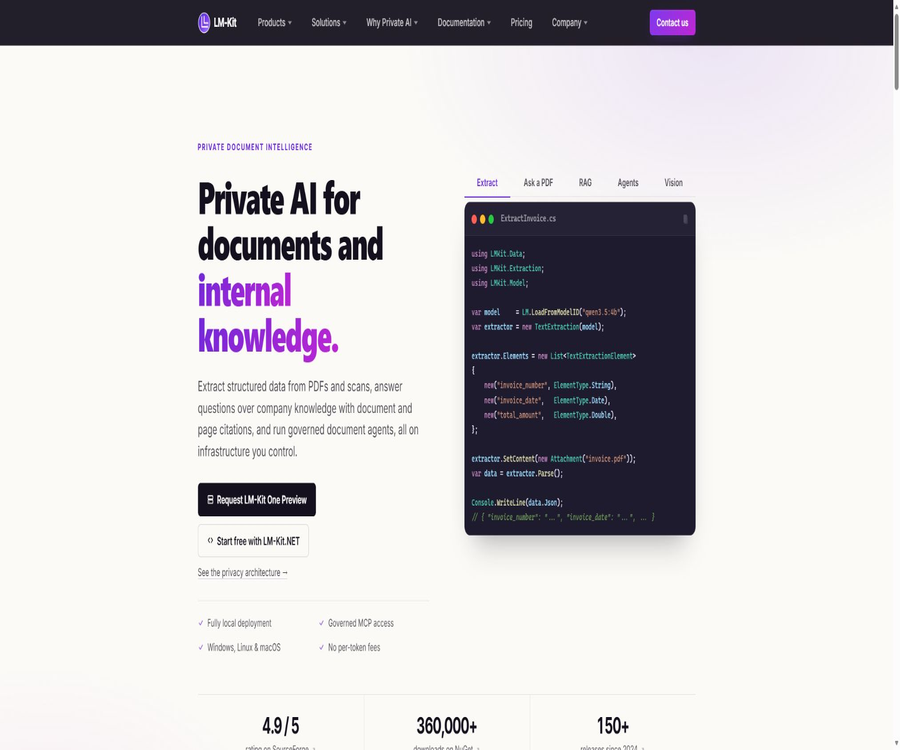
LM-Kit is a private AI platform for processing documents, knowledge, and agent-related tasks within a user’s own infrastructure. Its main versions include LM-Kit.NET, which can be integrated into .NET applications, and LM-Kit One, which can be deployed independently.
It primarily addresses the issue of sensitive documents such as contracts, invoices, claims, policies, and HR-related files, which should not be uploaded to public clouds; it also enables structured fields to include confidence levels, while Q&A entries come with page numbers and excerpts from the original text.
Two product formats
| Products | Usage method | Main interfaces | Core competencies | Suitable for users |
|---|---|---|---|---|
| LM-Kit.NET | Embed the process using a NuGet package | .NET API, Microsoft.Extensions.AI, Semantic Kernel, MCP | Local reasoning, documents, RAG, vision, speech, agents, and fine-tuning | .NET software developers and embedded products |
| LM-Kit One | Deploying standalone services in a corporate environment | REST, OpenAI-compatible interfaces, Ollama, Anthropic, MCP | Management console, document collection, search, model management, approval tools, and request records | Corporate AI and Documentation Team |
The LM-Kit One is currently in the Business Preview phase; the interfaces may change during this preview period, and a long-term support version will be available after its official release.
Main functions
Document parsing and structured extraction
- Read PDF, DOCX, PPTX, XLSX, EML, HTML, images, and scanned documents; choose the appropriate approach for text extraction – either based on the original format or through visual OCR – on a page-by-page basis.
- It returns parseable JSON in a user-defined structure, with each field including a confidence level and a flag indicating whether it has been manually reviewed; it is suitable for extracting information from invoices, contracts, forms, and documents.
- It can identify the boundaries of long PDF documents and split them automatically; it also enables merging, searching, rendering, unlocking, form filling, and conversion to PDF/A format.
- Personal information in text, images, and Office documents is detected, and permanent anonymization is carried out after verification by an auditor, rather than just visual masking.
RAG, search, and verifiable Q&A
- Establish policies, manuals, contracts, and internal wikis as a collection of documents, supporting full-text, vector, and hybrid retrieval as well as reordering.
- The response should include the document, the page number, and the original text fragment that supports the conclusion; if the document does not provide an answer, it is necessary to explicitly state that there is no basis for such a conclusion.
- The built-in storage can be used right away, or it is possible to connect to Qdrant or PostgreSQL pgvector, with replacement being achieved through a unified vector storage interface.
Agents, multimodal approaches, and local models
- Agents support ReAct, plan-and-execute, parallel processing, pipelines, supervisors, and graphical orchestration; tool calls can have settings for permission, prohibition, risk level, and approval requirements.
- It supports text generation, image understanding, OCR, embedding, classification, entity recognition, sentiment analysis, as well as local speech-to-text conversion using the Whisper series.
- Open weight models can be downloaded from the curation model card, or custom GGUF files can be loaded; it also supports LoRA fine-tuning, quantization, multi-GPU splitting, and encrypted model loading.
- The model can run on CPU, AVX2, CUDA 12/13, Vulkan, or Metal, and is compatible with Windows 10 and later, Linux x64 and ARM64, as well as macOS.
Usage tutorial
- Depending on the architecture, choose to embed LM-Kit.NET within the .NET application, or deploy LM-Kit One as a shared private service.
- Evaluate the operating system, CPU, memory, and GPU, starting with smaller models that can run stably on the target hardware.
- LM-Kit.NET installs the main package via NuGet, along with any optional acceleration packages that are suitable for the specific hardware, and initializes the runtime only once when the application starts.
- Define the extraction structure, manual review thresholds, search database, models, tool permissions, and external network access policies for the document processing workflow.
- Verify the extracted fields, OCR, question-answering references, tool calls, fallback mechanisms for failures, and handling of sensitive data using a fixed test set before going live.
- In the production environment, record models, prompts, structure versions, request trails, and manual approvals, and conduct regression testing in accordance with the release instructions.
Price and licensing
| Package or version | Price | Billing cycle | Core benefits or quota | Suitable for users |
|---|---|---|---|---|
| Free | $0 | No expiration date | The full SDK and server are available for commercial use and redistribution by companies that meet the required criteria; individuals, educational institutions, non-profits, and open-source projects can use them for free at all times. | Small teams, individuals, education, and assessment projects |
| Professional | Custom quote | Annual license | Large-scale commercial use and redistribution, long-term support, security patches, guaranteed response times; no limit on the number of developers or end users. | Commercial deployments that exceed the free threshold |
To use it for commercial purposes free of charge, a company’s annual revenue must be below $1 million, it must have no more than 10 employees, and its external financing must not exceed $3 million; moreover, the term LM-Kit.NET must be clearly indicated on the product page.
Evaluation and development are free of charge and available without time limits for companies of any size; however, for production use beyond that initial stage, a Professional license is required.
Commercial quotes are determined based on the company’s size, the scope of deployment, the number of standalone commercial products that incorporate the LM-Kit, and the level of support provided; they are not charged per token, per seat, or per end user.
For Professional annual subscriptions and multi-application license packs purchased through the product website or authorized dealers, a refund can be requested within 30 days from the date of purchase, provided that a proof of purchase is available; corporate agreements are subject to the terms stipulated in those agreements.
Difference between APIs, GitHub, and open source
- LM-Kit.NET offers a complete .NET API along with documentation, while LM-Kit One provides REST interfaces, various compatible interfaces, and MCP; however, both products require the LM-Kit commercial license for operation and are not open-source software.
- The official example repositories, Semantic Kernel, Microsoft.Extensions.AI, data connectors, and the AWS integration repositories use Apache-2.0 as their licensing scheme; however, the open-source status of these examples and connectors does not affect the licensing of the main products.
- The Maestro desktop application is licensed under the MIT license, while the LynxTranscribe text-to-speech application is licensed under GPL-3.0; both should be handled in accordance with the licenses of their respective repositories, and the LM-Kit platform itself should not be made open source.
- The open-weight models used in curation come with licenses from their respective providers, and the LM-Kit license does not cover the conditions for commercial use of these model weights.
Privacy and security architecture
- In the fully local mode, with external tools and optional telemetry disabled and the model already present on the host, documents, prompts, embeddings, and outputs can remain on the local machine.
- When external assistants use MCP to invoke local tools, the original documents, OCR results, and indexes can remain on the local device; however, the results generated by those tools are made available to the external model, and administrators must review the available tools as well as the content that is returned.
- By default, LM-Kit One is connected only to the local device; network access must be enabled explicitly. API keys are stored in hashed form, and sessions as well as accessible files are tied to the authenticated owner.
- Models, indexes, uploaded files, caching data, logs, and request history are stored in a configurable local storage directory or in a specified database; the retention period for logs can be set as desired.
- The website can collect the name, email address, and account information that users provide voluntarily; it also processes data related to IP addresses, browsers, the pages visited, and access statistics. Users can request that this information be deleted, and offline copies are retained for one month before being permanently removed.
Advantages and usage limitations
Main advantages
- OCR, structured data extraction, RAG, data masking, and agent tools are all integrated within the same .NET runtime or private service, which reduces the costs associated with maintaining multiple languages and services.
- It allows for inference using one’s own hardware in environments without an internet connection, where data remains local, or when there is a large volume of documents; no additional charges are applied based on the number of pages, tokens, or seats.
Usage restrictions
- For local deployment, one must plan for model weights, as well as for memory and GPU resources, backup solutions, logging, patches, access control, and high availability; compliance is not ensured automatically just by not uploading data to the cloud.
- Larger models, longer contexts, visual OCR, concurrent inference, and fine-tuning require significant hardware resources; although a CPU can be used for these tasks, it does not guarantee an appropriate speed for all workloads.
- The confidence level of the output, structural constraints, and page references can assist in the review process, but they cannot replace professional manual verification of contract, claims, financial, HR, or regulatory aspects.
- LM-Kit One is still in the Business Preview phase; it is necessary to account for potential changes to interfaces, data migration, and the possibility of reverting to an earlier version. The stability of this preview version should not be considered as an assurance of long-term stability akin to that of an official LTS version.
Summary
The LM-Kit is suitable for teams that need to keep sensitive documents, search indexes, and model inferences within their own environment, and that require .NET, RAG, MCP, document processing tools, as well as auditable intelligent agents.
Before going live, it is necessary to review separately the licensing for the LM-Kit product, the licensing for the GitHub subproject, and the licensing for the model weights; moreover, accuracy, throughput, hardware capacity, and data disclosure boundaries must be verified using a fixed set of documents.
Tools similar to LM-Kit





 Guigong Network Security Registration No. 45132202000164