






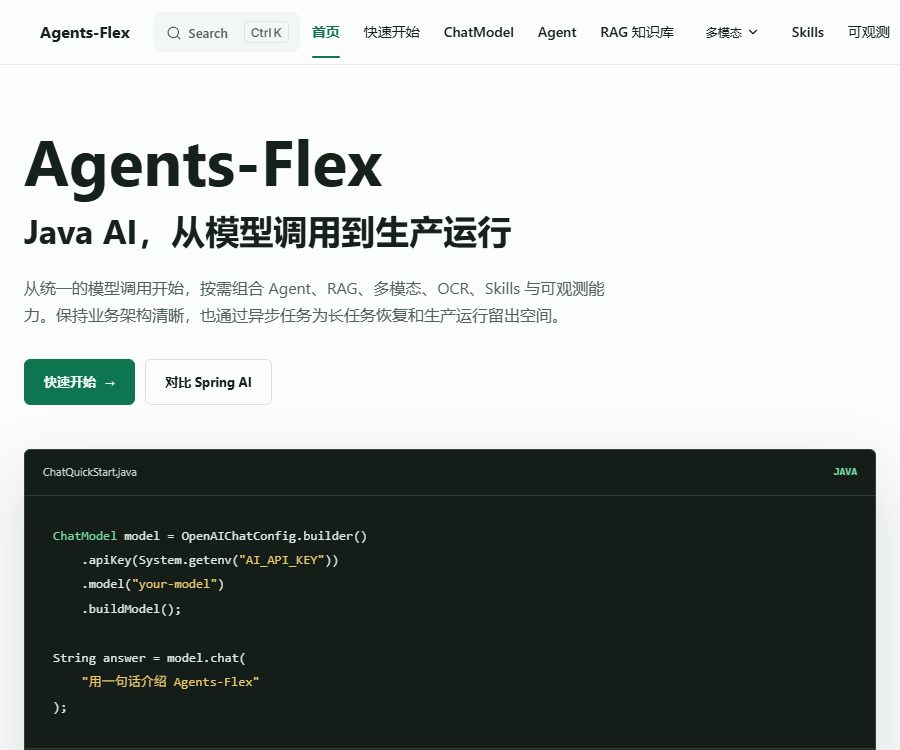
Agents-Flex
Agents-Flex makes AI development frameworks work more efficiently and simply.
Tags:AI development frameworksWhat is Agents-Flex?
Agents-Flex is an open-source AI application and agent development framework designed for Java developers. It breaks down model invocation, tools, agents, RAG, MCP, Skills, Text2SQL, and multimodal capabilities into modular components that can be combined as needed.
The framework does not require Spring; it can be used with plain Java, Spring Boot, and other JVM technology stacks. Most of the core modules are compatible with JDK 8 and later versions, while the MCP modules currently require JDK 17 or a higher version.
Main functions of Agents-Flex
1. Unified model invocation
Interfaces such as ChatModel, EmbeddingModel, ImageModel, and RerankModel are used to hide the differences between various service providers. Both normal responses and streaming responses share prompt words, options, context, and interceptor mechanisms.
2. Tool Calling
Developers can expose Java business methods as model tools through annotation scanning or code compilation. The results generated by these tools can be returned in the form of dialogues, and they can also be integrated with runtime configuration and plugin systems.
3. Agent runtime
The framework offers ReAct, routing, task planning, sub-Agents, manual approval, budgeting, retry mechanisms, and event streaming. Tasks can have snapshots saved, allowing them to be resumed after being paused, triggered by external callbacks, or interrupted.
4. RAG knowledge base
Document loading, parsing, splitting, vectorization, retrieval, and reordering constitute the complete RAG pipeline. Vector storage can be integrated with systems such as Redis, Qdrant, Chroma, Pgvector, MariaDB, Milvus, OpenSearch, and Elasticsearch.
5. MCP client
The MCP module can connect to external services via standard input/output, HTTP SSE, and streaming HTTP connections, and it is capable of converting remote tools into Agents-Flex tools. This module requires a JDK version 17 or higher.
6. Skills competency package
Skills organizes instructions, scripts, and resources in file directories; they can be discovered from local or remote storage and loaded as needed. Scripts can be executed on the local machine, in OpenSandbox, or in a centralized AIO Sandbox.
7. Text2SQL
The Text2SQL module allows for the listing of data sources, step-by-step exploration of table structures, and the generation of queries. The framework provides features such as read-only SQL checks, parameter constraints, limits on the number of results, tenant isolation, and audit capabilities.
8. Multimodal and documents
The image module handles image creation and editing, the audio module supports text synthesis and recognition, while the video module uses asynchronous task processing. OCR can be integrated with Baidu Smart Cloud, Gitee AI, and MinerU to parse images or PDF files.
9. Observability and production governance
The framework can link models, Agents, tools, and asynchronous tasks, and it enables tracking of delays, Tokens, and states. Model routing supports load balancing, retry mechanisms, circuit breaking, and semi-open recovery; its observability capabilities are based on OpenTelemetry.
Which developers are it suitable for
- The backend team hopes to integrate multiple large models into the Java service.
- Projects that require the creation of an enterprise knowledge base, intelligent customer service, and natural language data analysis.
- Developers who wish to use MCP, Skills, and sub-Agents to organize complex tasks.
- For enterprises with production-related requirements in terms of long-task recovery, approval, budgeting, and observability.
- Multimodal applications that require a unified Java interface for images, audio, video, and OCR.
- Teams that already have a Spring Boot system but do not wish to be tied to a single model provider.
Operating environment and module requirements
- Most of the core modules support JDK 8 or higher versions.
- The MCP module requires JDK 17 or a higher version.
- The project uses Maven to manage its dependencies; it is possible to include a BOM, aggregated dependencies, or individual modules.
- Regular Java applications can be used without Spring.
- Spring Boot projects can utilize the official Starters to enable common automatic configurations.
- JDBC and Redis can be used for persisting the state of agents and asynchronous tasks.
Fees and licenses
As of August 24, 2026, the Agents-Flex framework is available freely as open source; its official repository is licensed under Apache License 2.0. The official website does not disclose any information regarding cloud hosting packages or commercial subscription prices.
In practical applications, costs may still arise for model APIs, vector databases, search services, object storage, OCR, voice and video functions, as well as sandbox resources. It is necessary to check separately the quotas, prices, data policies, and regional restrictions for each of these external services.
Common cost items
- Chat, Embedding, rearrangement, and image model invocation.
- Managed vector database and search cluster.
- OCR, speech recognition, speech synthesis, and video generation services.
- The servers, databases, and Redis required for Agent to operate.
- A container or sandbox platform that provides isolated execution for Skills.
- Logs, metrics, trace tracking, and long-term data storage.
Quick Start Tutorial
- Select the JDK version based on the required modules; when using MCP, JDK 17 is the minimum requirement.
- Introduce the Agents-Flex BOM or the dependency for the target module into the Maven project.
- Select the model adapter, and use environment variables to configure the service address, model name, and key.
- First, carry out a simple synchronization or stream-based conversation to verify that authentication and error handling are functioning properly.
- Add Memory, Tools, RAG, MCP, or Agent modules as needed.
- Set timeouts, retries, rate limits, and cost caps for external calls.
- Verify tool permissions, prompt injection, and failure recovery in the testing environment.
- Enable OpenTelemetry or custom logging to monitor latency, tokens, and task status.
- Lock in the dependency versions and conduct security reviews prior to production deployment.
Tutorial for building RAG applications
- Determine the sources of knowledge, the frequency of updates, and access permissions.
- Load PDF, Office, HTML, or other documents and extract the text.
- Split the content according to the document structure, retaining the titles, source identifiers, and permission metadata.
- Select the Embedding model to write the vectors into the appropriate vector storage.
- Retrieve candidate segments based on the user’s query, and improve relevance through Rerank.
- Only the necessary segments and citation information are sent to ChatModel.
- A mechanism for rejecting responses with low confidence or for manually upgrading them should be in place.
- Use real-world problems to evaluate recall, accuracy, latency, and model cost.
Security recommendations for building agents
- By default, the tool operates with minimal permissions; actions such as writing, deleting, and sending data to external sources require approval.
- Set the number of steps, tokens, cost, and time budget for each task.
- Execute untrusted files and scripts in an isolated sandbox.
- Text2SQL prefers to use read-only database accounts and limits the number of results.
- The MCP service should verify the origin, permissions, and security of the transmission.
- When creating persistent snapshots and handling events, avoid recording keys and sensitive original text.
- Idempotent operations are designed for retries and recovery, to prevent duplicate charges or repeated writes.
Product advantages
- It is natively designed in Java, and its core modules can run on lower versions of JDK.
- The modules are clearly separated, allowing only the functionalities that are truly needed by the project to be included.
- It does not require the use of Spring, while still allowing for quick integration with Spring Boot.
- From models, RAG, and MCP to recoverable agents and observability capabilities.
- It supports a variety of domestic and international models, databases, and multimodal services.
- The Apache 2.0 license allows enterprises to use and modify it in compliance with regulatory requirements.
Usage restrictions and precautions
- The framework is not a ready-to-use visual AI platform; it requires Java development and operation skills.
- The parameters of model adapters, their streaming response capabilities, and tool invocation abilities may vary.
- The JDK requirements for the MCP module are higher than those of most core modules; it is necessary to conduct an assessment before upgrading older projects.
- External models and infrastructure costs are not included in the open-source framework.
- Agents, scripts, and Text2SQL can have real-world side effects, so permission control is necessary.
- There are many modules; when upgrading, it is necessary to review the change logs and carry out regression tests.
- Open-source licenses do not automatically cover the connected models, assets, and third-party SDKs.
Explanation of the open-source status
The source code for the Agents-Flex main repository is made available publicly, and it is licensed under Apache License 2.0; therefore, the framework can be considered open source. When using or redistributing it, it is necessary to comply with the copyright, disclaimer, and patent provisions specified in the license.
The model adapted for use in frameworks, OCR, search functions, vector databases, and sandbox services all come with their own separate licenses and commercial terms. The fact that these services are available does not mean that the platforms on which they operate are open source or free of charge.
Frequently Asked Questions
Must Agents-Flex use Spring?
It’s not necessary. The core module can run in standard Java, and Spring Boot Starter is provided to facilitate integration with existing projects.
Which JDK versions are supported?
Most modules support JDK 8 or later, while the MCP module currently requires JDK 17 or later.
Is it possible to create a RAG knowledge base?
Yes. The framework provides modules for document extraction, segmentation, embedding, vector storage, retrieval, and rearrangement.
Is Agents-Flex free?
The framework itself is free and open-source, but the connected models, databases, search, OCR, and sandbox services may incur costs.
Can it be used for commercial projects?
The Apache 2.0 license permits commercial use, but it is necessary to retain the relevant statements, as well as to examine the terms of service for any third-party dependencies and models.
Summary
Agents-Flex is suitable for development teams that wish to build models for invocation, RAG, and resilient agents using Java modularization. It offers a fairly comprehensive set of capabilities, but for practical use in production it is still necessary to choose the right JDK, manage tool permissions, account for external costs, and maintain the dependencies on a regular basis.
Tools similar to Agents-Flex





 Guigong Network Security Registration No. 45132202000164