






Contember
Contember: makes AI development frameworks work more efficiently and simply.
Tags:AI development frameworksWhat is Contember?
Contember is an open-source full-stack framework developed by the Irish company Contember Limited; it is designed for data-driven backends, internal tools, content systems, customer portals, and business applications. Developers define the data models, roles, and permissions using TypeScript, and the platform generates the corresponding PostgreSQL structure, GraphQL API, migration scripts, authentication mechanisms, as well as a React-based management interface.
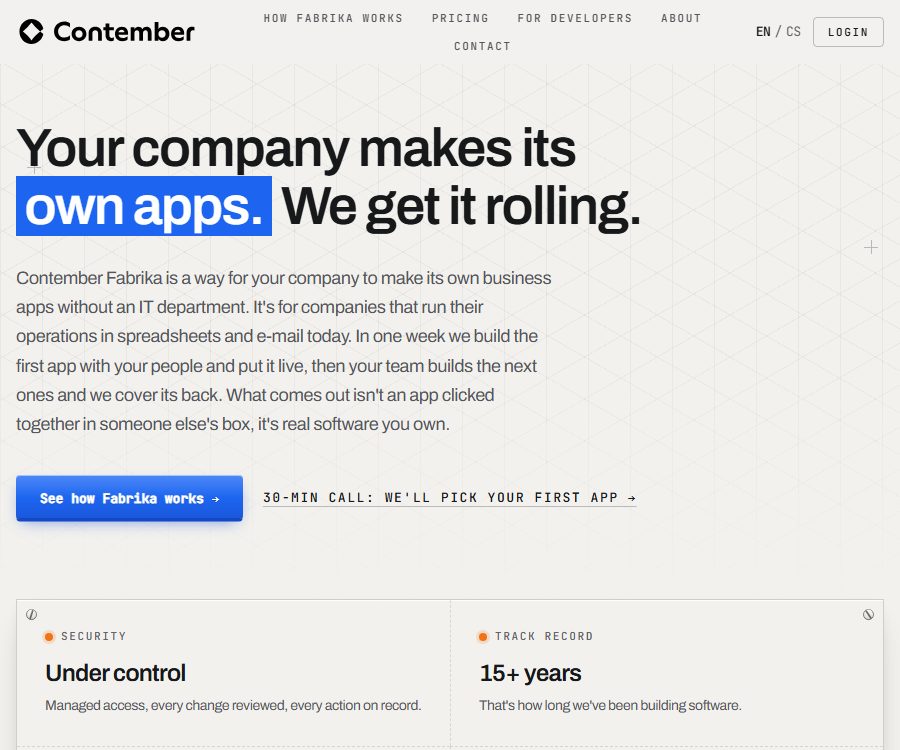
Contember is not a single AI code generator; rather, it is a declarative application framework that can be operated by developers or AI programming agents. Its current offerings also include Contember Cloud, which provides hosting on a project basis, and Contember Fabrika, which offers implementation, training, operation and maintenance services, as well as change review, for companies that do not have their own IT team.
Product composition
| Products | Positioning | Delivery method | Suitable for users |
|---|---|---|---|
| Contember Framework | Open-source full-stack application framework | Code, self-hosting, and official packages | TypeScript and React developers |
| Contember Cloud | Managed runtime platform | Provide infrastructure, patches, and backups on a project basis | Teams that do not want to handle maintenance themselves |
| Contember Fabrika | Enterprise application development and long-term operation services | Launch week, monthly support, deployment, and review | Medium-sized enterprises without a dedicated IT team |
| AI-assisted Studio | Create a prototype of the application through description. | There is very little information available on the current public page. | Users who explore AI-assisted modeling |
| Enterprise Edition | Advanced capabilities beyond the core | Individual license or managed service | Organizations with enterprise-level requirements |
The costs and responsibilities related to the core framework, cloud hosting, and Fabrika are different; it cannot be assumed that because something is open source and free of charge, all aspects such as hosting, implementation, and enterprise features are also free. The current page of AI Studio only shows the product name, while details such as models, quotas, data processing, and prices cannot be determined fully.
Main functions
TypeScript data models and automatic migration
- Developers use TypeScript classes and fields to describe entities, relationships, indexes, roles, and access rules; the resulting model serves as a common basis for both the database and the interfaces.
- The command-line tool compares the model changes and generates migration files, which are then applied to the local, testing, and production environments after verification.
- Migrations are carried out in version order, which facilitates the team in including both the database structure and the application code under version control.
- Automatic migration reduces the need for duplicate configurations, but deleting fields, changing relationships, and making modifications to large tables still require backup, review, and rollback plans.
Real-time GraphQL API
- The Contember Engine generates GraphQL queries and change interfaces based on the data model, eliminating the need to write custom controllers for basic create, read, update, and delete operations.
- The API filters the visible entities, fields, and operations based on the role of the caller, enabling the same data model to serve administrators, employees, and external customers.
- Any front-end or service that supports GraphQL can be integrated, not limited to the React interface provided by Contember.
- For public APIs, it is still necessary to design strategies for token lifecycle, query complexity, rate limiting, error handling, and compatibility with external clients.
Authentication, tenants, and fine-grained permissions
- The built-in Tenant API is responsible for managing users, projects, identities, and login processes, and it supports OAuth, two-factor authentication, as well as custom login interfaces.
- Declarative access control can be applied at the level of entities, records, fields, and even cells, making it suitable for isolating different departments, customers, and multi-tenants.
- Multi-tenant and multilingual capabilities can be utilized in SaaS platforms, cross-regional content systems, and platforms shared among multiple business units.
- Even when detailing permission statements, a role matrix, test accounts, and tests for privilege escalation are required; in particular, associated queries and batch operations need to be examined.
React management interface and data binding
- Contember Interface offers high-level React components that enable automatic binding to GraphQL data, allowing for the quick creation of tables, forms, detail pages, and relationship editors.
- Developers can add regular React components, styles, and business logic, without being constrained by a fixed set of low-code components.
- The structured rich-text editor supports custom content blocks, making it suitable for content management, knowledge bases, and editing workflows.
- Interfaces that are generated automatically or assembled quickly still need to meet requirements regarding responsiveness, accessibility, validation, handling of empty states, and performance when dealing with large amounts of data.
Actions, Webhooks, and History
- Actions can trigger business logic when data changes, call external systems, or execute asynchronous tasks.
- Webhooks are suitable for synchronizing orders, approvals, content, and customer information with accounting, warehouse, e-commerce, or notification systems.
- The History API and event logging record data changes, which can be used for auditing, issue tracking, and restoring previous operations.
- Automation requires idempotency, retry mechanisms, signature verification, and a failure queue to prevent duplicate callbacks or data inconsistencies caused by temporary unavailability of external systems.
AI-assisted development
- The declarative model is easier for programming agents to understand than scattered SQL statements and controllers; AI can suggest code modifications with regard to the model, the interface, and migrations.
- Fabrika allows the company’s own employees to use AI on a unified platform to develop subsequent applications, with the Contember team then reviewing those changes.
- Fabrika’s AI calls make use of the customer’s own model provider account, and the customer can see the flow of data; Contember states that it does not use customer data to train models.
- AI Studio used to offer the possibility of creating databases, authentication systems, GraphQL APIs, and user interfaces based on textual descriptions; however, the current public pages do not provide enough information regarding the models used, the scope of deployment, and the available quotas.
Input, output, and technology stack
| Enter or configure | Generate or provide | Key technologies | Uses |
|---|---|---|---|
| TypeScript data model | Database structure and migration | PostgreSQL, TypeScript | Business data modeling |
| Role and permission statements | Interfaces tailored by role | ACL, authentication, Tenant API | Isolation of internal and external users |
| Page and component code | Management backend and business interface | React, GraphQL data binding | Forms, tables, and workflows |
| Data changes and events | Actions, Webhooks, and logs | Event-driven automation | Integration and approval processes |
| Natural language requirements | AI-assisted model or code draft | The model supplier chosen by the customer | Accelerated prototyping and changes |
| Deployment configuration | Local, self-built, or hosted applications | Docker Compose or Cloud | Development and production operation |
Developer self-hosted tutorials
- Prepare the Node package manager, Docker, and Docker Compose; it supports macOS, Windows WSL, and Linux, while Apple Silicon may require additional compatibility settings.
- Use the current scaffolding commands to create a project and install dependencies; first check the documentation and the selected version to avoid using outdated Next tags.
- Start the local Engine, PostgreSQL, management interface, object storage, and email testing services, to ensure that the default development credentials are not exposed to the public internet.
- Declare the first entity, fields, and relationships in the API model directory, then generate and review the migration file.
- After the migration is completed, queries and writes are tested using GraphQL, while different roles are created to test field and record permissions.
- In the React management directory, create lists, forms, and detail pages, and add validation, error handling, and a responsive layout.
- Set signatures, timeouts, idempotency, and retry mechanisms for Actions and Webhooks, then use the testing environment to verify failure scenarios in external systems.
- Replace all default keys before production deployment, and configure TLS, backup, monitoring, object storage, email, domain names, and least privilege principles.
There are version differences between the scaffold examples on the official website and some commands mentioned in the documentation; in real projects, it is necessary to keep the versions of the core packages, the CLI tool, and the templates consistent. Before performing an upgrade, read the migration instructions and carry out regression tests on database replicas and pre-release environments.
Suitable for users and typical use cases
- Development team: Rapidly builds internal management backends, customer portals, CRM systems, headless content platforms, and multi-tenant SaaS solutions.
- Medium-sized enterprises: Move approval processes, assets, orders, working hours, inventory, and on-site reports from spreadsheets and emails to their own applications.
- Software agents and consultants: Deliver customized systems based on a readable, declarative model, and hand over the code and data to the client.
- Content team: Handles complex content workflows by leveraging a structured editor, multilingual support, fine-grained permissions, and history management.
- Regulated organizations: They manage their infrastructure through self-hosting, but are still required to carry out audits, ensure compliance with relevant regulations, and manage their supply chains on their own.
Contember Cloud prices
Cloud is billed on a monthly basis per project, with no limit on the number of users and roles. The main differences between the various tiers lie in the amount of credits allocated, API requests allowed, database capacity, storage space for assets, bandwidth, as well as the features and support provided. The Entry, Business, and Pro versions offer a 14-day trial period; specific fees, prices for excess usage, and payment details by region can be found on the account page.
| Package or version | Price | Billing cycle | Core benefits or quota | Suitable for users |
|---|---|---|---|---|
| Developer | Free | By project | 300 calculations for integrating data, 60,000 API calls, a database of 30MB, and 1.5GB of material data; Actions are not included. | Individuals and sub-projects |
| Entry | 29 dollars | Per project per month | 5,000 integrations, 1 million API calls, 100MB of database space, 5GB of storage for assets, 4,000 Actions | Small-team application development |
| Business | 99 dollars | Per project per month | 50,000 points for calculations, 10 million API calls, 2GB of database space, 50GB of storage for assets, 40,000 Actions | Internal applications for small businesses |
| Pro | 249 dollars | Per project per month | 300,000 integration calculations, 60 million API calls, 10GB of database space, 250GB of storage for assets, 250,000 Actions executions | Pay attention to applications that require scale and performance. |
| Enterprise Cloud | Custom quote | Contractual agreement | Dedicated infrastructure, SSO, remote databases, 99.99% SLA, priority support, and discounts for multiple projects | Critical business and multi-project organizations |
| Self-hosted core | No core license fee | Bear the costs yourself. | Apache 2.0 core; servers, databases, backup, monitoring, and operational management are handled independently | Teams that require infrastructure control |
The free tier provided by Developer is suitable for testing frameworks, but not for handling critical production loads. There is a separate fee associated with custom domain names in the Entry tier, while the Business and Pro tiers include such custom domain names; upgrades are available, ranging from community-based email addresses to dedicated Slack accounts.
Fabrika service prices
Fabrika is aimed at companies that need services for application development, training, operation, and maintenance – it is not equivalent to simply purchasing cloud services. The fixed cost for the initial setup period is determined after discussing the details; migration of historical data, integration of old systems, and any other modifications require additional fees.
| Package or version | Price | Billing cycle | Core benefits or quota | Suitable for users |
|---|---|---|---|---|
| Scope communication | Free | 30 minutes | Streamline the process, select the first workflow, and prepare a quote. | Assessing whether it is a suitable company |
| Fabrika Kickstart | Custom quote | 1-week project | Organize, develop, and launch the first application, while guiding company members through the relevant processes. | Build internal application capabilities |
| Foundation | Starting at $500 | Monthly | 1 to 2 production applications, 8×5 level 1 support, deployment, updates, health checks, and change reviews | The team that first started running the application |
| Growth | Starting at $1,800 | Monthly | Up to 10 production applications, SLAs, quarterly governance tasks, and 1 day of maintenance work per month | Multi-application business team |
| Enterprise | Custom quote | Contractual agreement | Multi-application management across branches or departments, priority support, and security audits | Key processes and large organizations |
Open source, APIs, and licenses
| Project | Status | License or interface | Precautions |
|---|---|---|---|
| Contember core | Open source and continuously updated | Apache 2.0 | Third-party components follow their respective licenses. |
| GraphQL API | The project is generated automatically. | Provided by model and role | A general SaaS API that does not feature fixed fields |
| CLI and official packages | Public | Node package ecosystem | Different package versions may vary, and it is necessary to lock down dependencies. |
| React Interface | Core components | Scalable components and data binding | Custom code is maintained by the project itself. |
| Starter Kits | Public examples | Used for starting out and as a reference | Sample licenses and production safety need to be checked individually. |
| Enterprise Edition | Commercial licensing | License fees or Cloud entitlements | It is not possible to conclude that advanced features are free based on the core open-source license. |
Apache 2.0 permits the use, modification, and distribution of the core code under conditions such as compliance with the license, copyright, and NOTICE provisions; it also includes corresponding patent grants. It does not grant rights to the Contember trademark, nor does it cover separate enterprise features, hosting services, or third-party dependencies.
Advantages and capabilities boundaries
- The same declarative model drives databases, APIs, migrations, and permissions, reducing redundant definitions across multiple layers and making it easier for programming agents to understand the project structure.
- Developers can freely extend React and the business code, taking advantage of both the efficiency of the framework and the flexibility for customization, without being constrained by fixed templates.
- Self-hosting, Cloud, and Fabrika offer different levels of control and operational management, allowing teams to choose between cost, sovereignty, and support.
- The framework automatically generates the standard infrastructure, but it does not handle business analysis, data cleaning, performance optimization, testing, or compliance certification on its own.
- Fine-grained permissions and historical logs need to be properly configured; incorrect rules, overly permissive tokens, or insecure Webhooks can still lead to data leaks.
- AI accelerates development speed, but it can lead to faulty models, disruptive migrations, and insecure code; manual review is still required for production changes.
Privacy, security, and refund guidelines
- The privacy policy states that the operator is Contember Limited, registered in Ireland, and that it is subject to the GDPR as well as Ireland’s data protection regulations.
- Account and customer details may include name, company, contact information, login and billing data; payments are tokenized by Stripe, and the platform claims it does not store the full card details.
- The personal information under the company’s control is stored in AWS data centers in Ireland; customer data can generally be retained for up to 7 years after the contract ends, while potential customer data can typically be kept for up to 1 year.
- Regarding the business data contained in the managed projects, Contember acts as the processor and shall not access such data unless instructed to do so by the client; the client remains responsible for ensuring the legality of the personal data it uploads.
- The AI in Fabrika runs through the customer’s own model account; it is still necessary to verify separately the supplier’s settings regarding data storage, training, as well as regional and corporate privacy considerations.
- Security vulnerabilities should be reported privately; the project has a security policy, but no paid vulnerability bounty program is currently available; self-hosted teams are responsible for applying patches, managing keys, handling backups, and responding to incidents.
The terms allow the hosting service to be canceled under certain conditions within 30 days of purchase or renewal, but they impose various non-refundable restrictions related to the amount already paid, the remaining time of the annual contract, and early cancellation. Before making a purchase, it is necessary to obtain written confirmation from sales or support regarding the costs associated with switching from a trial version to a paid plan, renewal fees, data export options, restoration costs, the deadline for cancellation, and the conditions under which a refund can be issued.
Frequently Asked Questions
Is Contember a low-code tool or a development framework?
At its core, it relies on TypeScript and the React full-stack framework; it can automatically generate a database, GraphQL APIs, as well as authentication and management interfaces. It helps to reduce the amount of basic code required, but complex projects still demand skills in development, testing, and maintenance.
Is it necessary to use AI in Contember?
It’s not necessary; the core framework can be developed following traditional coding procedures. The AI-assisted tools provided by AI Studio and Fabrika represent additional methods for working, and they do not replace models, access controls, or code reviews.
Can Contember be used commercially for free?
The Apache 2.0 core can be self-hosted and used for commercial purposes as long as the licensing terms are followed; the costs associated with servers and maintenance must be covered by the user. Enterprise features, Cloud services, Fabrika, trademarks, and third-party components come with their own specific requirements.
Is the free version of Cloud suitable for production environments?
Developers are provided with limited computing power, APIs, databases, and storage capacity; there are no Actions available, and this option is suitable only for personal projects and testing. For production applications, it is necessary to choose a pricing plan based on capacity, backup options, support services, and SLAs.
Will Contember use corporate data to train AI?
The factory explains that AI operates through the customer’s own supplier account, and Contember does not require customer data for training. Customers still need to check the storage and training settings of the model provider they have chosen, as well as prevent sensitive data from being included in the inputs.
How should one choose between self-hosting and the cloud?
Self-hosting is an option when full control over the infrastructure and the ability to manage it are required; Cloud can be chosen if the platform is to handle scaling, patching, and backups. Fabrika should be considered only in cases where there is no development team and ongoing maintenance and review are necessary.
Tools similar to Contember





 Guigong Network Security Registration No. 45132202000164