






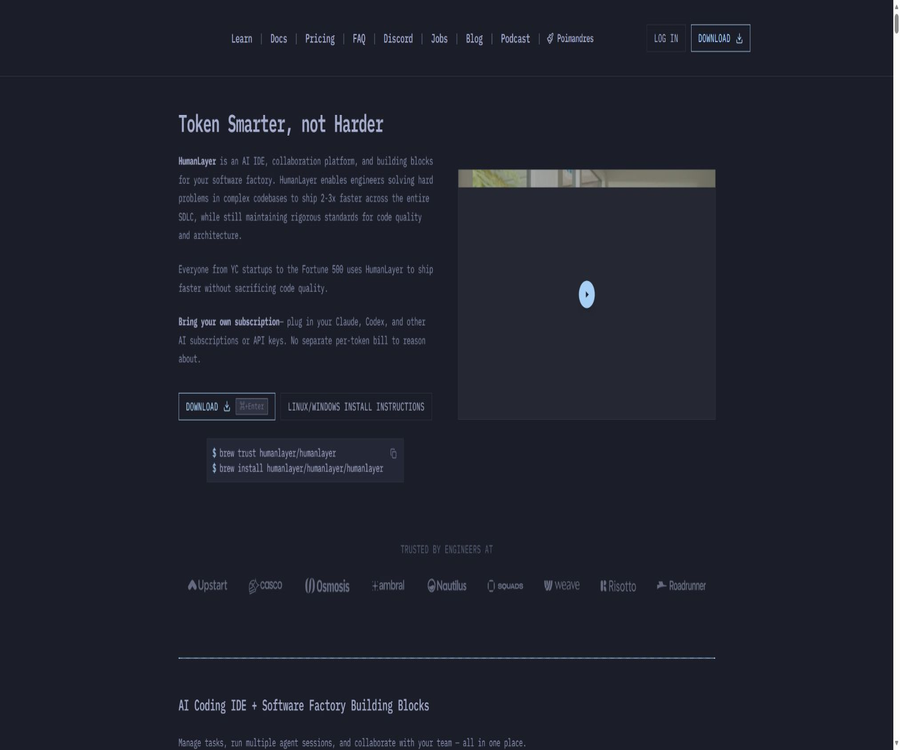
HumanLayer
HumanLayer: an intelligent tool focused on AI development frameworks
Tags:AI development frameworksA one-sentence summary
HumanLayer is an AI programming agent environment designed for software teams, allowing tasks, agent interactions, research documents, design drafts, implementation plans, and code structures to be gathered in a single workspace.
Tool Introduction
HumanLayer emphasizes keeping engineers actively involved in key decision-making, rather than handing over complex requirements to models to generate code in one go. A structured workflow involves clarifying requirements, examining the codebase, reviewing designs, and developing a phased plan before implementation.
The current product and the earlier SDK with the same name are not aimed at the same audience. The earlier HumanLayer was designed to introduce manual approval for calls to high-risk agent tools, while the current product has evolved into an AI programming environment as well as a platform for team-level agent orchestration.
Main functions
Unified management of tasks, sessions, and workpieces
Each task can be associated with multiple intelligent agent sessions, research and design artifacts, implementation plans, as well as code worktrees. Team members can monitor the progress of a given task together, which helps to avoid the problem of scattered information across chat windows and document tools.
QRSPI structured workflow
The platform breaks down complex development tasks into six stages: Questions, Research, Design, Structure, Plan, and Implement. At each stage, results that can be reviewed are produced, allowing errors to be identified before a large amount of code is generated.
| Phase | Main tasks | Output | Key points of manual inspection |
|---|---|---|---|
| Questions | Generate clarifying questions | List of issues and requirements boundaries | Are the objectives, constraints, and acceptance criteria complete? |
| Research | Organize the codebase, dependencies, and existing patterns | Research document | Do you understand the actual architecture and the reuse paths? |
| Design | Develop the technical design and discuss the trade-offs. | Design drafts that allow for comments | Are the interfaces, data flows, and risks reasonable? |
| Structure | Break down the design into verifiable phases | Structured implementation steps | Are the dependency order and rollback boundaries clear? |
| Plan | Detailed documentation, testing, and acceptance criteria | Implementation plan | Whether it is executable, testable, and auditable |
| Implement | Encode as planned and provide continuous feedback. | Code, tests, and change logs | Check whether there is any deviation from the approved plan. |
Multiple task workflows
In addition to the complete QRSPI process, the task creation interface also offers modes such as RPI, RPI Outline, PRD-Oriented, Oneshot, and Freeform. Users can choose between in-depth analysis, implementation based on an outline, approach driven by product requirements, or direct handling of simple tasks, depending on the scale of the changes required.
Research, design, and planning of workpieces
Research documents, design specifications, structural outlines, interface sketches generated from models, and implementation plans become artifacts associated with a particular task. These artifacts can be versioned and shared, allowing teams to avoid relying on ever-growing sets of conversation records that are difficult to review.
Comment-driven design review
Engineers, product managers, and technical leads can leave comments directly on the design documents, and the AI then adjusts the plans based on those comments. This integration of comments with the implementation process helps to identify architectural misunderstandings and missing features before coding begins.
Full session visibility
The platform displays the status, timing, and related artifacts of each session within a task, making it easy to see whether the agent is currently analyzing something, waiting, or taking action. The team can switch between tasks and sessions on the same interface, and can also provide further feedback to the agent.
Multi-warehouse workspace and Worktree
A task can be associated with multiple code repositories, and an isolated working tree is created for each selected repository. This feature is suitable for teams that need to modify the server side, the frontend, and shared type libraries simultaneously, without wanting different intelligent agents to overwrite each other’s working directories.
Local and cloud-based parallel agents
The local daemon can run multiple intelligent sessions in parallel on a computer, while long-term tasks can be handled by the cloud daemon. The platform synchronizes the status, allowing users to monitor progress through a web interface, desktop application, or mobile app.
Keyboard shortcuts and command panel
HumanLayer offers ways to switch between tasks, sessions, workpieces, and actions related to keyboard operations. Developers who work frequently can save time by avoiding the need to constantly navigate back and forth between the editor, terminal, ticket pages, and document pages.
Supported agent and model channels
HumanLayer employs the BYOK approach, allowing users to access existing AI subscriptions or API keys. The current page lists Claude Code, Codex, Copilot, and Fireworks, with plans to add more models and subscription options in the future.
| Channels | Access method | Suitable scenarios | Additional costs |
|---|---|---|---|
| Claude Code | Already have a subscription or key | Research and implementation of complex codebases | It is calculated separately based on the respective subscription or model service. |
| Codex | Already have a subscription or key | Code modification, validation, and automated development | It is calculated separately based on the respective subscription or model service. |
| Copilot | Already subscribed | The team’s current development toolchain | It depends on the existing account plan. |
| Fireworks | A service account or key already exists. | Leverage its managed model capabilities | Calculated according to the relevant service rules. |
BYOK does not mean that the cost of use is zero. HumanLayer does not charge any additional fees based on the number of tokens, but there may still be separate costs associated with model subscriptions, API tokens, cloud computing, and enterprise infrastructure.
Typical usage process
Handle complex requirements using a complete workflow.
- Create a task by importing requirements from text descriptions, Linear tickets, or Jira tickets.
- Select the code repository to participate in, and decide whether to create a working tree immediately, at a later time, or not at all.
- Have the agent first generate clarifying questions, and add business objectives, technical constraints, and acceptance criteria.
- Once in the research phase, assess its understanding of the codebase structure, dependencies, and existing patterns.
- Review the design documents and use in-document comments to correct issues related to interfaces, data flows, and architecture.
- Ensure that the structure and implementation plan include the file locations, test cases, acceptance criteria, and rollback strategies.
- After approval, it enters the implementation phase, during which the code, tests, and agent feedback can be viewed at each stage.
- After completion, manual code review, testing, security checks, and merge decisions are carried out.
Use lightweight processes to handle minor changes.
- Create separate tasks for defect fixes, text adjustments, or minor restructurings.
- Choose RPI Outline, Oneshot, or Freeform to avoid creating overly complex processes for simple changes.
- Limits the warehouses, directories, and testing scopes that can be modified.
- Check the differences among agents, test results, and unresolved issues.
- Confirm that no unauthorized modifications or sensitive information have been made before submitting the code.
Task creation and workspace configuration
- The task description should include objectives, non-objectives, technical constraints, and verifiable completion criteria.
- For multi-warehouse tasks, it is necessary to clarify the primary warehouse and the responsibilities of each auxiliary warehouse.
- The work tree is suitable for isolating changes in a parallel manner, but it is still necessary to plan branch naming, dependency installation, and cleanup strategies.
- After importing tickets from Linear or Jira, the missing code repository context in those tickets should be added.
- For high-risk migrations, permissions, and payment logic, a complete workflow should be used along with manual checkpoints.
Workpiece and team collaboration
- Study the structure of the workpiece record codebase, its dependencies, and existing implementation patterns.
- The design artifacts are used to discuss technical solutions, data flows, interfaces, and alternative paths.
- Structure and planning break down large changes into small, manageable phases that can be checked.
- Inline diagrams and interface sketches can help teams understand interactions and architecture more quickly.
- Comments and decisions are fed back to the agent, making the work item part of the execution process.
- Workpieces are linked to tasks, which makes it easier for new members to understand why a particular implementation was chosen.
Multiple warehouses and parallel development
| Ability | Function | Suitable for tasks | Precautions |
|---|---|---|---|
| Multi-warehouse workspace | Associate multiple warehouses with the same task | Changes across services, front-end and back-end, as well as shared libraries | It is necessary to clarify the warehouse dependencies and the order of submissions. |
| Worktree | Create an isolated working directory for the task. | Multiple branches or agents operate in parallel | Pay attention to disks, dependencies, and cleanup. |
| Local daemon | Running sessions in parallel on a personal computer | Local code and short-term tasks | Affected by device resources and online status. |
| Cloud daemon | Keep the task running in a remote environment. | Long tasks and software factory processes | Involves code upload, permissions, and corporate policies |
| Real-time collaboration | The team and agents jointly comment on the work items. | Design review and cross-role decision-making | Clear approval responsibilities are required. |
Prices and packages
As of August 23, 2026, HumanLayer offers three tiers: Starter, Pro, and Enterprise. The Starter tier is designed for small teams of up to three members; the Pro tier charges based on the number of users per month, while for the Enterprise tier it is necessary to contact sales to determine the deployment details and contract terms.
| Package | Price | Billing cycle | Core benefits or quota | Suitable for users |
|---|---|---|---|---|
| Starter | Free | No fixed subscription fee | Up to 3 team members, a maximum of 200 sessions per month, and Pro features available for small teams | Individual developers and small teams of up to three members |
| Pro | $ | Monthly | Infinity tasks and sessions, BYOK, multi-warehouse workspaces and work trees, inline charts and sketches, real-time collaboration on workpieces, remote daemons | Engineering teams that make continuous use of AI-driven programming processes |
| Enterprise | Custom quote | In accordance with the contract | Includes Pro features, as well as SSO or SAML, audit logs, bulk pricing, custom terms, local deployment, and a private VPC. | Organizations with requirements for compliance, auditing, and private deployment |
Suggestions for package selection
- Individuals or teams of up to three can use Starter to test workflows; a limit of 200 sessions per month may hinder frequent parallel development.
- Pro is suitable when infinite tasks, multi-warehouse collaboration, remote daemons, or team artifact review are required.
- Unified identity logging and audit logs are required; when deploying in a virtual private network or on-premises, Enterprise should be chosen and the contract finalized.
- All packages should include model subscriptions, API keys, and cloud operation costs in the overall budget.
- Prices, taxes, and benefits may change; prior to purchase, the information displayed on the account settlement page or in the sales quote should be taken as reference.
Explanation of BYOK costs
The platform allows the use of existing subscriptions such as Claude or Codex, or API keys; as a result, the billing for HumanLayer is separate from the billing for the models. When assessing costs, it is necessary to take into account both the platform seats, the amount of model usage, the resources required for remote execution, and the time spent on internal reviews.
Which users are it suitable for
- Software engineering teams that need to use AI agents in large or multi-warehouse codebases.
- Technical leaders who wish to incorporate research, design, planning, and implementation into a unified review process.
- Advanced developers who run multiple encoding sessions simultaneously and require isolation of work trees.
- Product development teams that wish to initiate agent tasks from Linear or Jira tickets.
- Enterprises that require a remote daemon, audit logs, a private VPC, or local deployment.
- Platform teams that place emphasis on traceable decision-making and the continuous accumulation of engineering context.
Situations that are not very suitable
- Suitable only for users who need single-file completion, simple Q&A, or occasional short code generation.
- Teams that are unable to provide a subscription for supported models or API keys.
- Individuals who are unwilling to maintain task boundaries, as well as to implement processes for design review and manual approval.
- Code or development artifacts are prohibited from being sent to external cloud services in organizations that have not opted for private deployment.
- For users who rely on completely open-source solutions and wish to deploy all components of the current platform on their own.
Product advantages
- Organize requirement clarification, codebase analysis, design, planning, and implementation into a continuous process.
- Tasks, sessions, work items, and work trees are all linked together, which helps the team understand the development status.
- Design feedback can be provided directly to the agent, reducing the disconnect between documentation and execution.
- It supports multiple warehouses and parallel work trees, making it suitable for complex engineering environments.
- Local and cloud agents can work together to carry out tasks of varying durations.
- BYOK allows teams to continue using the model channels that have already been purchased.
- The free Starter version allows small teams to test collaborative methods at a low cost.
Usage restrictions and risks
- Agents may still misinterpret code, introduce defects, or produce unsafe implementations; manual review is therefore indispensable.
- Structured processes increase the costs associated with initial discussions, and they may not be suitable for minor changes.
- Multiple concurrent sessions can lead to redundant work, dependency conflicts, and increased model consumption.
- The work tree can only isolate directories; it cannot replace branch strategies, continuous integration, or permission management.
- BYOK keys and development environment permissions need to be properly isolated to prevent agents from accessing unrelated production resources.
- Cloud sessions may handle code, prompts, and artifacts; sensitive organizations should first conduct data and compliance assessments.
- Services, features, and available packages may still change; the key procurement terms should be specified in the contract.
Privacy and data security
HumanLayer is operated by QueryTale, Inc. Its privacy policy applies to the website, software, and related services, and it outlines the types of information that may be collected, such as contact details, account information, payment data, user-generated content, usage patterns, device information, and approximate location data.
| Matters | Current instructions | User suggestions |
|---|---|---|
| Account and contact information | Registration, subscription, inquiry, and support may require a name, email address, and account details. | Use a work email address and limit the scope of sharing. |
| Payment data | The card details are processed directly by the third-party payment service provider; the platform states that it does not access or store the full card information itself. | At the same time, check the privacy policies of the payment service provider. |
| Use analysis | PostHog’s logging feature is used to track usage, pages visited, clicks, and various basic technical events; it is not intended for advertising purposes. | Companies should verify whether the analyzed data complies with internal policies. |
| User-generated content | It will be used for the purpose for which it was provided, and may also be displayed to other service users when appropriate. | Do not submit keys, customer privacy information, or unauthorized code. |
| Retention period | Stored for processing purposes or as required by law; deleted or anonymized when there is no ongoing business need. | Before deleting the account, export the required artifacts and submit a data request. |
| Cross-border transmission | The data may be transmitted to the United States or to the country where the supplier’s facilities are located. | Regulated organizations should first assess the basis for transmission. |
| Safety measures | Administrative, technical, physical, and organizational measures are employed, but complete elimination of risks is not guaranteed. | Combine least privilege, key rotation, and code review. |
Sensitive code and key management
- Create separate accounts or dedicated keys for HumanLayer and the model channels.
- Only the files, commands, and network permissions necessary for the current repository and task are granted.
- Exclude production credentials, customer data, and personal information from prompts and artifacts.
- Complete data classification and cross-border review before allowing the cloud daemon to process the code.
- Verify the output using code review, automated testing, secret scanning, and dependency checks.
- After the task is completed, the temporary key is revoked, and the work trees and sessions that are no longer in use are cleaned up.
Explanation of open source and GitHub
The current official website states clearly that the HumanLayer platform has not yet been made fully open source, although the research, planning, and implementation workflows are available publicly. Just because the code can be viewed in the historical repositories, it does not mean that the current cloud platform, local daemons, and team services should all be considered open source.
The original HumanLayer and CodeLayer repositories were licensed under the Apache-2.0 license, and there are traces of this historical transition in the current repository documentation and development status. The old SDK documentation indicated that it had been replaced by CodeLayer, and the relevant SDK code was removed from the main project.
| Project | Current status | License or availability status | Usage suggestions |
|---|---|---|---|
| The current HumanLayer platform | Continuous provision of team AI programming services | It has not yet been made fully open source. | Use it as Starter, Pro, or Enterprise. |
| RPI workflow | One of the foundations of the workflow used in current products | Already published | The engineering methods related to its context can be studied. |
| Historical CodeLayer and SDK repositories | It belongs to the early product stage and the transitional phase. | The repository was once labeled Apache-2.0 | Do not consider it as a fully self-hosted version of the current platform. |
| Early HumanLayer SDK | It has been replaced by later products and removed from the main project. | Historical codes and documents are available for reference. | New projects should not rely on deprecated SDKs. |
Differences between early SDKs and current products
| Comparison items | Early HumanLayer SDK | Current HumanLayer |
|---|---|---|
| Main positioning | Add manual approval for agent tool calls | Team-oriented AI programming environment and agent orchestration |
| Core object | Approval requests, manual feedback, and high-risk functions | Tasks, sessions, workpieces, work trees, and daemons |
| Typical user | Developers who create Agent applications | Software engineers, technical leaders, and R&D teams |
| Current status | It has been replaced by later products. | Current commercial products |
| Proposals for new projects | It should no longer serve as the primary foundation for integration. | Select the current package based on the team size. |
Basic information
| Project | Content |
|---|---|
| Tool name | HumanLayer |
| Operating entity | QueryTale, Inc. |
| Tool type | AI programming agent platform, team development environment, agent orchestration |
| Core workflow | Questions, Research, Design, Structure, Plan, Implement |
| Model approach | BYOK, supports Claude Code, Codex, Copilot, Fireworks, and more. |
| Price pattern | Free Starter, Pro based on seats, custom solutions for enterprises |
| Support interface | Web, desktop, and mobile interfaces |
| Is it open source? | The current platform has not been fully open sourced; only some workflows and historical projects are available publicly. |
| Recommended users | Users involved in AI development with complex codebases, multiple repositories, and team-level workflows |
Frequently Asked Questions
What is HumanLayer?
It is a team development platform that brings together AI programming agents, tasks, sessions, engineering artifacts, and code worktrees. Its core value lies in enabling engineers to carry out continuous reviews during the critical stages of research, design, and implementation.
Is HumanLayer free?
The Starter plan is free; it supports up to 3 team members and 200 sessions per month. For higher usage levels, multiple warehouse workspaces, remote daemons, and advanced collaboration features, the Pro or Enterprise plans are available.
How much is the Pro package?
The current public pricing is $100 per user per month. Model subscriptions or API usage are not included in this fee and must be covered separately through the BYOK option.
Is Codex supported?
Supported. The current product page lists Codex under the BYOK agents and models category, along with Claude Code, Copilot, and Fireworks.
Is it necessary to use the full QRSPI process?
It is not necessary. Users can also choose RPI, RPI Outline, PRD-Oriented, Oneshot, or Freeform, in order to reduce or increase the number of inspection stages depending on the complexity of the task.
Can it handle multiple warehouses?
Yes. The Pro plan includes multiple warehouse workspaces and work trees; when creating tasks, it is possible to set up isolated directories for different warehouses.
Is HumanLayer open-source software?
The current platform has not been made fully open source; only certain workflows and historical projects are available publicly. The Apache-2.0 license applied to the earlier versions of this platform cannot be applied to all components of the current commercial version.
Can the legacy manual approval SDK still be used for new projects?
It is not recommended. The relevant documentation clearly states that the earlier SDKs were replaced by CodeLayer, and the SDK code has been removed from the main project; new projects should reevaluate their approaches based on the current capabilities of the product.
Will the code remain in the cloud forever?
The public privacy policy does not specify a fixed duration for storing all codes and artifacts; instead, storage is determined based on business needs and legal requirements. Teams dealing with sensitive data should consult sales to understand the specifics regarding data flow, storage, deletion, and private deployment.
Can it completely replace code review?
No. The platform helps teams to review research, design, and plans earlier, but the model can still generate incorrect or unsafe code; ultimately, it is still the team’s responsibility to carry out testing, conduct permission checks, and handle merging.
Summary
HumanLayer is suitable for users who wish to elevate AI programming from a one-time conversation to a team-based engineering process. It provides more verifiable context for complex changes before they are implemented, through tasks, artifacts, comments, work trees, and local or cloud-based sessions.
When making a choice, it is important to compare factors such as team size, the number of sessions per month, the need for multiple warehouses, model costs, cloud-based code processing, and compliance requirements. It is also necessary to distinguish between existing commercial platforms, public workflows, and the older SDKs that are no longer in use, in order to avoid making incorrect deployment decisions based on outdated information.
Tools similar to HumanLayer





 Guigong Network Security Registration No. 45132202000164