






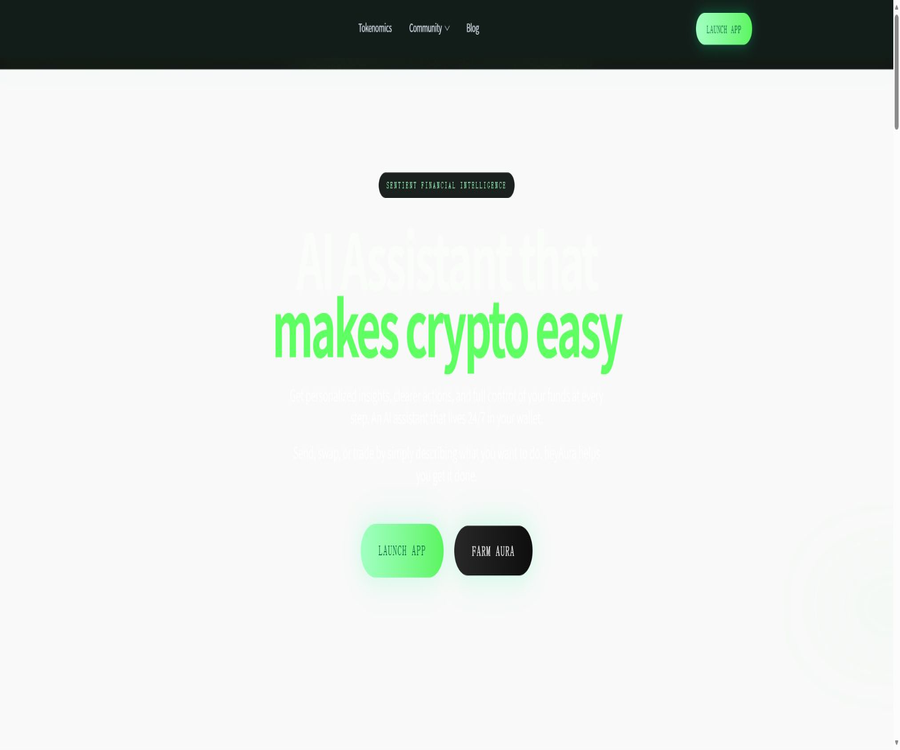
heyAura AI Assistant
heyAura AI Assistant: an intelligent tool focused on AI development frameworks
Tags:AI development frameworksA one-sentence summary
HeyAura is an AI assistant integrated into Web3 wallets; it can analyze assets and behavioral patterns on public blockchains, explain investment portfolios, identify DeFi opportunities, assess risks, and convert natural language commands into transaction actions that can be reviewed by users.
Tool Introduction
HeyAura is the core product launched by the AdEx team following its brand transformation in 2026; its operational focus has shifted from a decentralized advertising infrastructure to AI agents built into wallets. This product is based on the Ethereum and EVM ecosystem, with the ADX token being used for access, staking, governance, and various other functions.
As of August 23, 2026, heyAura is still in the Beta phase; its current version focuses on portfolio analysis, comparison of opportunities, risk assessment, and user-approved blockchain transactions. The official website highlights a vision of automation, but this does not mean that the current product can control wallets arbitrarily without any restrictions.
Evolution of brands and products
| Phase | Product name | Main positioning | Current judgment |
|---|---|---|---|
| Since 2017 | AdEx | Ethereum advertising protocols and the ADX ecosystem | Historical infrastructure still has code and token assets. |
| 2024 to 2025 | AdEx AURA | Chain-based activity analysis and recommendation framework | Develop prototypes for information extraction, LLMs, and strategy recommendation. |
| 2026 | heyAura | AI execution and automation layer within the wallet | Current brand and core direction |
| Current products | heyAura Beta | Comprehensive analysis, risk, returns, and transaction preparation | Access via stkADX is required, and the operation must be approved by the user. |
| Future directions | More complete autonomous agents | Local models, NFTs, airdrops, and complex automation | It cannot yet be considered fully online. |
Current main functions
Wallet and portfolio analysis
After connecting to or entering the account address, the system retrieves public on-chain information such as the cryptocurrency balance, holding positions, transaction history, chain distribution, and the protocols in use. It can explain the composition of assets and how funds are utilized, but it does not have knowledge of off-chain assets, tax costs, or the user’s overall investment objectives.
Opportunity identification for returns
HeyAura takes into account the wallet’s background, relevant protocols, and market data to identify idle funds and potential profit opportunities, while also comparing different strategies. The yields shown can change rapidly; it is also necessary to consider factors such as smart contracts, devaluation, liquidity, locking mechanisms, and token price risks.
Position holding and risk assessment
Assistants can compare positions, analyze the exposures associated with chains and protocols, and conduct stress tests on portfolios. The risk assessments are generated based on on-chain data and models; they do not constitute audit opinions, credit ratings, or licensed investment advice.
Natural language wallet operations
Users can specify goals such as swapping, trading, or cross-chain transactions; the system is responsible for determining the appropriate path and preparing the corresponding transactions. Ultimately, it is still the wallet owner who signs and approves these transactions – the model cannot assume any losses on behalf of the user.
Exchange and cross-chain
Beta offers support for token swapping and cross-chain operations, thereby reducing the need to switch back and forth between different protocol interfaces. Users should check the chain, token contract, quantity, recipient address, slippage, routing path, bridge transfer time, and total cost.
Transactions and multi-step processes
The system can break down complex intentions into one or more steps within the blockchain, and where wallet support is available, it uses batch transactions to reduce the number of signatures required. Batch signing is more convenient; it also means that a single approval may cover multiple actions with associated risks, and it’s not possible to skip reviewing each action individually.
Position monitoring and alerts
The official website lists continuous monitoring, recurring reminders of opportunities, changes in portfolios, and risk signals as part of the automated functions. The available triggers, frequency, notification methods, and scope of operations in the background are determined by the Beta account.
Context within the wallet
HeyAura does not start with an empty chat session; instead, it provides responses by taking into account the current balance in the wallet, the user’s location, past activities, and information related to the blockchain. This more context-aware approach enables the creation of detailed profiles of financial behavior.
Hybrid interactive interface
The product supports prompt-based dialogue, while also retaining a traditional graphical interface and direct visual control. Users can engage in conversation when explanations are needed, and return to the structured interface for signing and confirming amounts.
Current and planned capabilities
| Ability | Status | Current confirmable range | Do not misunderstand this as |
|---|---|---|---|
| Combinatorial analysis | Beta is now available. | Assets, positions, chain exposure, and historical background | Complete financial statements or tax software |
| Comparison of opportunities and risks | Beta is now available. | Profit discovery, location comparison, and stress testing | Guaranteed returns or risk-free recommendations |
| Exchange, cross-chain, and transaction preparation | Beta is now available. | Generate on-chain actions for user review | Any transfer that does not require a signature |
| Ongoing monitoring | Current product direction | Combinations of changes, opportunities, and risk signals | Publicly committed 24/7 SLA |
| Complete autonomous execution | Ongoing development | Agent workflow under human supervision | Transfer of private key or unlimited authorization |
| NFT support | In planning | Further expansion of wallet assets and functions | All current NFTs can be processed. |
| Automatic pickup via airdrop | In planning | Discover and collect under appropriate conditions | All airdrops have been covered. |
| Local privacy model | Research and development directions | Try to explain the background of the wallet within the user’s environment. | All current inferences are offline. |
| Deeper behavioral analysis | In planning | Trading patterns and historical preferences | A complete user profile has been established at present. |
Working principle
| Processing stage | Input or action | Main function | Risk points |
|---|---|---|---|
| Account address | Public wallet address | Specify the on-chain account to be analyzed. | Address association reveals the entire public history. |
| Circle and Velcro | RPC queries and aggregation | Read tokens, NFTs, prices, and other composite data at once | Nodes and upstream data may be delayed or incomplete. |
| Large language models | Format the wallet background and external information | Generate explanations, opportunities, and strategic recommendations. | Hallucinations, prompt contamination, and outdated information |
| Safe handling | Model output and risk rules | Suggestions for screening for potential malicious or abnormal activities | It cannot replace contract audit and user review. |
| Reverse instruction conversion | Human-readable suggestions | Convert to machine-readable actions such as transactions or intents | Conversion errors may change the address, amount, or order. |
| Wallet approval | Transaction preview and signing | The user makes the final decision on execution. | Blind drawing and excessive authorization can still lead to losses. |
External data
The assistant provides real-time context by drawing on the Web3 application directory, DeFi data, DApp data, airdrop interfaces, and on-chain analysis tools. Disruptions in upstream interfaces, incorrect labeling, or changes in protocols can affect the recommendations; users should therefore check the protocol details and on-chain records.
Which users are it suitable for
- Multi-chain wallet users: Gain a unified understanding of assets and positions across different EVM chains.
- DeFi participants: Compare returns, risks, locking, and capital utilization efficiency.
- Crypto beginners: Understand wallet activities and transaction steps in natural language.
- Active traders: Designed for swaps, cross-chain operations, and multi-step tasks, with reduced interface switching.
- ADX holders: Gain governance, rewards, and Beta access by pledging assets.
- Wallet and Web3 Product Team: Assessing the integration of AI for analysis and execution into the products.
- Developer: Researching some open-source versions of the AURA framework as well as the paid invocation method for x402.
Scenarios that are not suitable
- Users who are reluctant to connect their wallets, expose their public addresses, or lock up their tokens.
- Those who need a bank account in fiat currency, stocks, and comprehensive offline asset management.
- Investors who require guaranteed returns, capital preservation, or licensed investment advice.
- Users who need a Bitcoin-native, non-EVM chain, with all NFT functions fully available.
- The corporate treasury operates automatically without any systems for multi-signing, access control, auditing, or approval.
- Users who wish to delegate their private keys, seed phrases, or unlimited spending authority to an AI.
Basic usage tutorial
- Prepare a separate wallet for testing; do not use the main wallet that holds all assets to try out the Beta version.
- Check the official contracts for ADX and stkADX as well as the current pledging pages to avoid fake tokens with the same name.
- Pledge or hold at least 300 stkADX tokens that meet the access requirements, and document the rules for locking and unlocking them.
- Open the official app and connect to a test wallet; avoid any pages that ask for a seed phrase or private key.
- Have the assistant first conduct a read-only analysis of assets, positions, chain exposure, and risks, without executing any trades immediately.
- Select a small-scale exchange or cross-chain task, and compare the recommendations of the models with the actual pricing offered by the protocols.
- Check each step: the chain, contract, authorization, amount, slippage, fees, and recipient address.
- The wallet signs only when all fields match, and the final result is verified in the block explorer.
- After use, revoke unnecessary authorizations, and keep track of costs, deviations, and the steps that require manual handling.
Secure transaction review process
- Verify the application domain name, connect to the wallet and the network, and reject signature pages sent via chats or private messages.
- The reading assistant provides explanations, but it is necessary to verify the agreement’s official website, the contract address, and the audit status separately.
- Determine whether the transaction is a regular authorization, an unlimited authorization, an exchange, a cross-chain operation, a pegging, or a batch call.
- Limit the authorization level to what is required for the task, and verify that the entity to which authorization is granted is part of a formal contract.
- Compare the minimum received amount, slippage, Gas fees, bridge fees, protocol fees, and potential price impacts.
- When using a hardware wallet or multi-sig, ensure that all approvers see the same human-readable summary.
- Start with a test using the minimum amount, and only after the funds have been credited and the authorization has been revoked should you gradually increase the amount.
Beta access and pricing
HeyAura does not currently have a fixed subscription price in US dollars that is made public. To access the beta version, users need to own at least 300 stkADX tokens; these tokens can be obtained by purchasing or pledgingADX, and their actual cost varies depending on market prices, transaction fees, and the conditions of pledging.
| Costs or thresholds | Current rules | Is it fixed? | Main risks |
|---|---|---|---|
| Beta access | Hold at least 300 stkADX tokens. | The quantity is fixed, while the value in fiat currency varies. | Token price and liquidity risks |
| ADX collateralization | Deposit ADX into the unified collateral pool in exchange for stkADX. | Rewards and conditions are variable. | Smart contracts, locking, and opportunity cost |
| On-chain Gas | Connection, authorization, pledging, exchange, and payments across chains | Along with changes in the network | It increases significantly during congestion. |
| Exchange fees | Routing, protocols, slippage, and price impacts | It depends on the transaction. | Changes in quotes and MEV risks |
| Cross-chain fees | Bridge and target chain execution costs | Depends on the chains and bridges. | Delays, liquidity, and bridge contract risks |
| Advanced features | ADX can be unlocked; in the future, monthly fees may be deducted from the amount pledged. | The specific rates are not publicly available. | It is not possible to estimate the current cost based on the plan. |
| API call | Payment can be made by using x402. | The public page does not list a unified unit price. | The agent should set budget and payment limits. |
Pawning is not a free subscription.
The user still retains the assets that represent the collateralized position and may receive rewards as well as governance rights, but the funds are exposed to risks related to price fluctuations, contracts, liquidity, and exit conditions. The threshold of 300 units cannot be simply regarded as a free allowance.
The planned premium pricing
According to the official assistance information, in the future higher output levels and greater request limits may result in charges being deducted monthly from the amount pledged, while larger pledge amounts could entitle one to discounts. At present, there are no fixed rates, specific times for charging, or rules regarding refunds; therefore, this can only be considered as a plan for the future.
ADX and stkADX
| Project | Uses | Current instructions | Precautions |
|---|---|---|---|
| ADX | Eco-tokens | Pawning, governance, security guarantees, and functional access | Fluctuations in prices do not indicate equity or principal-protected products. |
| stkADX | Unified pool collateral positions | The current Beta version requires at least 300 tokens to be held. | Check the rules for exchange, locking, exit, and rewards. |
| Governance | Voting on protocol decisions | The weight is related to the amount of collateral and the duration. | The outcomes of governance may change the mechanisms. |
| Rewards | Pledge earnings | Supported by agreement-based revenue and distribution mechanisms | The yield is not fixed and can change. |
| Application security assurance | The new agreement provides a pledge ofADX in an effort to get it included on the pre-approval list. | Used to add constraints to the discovery process | Being on the list does not mean that the audit is risk-free. |
| Recommended improvement | The protocol allows for pledging in order to increase the visibility of relevant recommendations. | It is necessary to first meet the user’s interests. | Commercial incentives should still be transparent to users. |
Support for networks and assets
The current instructions focus on Ethereum, Layer 2 networks, and other EVM-based chains; it is possible to view ERC-20 tokens, NFTs, prices, protocol status, and historical activities. The list of specific chains, bridges, DEXs, vaults, and assets will be updated as part of the Beta version, so it is necessary to check these details within the application before using it.
| object | Current capabilities | Restrictions |
|---|---|---|
| Ethereum | Core support and theADX ecosystem | The gas level might be high. |
| EVM Layer 2 | Combinatorial analysis and cross-chain scenarios | The data, bridges, and fees vary across different chains. |
| ERC-20 tokens | Balance, price, exchange, and position analysis | Counterfeit currencies with the same name and tokens with low liquidity need to be verified. |
| DeFi positions | Analysis of returns, risks, and capital utilization | Agreement-specific debts and rewards may be delayed. |
| NFT | The data extraction framework can be read; full product support is still under development. | It cannot be assumed that all sets and operations are available. |
| Non-EVM networks | Full support not publicly available | It cannot be assumed that coverage is achieved through cross-chain promotion. |
| Legal tender and centralized accounts | It’s not within the main scope. | It is not possible to obtain a complete view of the net assets. |
Safe design
The user finally gives approval.
HeyAura can generate and prepare transactions, but actions such as swapping, cross-chain transfers, executing trades, and other similar tasks still require user approval. This process reduces the risk of AI transferring funds without authorization, but it does not prevent users from accidentally approving malicious or incorrect transactions.
A private key is not required.
Composite analysis makes use of public account addresses and on-chain data; normal use should not require the submission of private keys or seed phrases. Any page, robot, or customer service representative that asks for such secrets must be stopped immediately.
Security processing layer
The model’s outputs are subject to security screening in order to reduce the risks associated with attacks such as prompt injection. The public documentation does not provide information on coverage rates, false positive rates, or a complete threat model, and it cannot serve as a substitute for contract auditing.
Code and token auditing
The team notes thatADX and the collateral contracts have been audited by multiple institutions, and ongoing AI-assisted code review is being implemented. The audits of tokens or collateral contracts do not automatically cover the heyAura application, the underlying protocols, cross-chain bridges, or each individual transaction that is generated.
Local model direction
The team plans to keep the first level of explanation for the wallet in the user’s environment whenever possible, sending only the minimal amount of background information required by the remote system. This capability is still under development; it cannot be claimed that all data is processed locally at present.
Privacy and wallet profiling
Blockchain addresses and transactions are public information, but a comprehensive analysis of balances, positions, history, protocol preferences, risk indicators, and conversations yields a more detailed financial profile. Being public does not mean that users do not care about linking, storing, and inferring information.
The team has released guidelines on security and privacy design, but it has not provided, on the publicly available pages that have been verified, a complete list regarding data retention, model providers, conversation deletion, and sub-processors as applied to Beta versions of the application. More specific policies should be requested before connecting to the main wallet.
| Data items | Purpose of processing | Main risks | Suggestions |
|---|---|---|---|
| Wallet address | Read chain combinations | Associated with an identity or multiple addresses | Give priority to using separate test wallets. |
| Transaction history | Identifying behaviors and strategies | Infering wealth, habits, and risk preferences | Do not reveal your real identity in the conversation. |
| Holdings and authorizations | Identifying returns and risks | Exposing high-value assets and attack vectors | Limit the visibility of sessions and notifications |
| Prompt and question | Generate personalized suggestions | It may include financial goals and plans. | Do not submit private keys, passwords, or sensitive offline information. |
| Remote model | Handle tasks that require cloud-based inference. | The data leaves the wallet environment. | Confirm the model provider, region, and training rules. |
| Local model | Reduce transmissions from the original background. | Not all paths have been localized yet. | View it as a direction rather than a guarantee of the current situation. |
| Third-party agreements and data services | Quotations, bridging, and market context | Each has its own independent logs and policies. | Check each connection and authorization individually. |
Financial and on-chain risks
- AI recommendations may be incorrect, outdated, or fail to take into account changes in contracts, governance, and liquidity.
- The return rate is not equal to the net profit; Gas fees, slippage, bridge fees, and exit costs also need to be deducted.
- High-return opportunities often come with risks related to smart contracts, decoupling, liquidation, and token incentives.
- Cross-chain bridges represent a separate layer of trust, and delays in fund arrival or contract vulnerabilities can lead to losses.
- Infinite token authorization leaves the balance exposed for an extended period; it is therefore necessary to limit the amount involved and revoke such authorization on a regular basis.
- Batch transactions reduce the number of signatures required, and it is also possible to approve multiple unknown calls at once.
- Price quotes may be affected by MEV, low liquidity, and market volatility.
- ADX pledging entails risks related to token prices, smart contracts, and liquidity for exiting the position.
- The inclusion of a protocol in the pre-approval list does not guarantee safety, profitability, or solvency.
- Tax and regulatory obligations vary depending on the region, transaction, and collateral incentives.
Developer API and x402
heyAura offers APIs for functions such as wallet management, and it supports the x402 Internet-based payment method. callers do not need to use traditional API keys; instead, the proxy handles the payment on a per-request basis.
Self-payment converts model errors into actual expenses; developers must set limits for single transactions, daily usage, and overall budget, restrict the accessible endpoints, and keep track of each payment along with its impact on business performance. The public documentation does not specify a uniform rate per call.
x402 access check
- Only approved agent and service accounts are allowed to initiate paid calls.
- Set the allowlist endpoints, tokens, networks, single transaction amount, and daily cumulative limit.
- Use idempotency control for retries, timeouts, and duplicate requests.
- Isolate the payment account from the main fund wallet, retaining only the necessary balance.
- Record requests, responses, on-chain payments, and the final business purpose.
- Simulate service unavailability, abnormal quotes, and payment failures before going into the production environment.
GitHub and the open-source status
The official GitHub organization has made available various repositories related to the AURA framework, the AdEx protocol, the staking interface, the MCP for transaction construction, as well as brand-related resources. The AURA repository is licensed under GPL-3.0 and includes tools for retrieving information from the blockchain, integrating LLMs, and generating basic prompts.
This represents a form of partial open source; it does not mean that the heyAura Beta website, the fully functional backend, all security rules, training data, model weights, and commercial services are all made available. Just because the brand resource repository is public does not imply that the brand materials can be used without any licensing restrictions.
| Project | Public status | License or instructions | Relationship with the product |
|---|---|---|---|
| AURA framework | Public | GPL-3.0 | Information acquisition, LLM integration, and basic recommendation framework |
| AdEx Protocol Repository | Public | Each warehouse has different licenses. | Historical agreements and the foundation of theADX ecosystem |
| Construct MCP for transactions | Public warehouse | Verify the license for each warehouse before use. | Experimental studies on transaction commands and local model services |
| Brand resources | Public warehouse | It is not equivalent to free commercial use. | Logos and visual assets |
| heyAura Beta complete product | Not fully made public | A combination of closed-source services and open-source components | Current user-facing applications |
| Model weights and training data | No complete release was found. | Cannot be proven or deployed on one’s own. | Part of the core AI capabilities |
Product advantages
- Suggestions are generated based on the actual on-chain details of the wallet, which makes them more aligned with the actual holdings than those provided by generic chatbots.
- Combination analysis, opportunity identification, risk comparison, and transaction preparation form a continuous workflow.
- Natural language is combined with traditional interfaces, and there are distinct entry points for the explanation and signing processes.
- The final transaction is approved by the user, and there is no need to hand over the private key to the AI.
- Designed for Ethereum and EVM multi-chain environments, it helps DeFi users avoid the need to switch between different tools.
- ADX collateralization connects Beta access, governance, and ecosystem participation.
- Some components of the AURA framework are licensed under GPL-3.0, which facilitates review and extension by developers.
- x402 provides a programmable payment pathway for proxies to purchase API capabilities on a per-use basis.
Usage restrictions and precautions
- The product is still in Beta version, and its features, access requirements, and transaction processes may change rapidly.
- Currently, access is available only to those who hold at least 300 stkADX tokens; it is not a tool that can be used freely without any requirements.
- There is no fixed price in dollars; the tokens, Gas fees, and protocol costs all fluctuate.
- NFTs, automatic receipt of airdrops, local models, and greater levels of automation are still part of the plans.
- The public page does not list all supported chains, protocols, bridges, and assets.
- AI recommendations do not guarantee returns, nor can they replace independent research and professional financial advice.
- The security processing layer cannot detect every malicious contract, incorrect address, or economic attack.
- Once the public data from wallets is aggregated, sensitive profiles are created; the details of the privacy policy still need to be confirmed.
- Local models represent the direction of development; it cannot be assumed that current inference is entirely offline.
- The audit of ADX contracts does not mean that the heyAura application and all external protocols have undergone the same level of auditing.
- Partial open source does not mean a complete product; the backend or model weights are not fully made available in open source format when the system is run independently.
- Automatic payment via x402 requires a strict budget; otherwise, repeated attempts by the agent may continue to consume funds.
Basic information
| Project | Content |
|---|---|
| Tool name | heyAura AI Assistant |
| Predecessor | AdEx and AdEx AURA |
| Tool type | Web3 wallet AI assistant, DeFi analysis, and on-chain execution layer |
| Current stage | Beta |
| Main networks | Ethereum, Layer 2, and EVM chains |
| Core competencies | Combinatorial analysis, opportunity identification, risk assessment, swapping, cross-chain operations, and transaction preparation |
| Access barriers | Hold at least 300 stkADX tokens. |
| Fixed subscription price | Not disclosed |
| Final transaction approved | To be completed by the user. |
| Whether API is provided | Yes, it supports x402 payment. |
| Is it open source? | Partially open source; the AURA framework uses GPL-3.0 |
| Is it fully self-hosted? | No complete self-hosting solution for the product was found. |
Frequently Asked Questions
Is heyAura free?
It cannot be simply described as free. The current beta version requires at least 300 stkADX to use, and users still have to bear the costs associated with purchasing, pledging, Gas fees, and other on-chain operations.
Will heyAura control the wallet directly?
It can analyze, prepare, and suggest actions to be carried out on the chain, but current security guidelines emphasize that swaps, cross-chain transactions, and other transactions must be approved by the user. Any process that requests private keys or seed phrases is not considered legitimate use.
What operations are supported?
The current Beta version allows for analyzing portfolios, comparing positions, identifying potential profits, and conducting stress tests to assess risks; it also enables preparation for swaps, cross-chain transactions, and regular trades. The specific protocols and chains involved must be confirmed in real time within the application.
Can it guarantee the highest return?
No. The market, agreements, liquidity, and incentives are constantly changing, and AI may fail to detect risks or use outdated data.
Are NFTs and automatic airdrops available yet?
Not all of them can be considered as already available. NFT support and automatic receipt of airdrops are still listed among future features in the Beta release notes.
Are 300 units ofADX the same as 300 units of stkADX?
They are not the same. ADX is the underlying token, while stkADX represents the pledged position in the unified pool; according to the current guidelines, one must hold 300 units of stkADX to access it, and the conversion and migration ratios are determined by the pledging interface.
Is heyAura open source?
Partially open source. The AURA framework repository is licensed under GPL-3.0, but the complete beta version of the application, as well as the backend and models, are not fully available to the public.
Are APIs provided?
It offers some API capabilities and supports x402 pay-per-use pricing. The public version does not specify a fixed price; for automatic proxy services, strict limits on expenses and endpoints must be set.
Is it suitable for connecting a main wallet?
The beta phase is better suited for starting with separate, small-scale testing wallets. Once privacy, transaction previews, the ability to revoke authorizations, and risk control have been verified, a decision can be made regarding whether to expand the range of assets supported.
Summary
HeyAura connects the understanding of wallet structures, the identification of DeFi opportunities, the explanation of risks, and the blockchain-based operations that require user approval; as a result, it operates at a level closer to the execution layer within wallets than ordinary crypto chatbots. The ADX ecosystem and certain open-source AURA frameworks further provide it with a solid Web3 technical foundation.
However, it is still in the Beta phase; access to it relies on stkADX, and full automation as well as local models have not yet been implemented. Users should treat each suggestion as a draft transaction that needs to be verified, use a small separate wallet to examine the contracts, permissions, fees, and privacy aspects one by one, before deciding whether to expand their use of this service.
Tools similar to the heyAura AI Assistant





 Guigong Network Security Registration No. 45132202000164