






Ask On Data
Ask On Data is an intelligent tool focused on AI development frameworks.
Tags:AI development frameworksWhat is Ask On Data?
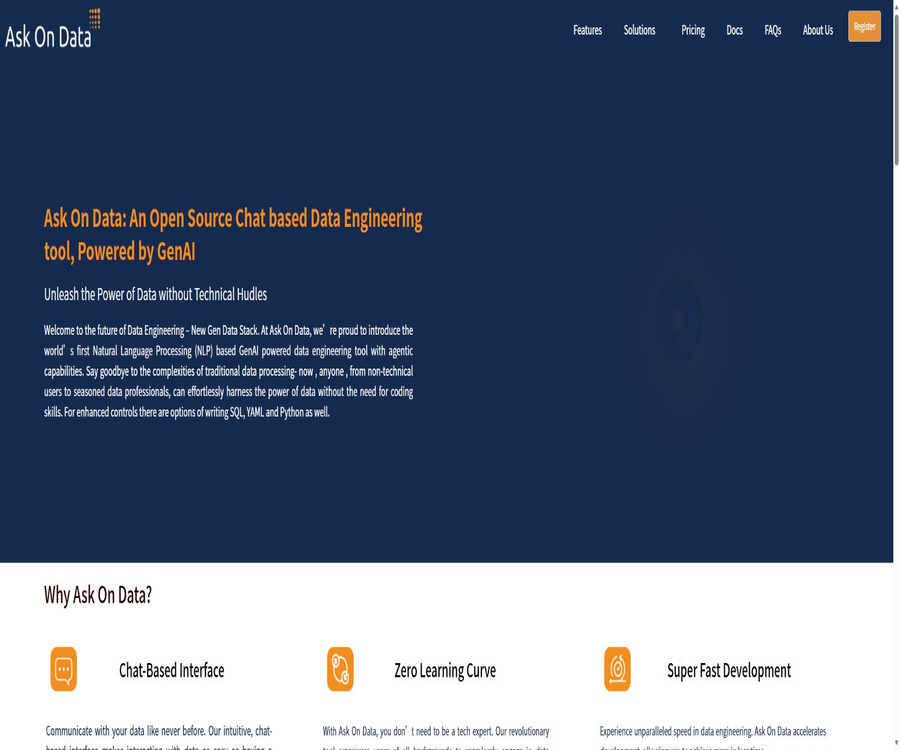
Ask On Data is a generative AI data engineering tool that relies on chat interactions for operation; users can describe their needs related to data migration, cleaning, integration, transformation, and scheduling using natural language. It is intended for data engineers, analysts, data scientists, as well as business users who wish to reduce their coding workload.
This product is better positioned as an AI-driven ETL and data pipeline platform, rather than just a database Q&A tool that converts natural language into query statements. The platform also retains professional control methods such as SQL, Python, and YAML, enabling technicians to handle complex logic and edge cases.
Main functions
- Building pipelines with natural language: Describe the data processing requirements through English conversations, and the system will generate the corresponding steps for the data pipeline.
- Data integration: Supports merging, connecting, migrating data, as well as enabling data flow between different sources.
- Data cleaning and organization: Handling missing values, formatting, fields, and other data quality issues.
- Data conversion: Performs custom calculations, field derivation, and transformation of business rules.
- Real-time data preview: View sample results after each conversion command is submitted, to conduct a cross-check before running the actual task.
- Operation history and undo: View the historical actions within a workflow, and undo changes when errors are detected.
- Task orchestration and scheduling: Choose between full loading, incremental loading, or reloading after clearing, and set the frequency at which tasks are executed.
- Code control: When precise adjustments are needed, SQL or Python can be used to write scripts, or YAML configurations can be edited.
- Custom Spark logic: Add Apache Spark code during the task scheduling phase to handle specific requirements.
Supported data sources
The official website states that the platform is capable of handling data from databases, data warehouses, data lakes, APIs, flat files, and logs, and it allows users to request the inclusion of custom data sources. The range of data sources available varies depending on the chosen package.
| Data source | Content suitable for processing | It is necessary to confirm before use. |
|---|---|---|
| Excel and CSV | Local tables, exported data, and small datasets | The free cloud version supports only these two types of files, and it has a capacity limit. |
| Relational database | Business database, order database, and analysis database | Drivers, network, permissions, and read/write scope |
| Data warehouses and data lakes | Large-scale historical and analytical data | Connector, computing resources, and target table policies |
| API | Data from third-party systems and online services | Authentication, frequency limits, and field changes |
| Logs and other files | Application logs and batch files | Format parsing, encoding, and error data handling |
How data pipelines work
- Select or connect to a data source, and set the access credentials and the minimum necessary permissions.
- Let the platform load the data for preview to verify that the fields, types, and samples are correct.
- Describe the connection, cleaning, calculation, or transformation steps in natural language.
- Gradually check the data preview and operation history after each instruction.
- Check and modify the generated YAML, SQL, or Python logic as needed.
- Determine the target data source, the method of writing data, and the rules for handling failures.
- Set up manual triggering or scheduled tasks, and choose between a full or incremental strategy.
- Run small-scale tests, verify the results, and then process the actual data.
What use cases are suitable?
- Data migration: Moving data from files, databases, or other systems to the target platform.
- Data cleaning: Standardize field formats, correct abnormal values, and prepare an analyzable dataset.
- Data integration: Combining the data from multiple business systems by connecting or merging them.
- Report preprocessing: Perform conversion, aggregation, and standardization before accessing the BI tool.
- Machine learning preparation: Generate cleaned and feature-processed data for model training.
- Scheduled synchronization: Executes repetitive data update tasks on an hourly, daily, or other frequent basis.
- Pipeline prototype: The conversion approach is quickly tested through chat, after which engineers refine the production configuration.
Which users are it suitable for
- Data Engineer: Quickly create a preliminary version of the pipeline, and exert precise control through code and configurations.
- Data analyst: Reduces the time spent on simple data preparation, allowing more time to be devoted to analysis and verification.
- Data scientist: Organize the training data on their own, without having to wait for separate engineering support for each preprocessing task.
- BI team: Handles data cleaning, integration, and scheduled updates prior to the creation of reports.
- Sales staff: Within the framework of permissions and approval mechanisms, they submit requests for basic data processing in natural language.
- Small and medium-sized enterprises: Evaluate chat-based data engineering processes using self-hosted or free cloud versions.
Product advantages
- The conversational interface lowers the barrier to carrying out common data processing tasks.
- It is possible to preview the data at each step, which helps to identify errors before official execution.
- YAML, SQL, Python, and Spark controls are retained, so it is not limited to purely code-free operations.
- It supports operation history and undo functions, making it easy to track how the workflow is developed.
- It is possible to further organize and schedule the conversion steps as tasks that run repeatedly.
- The self-hosted option is listed as free on the official website, making it suitable for technical teams to use for testing.
Usage restrictions
- The current chat interface uses English commands primarily; the quality of Chinese understanding and generation needs to be tested by yourself.
- Generative AI may misinterpret the meaning of fields or business rules; a preview does not constitute complete data validation.
- Write, delete, and overwrite operations on databases can result in actual losses; therefore, it is necessary to restrict permissions and create backups.
- The free cloud version supports only Excel and CSV formats, with a maximum file size of 5MB.
- The free cloud version does not offer task scheduling, and it is therefore unable to handle continuous production processes.
- There is no fixed public price for the enterprise version; the cost is determined based on the amount of data and the scope of services provided.
- The official website claims that the software is open source, but the official GitHub repository was empty at the time of verification, making it impossible to download the complete source code for deployment.
- The public documentation is not sufficient to confirm all database connectors, system requirements, and details related to operational maintenance at production level.
Comparison of versions and prices
The Ask On Data website lists three options: open-source self-hosted, free cloud-based, and enterprise cloud-based solutions. The enterprise version is charged based on the amount of data used, but no specific fee amount is specified.
| Version | Price | Data source | Scheduling | Hosting and support |
|---|---|---|---|---|
| Open Source | Free | The official website states that it supports all databases as sources and targets. | Support | Self-hosting, community support, manual deployment of patches and upgrades |
| Free | Free | Only Excel and CSV, with a file size limit of 5MB. | Not supported | Official hosting, community support, automatic upgrades, backups, and monitoring |
| Enterprise | Contact for a quote | The official website states that it supports all databases as sources and targets. | Support | Official hosting, enterprise support, automatic upgrades, backups, and monitoring |
The official website’s FAQ also states that self-hosting is available at no cost, while the enterprise version’s fee depends on the amount of data used. Since the official code repository is currently empty, it is necessary to consult the team before actually downloading and deploying the self-hosting solution.
Open source and GitHub status
On the official website, Ask On Data is referred to as an open-source product in various places, and the open-source self-hosted version is presented as a free option. A public repository with the same name also exists within the official GitHub account.
As of this verification, the repository appears to be empty – it contains no source code, installation instructions, version releases, or license files. Therefore, it is not possible to conclude based on the information provided on the official website that an auditable and deployable open-source version is currently available.
| Verification items | Current status | Conclusion |
|---|---|---|
| Official product description | State that the product is open source. | It falls within the manufacturer’s publicly specified scope. |
| GitHub repository | Public, but empty. | No code is available at the moment. |
| License | Not provided by the warehouse | It is not possible to determine the specific open-source license. |
| Installation documentation | Not provided by the warehouse | It is not possible to complete self-deployment following the publicly available steps. |
| Version and Release | No public release available. | It is not possible to verify the stable version and update history. |
Technical architecture
The official FAQ states that the backend is built on Python, the frontend uses React, and the data processing pipeline involves Apache Spark tasks that are orchestrated. The product also mentions technologies such as LangChain, Ollama, and Airbyte.
- Python: Handles backend services and logic related to data processing.
- React: Used for building interactive interfaces for web pages.
- Apache Spark: Executes data processing tasks generated.
- LangChain: Connects large models to application workflows.
- Ollama: Provides the capabilities needed to run local or self-managed models.
- Airbyte: Used for data connectivity and integration ecosystems.
Suggestions for safe use
- Priority should be given to using read-only accounts for verifying the source data, while separate accounts with limited permissions should be employed for writing data to the target database.
- Do not submit passwords, keys, sensitive personal information, or unauthorized production data in the chat box.
- Manually review the generated connection, filtering, aggregation, and calculation logic.
- First, run it on a test database and a small sample set; once the results are confirmed, expand the scope of the data.
- Establish snapshot, backup, and recoverable versioning strategies for the target table.
- Record prompts, configurations, models, pipeline versions, and the results of each run.
- Before proceeding with the official purchase, confirm the details regarding data storage location, encryption, auditing, deletion, and incident response procedures.
Beginner trial tutorial
- First, prepare a small Excel or CSV test file that does not contain sensitive information.
- Register for the free cloud version and upload files not exceeding 5MB.
- Check the field names, data types, and sample records identified by the system.
- Perform a filter or field cleaning using simple English instructions.
- View the real-time preview of the converted content and compare it manually with the original data.
- Add one more connection, calculation, or formatting operation.
- Check the operation history and test whether the undo function works as expected.
- Export or save the results, and record the accuracy, time taken, and the steps that require manual modification.
Corporate Evaluation Tutorial
- Select a data pipeline with clear rules, low risk, and existing manual results.
- Organize the data volume, source, destination, update frequency, and compliance requirements.
- Confirm with the product team regarding the connectors, deployment location, source of the models, and whether data is sent externally.
- Demonstration of error recovery, task monitoring, permission control, and audit logs is required.
- Use masked data to validate complex connections, incremental synchronization, and exception handling.
- Compare the development time, operating costs, accuracy, and maintenance effort of the existing processes.
- Confirm the data processing, support levels, failure recovery, and exit mechanisms specified in the contract.
- Migrate production data and critical scheduled tasks only after passing the acceptance criteria.
Differences from natural language database Q&A tools
| Comparison dimensions | Ask On Data | Database Q&A tool |
|---|---|---|
| Core goal | Create, transform, and schedule data pipelines | Query and explain data in natural language |
| Main output | Executable data processing workflows | SQL, answers, charts, or analysis results |
| Change the data? | Migratable, convertible, and writable to the target. | It is usually focused on reading and analysis. |
| Execution technology | Spark task and pipeline orchestration | Database query engine |
| Main risks | Incorrect conversion, overwriting, or migration of data | Incorrect query or interpretation of results |
Basic information
| Project | Content |
|---|---|
| Product name | Ask On Data |
| Product type | Generative AI data engineering and ETL platforms |
| Interaction method | Natural language chatting in English, SQL, Python, and YAML |
| Key capabilities | Data integration, cleaning, transformation, preview, orchestration, and scheduling |
| Execution framework | Apache Spark |
| Hosting method | Free cloud version, enterprise cloud version, and the self-hosted option as advertised on the official website |
| Price pattern | Free inquiry to companies |
| Is it open source? | The official website claims it is open source, but the official repository is currently empty and lacks a license. |
| Suitable for users | Data engineers, analysts, data scientists, BI teams, and enterprise data teams |
Recommendation score
The comprehensive recommendation score is 3.2 out of 5 points. Ask On Data combines natural language processing, data preview, code control, and Spark pipelines; its approach is clear. However, the lack of empty warehouses, insufficient documentation, and opaque pricing for enterprises limit its current verifiability.
Frequently Asked Questions
What is Ask On Data mainly used for?
It is used to create pipelines for data migration, cleaning, joining, transformation, and scheduling through chat.
Is it a database-based chat and Q&A tool?
Not exactly; its main output are executable data engineering workflows, rather than just query results.
Is Ask On Data free?
Both the self-hosted version and the basic cloud version listed on the official website are free of charge, while the enterprise cloud version requires a quote.
What are the limitations of the free cloud version?
It only supports Excel and CSV formats; the size of a single file cannot exceed 5MB, and there is no task scheduling available.
Can it be connected to a database?
The official website states that both the open-source version and the enterprise version support databases as sources and targets; the specific connectors need to be confirmed before use.
Can I view the processing logic generated by AI?
It is possible to view and edit YAML files, and control can also be enhanced using SQL, Python, as well as Spark code during the scheduling phase.
Is Ask On Data truly open source?
The official website claims it is open source, but the official repository does not contain any code or license at the moment, which makes it impossible to carry out independent audits or deployments for now.
Will the data be modified immediately?
When setting up the pipeline, a preview is loaded first; actual data is processed only after the task is triggered manually or runs according to the schedule.
Is it suitable for directly working with production databases?
It is not recommended to use it directly without testing; instead, low-privilege accounts, test data, manual review, and reliable backups should be employed first.
Tools similar to Ask On Data





 Guigong Network Security Registration No. 45132202000164