






MindSpore by Ascend
An open-source AI computing framework that supports training, inference, and deployment on multiple hardware platforms
Tags:AI development frameworksWhat is MindSpore?
MindSpore is an open-source AI framework designed for training and inference, emphasizing coverage across cloud, edge, and on-device environments as well as optimized coordination between MindSpore’s software and hardware. It offers capabilities such as support for Tensor operations, neural networks, automatic differentiation, data processing, graph compilation, distributed training, debugging and analysis, and lightweight deployment.
Developers can use Python to build models, train and infer them in environments such as CPUs or Ascend NPU, and they can also deploy these models on mobile, IoT, and embedded devices via MindSpore Lite. The ecosystem further includes MindFormers, large-model inference capabilities, scientific computing tools, and industry-specific suites.
Current version of MindSpore: 2.8
MindSpore 2.8 was officially released in January 2026 and represents the current stable version available on the official website at the time of this verification. This version focuses on hypernodes, distributed training of large models, expansion of dynamic graphs, and improvements to the inference ecosystem; it introduces the HyperParallel architecture as well as features such as HyperShard, HyperOffload, and HyperMPMD.
The official website provides both the Master development documentation and documentation for older versions. The production environment should use version 2.8, along with corresponding CANN components, drivers, firmware, and Python.
The experimental features in Master cannot be considered as part of the commitments for the stable version.
Dynamic graph PyNative mode
The PyNative dynamic graph mode executes Python code in real time, which facilitates line-by-line debugging, printing of intermediate results, and the implementation of dynamic control flows. Version 2.8 adds features such as Tensor Dispatch and saved_tensors_hook, which provide options for previewing or enhancing performance, as well as enabling the distribution of operations to heterogeneous devices and the unloading of computed values.
Dynamic graphs are flexible, but their runtime overhead and parallelism handling differ from those of static graphs. Before using experimental features, it is necessary to verify the environment variables, supported operators, and limitations, as well as to prepare a fallback option to turn these features off.
Static image Graph mode
The Graph mode captures and compiles the computation graph through JIT, enabling operator fusion, memory reuse, and global scheduling; it is suitable for training and inference tasks that require high performance. MindSpore relies on source code transformation for automatic differentiation, allowing the program structure to be analyzed during the compilation phase.
Static diagrams have limitations when it comes to Python syntax, side effects, and dynamic structures. The first compilation increases startup time, and dynamic shapes may also trigger recompilation.
It is necessary to evaluate both the compilation time and the steady-state throughput.
Automatic differentiation
MindSpore’s automatic differentiation relies on the Source Transformation approach, which involves performing symbolic transformations on the intermediate representation of a program; it supports higher-order functions, closures, and somewhat complex control flows, and it provides a foundation for static compilation optimization.
Custom operators and special numerical logic may require additional reverse rules. During training, gradient checking, finite difference methods, or comparison with a baseline framework should be employed, with particular attention paid to complex numbers, higher-order derivatives, and mixed precision.
HyperParallel architecture
MindSpore 2.8 introduces a HyperParallel architecture designed for hypernodes, which allows large-scale computing resources to be treated as a single system for programming and scheduling purposes. The key components of this architecture are HyperShard for declarative parallelism, HyperOffload for multi-level storage offloading, and HyperMPMD for irregular, heterogeneous parallelism.
These capabilities are primarily designed for very large models and complex, heterogeneous clusters. Some of these functions are still in the preview or experimental stage; users working with single machines do not need to configure HyperParallel in order to use the basic APIs.
HyperShard declarative parallelism
HyperShard allows users to develop PyNative models from a single-card perspective, after which they can specify parallelization strategies; the system then handles the derivation of these strategies, the segmentation of subgraphs, resource mapping, and mixed parallel scheduling. It also offers different levels of control, including manual control, DTensor control, and Shard control.
This capability is designed to decouple model computation from distributed strategies, but automatic derivation still requires the support of model operators, cluster topology, and communication backends. Before deployment, it is necessary to compare throughput, memory usage, and scalability efficiency with those of manual strategies.
HyperOffload VRAM optimization
HyperOffload abstracts data transfer as operations within a computation graph, scheduling parameters or activations among device memory, main memory, and other storage levels, while striving to overlap prefetching with computations. Static graphs allow for automatic orchestration of the entire graph, whereas dynamic graphs offer a finer-grained level of control.
The official release notes clearly state that HyperOffload is still in the experimental stage. Disabling it can reduce the amount of video memory used, but it may increase bus and storage I/O operations.
If the bandwidth is insufficient, throughput will actually decrease; in such cases, a Profiler should be used for verification.
Distributed training
MindSpore supports data parallelism, operator-level model parallelism, pipeline parallelism, parameter sharding, and various hybrid parallelism strategies. Tools such as msrun can initiate multi-process training or inference, and automatic parallelism enables the search for and application of operator splitting strategies.
Distributed tasks require communication frameworks such as HCCL, proper topology configuration, data sharding, and fault-tolerance mechanisms. Before scaling up, it is necessary to conduct tests to verify the correctness of individual cards and to test recovery processes on a small scale, while also saving the relevant strategies and Checkpoint metadata.
Large model training and MindFormers
MindFormers is an ecosystem suite designed for the pre-training, fine-tuning, evaluation, and inference of large models; it provides Transformer models, parallel configurations, data processing tools, and distributed scripts. It is specifically optimized for Ascend clusters and the MindSpore framework.
The MindFormers version, MindSpore, CANN, and the hardware must be perfectly compatible with each other. The MindSpore implementation of an open-source model with the same name may differ from the original PyTorch version in terms of weight format, tokenizer, and generation parameters; therefore, a regression test should be conducted after the migration.
Large model inference
MindSpore enables the inference of large models using either a single card or multiple cards. Version 2.8 further improves compatibility with the SGLang and vLLM ecosystems, offering support for certain core caching mechanisms as well as the ability to process data at the graph level. For multi-card inference, it is necessary to start multiple processes simultaneously, rather than simply repeating the script intended for a single card.
The list of supported models, quantization options, parallel processing capabilities, and service interfaces may change as the version of the inference framework evolves. It is necessary to test the latency for generating the first token, the throughput, the amount of memory used by the KV Cache, and the long-term stability of the system in relation to the specific model and hardware combination being used.
MindSpore Lite
MindSpore Lite is a lightweight inference and edge training component designed for use on smartphones, IoT devices, embedded systems, and edge devices. The conversion tool can transform models in formats such as MindSpore, ONNX, and TensorFlow into Lite format, with optimizations for ARM, x86, and certain NPU backends.
Lite also supports the generation of code that can be deployed on MCUs or small systems. The successful conversion of a model does not mean that all operators are accelerated by hardware;
It is necessary to check the conversion logs, accuracy errors, model size, peak memory usage, and end-device processing time.
Full-scenario cloud, edge, and on-premises deployment
- Training can be carried out in the cloud or data centers, and after conversion, quantization, and trimming, it is deployed to edge locations and devices;
- Edge-side data can also be used for lightweight training or personalized updates;
- This is the core pathway for the combination of MindSpore and MindSporeLite;
- A single scenario does not mean that the same model file can be run without any modifications on all devices;
- Different backends provide varying support for operators, precision, and dynamic shapes, and it is usually necessary to perform separate conversion, optimization, and verification steps.
Data processing and debugging
MindSpore.dataset offers functions for data reading, mapping, batching, shuffling, and visual transformations, enabling the parallel construction of input pipelines. Profiler, Dump, and debugging tools can collect information on operators, timelines, memory usage, and errors.
Multiple data processes consume shared memory, and debugging and dumping can generate a large number of files that affect performance. For production diagnostics, it is necessary to set sampling ranges, directories, and retention policies in order to prevent the disk from being filled up.
MindSpore Science
MindSpore Science is designed for AI in scientific applications, and it offers graph computing, equivariant networks, physical information neural networks, differentiable solvers, and scientific operators. The relevant subfields include meteorology, fluids, electromagnetism, molecules, materials, energy, and more.
MindSpore Earth can be used for weather and earth science models, MindElec is designed for electromagnetic simulation, while MindQuantum serves quantum computing research. Given the varying levels of activity and different versions of these sub-projects, it is necessary to consider the specific repositories rather than judging their maturity based solely on the overall suite.
Hardware and installation
MindSpore natively supports the Ascend AI processors, and it also offers a CPU environment; as for GPU support, the options available depend on the 2.8 installation selector.
The installation of Ascend requires matching the CANN Toolkit with Ops components, drivers, and firmware, as well as setting the environment variables correctly.
Examples from the official forums show that even if the basic multiplication checks succeed but errors occur in the te module, this should not be considered a complete successful installation. It is necessary to resolve the version checking errors and run the actual operators as well as the training examples.
Installation verification
It can be installed using pip, the official Wheel format, containers, or by compiling from source code. After installation, mindspore should be imported, its version checked, the official verification tools as well as simple Tensor calculations run, in order to verify functionality on the target device, support for distributed communication, and the ability to use Lite conversion.
The name of the Wheel file includes the Python version, operating system, and architecture; any mismatch will result in a failed installation. It is recommended to use a separate Conda environment and to save a complete list of dependencies.
Prices and fees
The MindSpore core framework, MindSpore Lite, and the official repository are available free of charge, with no membership fees required. The Apache 2.0 license permits use, modification, and distribution under its terms.
The free framework does not include Ascend servers, cloud computing power, storage, electricity, cluster management, or commercial support. When using Huawei Cloud ModelArts or other cloud platforms, charges are applied according to the respective cloud services.
Enterprise customization and service prices require separate consultation.
GitHub, Gitee, and AtomGit
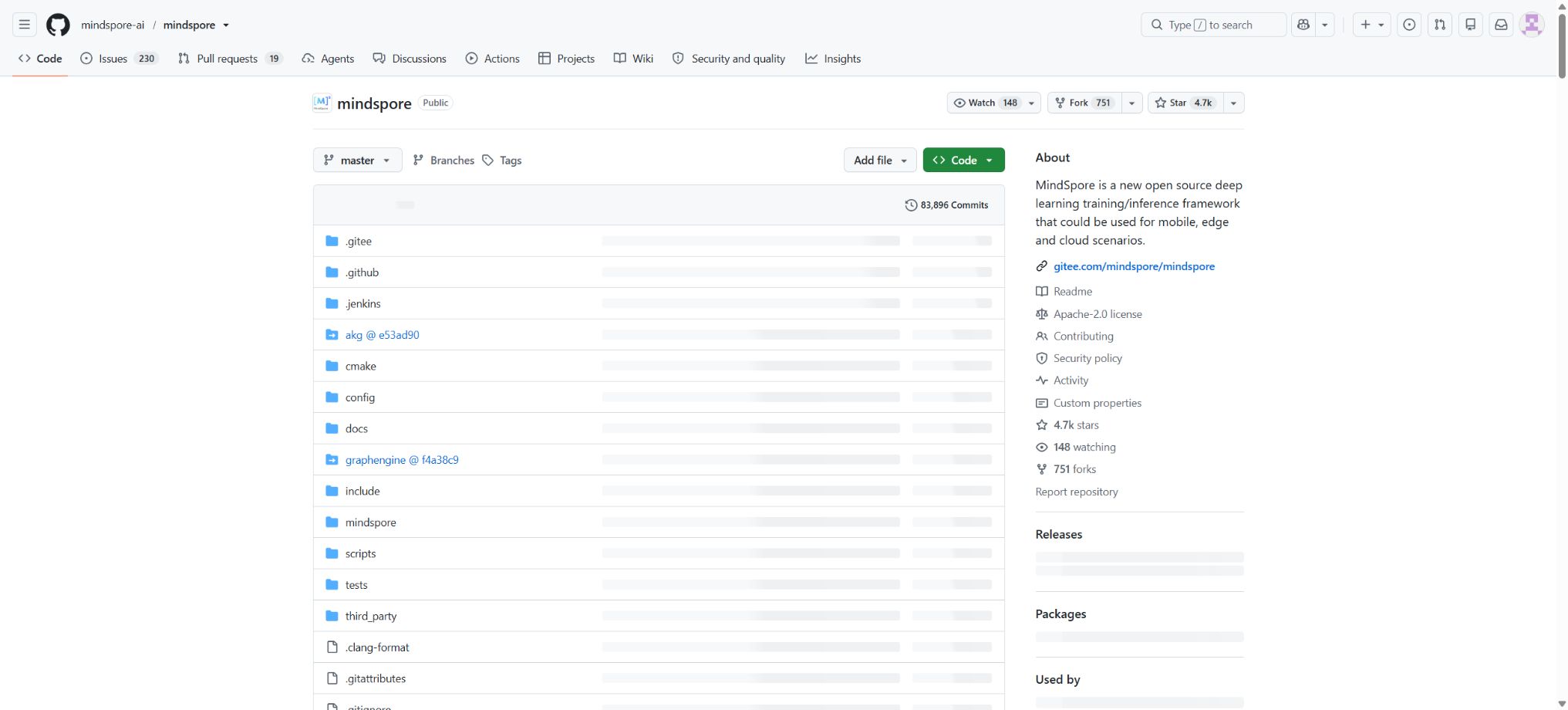
The core code is available in the mindspore-ai/mindspore GitHub repository as well as in the MindSpore Gitee organization; new ecosystem components can also be maintained via AtomGit. The core repository is licensed under Apache License 2.0.
Different suites, examples, model weights, and datasets may be subject to various licenses. The fact that the source code is open-source does not mean that the Ascend hardware, all components of CANN, and cloud services are covered under the same open-source license.
MindSpore Usage Guide
Complete a basic task.
- Install and configure MindSpore from Ascend, and create separate projects and runtime names for the experiments;
- Record the hyperparameters, data version, code version, and random seed in the training script;
- Initialize the task using the current version of MindSpore 2.8 and connect to the appropriate cloud or on-premises service;
- Use the PyNative mode of dynamic graphs to continuously record Loss values, metrics, logs, and hardware status;
- Run a small-scale training session to check whether the number of steps, units, curves, and media samples are correct;
- After completion, save the model, configurations, results, and instructions for reproducing the experiment;
Create reusable professional workflows
- Standardize the naming conventions for projects, experiments, metrics, and labels;
- Include the current version of MindSpore 2.8, as well as the PyNative mode for dynamic graphs and the Graph mode for static graphs, in the training templates;
- Establish version associations for datasets, code, environments, and models;
- Use the same evaluation set and comparison methodology to avoid focusing solely on the smooth curves;
- Restrict the scope of uploading sensitive samples, prompts, and model outputs;
- Set up exception alerts, retention policies, and conduct manual review before rolling them out to the team;
Which users is it suitable for?
- Developers who use the Ascend NPU for training and inference of models;
- Teams that require large-model automatic parallel processing, GPU memory offloading, and hypernode capabilities;
- Engineers who wish to deploy the model on smartphones, IoT devices, and edge devices;
- Users who conduct research in meteorology, physics, molecular science, and scientific computing;
- Students who are learning domestic open-source deep learning frameworks as well as hardware-software optimization techniques.
Product advantages
- Native Ascend optimization and hardware-software coordinated tuning;
- Dynamic graphs, along with static graphs, offer a good balance between usability and compilation performance;
- Automatic differentiation, automatic parallelization, and HyperParallel are designed for large-scale training;
- MindSpore Lite covers edge devices and MCUs;
- MindFormers and MindSpore Science offer large-model and science kits;
- Apache 2.0 is open-source and comes with complete Chinese documentation.
Restrictions and Precautions
- MindSpore is closely tied to specific versions of CANN, drivers, firmware, MindFormers, and hardware models; therefore, the installation documentation must correspond to the same version.
- Features such as HyperOffload in version 2.8 are still in the experimental stage, and should not be used for critical production tasks without first undergoing testing.
- The number of ecological models and third-party compatibility differ from those in PyTorch, and migration requires weight conversion and operator validation;
- The framework is free, but the computing costs are high;
- The commercial rights for specific models and data also need to be checked separately.
Frequently Asked Questions
Is MindSpore free?
The core framework and Lite are available freely and open-source, with no membership fees; however, Ascend hardware, cloud computing resources, storage, and enterprise support require additional payment.
What is the current latest stable version of MindSpore?
As of this verification, the value is 2.8, with the official release scheduled for January 2026. The Master document includes updates or experimental features; it is recommended to use version 2.8 for production purposes.
Can MindSpore only run on Ascend?
No. It provides an environment including a CPU, but the most comprehensive capabilities related to the integration of software and hardware, as well as those related to large models, are focused on Ascend.
For other devices, the installation page at 2.8 applies.
Can MindSpore be deployed on mobile phones?
Model conversion and edge-side inference can be carried out using MindSpore Lite; it supports ARM, x86, certain NPU architectures, as well as small systems, but it is necessary to verify the operators available on the target device.
Is MindSpore open-source?
It is open source, with the core repository using Apache 2.0. The model weights, data, CANN components, and cloud services may not all be governed by the same license.
Tools similar to Ascend MindSpore





 Guigong Network Security Registration No. 45132202000164