






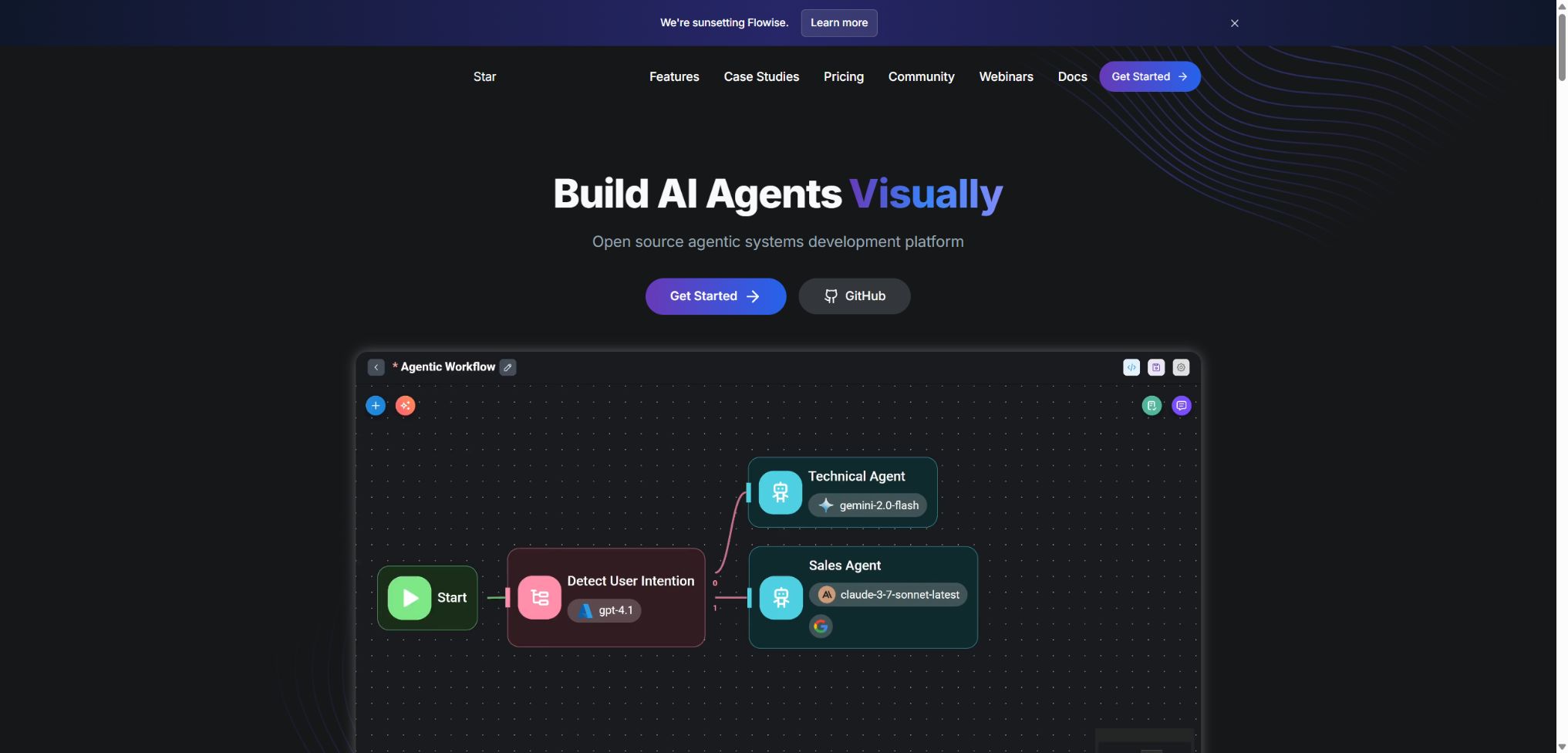
Flowise
Build LLM workflows, multi-agent, and embedded AI applications by dragging and dropping on the canvas.
Tags:AI development frameworksWhat is Flowise?
Flowise is a visual generative AI development platform that allows users to create chatbots, RAG knowledge bases, single-Agent and multi-Agent systems, as well as complex LLM workflows by dragging and dropping nodes. It is built on Node.js and integrates with ecosystems such as LangChain; it offers APIs, JavaScript/Python SDKs, embedded chat components, execution tracking, evaluation capabilities, and the ability for horizontal scaling.
Users can deploy the open-source version on their own, or they can purchase a Flowise Cloud subscription.
Important status reminder:As of this verification, the top section of the Flowise official website clearly states that \"the Flowise service is being discontinued.\" The website still displays the products and previous cloud packages, but it does not show on the main page the exact date of discontinuation nor all the details related to the migration process.
Before planning to set up new production projects or purchase cloud services, it is necessary to consult the authorities regarding account settings, data export procedures, the timing for terminating services in the cloud, and available support options. Existing users should immediately back up Flows, credential configurations, vector data, and operation records, and develop a migration plan.
Three construction methods
- Assistant:The easiest-to-use assistant builder, allowing for the setting of instructions, tools, and a knowledge base for uploading files; it is suitable for standard Q&A and RAG applications.
- Chatflow:It is suitable for single agents, chatbots, and flexible LLM chains; it allows for the configuration of Retriever, Reranker, Graph RAG, Memory, and custom logic.
- Agentflow:It covers multiple agents, branches, loops, tool orchestration, and complex stateful processes, making it suitable for systems that require collaboration among multiple roles.
Core functions
- Connects more than 100 types of models, Embeddings, vector databases, document sources, and tools
- Routing, looping, expressions, data conversion, and custom code are implemented through visual nodes.
- Supports MCP client and server nodes, tool discovery, SSE, and authentication.
- It features Human in the Loop, allowing users to approve key actions taken by the Agent.
- Provides a Prediction API, CLI, JS/Python SDKs, and customizable chat widgets
- It records the step trajectories of Agentflow and can be connected to monitoring tools such as Langfuse, LangSmith, and Phoenix.
- Supports horizontal scaling at the queue and Worker levels, as well as capabilities such as Prometheus, OpenTelemetry, RBAC, and SSO.
Historical cloud prices
| Package or version | Prices, quotas, and core benefits |
|---|---|
| Free | $ |
| Starter | 35 dollars per month, with no limit on the number of Flows and Assistants; 10,000 predictions per month, and 1GB of storage. |
| Pro | $ |
| Enterprise | Historically, it has offered cloud or on-premises enterprise deployment, scaling, and support, along with customized quotes. |
The information above is the historical reference still displayed on the official website; it should not be regarded as a commitment to permanent availability for purchases, especially given the announcements regarding the suspension of services. Predictions refer to the number of times a particular Flow has been invoked, while model tokens, embeddings, vector databases, and external services are usually charged separately.
Self-hosting does not incur any costs related to Cloud subscriptions, but it still requires investment in servers, databases, models, and maintenance.
Open source and self-hosting
The main Flowise repository is licensed under Apache License 2.0; it is possible to install Node packages or use Docker for self-hosting, and modification as well as commercial use are allowed under the terms of this license. Enterprise features, Cloud services, and third-party nodes may have their own separate terms.
Whether an open-source repository will continue to be maintained, its vulnerabilities will be fixed, and community support will be provided depends on the official decisions regarding the discontinuation of the service; therefore, it is not possible to assess its future maintainability based solely on the current license.
Flowise usage tutorial
Complete a basic task.
- In Flowise, specify the trigger conditions, input data, and final actions;
- Connect to the required application using a test account and grant only the minimum necessary permissions;
- Configuration is achieved through visual nodes for routing, looping, expressions, data conversion, and custom code; it also supports MCP client and server nodes, tool discovery, SSE, and authentication, with fields being mapped one by one.
- Add branch handling, failure management, retry options, and manual approval;
- Run with a small amount of test data and check the output at each step;
- Enable the official process only after confirming that there are no duplicate writes or abnormal charges.
Create reusable professional workflows
- Choose business processes with a high frequency of repetition and clear rules;
- Draw the paths for triggering, decision-making, execution, and rollback;
- Break down routing, looping, expressions, data conversion, and custom code implementation through visual nodes, as well as support for MCP client and server nodes, tool discovery, SSE, and authentication, along with the three different construction methods, into reusable modules.
- Set log settings, budgets, timeout values, and permission limits;
- Assign a responsible person to randomly check the results and handle the failed queues;
- Review application permissions, business rules, and actual costs on a monthly basis;
Which users are it suitable for
- Teams that are responsible for maintaining existing Flowise projects and need to understand its capabilities as well as the scope of possible migrations
- Developers interested in researching the visualization of RAG and Agent orchestration
- Open-source teams that can maintain their own Forks, dependencies, and security updates
For entirely new, long-term production projects, it is not recommended to use Flowise as the sole core platform before a clear commitment regarding its lifecycle is in place. Options such as Dify, Langflow, n8n, or the Agent framework can be evaluated; the choice depends on the requirements related to workflows, RAG, automation, and code management.
Safety and migration considerations
- Flow exports usually do not include all external credentials and database contents; therefore, during migration it is necessary to back up the process JSON, environment variables, encryption keys, databases, vector indexes, uploaded files, and logs separately.
- Do not submit uncleaned credentials to Git;
- Before upgrading or forking, scan npm dependencies, container images, and community nodes;
- PredictionAPI, embedded components, and FlowID should be subject to authentication and rate limiting;
- The default public endpoint can be misused, resulting in charges for the model.
- The Agent tool should have minimal permissions, and any write or delete operations must undergo manual approval.
Frequently Asked Questions
Can Flowise still be used?
The open-source code and existing deployments remain functional, but the official website has announced that services will be discontinued. Cloud availability, support, and future maintenance must be confirmed with the official sources.
Is Flowise open source?
The main repository is licensed under Apache 2.0, allowing for self-hosting and modification; Cloud and enterprise services come with separate commercial terms.
What should existing users do?
Export the process immediately and back up the database, vector data, files, key configurations, and logs; at the same time, test the migration path to alternative platforms.
Tools similar to Flowise





 Guigong Network Security Registration No. 45132202000164