






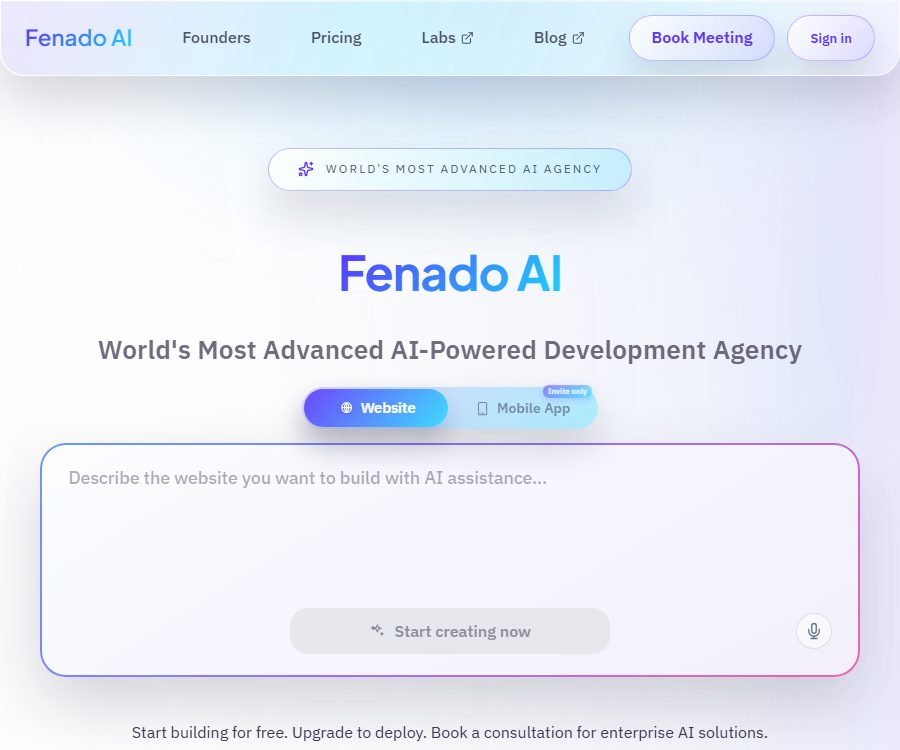
Fenado AI
Fenado AI – makes AI programming more efficient and simpler.
Tags:AI programming toolsWhat is Fenado AI?
Fenado AI is an AI application and website development platform operated by Fenado Services Private Limited; it was founded by Azhar Iqubal and Manish Singh Bisht. This product evolved from the earlier Cades brand, and the older versions of Cades as well as the related Cloud IDE documentation have been marked as archived.
It combines AI-driven self-creation with human engineering services: users first generate designs and prototypes through chat, and then purchase deployment, backend, application publishing, or enterprise customization services as needed. It is neither a code completion tool nor a fully automated website builder that requires no human involvement.
Main functions
Dialogual requirements and interface design
Users describe the business, pages, user workflows, and visual preferences in natural language, and the AI uses this information to create the interface for a website or mobile application. Subsequent changes can also be requested through dialogue, with the results available for review in real time.
- It is suitable for quickly converting text requirements into page structures and interaction flows.
- Projects can be created for websites, as well as for iOS and Android applications.
- Complex business rules, abnormal states, and data permissions still require clear specification in the requirements.
- The initial draft created by AI is suitable for discussing options, but it does not mean that the requirements regarding production safety and performance have been met.
Interactive prototypes and sharing
The platform allows multiple pages to be combined into a clickable prototype, enabling teams, clients, or investors to experience the process in advance. Users can verify the information architecture, interface, and key pathways before investing in development, thus reducing the need for changes later on.
Production development and collaborative integration
Users can continue to make minor adjustments to the appearance of the product, while tasks related to infrastructure, complex functions, and launching the product can be entrusted to Fenado’s engineering team. This hybrid approach is suitable for entrepreneurs who lack a full technical team but still need a functional product that can be actually used, rather than just a demonstration.
Website hosting and source code
The paid deployment package includes a custom domain name, SSL encryption, professional hosting, performance optimization, SEO and analysis settings, as well as full access to the source code. However, having access to the source code does not mean that the Fenado platform is open-source; users still need to take into account the repository used for delivery, the licensing terms for the dependencies, the build instructions, and who will be responsible for subsequent maintenance.
Release of mobile app
Fenado can prepare application packages, store descriptions, screenshots, and metadata, which can then be submitted to Google Play or the App Store after being reviewed by users. Users need to have their own developer account and grant the appropriate permissions to the publishing team.
Custom backend and API
Business services allow for the development of custom backends, business APIs, and integrations with third-party services, along with hosting and ongoing support. The public website does not provide documentation for the Fenado platform APIs that can be used independently; the technical stack, ownership, and maintenance methods related to these custom interfaces must be specified in the project contract.
Enterprise AI solutions
Enterprise services include customized AI Agents, retrieval-enhanced generation processes, generative AI integration, as well as AI-native functions for existing products. Data integration, model selection, evaluation, security, and long-term maintenance requirements need to be defined separately during the consultation phase.
Product path
| Phase | User input | Main output | Key checks |
|---|---|---|---|
| Requirement description | Business objectives, users, pages, and design preferences | Preliminary product structure | Are the scope and success criteria clear? |
| AI design | Dialogue modification instructions | Pages and real-time preview | Status, forms, and mobile adaptation |
| prototype | Page order and interaction | Shareable click prototype | Can the core tasks be completed successfully? |
| Production development | Confirm requirements, data, and integration | Website or mobile app | Security, testing, performance, and permissions |
| Deployment release | Domain name or store account | Submit via online website or store | User approval and platform review |
| Ongoing operation | Feedback, defects, and iteration requirements | Updates and technical support | SLA, costs, and source code maintainability |
Usage process
- Create an account and describe the problem to be solved, the target users, and the core functions.
- Use AI to generate the initial version of a website or app page, and check the layout in a real-time preview.
- Modify the copy, components, processes, and brand elements page by page through dialogue.
- Connect the pages to create an interactive prototype, and invite relevant personnel to go through it in its entirety.
- Organize the feedback, finalize the scope of the first version, and determine which functions require a real backend.
- Choose a deployment option or schedule an enterprise consultation to confirm the deliverables, price, and timeline.
- Conduct authority, security, compatibility, performance, and business acceptance testing on the production version.
- After the user approves the store materials or website settings, the official release is carried out.
Application store release process
- Users must register and maintain their own Apple Developer or Google Play Developer accounts.
- Invite the Fenado publisher according to the document, and grant only the permissions required to complete the publication.
- Fenado prepares the application package, store details, screenshots, descriptions, and other metadata.
- Users review the application content, privacy policy, screenshots, and product information before submission.
- Once verified, it is submitted by the release team for review by Apple or Google.
- After going live, regularly check the permissions, and remove access for accounts that are no longer needed once the project is completed.
The costs associated with store accounts, the review timeline, and whether the account will ultimately be approved for use are determined by the platform’s rules, and should not be considered as part of the guarantees provided by the Fenado package. The prices related to Apple memberships mentioned in the documents may also change depending on regional regulations and platform policies.
Current homepage price
| Package or version | Price | Billing cycle | Core benefits or quota | Suitable for users |
|---|---|---|---|---|
| Free | 0 dollars | Free for a long time | AI website creation, projects and previews, basic templates, community support | Explore ideas and create prototypes |
| Premium | Starting at $20 | The page does not specify it. | Custom domain names, SSL, hosting, source code, priority support, performance, SEO, and analytics | Users preparing to deploy a website |
| Enterprise | Custom quote | In accordance with the contract | Agent, RAG, AI integration, dedicated engineering team, SLA, and white-glove deployment | Enterprise AI projects |
During verification, the self-service buttons for all three options indicated that they were temporarily unavailable; therefore, the prices shown on the page do not mean that the items can be purchased immediately. The number of free items also varies between the homepage and the FAQ, and it should be based on the actual permissions of the account.
Business packages in the document
| Package or version | Price | Billing cycle | Core benefits or quota | Suitable for users |
|---|---|---|---|---|
| Business Plus | 1,999 US dollars | Monthly | Functional applications and websites; up to 100 hours of support per month; custom APIs and backend systems; account managers | Early startup teams |
| Business Plus annual plan | $ | On an annual basis | Similar to the monthly version, with an annual commitment. | Stable and continuous development team |
| Business Express | 9,999 US dollars | Monthly | Up to 720 hours of support, a dedicated engineering team, custom integration, as well as enterprise-level functions and compliance support. | Fast-growing companies |
| Business Express annual plan | $ | On an annual basis | Similar to the monthly version, with an annual commitment. | High-intensity long-term projects |
The new packages available on the homepage differ significantly from those described in the documentation; they may correspond to two types of services – self-deployment via a web interface or manual development – or it could be that the products are still in the process of adjustment. Before signing a contract, it is necessary to obtain written confirmation from the sales team regarding the total cost, the amount of support provided, the scope of development, any third-party costs involved, and the delivery standards.
Suitable for users and scenarios
- Non-technical founders: First turn the idea into a demonstrable prototype, and then decide whether to proceed with production development.
- Early-stage startup teams: Outsource mobile applications, websites, backend development, and deployment tasks.
- Small and medium-sized enterprises: Creating responsive websites, internal tools, or business applications for customers.
- Teams that need to be listed: Engineering and release team members assist in preparing the materials for the store.
- Large enterprises: Custom agents, RAG pipelines, and AI integration with existing systems.
- Design and sales teams: Use clickable prototypes to validate processes in advance and communicate requirements.
Advantages
- A continuous pathway is formed from requirements, design, prototyping to production and delivery.
- Users can adjust the interface themselves, while leaving complex projects to professional teams.
- It supports both websites and mobile apps, and provides guidance on publishing to stores.
- The business solution includes the backend, APIs, hosting, and ongoing technical support.
- Enterprise services deal not only with user interfaces but also include Agents, RAG, and integration projects.
Capacity limits and procurement risks
- An AI-generated interface cannot automatically ensure that the code is secure, maintainable, accessible, or capable of handling real-world traffic.
- A store listing is a submission for a service, and its final approval depends on Apple’s or Google’s review.
- The homepage provides information that conflicts with the prices of documents, the free usage limits, and the product names; therefore, it is not possible to estimate the cost of a contract based solely on the information on that page.
- It is supported that the maximum number of working hours does not mean that all of those hours are spent on development; it is necessary to clarify how meetings, testing, emergency support, and rework are accounted for.
- Third-party cloud services, domain names, databases, payment systems, SMS services, models, and store accounts may incur additional costs.
- Before suspending the service, it is necessary to ensure that the source code, database, domain names, keys, and deployment accounts can be transferred intact.
Privacy and security
The privacy policy covers registration details, photos, device and communication records, payment-related information, as well as data related to service usage; it permits the processing or sharing of this data in situations such as providing services, ensuring compliance, combating fraud, and handling corporate transactions. Some of its provisions use terminology from older versions of applications, communication tools, and payment systems, which means that the scope of these provisions does not correspond exactly to that of the current platform.
- Users can contact the operators to inquire about, correct, or delete their personal data, but certain records must be retained in accordance with legal requirements, anti-fraud measures, or for the resolution of disputes.
- Communication records can be retained for an extended period; the deletion of an account does not mean that all transaction or security records are immediately removed.
- When releasing a mobile application, store management permissions must be granted; the principle of least privilege should be applied, and these permissions should be revoked once the project is completed.
- For sensitive projects, it is necessary to obtain information regarding the current data processing protocols, sub-processors, storage locations, backup procedures, and security certifications.
- Do not upload unnecessary customer identities, production keys, or unmasked databases in the prototype prompt.
Copyright, source code, and refunds
Users must have the right to upload text, images, logos, and other types of content. The terms grant the platform operator broad rights to use the content uploaded by users; however, any confidential information or customer-related materials should be checked by the legal department to determine which version applies before they are uploaded.
- After cancellation, the service will continue until the end of the current billing cycle; no refund is provided for the canceled cycle.
- Once custom modeling, image generation, or other custom services are initiated, the public policy does not allow for refunds.
- Premium includes access to the complete source code, but the scope of delivery, third-party components, and the right to ongoing updates are subject to the terms of the contract.
- Obtaining the project’s source code does not mean getting the source code for the Fenado build platform, AI models, or internal tools.
- When finished products use third-party libraries, fonts, images, or models, it is also necessary to comply with their respective licenses.
API, GitHub, and platform status
| Project | Current confirmation status | Explanation |
|---|---|---|
| Custom business API | Provision of business services | For project development, the scope and ownership must be specified in the contract. |
| Fenado public API | Not yet made public | The self-service key and public endpoint documentation have not been confirmed. |
| SDK and plugins | Not confirmed yet | No public SDKs or browser extensions have been confirmed. |
| Official GitHub | Not confirmed yet | Do not consider third-party repositories with the same name as product codes. |
| Open-source status of the product | Proprietary services | The delivery of source code is intended for customer projects and does not imply that the platform is open source. |
| Self-purchase status | Not available temporarily | During verification, the package buttons on the homepage all indicate that they are temporarily unavailable. |
Frequently Asked Questions
Was Fenado AI previously called Cades?
Yes. The current document labels Cades as an older brand, and its Cloud IDE along with the example tutorials are classified as archived content.
Can it be used without knowing how to program?
It is possible to create interfaces and prototypes using natural language first. For a production-ready backend, as well as for aspects related to security, testing, and deployment, the help of Fenado’s engineering team or other specialists may still be necessary.
Is Fenado AI available for free now?
The home page lists a long-term free plan at $0, but upon verification the corresponding option appears to be unavailable, and the FAQ provides different information regarding the number of free items available. Whether registration is possible and what the actual quota is depend on the account page.
Can a complete mobile application be developed for 20 dollars?
No conclusions can be drawn from this. That price is indicated as the starting point for website deployment; separate estimates and pricing are required for mobile applications, backends, store launches, and manual development.
Will Fenado ensure that the app gets approved by the App Store?
No. The team can prepare and submit the application; the final decision on approval rests with the store platform. Users must also ensure that their privacy, content, and account information are in compliance with relevant regulations.
Can I get the source code?
The Premium plan on the homepage states that full access to the source code is provided, but it is necessary to confirm in writing before making the payment whether specific repositories, the backend, infrastructure, and third-party dependencies are included.
Is Fenado AI open source?
It is not an open-source product that has been verified. The customer’s project may provide the source code, but the build platforms, internal tools, and AI systems remain proprietary services.
Can I get a refund after cancellation?
The official policy states that no refunds will be given, and the service will be available until the end of the current billing period; no refunds are also provided once customized services have begun.
Summary
Fenado AI is suitable for entrepreneurs who wish to create prototypes quickly through dialogue, and who want to delegate complex tasks related to engineering, deployment, and publishing to app stores to specialized service teams. Its value lies in its combination of an AI-driven development platform and proxy services.
There are version differences on the current pricing page, and the self-service access is not available at the moment; a written proposal should be obtained before making a purchase. It is important to clarify the deliverables, source code, labor costs, third-party expenses, data access rights, refund policies, and long-term maintenance arrangements.
Tools similar to Fenado AI



 Guigong Network Security Registration No. 45132202000164