






Featherless
Featherless makes AI programming more efficient and simpler.
Tags:AI programming toolsWhat is Featherless AI?
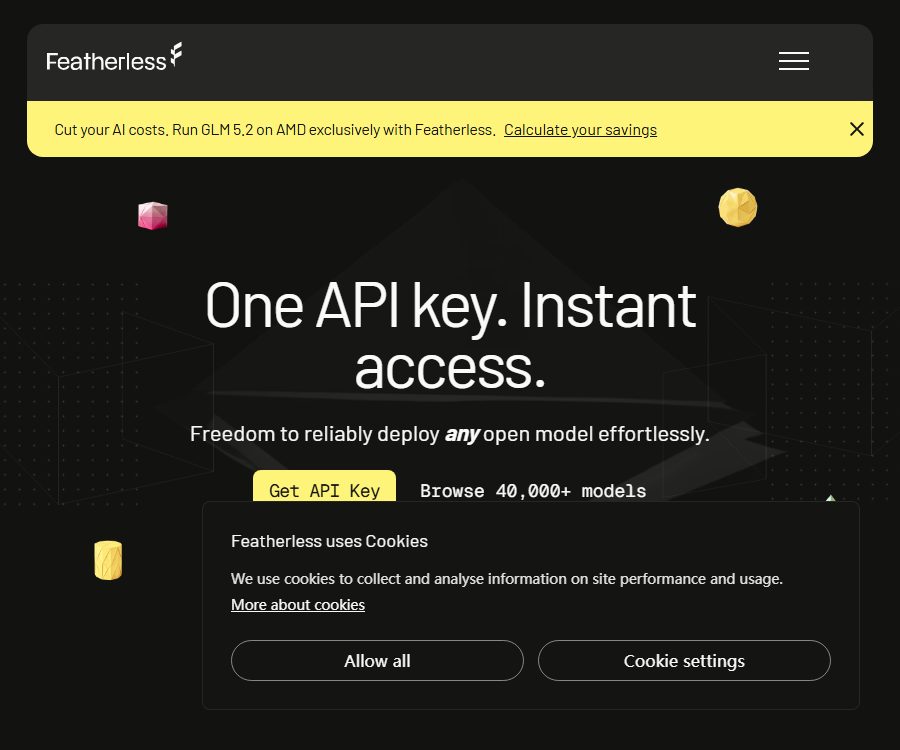
Featherless AI is a serverless AI inference platform and research team that helps developers utilize open-weight models without having to set up their own GPUs, inference frameworks, or scaling infrastructure. Its core products include APIs that are compatible with OpenAI’s interface format, a model catalog, and a hosted environment for running agents.
The platform offers services for running models, but this does not entail obtaining a license for the models themselves. The training methods, usage restrictions, commercial rights, and associated risks related to each model must still be assessed in accordance with its individual license terms.
Main functions
Inference of the open-weight model
The user selects a specific model ID from the model directory and then submits a generation request through a unified interface. The directory provides filtering options such as model family, parameter size, context length, task type, mode, license, deployment status, and current availability.
- It is possible to switch between various model families such as Qwen, Llama, Mistral, DeepSeek, and RWKV.
- The model details will show the operating status, such as hot start, loading, cold start, or offline.
- The maximum context in the directory is not necessarily equal to the account package limit; the actual value is the smaller of the two.
- Restricted models may require users to first obtain access rights in their associated Hugging Face account.
Text generation and stream output
Chat Completions are suitable for multi-turn conversations, role-based interactions, and tool-related messages, while Completions are better suited for extending traditional prompts. The caller can request streaming responses, thereby receiving the generated content gradually and improving the wait time during the interaction.
Visual understanding
Models with visual capabilities can receive image URLs or Base64-encoded images in chat messages, and together with textual descriptions they enable tasks such as comparison and information extraction. The level of visual capability depends on the model chosen; larger images may result in higher latency or higher costs.
Vector embedding
The Embedding interface accepts a single string or an array of strings, and returns a corresponding vector for each item. It is suitable for semantic retrieval, similarity analysis, clustering, classification, and retrieval-enhanced generation processes.
Speech synthesis
The Speech interface passes the text input to a compatible speech model, which then generates audio output. Delivery can be done in various formats such as batch binary data, JSON, or server-pushed events. The supported formats and the maximum length of the text are determined by the specific model; stream-based transmission does not necessarily mean that the model generates audio frame by frame in real time.
Agent Marketplace
Agent Marketplace offers pre-configured chat interfaces, assistants, and other AI applications that can be launched directly within a hosted cloud sandbox. The inference capabilities are integrated with Featherless, making it suitable for users who do not want to deploy the Agent software on their own.
If there is no activity in the Agent sandbox for 24 consecutive hours, it will stop automatically; however, the files and configurations will be retained and can be restored manually later. This feature is available for paid plans with a pricing level higher than $25.
Dedicated GPU deployment
Teams that require a fixed capacity, a specific model, higher throughput, or customized infrastructure can apply for dedicated GPUs. The hardware, models, performance goals, engineering support, and contract pricing need to be confirmed with the sales team.
API format
| Interface or capability | Enter | Output and uses |
|---|---|---|
| Chat Completions | Messages, models, and generation parameters | Dialogue responses, code, tool calls, and streaming text |
| Completions | Hint text | Text continuation and batch generation |
| Models | Query, filter, or model ID | Model directory, license, status, capabilities, and real-time prices |
| Plan | Account API key | Context of the current plan, model size, and concurrent usage limit |
| Embeddings | String or array of strings | Vector lists and usage data |
| Vision | Text with image URL or Base64 | Visual question answering, description, comparison, and extraction |
| Audio Speech | Text, speech models, and audio options | Audio formats supported by MP3, WAV, etc. |
API integration process
- Create an account and choose between chat, developer, or custom deployment options.
- Create an API key in the account console and store it in the server-side key management system.
- Browse the model catalog and filter models by task, modality, license, context, and availability.
- Use an OpenAI-compatible SDK and replace the base address and keys with Featherless configurations.
- First, call Models and Plan to obtain the model status, price, and account limits.
- Submit a minimal test request to the chat, completion, embedding, or voice interface.
- The production environment includes features such as timeout handling, retry mechanisms, rate limiting, cost tracking, content filtering, and model fallback.
Third-party tools and frameworks
| Category | Access guidance has been provided. | Typical uses |
|---|---|---|
| Programming tools | Cursor, Aider, Cline, Roo Code | Code completion, terminal assistant, and coding agent |
| Development framework | LangChain, LlamaIndex, LiteLLM | Agent, RAG, unified model routing |
| Workflow platform | n8n, Dify | Automation and low-code AI applications |
| Role-based chat client | SillyTavern, WyvernChat, HammerAI, Venus AI | Role-playing and dialogue frontend |
Compatibility guidance does not imply that Featherless owns or maintains all third-party products. After a version upgrade, it is necessary to verify again that the fields, tool calls, visual messages, and streaming behaviors remain consistent.
Price packages
| Package or version | Price | Billing cycle | Core benefits or quota | Suitable for users |
|---|---|---|---|---|
| Featherless Chat | 25 dollars | Monthly | Model directory access, up to 32K of context, 4 concurrent units, unlimited requests per month | Interactive chatting, role-based conversations, and personal experiments |
| Featherless Developer | Starting at $50 | Monthly prepaid points | No model size limit; up to 256K of context, 100 concurrent units; charging based on successful requests | API applications and production workloads |
| Dedicated GPU | Contact sales | Custom contract | Maintain GPU capacity, customize models, ensure throughput, and enjoy engineering support. | Team for high concurrency and stable capacity |
The unlimited use of Chat is subject to constraints such as the number of concurrent sessions allowed, the size of the models, the context, and reasonable usage guidelines; it does not mean unlimited concurrency or constant performance. Larger models require more concurrent sessions.
Developer points billing
- Select a prepaid amount each month; once the payment is completed, it is added to the organization’s balance.
- Only when the charge request is successful will the cost be calculated based on the model, the amount of input, and the amount of output.
- Different models or modalities may have different unit prices; the current price can be found in the details of the model.
- APIs that are priced based on requests will stop functioning when the balance is insufficient; users can top up their account in a single transaction.
- Unused points do not expire; once cancellation is requested, further monthly top-ups will cease, but the remaining balance can still be used until it is exhausted.
- An increase in the monthly limit takes effect immediately and is applied on a pro-rata basis for the remaining billing period, while a decrease in the limit comes into effect in the next billing period.
Suitable for users and scenarios
- AI application developers: Use a compatible interface to test and switch between different open-weight models.
- Coding team: Provides the inference backend for Cursor, Aider, Cline, or custom code agents.
- RAG team: combination embedding, text generation, and development of tool frameworks for retrieval-based question answering.
- Content and character chat users: Choose between a creation model or a role-playing model based on the style of the model.
- Researchers: Compare the performance of outputs under different architectures, parameter scales, and contexts.
- Enterprise platform: Offers more controllable capacity and deployment options through dedicated GPUs.
Advantages
- The OpenAI-compatible interface can reduce the cost of migrating existing clients.
- The model catalog has a wide range of options, and it provides fields for capabilities, licenses, and real-time deployment status.
- The fixed monthly fee for chatting is separate from the points awarded to developers based on their requests, allowing for differentiation between interactive and production-related usage.
- Text, visuals, embeddables, and audio can be utilized within one account system.
- The official examples cover common frameworks, programming tools, and workflow platforms.
Capacity boundaries
- Open weight does not equate to open source, nor does it automatically grant licenses for commercial use, redistribution, or high-risk applications.
- The model directory can change; models may experience a cold start, fail to load, go offline, or be removed.
- Compatibility with OpenAI is based on interface compatibility; however, specific parameters, tool calls, and output fields may still differ.
- The accuracy, secure behavior, language capabilities, context handling, and multimodal abilities of different models vary greatly.
- Third-party models may generate incorrect, harmful, or inappropriate content for minors, and the application developers are responsible for conducting their own reviews.
- The individual tier with a fixed monthly fee is designed for use in interactions, prototyping, and experimentation; it should not be used for large-scale reselling or in unauthorized production scenarios.
Privacy and logs
The privacy document states that API conversations, suggestions, and completed text are processed in real time and are not stored or recorded on the Featherless servers. This provision applies to the reasoning processes only; it should not be interpreted as meaning that there is no metadata at all related to accounts, payments, abuse prevention, or the operation of the service.
- API keys must be stored only on the server side; they should not be uploaded to public repositories or front-end code.
- Before processing personal data, trade secrets, or regulated information, it is necessary to review the complete privacy policy and contract terms.
- The Agent sandbox retains files and configurations, and they are not automatically discarded even if the operation stops due to inactivity.
- When integrating third-party clients, it is also necessary to separately examine the client’s logging, caching, and telemetry behaviors.
- The public materials do not specify the exact security certifications, data protection measures, or enterprise-level storage controls; for sensitive items, a written explanation from the team should be requested.
Copyright, Commercial Use, and Refunds
Users retain ownership of the content they upload as well as of the content generated by the models, but the terms of service do not grant users licenses to third-party models. Users must examine each model’s license carefully and ensure that the way in which data is input, processed, and deployed complies with legal requirements and the conditions set by the models.
- Subscriptions for the current month are non-refundable, but renewals can be canceled at any time.
- Violating the restrictions on the intended use of the individual plan may result in termination without a refund.
- For refunds of developer points or adjustments to the balance, contact support; the official documentation does not guarantee automatic refunds.
- Users must not present content generated by models as having been created by humans, nor must they bypass restrictions, disrupt the service, or violate the rights of others.
- The platform software, technologies, and processes belong to Featherless; the subscription does not transfer its intellectual property rights.
GitHub and the open-source status
| Project | Status | License or instructions |
|---|---|---|
| Open Agent Loops | Public code | MIT; a replaceable Agent loop component for TypeScript |
| Guardrails Webhook Example | Public examples | MIT; Demonstrating the protection Webhook service |
| Featherless Cookbook | Public examples | It includes notebooks for API, LangChain, LiteLLM, and LlamaIndex; the license for the repository has not yet been determined. |
| KVM paper code | Public forked repository | Studying the code does not mean examining the source code of the online inference platform. |
| Featherless hosting platform | Proprietary services | Public warehouses do not mean that the entire platform is open source. |
| Models in the catalog | The licenses vary. | It is necessary to verify each model’s details separately. |
Frequently Asked Questions
Can Featherless AI be used for free?
The current available plans start at $25 per month; there is no confirmed free subscription option for a long term. The information on the registration page or during temporary promotions may change, so it is necessary to refer to the account billing page.
Which package to choose: Chat or Developer?
Chat is suitable for interaction and prototyping, featuring a fixed monthly fee based on the number of concurrent connections; Developer is suited for API workloads, with charges deducted from prepaid credits according to the number of successful requests.
Do unused developer points expire?
The current document states that the points do not expire. After canceling the monthly subscription, the remaining balance can still be used; requests will stop once that balance is exhausted.
Does Featherless save prompts and answers?
The API documentation states that chats, prompts, and completion texts are not recorded or saved, but Agent files, account information, payment details, and data required for operation fall under different categories of data.
Can I use the OpenAI SDK directly?
Yes, the platform provides compatible interfaces that allow for the replacement of the base address and API keys in order to establish a connection. It is still necessary to test whether the required endpoints and parameters are fully compatible before going live.
Can all models be used for commercial purposes?
It cannot be generalized. Models are provided by different publishers, and the open weights, licenses, commercial restrictions, and attribution requirements all need to be checked individually.
Is Featherless open-source itself?
The hosting platform is not a fully established open-source product; the official team has made available the Agent SDK as well as some example repositories, each of which comes with its own license or may lack one.
Summary
Featherless AI is suitable for developers who wish to invoke a large number of open-weight models through a unified interface; it also covers areas such as vision, embedding, speech, and cloud agents. When selecting a plan, it is necessary to consider two different calculation methods: a fixed monthly fee based on concurrent tasks, or a pricing system based on the number of requests.
Before integrating the model into production, it is necessary to verify its availability, as well as the associated costs and context; mechanisms for retrying and falling back should be established, and each model license must be examined carefully. For sensitive data, it is also essential to ensure compliance with all relevant privacy, security, and corporate contractual requirements.
Tools similar to Featherless



 Guigong Network Security Registration No. 45132202000164