






FASHN
FASHN – makes AI programming more efficient and simpler.
Tags:AI programming toolsWhat is FASHN AI?
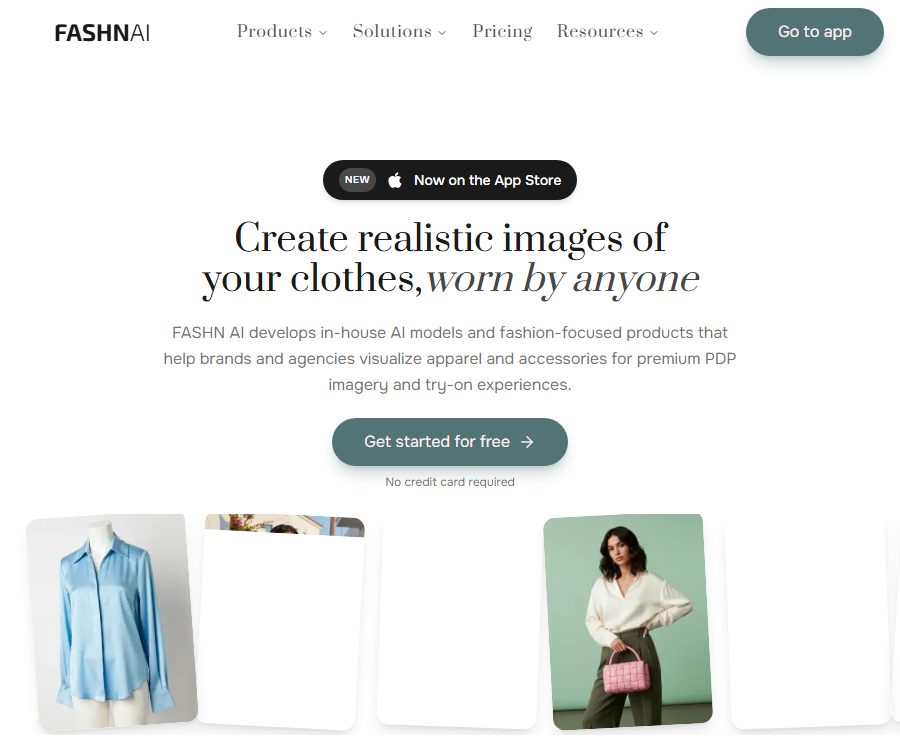
FASHN AI is a fashion visual generation platform developed by the British company FASHN LTD, intended for brands, e-commerce businesses, creators, and application developers. It is not a general-purpose programming assistant; its main functions are virtual try-on, as well as the creation of content featuring AI models and clothing products.
Users can create content in the Studio and Agent web interfaces; they can also integrate these capabilities into websites and applications using REST APIs, Python SDKs, or TypeScript SDKs. The points associated with web applications are separate from those related to APIs.
Main functions
Virtual try-on
Users submit images of people and clothing, and the system generates images showing those people wearing the corresponding products. Try-On Max supports resolutions of up to 4K and a wider range of products such as shoes, hats, jewelry, and bags; version 1.6, on the other hand, focuses on speed and lower costs.
- Fashion images can come from tiled images, ghost model images, or existing product images of models.
- Version 1.6 can automatically determine whether it is an upper garment, a lower garment, or a one-piece outfit; manual specification is also allowed.
- The performance, balanced, and quality modes trade off between speed and effectiveness.
- Trying on items only provides a visual impression; it cannot accurately indicate the size, the feel of the fabric, or how well they will fit in reality.
Product to Model
Product to Model transforms individual product images into images showing the product on a model, and it allows the use of backgrounds, inspiration images, and facial references. It is useful for reducing the costs associated with traditional studio photography and for quickly creating e-commerce content tailored to different audiences or scenarios.
Model creation, model switching, and face reference
Model Create allows for the creation of models using text or reference images; Model Swap enables the replacement of characters in existing images while trying to retain their clothing. Face to Model transforms a face into a torso model suitable for try-ons, and face references help ensure consistency among the characters in a series of images.
Editing and image enlargement
Edit allows for correcting the pose, shape, background, or various details of an image according to given instructions; Reframe changes the image size by cropping or using intelligent expansion techniques. Generative editing can alter the details of a product, so it is necessary to check each element such as brand logos, buttons, textures, and colors individually.
Tusheng Video and Background Removal
Image to Video converts a single fashion image into a short video featuring a camera angle and the movements of the model. Background Remove generates images with a transparent background, which is useful for product catalogs and further design work.
Product format
| Products | Main entrance | Suitable for tasks | Integration |
|---|---|---|---|
| Studio | Websites and iOS apps | Visual creation, editing, and cross-tool processing | App points |
| Agent | Natural language dialogue | Generate images and videos sequentially through dialogue. | App points |
| Gallery | Account media library | Search for and manage generation history | Not applicable |
| Developer API | REST, SDK | Integration with e-commerce, applications, and automated processes | API integration |
| Organizations | Team account | Invite members and share quotas | App team score |
Web page usage process
- Register an account and receive 10 initial points.
- Select Product to Model, Try-On, Model Create, Edit, or other tools.
- Upload images of the authorized characters, costumes, or references.
- Select clarity, generation mode, format, quantity, and available advanced parameters.
- Generate a small number of samples first to check the consistency of the characters, products, and background.
- Adjust the footage using Edit or Reframe, and then generate the video as needed.
- Download the finished product, and save the original images of the goods along with the records of manual inspection.
API integration process
- Create an account, generate a key in the Developer API console, and store it securely.
- Buy points as needed or choose a subscription plan; do not mix up the balance in the app.
- Install the official Python or TypeScript SDK, or use any language that can send REST requests.
- Submit the model name and the inputs object to the unified execution endpoint; image URLs or Base64 data can be used.
- Save the prediction ID, and retrieve the completion status via polling or Webhook.
- Upon success, the output should be downloaded promptly; for failed tasks, no points are deducted, but they should be handled according to the type of error.
- Add rate limiting, idempotency, timeouts, content moderation, and cost alerts to the production environment.
API endpoint
| Endpoint | Enter | Output and uses |
|---|---|---|
| Try-On Max | Character images, product images, optional prompts | High-fidelity try-on images, up to 4K |
| Try-On v1.6 | Portraits, clothing images | Quick real-time try-on |
| Product to Model | Product images and optional references | Product images of the model wearing it |
| Face to Model | Face image | Try on the upper-body model. |
| Model Create | Hints or reference diagrams | New AI models |
| Model Swap | Existing model images | Keep the clothing and replace the character. |
| Edit and Reframe | Images, instructions, or frames | Local editing, image enlargement, or cropping |
| Image to Video | Fashion photos | Short videos |
| Background Remove | Images of products or people | Transparent PNG clipping |
App price plans
The app allows for the use of points to carry out various generation actions; most tools award 1 point for each output, while high-resolution outputs and complex settings result in higher costs. The annual subscription is priced as if it covered ten months, with the website stating that this approach saves two months’ worth of cost.
| Package or version | Price | Billing cycle | Core benefits or quota | Suitable for users |
|---|---|---|---|---|
| Free | Free | Initial limit | 10 points | First trial |
| Basic | 19 dollars | Monthly | 200 monthly points, 2 members, 3 concurrent connections, up to 4K images, 720p videos | Individuals and small teams |
| Pro | 49 dollars | Monthly | 750 monthly points plus 50 points per day, 5 members, 6 concurrent users, 1080p videos | Large-scale content team |
| Agency | 99 dollars | Monthly | 1500 monthly points plus 100 points per day, 10 members, 11 concurrent users, custom face reference | Agents and high-frequency teams |
Daily points are refreshed every 24 hours and do not accumulate; monthly points are reset at the end of each billing period. The amount of points available through top-ups, package options, and regional taxes are indicated on the settlement page.
API price
| Package or version | Price | Billing cycle | Core benefits or quota | Suitable for users |
|---|---|---|---|---|
| On-Demand | 0.075 USD per point | Prepay as needed | A minimum of 100 points, which is equivalent to 7.50 dollars. | Testing and fluctuating usage amounts |
| Tier I | 19 dollars | Monthly | 282 points; cost of top-up: 0.0675 USD per point | Small-scale production applications |
| Tier II | 249 dollars | Monthly | 4150 points; cost of top-up: 0.0600 USD per point | Medium-scale applications |
| Tier III | 1249 US dollars | Monthly | 25,594 points; cost of top-up: 0.0488 USD per point | High-volume platforms |
The annual fees are 190, 2490, and 12490 dollars respectively. Points purchased as needed expire after 12 months, while the discount points associated with subscriptions expire at the end of the subscription period; any unused balance is not refundable.
Endpoint integration cost
- Try-On v1.6 and Background Remove: 1 point is awarded for each successful output.
- Image generation endpoint: combinations of 1K, 2K, 4K and Fast, Balanced, Quality, with 1 to 5 points for each output.
- Enable Face Reference: 3 additional points for each output image.
- Video: For 5 seconds, 480p earns 1 point, 720p earns 3 points, and 1080p earns 6 points; for 10 seconds, the corresponding points are 2, 6, and 12 respectively.
- When multiple outputs are requested, the cost per output is multiplied by the number of outputs.
- Failure to make a prediction does not result in point loss.
Suitable for users and scenarios
- Apparel brands: Quickly convert flat product images into images showing the products on multiple models.
- E-commerce platforms: Add virtual try-on features for users or models on the product pages.
- Content team: Generates a large number of videos with different backgrounds, resolutions, and lengths.
- Agent: Shares team points and manages multiple client projects.
- Developer: Establish an automated product image process through SDK and Webhook.
- Researchers: Refer to the publicly available VTON and human anatomy projects, but must comply with their respective licenses.
Capacity boundaries
- Trial photos cannot reveal the actual size, elasticity, drape, texture, or comfort of movement.
- Patterns, text, buttons, decorations, and garments with complex layers may be altered.
- Generating models and changing models can lead to variations in identity, skin tone, or physical details.
- 4K refers to the output capability; it does not guarantee that the true details of the product can be restored from low-quality input.
- Third-party AI services may be involved in some parts of the processing; for sensitive projects, it is necessary to review the DPA as well as the sub-processors.
- Before going live, an evaluation set for color differences, logos, design styles, and failure rates should be created using actual products.
Privacy and data storage
- The standard API output will expire in 3 days, so users should download it promptly.
- In v1.6, it is possible to choose Base64 as the output format; the duration of the output is limited to a maximum of 60 minutes, and only placeholders are retained for historical data.
- API request records are retained in the console until the user deletes them manually.
- The website’s Gallery and Agent history keep relevant information; users can delete individual items, all the content, or close their account.
- The policy states that customer content must not be used for training or improving AI models, and commercial customers are also subject to the DPA.
- Some requests may be temporarily processed by third-party AI and media processing services.
- The data may be processed in countries such as the United Kingdom, the European Economic Area, and the United States, with appropriate transmission safeguards in place.
Commercial use, refunds, and copyrights
The results provided by the FASHN API can be utilized in various business applications such as e-commerce, marketing, content creation, and digital fashion, and no additional licensing fees are charged for their use. Users still need to have the rights to upload images of people, products, brands, and reference materials.
- Subscriptions, points, and outcomes that do not meet an individual’s expectations are generally not refundable, unless required by law.
- After canceling a web subscription, it can still be used until the end of the current billing period; purchases from app stores are handled in accordance with the rules of that respective platform.
- The ownership of customer content is separate from the platform’s technical rights; purchasing an API does not entail obtaining the source code of the models.
- Before using product images for sales, it is necessary to verify that the color, structure, trademark, and the actual product are consistent.
- End-users must reach the legal age of majority, while business clients bear the responsibility for handling such matters legally when providing services to younger end-users.
GitHub, SDKs, and open-source status
| Project | Status | License or instructions |
|---|---|---|
| Python SDK | Public | Apache-2.0 |
| TypeScript SDK | Public | Apache-2.0 |
| n8n integration | Public | MIT |
| FASHN VTON v1.5 | Public research projects | It is used in accordance with the warehouse license; it does not apply to all models available online. |
| Human Parser | Public research projects | Use in accordance with the warehouse license. |
| Generating APIs and platforms | Proprietary business services | The open-source nature of the SDK does not mean that the backend, data, or production models are also open source. |
Frequently Asked Questions
Can FASHN AI be tried out for free?
Yes, new accounts in the app come with 10 points available at the moment. The minimum amount required for using the API is 100 points, which is equivalent to $7.50; the balance associated with the API and that of the app are not shared.
How to choose between Try-On Max and v1.6?
Try-On Max is suitable for resolutions of up to 4K, as well as for a wider range of product categories and high-quality images; version 1.6 is lighter, faster, and requires 1 point per image.
Do failed requests deduct points?
The API is charged based on the number of successful outputs; no points are deducted for failed attempts. Multiple outputs, high-definition quality, premium quality modes, and face reference features increase the cost of successful tasks.
How long are API images stored?
The standard output schedule expires after 3 days; the Base64 privacy mode in version 1.6 is limited to a maximum of 60 minutes. The request history must be deleted by the user through the console.
Can the images generated by FASHN be used for commercial purposes?
The API outputs can be used for commercial purposes, but users still need to obtain the rights to the individuals, products, brands, and reference images, as well as verify that the generated results correspond to the actual products.
Is FASHN open source?
The platform and the production APIs are not fully open source; the official version provides SDKs, n8n integrations, and some research models. It is necessary to check each repository’s license and commercial terms separately.
Is there a mobile app?
It has been confirmed that iOS apps and web pages use the same account as well as the same app credits. The official store page for Android native apps has not yet been verified.
Summary
FASHN AI is suitable for integrating images of fashion products, virtual try-ons, AI models, and short videos into a production workflow; it offers both visual interfaces as well as mature REST APIs and official SDKs.
When making a selection, it is necessary to calculate the costs associated with the app integration and API integration separately; estimate the costs based on factors such as clarity, format, and the number of outputs. Additionally, real products should be used to verify visual accuracy, data privacy protection, and commercial permissions.
Tools similar to FASHN



 Guigong Network Security Registration No. 45132202000164