






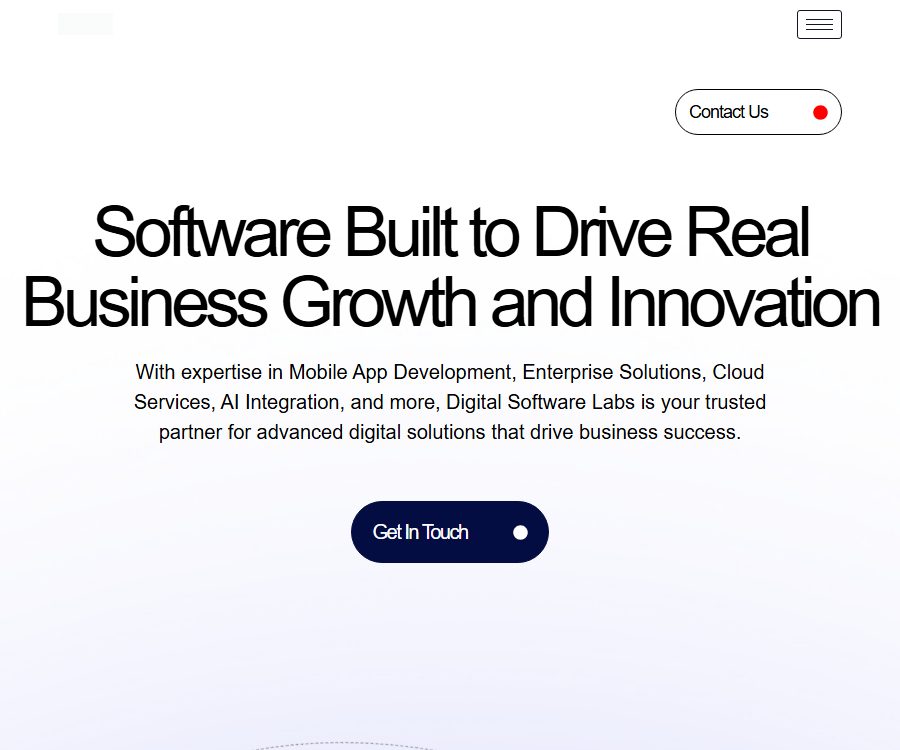
Digital Software Labs
Digital Software Labs – makes AI programming more efficient and simpler.
Tags:AI programming toolsWhat is Digital Software Labs?
Digital Software Labs is a company that specializes in the development of custom software and digital services; it offers AI software, mobile applications, web applications, enterprise systems, backend infrastructure, and cloud services. It does not provide AI programming assistants that can be used right after installation, nor does it offer any standard subscription plans for individual developers.
Customers usually first submit their business objectives and project requirements, after which the team takes care of consulting, design, development, integration, testing, deployment, and maintenance. The actual features, technology stack, delivery timeline, and price depend on the details specified in the written project scope.
Overview of Core Services
| Services | Main inputs | Delivered results | Suitable for users |
|---|---|---|---|
| AI software development | Business data, automation objectives, and model requirements | Recommendation, prediction, search, or conversation features | Companies that need to integrate AI |
| Mobile apps | Product requirements, platforms, and user workflows | iOS, Android, or cross-platform apps | Startups and consumer products |
| Web and enterprise systems | Process, permissions, data, and integration requirements | Web applications, backends, and internal platforms | Operations and enterprise IT teams |
| API and backend | Data models, interfaces, and performance metrics | Server, API, and infrastructure | Teams that need to expand the existing system |
| Cloud services | Existing architecture, workloads, and compliance requirements | Migration, cloud-native architecture, and continuous management | Modernization or expansion projects |
| Team expansion | Skills, number of personnel, timeline, and management methods | Specialized engineers or project teams | Companies with insufficient in-house R&D capabilities |
AI-driven software development
The company’s website describes AI services as tools for creating customized systems aimed at automating business processes, enabling predictive analysis, providing personalized experiences, and assisting in decision-making. Common applications of these services include recommendation engines, intelligent search functions, conversation assistants, process automation, and data analysis.
- First, identify the business objectives and metrics, rather than simply deciding on a particular model to use.
- Organize the data required for training, retrieval, or reasoning, and assess authorization and quality.
- Choose a custom model, a third-party API, or a hybrid architecture.
- Design for manual review, failure rollback, content security, and cost limits.
- After going live, continuously monitor accuracy, deviations, latency, and changes in model versions.
The page does not provide a list of available models, platforms for hosting these models, information on token quotas, or details regarding standard AI packages. The purchaser should specify in the proposal the provider of the models, the purpose for which the data will be used, the evaluation sets, the criteria for measuring accuracy, and the mechanism for replacing models.
Mobile and Web Applications
Mobile development covers iOS, Android, as well as cross-platform solutions such as Flutter and React Native; web services include responsive websites and business applications. The choice between native development and cross-platform approaches should be based on the capabilities of the devices, performance requirements, team maintenance needs, and the schedule for releasing updates.
- Prototypes and MVPs are used to validate core user workflows and market assumptions.
- The front end, back end, and third-party services require unified interfaces and error handling.
- It is necessary to determine ownership for apps listed in app stores, accounts, certificates, and ongoing updates.
- Accessibility, offline functionality, notifications, payment options, and privacy settings require separate verification.
- Upon delivery, the source code, build instructions, as well as a list of testing and environment configurations must be provided.
Enterprise systems, APIs, and infrastructure
Enterprise services include custom platforms, system integration, backend solutions, APIs, and infrastructure development, enabling the connection of existing applications, data, and workflows. It is necessary to define in advance the authoritative data systems, responsibilities for interfaces, boundaries of permissions, and procedures for recovering from failures.
- Define authentication, versioning, rate limiting, error codes, and idempotency rules for the interface.
- Define capacity, latency, availability, and disaster recovery objectives for high-traffic systems.
- Use service accounts with the minimum required permissions, and rotate keys and certificates regularly.
- Log data changes, administrator actions, and key business events.
- Develop and validate rollback and data migration plans when replacing the old system.
Cloud migration and management
Cloud services cover migration, cloud-native technologies, hybrid clouds, multi-cloud environments, FinOps, and full lifecycle management. The page lists AWS, Microsoft Azure, and Google Cloud, and mentions microservices, Kubernetes, and continuous delivery.
| Method | Suitable situations | Conduct a focused inspection. |
|---|---|---|
| Public cloud | Flexibility and rapid scalability are required. | Cost, region, shared responsibilities |
| Private cloud | High requirements for control and data sovereignty. | Operations capabilities and hardware costs |
| Hybrid cloud | Retain the local system and migrate it gradually. | Network, identity, and data consistency |
| Cloudy | Reduce dependence on a single supplier | Governance complexity and portability |
| FinOps | It is necessary to control ongoing cloud expenses. | Labels, budget, usage, and responsible person |
The costs related to the resources of the cloud platform itself, as well as the costs for third-party licenses and maintenance tools, are usually separate from the pricing for development services. The contract should specify who owns the cloud account, who is responsible for paying for the usage, and how the assets will be transferred in case the partnership ends.
Project implementation process
- Discovery and consultation: Explain business issues, users, budget constraints, and success metrics.
- Research and strategy: Define the scope, technical approach, risks, milestones, and responsible parties.
- Design and Prototyping: Use flowcharts, wireframes, and clickable prototypes to validate key user experiences.
- Development and integration: Deliver the frontend, backend, AI, and system interfaces in iterative stages.
- Testing and acceptance: Covers functionality, compatibility, performance, security, and user acceptance.
- Release and Deployment: Complete environment configuration, data migration, as well as monitoring and rollback testing.
- Support and maintenance: Handling defects, upgrading dependencies, optimizing performance, and enabling further expansion.
The page mentions the use of an agile approach, but agility does not mean that the scope and costs can change indefinitely. Each iteration should have verifiable deliverables, approvers, and a process for making changes.
Which customers are suitable?
- Startup team: Needs comprehensive development support, from product consultation and prototyping to the launch of the MVP.
- Growth-oriented companies: need to add features, improve performance, or expand their existing platforms.
- Enterprises: Need customized systems, cloud migration, security, and ongoing maintenance.
- In-house R&D team: Specific technical personnel or temporary team members are required for expansion.
- Industries such as retail, healthcare, finance, education, and manufacturing: customization is required to meet business and compliance requirements.
Industry experience and examples listed on marketing pages cannot serve as a substitute for proof of project capabilities. Purchasers should request verifiable cases of similar requirements, customer approvals, resumes of the actual team members, and technical demonstrations.
Prices and cooperation methods
| Package or version | Price | Billing cycle | Core benefits or quota | Suitable for users |
|---|---|---|---|---|
| Custom projects | Custom quote | By milestone or contract | Scope, team, deliverables, and support are determined through negotiation. | Software projects with clear requirements |
| Dedicated team or personnel | Contact sales | It is usually on a monthly basis or according to an agreed schedule. | Configure by role, number of people, and time invested | Teams that need to enhance their R&D capabilities |
| Maintenance and cloud management | Contact sales | On a monthly basis or per service period | Monitoring, updating, issue resolution, and optimization scope negotiation | The system is now online. |
At present, there are no fixed public pricing amounts, a free version, a trial quota, or standard subscriptions for AI products. The cost estimate should be broken down into phases such as discovery, design, development, third-party fees, cloud resources, app store fees, maintenance, and changes to requirements.
Refunds and contract considerations
The public refund page focuses on design packages, outlining the seven-day application period, certain cancellation fees, and various situations in which refunds are not available; it does not indicate that the same rules apply to all software development projects. There are also inconsistencies regarding email addresses and brand messaging, and it is necessary to obtain the contract version specific to the particular project before signing.
- Once the design concept is approved or modifications are required, the page indicates that it may no longer meet the conditions for a refund.
- Certain marketing, hosting, domain name, and content services are classified as non-refundable items.
- Software development, dedicated teams, and cloud services should have their termination and settlement procedures specified separately in the contract.
- Before making the payment, confirm the cancellation fee, the cost of work already completed, any unused advance payments, and the deadline for refunds.
- After the refund, the rights to use the design and code shall be handled in accordance with the contract and the actual payment status.
Intellectual property and delivery acceptance
- Clarify the ownership of the source code, design drafts, model configurations, data pipelines, and deployment scripts.
- List the licenses for open-source components, commercial SDKs, fonts, images, and datasets.
- It specifies the ownership of code repositories, cloud accounts, domain names, app store accounts, and keys.
- Acceptance is completed based on the test results, performance metrics, and criteria related to security issues.
- Define the warranty for defects, maintenance response times, and procedures for replacing key personnel.
\"Custom development\" does not automatically mean that the customer receives all the source code or unlimited rights to sub-license it. The scope of intellectual property transfer, payment terms, and any dependencies on third parties must be specified in the contract.
Privacy and security
The privacy page states that information related to contacts, bills, and project collaborations will be processed, and may be shared with authorized suppliers needed to provide the services. It also describes access restrictions, encryption, and procedures for correcting or deleting data, but does not specify a clear timeline for data retention nor a list of sub-processors.
The current privacy page contains old domain names, other brand names, and template text, resulting in inconsistencies in the wording used. Sensitive information should not rely solely on this page; it is necessary to obtain the current data processing agreements, security attachments, procedures for notifying in case of incidents, as well as terms related to cross-border data transfer and data deletion.
- Development and testing environments should avoid using production data that has not been anonymized.
- Restrict access to customer data by outsourced personnel, suppliers, and support teams.
- Perform security testing on code, dependencies, mobile, and cloud configurations.
- Record the processing boundaries for prompts, outputs, training, or retrieval data of AI models.
- After the collaboration ends, the account, keys, warehouses, and cloud platform permissions are revoked.
API, GitHub, and open-source status
| Project | Current status | Explanation |
|---|---|---|
| Customer Project API | Custom development available | It falls under project delivery, not public SaaS interfaces. |
| Public developer APIs or SDKs | Not yet made public | No self-service documentation or unified pricing available. |
| GitHub product source code | Not yet made public | The open-source repository for the company’s products has not been confirmed. |
| Open-source status | Private open-source platform | Specific project dependencies and licenses are determined as per the contract. |
| iOS and Android | Development services are available. | It doesn’t mean that the company has a unified proprietary application. |
Advantages and capabilities boundaries
Advantages
- It covers the entire lifecycle of product consulting, design, development, cloud services, and maintenance.
- It also offers capabilities in mobile, web, backend, system integration, and AI.
- The scope of cooperation can be adjusted according to startups, growing enterprises, and large organizations.
- It supports public clouds, private clouds, hybrid clouds, and multi-cloud approaches.
Careful verification is required.
- It is not a standard AI programming tool that can be registered for a trial use right away.
- Price, team composition, schedule, and delivery rights must all be specified in a written quote.
- There are issues with templates and brand messaging on the privacy and refund pages.
- Some cases and promotional metrics lack sufficient public evidence.
- No public APIs, SDKs, product source code, or unified licenses have been confirmed.
Frequently Asked Questions
Is Digital Software Labs an AI programming assistant?
No. It is a company that provides customized software and technical services; AI is just one of the optional capabilities it offers.
What products can be developed?
The current services cover iOS, Android, cross-platform mobile apps, web apps, enterprise systems, backend APIs, AI functions, and cloud architectures.
What is the price of the project?
There is no fixed public price; a customized quote must be obtained based on scope, team, integration, timeline, and maintenance requirements.
Is there a free trial?
At the moment, there are no free AI products or trial periods available for the general public. The first consultation does not equate to a free development phase.
Does the refund policy apply to all projects?
It cannot be understood in that way. The public pages mainly describe the design packages; the cancellation of software projects, the work that has been completed, and any refunds are subject to the terms outlined in the contract signed.
Will the source code be provided?
The issue of whether delivery will take place, when rights will be transferred, and how third-party components are to be licensed all need to be specified in the contract. Custom development alone cannot replace provisions regarding property rights.
Is maintenance provided after the project goes live?
The page lists ongoing support, monitoring, updates, and performance optimization. Specific response times, service hours, and costs need to be agreed upon separately.
Can it be integrated with existing systems?
System integration can be included within the scope of the project, but it is necessary to assess the existing interfaces, data quality, supplier permissions, and migration risks.
Does the company offer public APIs or SDKs?
At present, there is no unified platform API or SDK available for all developers; companies can develop dedicated interfaces for their clients’ projects.
How to determine whether a partnership is suitable?
It can be initiated on a small scale or at the prototype stage; real teams, similar cases, technical solutions, acceptance criteria, and data-related terms are required before deciding whether to expand the project.
Summary
Digital Software Labs is suitable for companies that need external teams to develop custom AI solutions, applications, back-end systems, or cloud-based services; it is not intended for users looking for individual AI programming tools. The value of such collaboration depends on the scope of the requirements, the team responsible for delivery, the rights outlined in the contract, and the verifiable results of completion.
Tools similar to Digital Software Labs



 Guigong Network Security Registration No. 45132202000164