






Dhiwise
Dhiwise – makes AI programming more efficient and simpler.
Tags:AI programming toolsWhat is the current status of DhiWise?
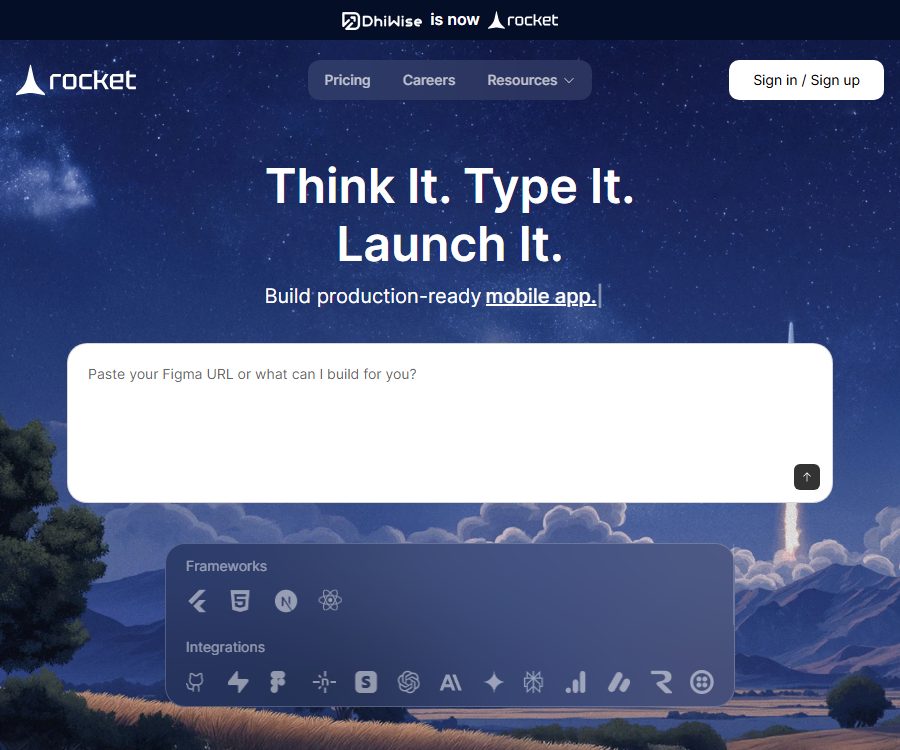
DhiWise has been transformed into Rocket.new; the original domain name now clearly indicates this brand transition, directing users to Rocket for access to products, accounts, documentation, and privacy settings. Describing it merely as a tool that converts Figma designs into React or Flutter formats would overlook its current product structure.
Rocket.new is operated by Rocket USA Inc.; it is an AI platform that enables product research, full-stack application development, and competitor monitoring through natural language. The old DhiWise documents and GitHub projects are still accessible, but the old packages, technical capabilities, and licenses cannot be applied automatically to the current Rocket services.
Current three key product capabilities
| Ability | Main inputs | Main output | Suitable for tasks |
|---|---|---|---|
| Solve | Business ideas, problems, market, and business context | Research, creative validation, PRD, market and competitor reports | Product planning and decision-making preparation |
| Build | Natural language, Figma, templates, attachments, or existing code | Web applications, mobile applications, source code, and deployment versions | SaaS, internal tools, dashboards, e-commerce, and landing pages |
| Intelligence | Company information, competitors, and monitoring signals | Ongoing competitor updates, summaries, and dashboards | Marketing, Products, and Growth Teams |
Generate the Build application
Users can describe the target users, functions, pages, and business rules using a sentence or a paragraph of natural language; Rocket will analyze the scenario, plan the functions and user experience, and create front-end and back-end applications. It is suitable for transforming prototypes into functional projects, but the resulting applications still require testing, security reviews, and ongoing maintenance.
- Web applications: By default, projects built with Next.js and TypeScript are created, which can be used for websites, SaaS applications, dashboards, and internal tools.
- Mobile apps: By default, Flutter and Dart projects are generated, which can be used for iOS and Android.
- Backend: It can be connected to Supabase, and utilizes PostgreSQL, authentication mechanisms, storage solutions, as well as Edge Functions.
- Payment and integration: External services can be connected on a project-by-project basis, and environment variables can be configured; sensitive keys should not be included in the client code.
- Real-time preview: Check the page, routing, responsive layout, and interactions during the generation process.
- Bug fixes: It is possible to request diagnosis and repair within the conversation; paid users can use the Fix it tool for error detection without using any credits.
Starting point for supported projects
| Starting point | What does the user provide? | How does Rocket handle it? | Key constraints |
|---|---|---|---|
| Natural language ideas | Product goals, users, and features | Plan and generate a complete application. | The more vague the requirements, the higher the likelihood of rework and loss of points. |
| Figma | Accessible design links | Convert to an editable Web or Flutter app | The existing screens have not yet been fully supported with these updates. |
| Screenshot or image | Interface reference diagram | Identify the layout and generate the workspace interface. | There is no guarantee of pixel-level accuracy. |
| File attachment | PDF, XLSX, CSV, or Markdown | Generate or modify applications based on the content of the files. | Up to 5 files per item, with each file being less than 5MB. |
| Template | Pre-built application templates | Reuse the structure and modify it as needed. | Authorization, content, and dependencies still need to be checked. |
| GitHub project | Existing code repository | Continue editing after importing and synchronize in both directions. | Currently importing is limited to Next.js TypeScript projects. |
Convert Figma to code
DhiWise’s renowned capability for converting design drafts into code is now integrated into Rocket Build. Users can copy a Figma link for which they have view permissions, use it to create web or mobile applications, and then further refine the logic within the dialog or editor.
Currently, it is possible to add new screens using the updated Figma file, but directly refreshing the existing screens that have already been created is not yet fully supported. Complex components, automatic layout, font settings, image permissions, and different screen sizes can still affect the quality of the conversion.
Solve Research and PRD
Solve is used for idea validation, market research, needs analysis, and product documentation; it allows exports in PDF, PPT, HTML, or PRD format. Free and Pro versions offer a faster version of Light Solve, while Rocket and Booster enable automatic routing to the more comprehensive Full Solve.
| Pattern | Available packages | Handling method | Suitable for tasks |
|---|---|---|---|
| Light Solve | Free, Pro, Rocket, Booster | Quick conversational research, with the possibility to ask follow-up questions | Preliminary verification, briefings, and rapid analysis |
| Full Solve | Automatic routing for Rocket and Booster | Structured decomposition and in-depth analysis usually take longer. | PRD, strategic research, and complex market reports |
Users cannot manually select a mode across all plans; the system handles the routing automatically based on the plan and the issues at hand. The research findings may contain errors or outdated information, so it is still necessary to consult the original materials for important market, legal, and financial conclusions.
Intelligence: Competitor monitoring
Intelligence enables continuous tracking of competitors’ websites, social media accounts, news articles, reviews, and other relevant sources, compiling any changes in a dedicated dashboard. This feature is ideal for ongoing market monitoring, as it eliminates the need for users to carry out checks on a daily basis.
- Configure the enterprise and its competitors: specify the business website, team information, and the entities to be monitored.
- Selection criteria: Pay attention to product, price, marketing, recruitment, reviews, or other categories of changes.
- Continuous updating: Monitoring is maintained until the user pauses or stops it.
- Cost characteristics: Intelligence in the Rocket and Booster packages does not require any additional points at the moment.
- Boundary determination: Automatic capture and classification may result in the omission of certain pages or incorrect detection of changes; significant actions require manual confirmation.
The process from idea to launch
- Create a Rocket account, and under the Free plan check out the one-time credit points as well as the rules for public projects.
- Choose Solve, Build, or Intelligence; when building an application, specify the target users, core processes, platform, and data requirements.
- Start a project with natural language, Figma, templates, attachments, or supported GitHub repositories.
- Review the functions, pages, and technical solutions proposed by the system, and remove unnecessary elements in order to control the points.
- Generate the first version and test navigation, forms, responsive layout, empty states, and error states in the preview.
- Connect to Supabase, payment, or other services, and set up the database, authentication, storage, and environment variables.
- Use Code View, dialog-based modification, or Visual Edit to refine the implementation, and repeatedly test permissions and data validation.
- Download the code as a compressed package or sync it to GitHub, and then deploy it using Netlify or your own process.
- Before going live, check for dependent licenses, key leaks, privacy disclosures, accessibility, performance, and backup solutions.
Code, deployment, and mobile publishing
The paid plan allows users to view and edit the complete source code through Code View, as well as download the project’s compressed version or connect to GitHub. Users can continue developing in their local IDEs and deploy the project on infrastructure other than Rocket.
- GitHub synchronization: Push the generated code to the repository and enable two-way updates within supported workflows.
- Web deployment: It is possible to connect to Netlify, which provides encrypted access, the ability to preview builds, and the option to use a custom domain name.
- Mobile preview: Flutter projects can generate web previews suitable for sharing via mobile browsers.
- Android: Paid users can download the APK for testing on the web, or they can download the source code and submit it to Google Play.
- iOS: It is possible to download the Flutter source code and build serta submit it in Xcode, but it is not currently possible to download the IPA directly.
- Store fees: The setup of Apple and Google developer accounts as well as the related approval processes are the user’s responsibility and are not included in the Rocket subscription.
Price packages
Rocket uses a unified credit balance to cover Build, Solve, and Intelligence operations; the pricing model is no longer based on the old DhiWise package structure. All subscription plans include unlimited team members, and there is a 20% discount on annual plans, with credits allocated on a monthly basis.
| Package or version | Price | Billing cycle | Core benefits or quota | Suitable for users |
|---|---|---|---|---|
| Free | 0 dollars | Free | 20 points per use, for Build, Light Solve; the project is made public. | First experience with the public prototype |
| Pro | 25 dollars | Monthly | 100 points per month: Build, Light Solve, source code download, private builds | Personal projects and early MVPs |
| Rocket | 50 dollars | Monthly | 250 points per month, Build, automatic routing Solve, Intelligence | Frequently used individuals and teams |
| Booster | 250 dollars | Monthly | 1,500 points per month, a complete set of tools, and support for high usage levels | High-frequency teams and intensive development |
| Enterprise needs | Contact sales | Customization | SSO, data localization, advanced support, or onboarding assistance | Organizations with governance and compliance requirements |
Points rules
- Subscription points: They can be carried over month by month during the validity period of the paid plan, and are not automatically reset at the end of each month.
- Annual plan: Points can be carried over over a period of twelve months, but the remaining points expire and the balance is updated when the contract is renewed.
- Extra points: They can only be purchased with a valid paid subscription, and they do not expire during the duration of the subscription.
- Cancel subscription: At the end of the current billing period, any unused subscription points as well as additional points will expire.
- Credit limit exhausted: New creation, research, and monitoring activities will be suspended, but existing projects and outputs remain accessible.
- Consumption difference: Complex applications, role-based permissions, analysis interfaces, and in-depth research typically require more resources compared to simple landing pages.
- Base fee: The document states that points cover computing, storage, and hosting services on the platform, and no separate charges are applied for these; however, external services may still incur fees.
Upgrades, downgrades, and refunds
Upgrades take effect immediately and are billed proportionally, with the points also being adjusted according to the new plan; downgrades become effective in the next billing period. Subscriptions are renewed automatically on a monthly or annual basis, and users should manage them through the subscription settings on the web interface.
- There is no additional fee for cancellation, but unused points will expire at the end of the billing period.
- The terms of service stipulate that payments made are non-refundable, and any issues with the bills must be raised within 30 days of their occurrence.
- Only with specific performance guarantees may prepaid fees be refunded, and this does not apply to free trials or free plans.
- The project documentation states that the project will remain accessible even after cancellation, but the general terms also allow for the deletion of customer content once termination occurs; it is important to export and back up critical code in advance.
Web, iOS, and functional differences
| Platform | Current status | Key capabilities | Restrictions |
|---|---|---|---|
| Web | Full entry point | Research, building, editing, subscribing, code, integration, and deployment | Advanced features are mainly focused on the Web. |
| iPhone and iPad | The official Rocket app | Create, manage, and synchronize projects as well as receive build notifications. | Some advanced features are available only via the Web. |
| Android Native Builder | The official version has not been confirmed yet. | Android applications can be developed, but the official client has not been verified. | Do not confuse “creating Android applications” with “the Android version of Rocket”. |
| Figma plugins | The old DhiWise Design Converter is still visible. | Design the code conversion entry point | The current main workflow and scope of support are as specified in the Rocket documentation. |
| Browser extensions | The official version has not been confirmed yet. | No verified necessary extensions available. | You can use the Web workspace. |
API, GitHub, and open-source status
Rocket can create API endpoints for the applications developed by users, and it can also be connected to GitHub; however, this does not mean that the platform offers unlimited public developer APIs. As of now, there is no Rocket SDK or complete platform API available for the general public, independent of the product’s workspace.
| Project | Current situation | License or permissions | Conclusion |
|---|---|---|---|
| Rocket.new platform | Commercial cloud services | Terms of Service | Not verified as open source |
| User-generated source code | Paid plans allow downloading and syncing. | The user retains ownership. | It is still necessary to comply with the licenses regarding dependencies and third-party materials. |
| DhiWise Node.js API Generator | Old public warehouse | Apache-2.0 | It only applies to that old project, not to Rocket. |
| DhiWise examples and tools | Multiple old warehouses | MIT, Apache-2.0, or unspecified; varies from database to database. | They cannot be considered as the same authorization. |
| GitHub integration | Current Build feature | User authorization for warehouse access | It is code synchronization, not proof of open-source product. |
Privacy, security, and training usage
Rocket will handle account and project data, as well as information related to devices, browsing behavior, IP addresses, geographical location, search queries, and transaction records. The privacy policy states that personal data or content submitted by customers will not be used to train external AI models, nor will it be utilized beyond the scope of the services provided.
- Free project: The Build tasks are always available to the public; they may be included in showcases of completed works and could also be used to improve Rocket’s own AI.
- Paid features: The document descriptions are not used for AI training, and the Build task can be set to Private to prevent it from being made publicly available.
- Task-level permissions: Public or private settings are applied specifically to Build tasks; they are not universal project switches for Solve and Intelligence.
- External deployment: The user is responsible for the protection and backup of data after it is downloaded or transferred to a third party.
- Data requests: Users can request access to, correction of, deletion of, restriction of processing, objection to, or export of their personal data.
- Account deletion: According to the help documentation, once a request is received via email, the account and all associated data are permanently deleted within 48 hours.
- Infrastructure: The policy mentions the use of AWS and cross-border transmission safeguards; companies can consult the data processing appendix for further details.
- Security boundaries: No cloud transfer is risk-free; users still need to verify keys, database rules, authentication methods, and the code that is generated.
Suitable for users and scenarios
- Non-technical founders: Combine ideas, market research, PRDs, and the first functional product within a single process.
- Product Manager: Use Solve to validate requirements, and use Build to quickly create internal tools or product prototypes.
- Designer: Create a functional interface from Figma or screenshots, and then work with the engineering team to further develop it.
- Front-end and full-stack developers: Create the basic code for Next.js or Flutter, and work with it using GitHub and local IDEs.
- Marketing and Strategy Team: Utilizes Intelligence to stay informed about changes among competitors on a continuous basis.
- Small teams: Use a paid plan with no limit on the number of users in order to collaborate, avoiding repeated charges based on the number of team members.
Advantages
- A relatively complete product lifecycle is formed, ranging from market research to application development and competitor monitoring.
- It supports both Next.js Web and Flutter mobile projects, and can be integrated with a Supabase backend.
- Natural language, Figma, files, templates, and GitHub offer various starting points for projects.
- The paid plan allows downloading the complete source code, continuing local development, and deploying to external platforms.
- All paid plans have no limit on the number of team members, making them suitable for multiple people to use the same credit pool.
Restrictions and Precautions
- DhiWise has undergone a transition in terms of its brand and products; therefore, the old tutorials, prices, and technical specifications may no longer be applicable.
- The Free Build task requires public disclosure and can be used to improve AI; it is not suitable for confidential products or customer code.
- Downloading the source code, using private tasks, custom domain names, and various advanced editing features all require payment.
- Updates to existing Figma screens are not yet fully supported, and the conversion of complex designs may still require manual adjustments.
- On mobile devices, it is not possible to download IPAs directly; publishing to the iOS App Store still requires Xcode installed locally as well as a developer account.
- The generated code may have issues related to security, performance, dependencies, or business logic; therefore, code review and testing cannot be skipped.
- Points are consumed based on the complexity of the task; there is no fixed conversion rate specifying how many points correspond to one page.
- The general terms and the help documentation provide different statements regarding data access after termination; it is important to continue exporting backups of critical data.
Frequently Asked Questions
Is DhiWise still operating independently?
The current DhiWise website clearly indicates that it has been converted to Rocket.new; the main products and documentation are all based on Rocket. The old DhiWise materials are only useful for understanding previous features.
What technology stacks can Rocket.new generate?
Currently, web applications use Next.js and TypeScript by default, while mobile applications employ Flutter and Dart. The backend can be connected to Supabase, and web deployments can be handled with Netlify.
Can the source code be downloaded with the free plan?
No. Downloading the complete source code is available only with the Pro or higher plans; the Free plan is intended for using Build and Light Solve for a one-time usage of 20 points.
Are free programs private?
No. The Build tasks in Free are always public; they may be displayed in the community and used to improve Rocket AI, while sensitive projects should make use of paid, private tasks.
Do unused points expire?
The period of a monthly subscription can be carried over, while annual credits can be carried over within twelve months; however, they are reset when the subscription is renewed. Once a plan is canceled, both the subscription credits and any additional credits purchased become invalid at the end of the current billing period.
Can existing GitHub repositories be imported?
It is possible to import Next.js TypeScript repositories and use two-way synchronization to continue iterating. Existing repositories based on other technology stacks cannot be considered compatible by default at the moment.
To whom does the generated code belong?
The help documentation states that users retain full ownership of the generated source code and the output. Users still need to check the licenses for open-source dependencies, fonts, images, models, and third-party services.
Is Rocket.new open source?
It has not been verified whether the current platform is open source. The Node.js tools and some examples from the old DhiWise organization use licenses of Apache-2.0 or MIT, but these licenses apply only to their respective repositories.
Is there a mobile app?
There are official iPhone and iPad apps for creating and syncing projects. Importing from Figma, downloading the complete code, using Visual Edit, handling subscriptions, and certain integration features still require the web version.
Summary
DhiWise users should now consider Rocket.new as a subsequent product, and reevaluate it in light of the current capabilities related to Solve, Build, and Intelligence. When choosing a package, it is important to compare points, private tasks, source code downloads, the depth of research available, as well as the needs related to competitor monitoring; moreover, human review and external backups should be reserved for the generation of code.
Tools similar to Dhiwise



 Guigong Network Security Registration No. 45132202000164