






DataRobot
DataRobot makes AI programming more efficient and simpler.
Tags:AI programming toolsWhat is DataRobot?
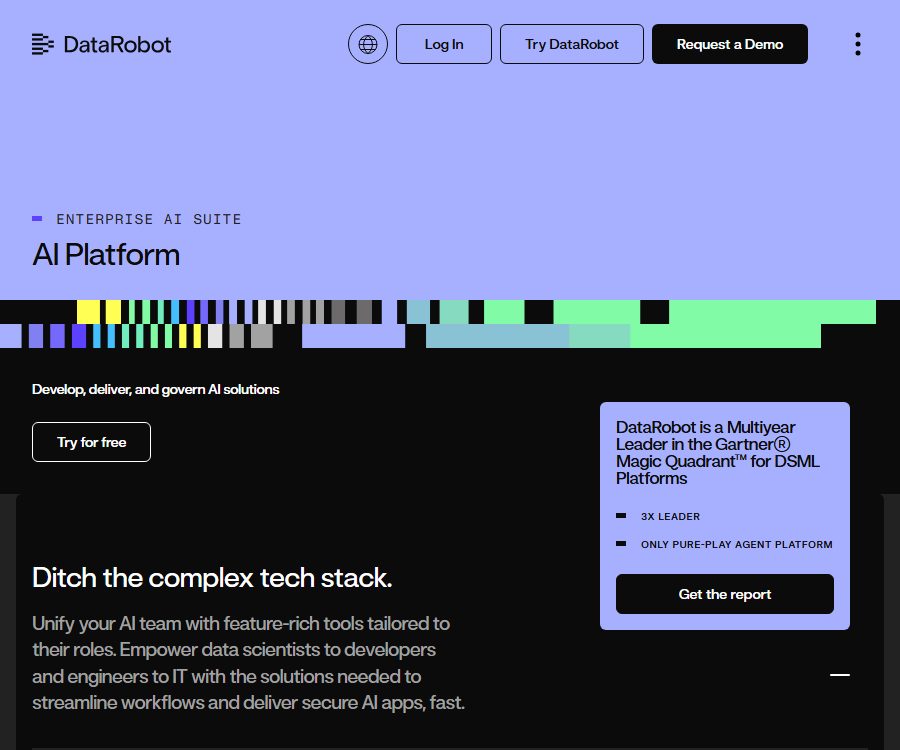
DataRobot is an enterprise AI platform provided by DataRobot, Inc., used for building, deploying, running, and managing predictive models, generative AI applications, and agent workflows. It integrates data experimentation, asset registration, production deployment, monitoring, and approval within a single environment, and is aimed at organizations that need to manage AI on a large scale.
The current product uses Workbench, Registry, and Console as its core working areas. Users can operate through the graphical interface in the browser, as well as automate processes using code clients, the command line, and REST APIs.
Main functions
- Predictive AI and AutoML: After importing structured, time-series, text, image, or geospatial data, it is possible to carry out data processing, feature engineering, model training, and optimization, as well as compare various algorithms and approaches.
- Specialized modeling tasks: It supports workflows such as classification, regression, multi-label, multi-class classification, time series prediction, anomaly detection, and clustering; it is suitable for use in demand forecasting, risk scoring, fraud detection, and quality inspection.
- Model explanation and quality checking: Predictions are explained through various approaches such as feature impact, SHAP, LIME, coefficients, and feature effects; in addition, functions for bias detection, external testing sets, and automated compliance documentation are provided.
- Generative AI experiments: It is possible to compare large language models, embedding models, vector databases, retrievers, and prompt templates in order to develop applications for RAG, document QA, data QA, and content generation; the availability of specific models and regions depends on the package chosen and the administrator’s settings.
- Agent development: It supports tool registration, data registration, vector storage, pre-built components, as well as framework templates such as CrewAI, LangGraph, and LlamaIndex; it also allows agents developed externally to be integrated into the platform.
- Evaluation and governance: It is possible to test intelligent agents or generative AI workflows side by side, and to manage production risks through tracking, lineage analysis, approval processes, compliance testing, safeguards, and human intervention.
- Deployment and MLOps: After registering a model or agent version, it is possible to create batch or real-time services; accuracy, data drift, latency, service health, costs, and custom business metrics can be monitored, and versions can be replaced without disrupting the services.
- AI applications: Application templates, code-free applications, or custom applications built with Streamlit, Flask, etc., can be used to enable business users to submit data, view predictions, and share results.
Input, processing, and output
| Stage | Processable content | Typical results |
|---|---|---|
| Data and knowledge | Tables, databases, time series, text, images, geospatial data, documents, and vector data | Reusable data assets, features, vector databases, and training data |
| Predictive modeling | Target fields, time windows, business constraints, and custom code | Classification or regression models, prediction, interpretation, scoring interfaces, and compliance documents |
| Generative AI | Prompt words, documents, retrieval configurations, LLMs, embedding models, and evaluation data | RAG workflows, chat applications, quality assessment, and monitoring metrics |
| Agent | Code, tools, data, external framework workflows, and permission policies | It supports the deployment of agents, tracking of calls, approval records, alerts, and business outputs. |
The connectors cover common databases, data warehouses, and object storage, and provide integration guides for AWS, Azure, Google Cloud, Snowflake, and others. The actual connectors, models, computing resources, and deployment targets are determined by the version, region, organizational licenses, and administrator settings.
Usage process
- Apply for a one-time trial or contact sales to set up an organization; choose between a hosted SaaS solution, a VPC, or a self-managed environment based on compliance, data residency, and infrastructure requirements.
- Create a new Use Case in Workbench, and import data by uploading files or configuring connectors; for generative AI and agent tasks, it is also necessary to select models, knowledge bases, tools, and credentials.
- Choose between predictive, generative AI, or agent workflows to train, combine, debug, and compare candidate solutions in a graphical interface or code environment.
- The effectiveness is evaluated using a validation set, business metrics, compliance testing, and manual inspections, in order to identify issues such as biases, hallucinations, prompt injection, personal information leaks, and cost risks.
- The models, applications, or agents that pass the testing are registered in the Registry, where the versions, metadata, test results, approval status, and related documents are stored.
- Deploy to DataRobot’s managed computing environment, dedicated prediction servers, or external environments, and generate interfaces or shared applications that can be used by business systems.
- In the Console, monitor quality, drift, latency, call trajectories, and service health; configure alerts, interventions, and approvals, and then update the version based on feedback from production.
Trial and paid versions
| Package or version | Price | Billing cycle | Core benefits or quota | Suitable for users |
|---|---|---|---|---|
| Self-Service SaaS Trial | 0 dollars | 30 calendar days at a time | Up to 5 members, batch prediction only; up to 15 vector databases and 1000 LLM calls; NVIDIA NIM and GPUs are not included. | Teams looking to validate AI, machine learning, or generative AI workflows |
| Corporate hosting solutions | Contact sales | In accordance with the contract | Functions, working threads, inference, LLMs, GPUs, as well as support and service quotas are determined based on the order. | Enterprises that require production deployment, governance, and organizational collaboration |
| VPC or self-managed solution | Custom quote | In accordance with the contract | Deployed in cloud or hardware clusters for customer management; it can support private clouds, sovereign environments, or isolated networks. | Organizations with requirements for data residency, isolation, or infrastructure control |
The trial period begins on the day of registration; the modeling work threads are allocated by the account and shared among organization members, though some advanced templates and computing resources are not available. After the trial period ends, it is necessary to contact sales to upgrade to a paid version; if no upgrade is carried out, the trial data and assets will be permanently deleted 30 days after the trial expires.
The official plan does not specify a fixed price; the cost varies depending on the method of deployment, the users involved, as well as the computing, inference, and service capabilities offered. The terms of the self-service platform state that any costs incurred and the Credits purchased are non-refundable. Corporate contracts may contain different provisions in cases of termination or remedial actions, so it is necessary to refer to the actual order and contract details before making a purchase.
APIs, clients, and code repositories
- Obtain the API token from your account and identify the API endpoint for your region or self-managed instance; avoid storing the token in public code repositories.
- Authentication can be performed using the REST API, DataRobot CLI, or Python client; alternatively, an organization can configure OAuth with enterprise identity providers.
- Create and manage datasets, projects, models, vector databases, applications, deployments, prediction tasks, and monitoring assets through interfaces.
- The deployment interface is called from automated scripts or business systems, and the solution is put into use by incorporating strategies for rate limiting, error handling, auditing, and key rotation.
| Project | Current status | License Instructions |
|---|---|---|
| DataRobot platform | Commercial proprietary products | The right to use is determined by the trial terms, platform agreement, or corporate contract. |
| REST API and CLI | Already provided | A valid account, token, and corresponding platform permissions are required. |
| Python client | Public release | Adopting the DataRobot Tool and Utility Agreement should not be equated with common open-source licenses. |
| Examples and open projects | There are multiple public warehouses. | Some repositories use Apache 2.0 or MIT; community examples may not be maintained by DataRobot, and it is necessary to check each repository individually. |
Public clients, templates, or sample code do not imply that the platform itself is open source. When preparing the code for commercial use, modifying it, or redistributing it, it is necessary to check the licenses of the target repository and software package separately, rather than relying on the licenses of other DataRobot projects.
Deployment platform and integration
| Method | Access pattern | Main features |
|---|---|---|
| Managed SaaS | Browsers, APIs, Python clients, and CLI | The infrastructure is managed by DataRobot, and availability may vary by region, feature, and model. |
| Virtual Private Cloud | Organize a dedicated environment | Emphasize isolation, network control, and organizational-level configuration. |
| Self-managed deployment | Customer cloud or on-premises Kubernetes cluster | It can be deployed on local systems, private clouds, sovereign environments, or isolated networks, with the organization being responsible for its installation and maintenance. |
As of now, there are no official iOS or Android native applications, nor Chrome extensions released by DataRobot, Inc.; the app with the same name, DataBot, is not related to this product. Whether full functionality is available on mobile devices must be verified based on browser compatibility and the organization’s security policies.
Privacy, security, and data considerations
- The platform states that it encrypts both data in transit and static data, and it mentions compliance with ISO 27001 and SOC 2 Type II; single-tenant SaaS solutions that are HIPAA compliant are available only within the scope of the respective products and contracts.
- SaaS may collect metrics such as the frequency of logins, the number of deployments, and the usage of various functions; it also analyzes model, project, and dataset metadata after removing personal information and customer data.
- Upon terminating or disabling an account, customer data is deleted and the usage metrics are anonymized; however, personal information such as contact details and user profiles may be retained for business or legal purposes.
- Hosting, storage, billing, analytics, and support service providers may process personal information within the scope required to fulfill their obligations, and global services may involve cross-border data transfers.
- Organizations should conduct checks for legality, minimization, and data masking before uploading data, and assess sensitive data in light of the data processing protocols, the list of sub-processors, regional settings, and retention policies.
- Model explanations, automated compliance documents, safeguards, and monitoring cannot replace legal review or manual verification; for high-risk decisions, it is still necessary to establish responsible persons as well as approval and appeal mechanisms.
Suitable for users and typical use cases
- Data science team: Batch comparison of models, management of experiments, and automatic generation of model explanations.
- AI engineering team: Builds RAG, agents, and custom models, and delivers them for production through a unified registry.
- MLOps and platform teams: Centralized deployment, monitoring, replacement, and governance of internal or external models.
- Regulated organizations: Implement approval processes, lineage tracking, deviation checks, and audit documentation in the financial, medical, manufacturing, or public sectors.
- Business Analysis and Operations Team: It leverages capabilities such as application usage forecasting, anomaly detection, demand prediction, and data querying.
Capacity boundaries
- The products offer a wide range of capabilities, and the deployment, permissions, data connections, LLMs, and computing resource configuration are quite complex; as a result, their implementation typically requires the collaboration of teams responsible for data management, engineering, security, and business operations.
- The trial version only offers batch predictions, and it imposes restrictions on the number of users, vector database access, and LLM calls; it is not possible to use it to assess real-time inference capabilities, GPU usage, or the costs associated with large-scale operations.
- The availability of models, vector databases, and third-party frameworks varies depending on region, version, administrator settings, and supplier; it is necessary to check the current support matrix before performing a migration.
- The platform can provide signals related to deviations, hallucinations, drift, and service quality, but the detection results do not guarantee accuracy or compliance.
- The price of the enterprise version has not been made public yet; hardware, cloud resources, professional services, LLM calls, and costs related to external suppliers may need to be evaluated separately.
Frequently Asked Questions
Is DataRobot only used for AutoML?
No. It still offers automated predictive modeling, while also covering generative AI, RAG, agent development, application delivery, MLOps, governance, and observability.
Is there a permanently free version of DataRobot?
A permanently free plan has not been confirmed yet. What is available at the moment is a one-time 30-day trial period; to use the service on a permanent basis, it is necessary to contact sales for an upgrade.
Does the trial include real-time forecasting?
Not included. Trial accounts only offer batch prediction, along with vector databases, LLM calls, as well as restrictions on the number of members and computing resources.
Can DataRobot be deployed locally?
You can choose self-managed deployment, or opt for VPC, hosted SaaS, private or sovereign environments, as well as isolated networks; the specific architecture and scope of support will be determined based on the enterprise solution.
Is DataRobot open-source software?
The platform itself is not open-source software. Some clients, templates, and example repositories are available publicly, but their licenses vary; the Python client also uses its own proprietary protocol.
What will happen to the data after the trial period expires?
If no action is taken to upgrade through sales, the trial data and assets will be permanently deleted 30 days after the trial period expires. Models, documents, and results that need to be retained should be exported in the allowed manner before the expiration date.
Tools similar to DataRobot



 Guigong Network Security Registration No. 45132202000164