






Codev
Codev – makes AI programming more efficient and simpler.
Tags:AI programming toolsWhat is Codev?
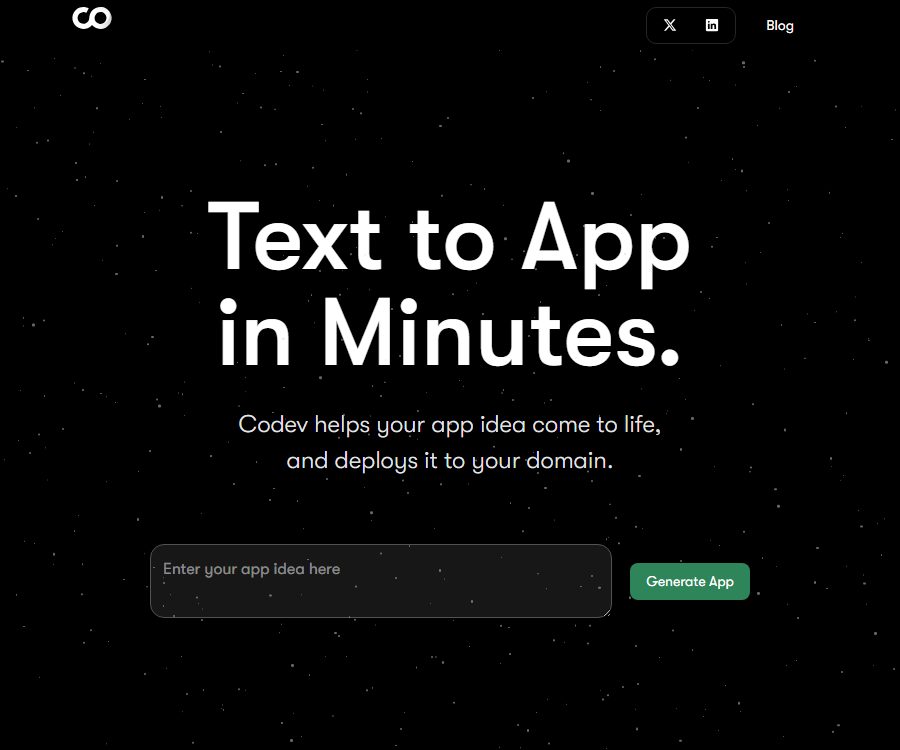
Codev is an AI-powered full-stack web application development platform operated by Wisp Labs, Inc.; it is also available under the co.dev brand. This platform converts natural language descriptions of requirements into functional projects using Next.js and Supabase, with the aim of reducing the amount of repetitive work involved in developing the database, user interface, and deployment environment from the initial idea of a product.
It is designed for web applications rather than general code completion: after the user describes the business processes, pages, and data relationships, the system generates the front-end and back-end components as well as the project structure, allowing for further modifications through dialogue. This tool is suitable for quickly testing prototypes, creating internal tools, or developing early-stage software products; however, it is not equivalent to an automated outsourcing service that allows for deployment without any review process.
Main functions
Generate full-stack web applications from requirements
- By receiving natural language descriptions of products, it is possible to start developing applications based on the user roles, core pages, data fields, and interaction rules.
- By default, Next.js is used to develop the web frontend and application logic, while Supabase handles the PostgreSQL database, authentication, APIs, and real-time data functions.
- The system will automatically install software packages based on the project’s requirements, thereby reducing the need for manual handling of dependencies and basic directories.
- After it is created, you can proceed to request the addition of new pages, adjustments to the workflow, fixes for issues, or changes to the visual style, without having to outline all requirements at once.
Databases, authentication, and business data
- It is possible to connect to Supabase projects, using the project address and anonymous key to establish a database connection; however, users still need to create and manage their own projects in Supabase.
- It supports the creation of data tables, as well as queries and common operations such as adding, reading, updating, and deleting data. It is suitable for structured scenarios like customer lists, orders, content management, reservations, and task dashboards.
- It supports login using email and password as well as third-party logins, and can employ row-level security policies to restrict the data accessible to different users.
- The authentication callback address, keys, database structure, and permission policies must be set correctly according to the deployment environment; incorrect configuration can lead to login failures or unauthorized access to data.
Interface, images, and iterative revisions
- Users can upload reference images or project materials as suggested, allowing the system to generate or adjust the page based on these visual references.
- The project can make use of the components and theme capabilities provided by shadcn/ui, and is suitable for creating forms, navigation elements, dialog boxes, data tables, as well as various common backend interfaces.
- Existing applications can be modified in stages; it is appropriate to first define the core workflow and then gradually add responsive layouts, empty state handling, error handling, and detailed styling.
- Interfaces and code generated by AI may contain inconsistencies, omissions, or invalid logic; complex interactions still require browser testing and manual code review.
Source code, GitHub, and deployment
- The paid features include source code download and GitHub integration, which allow projects to be incorporated into regular version control processes.
- After exporting via GitHub, it can be deployed further in environments that support Next.js such as Vercel, where environment variables like Supabase can be configured.
- It is possible to associate a custom domain name with a project and have SSL configured automatically; however, the exact time when this configuration takes effect depends on the domain name provider.
- The project page can be hosted directly, but when long-term maintenance, team collaboration, or migration is required, it is advisable to keep the code repository and the list of environment configurations as soon as possible.
Input, output, and technical components
| Project | Supported content | Actual use | Precautions |
|---|---|---|---|
| Text input | Product description, page requirements, data structure, modification instructions | Generating and iterating web applications | The more specific the requirements, the easier it is to verify the generated results. |
| Image input | Interface reference diagrams and project materials | Assists in determining layout, style, and visual content. | The uploader must possess the appropriate rights to do so. |
| Application output | Next.js Web project | Browser-based business applications and responsive pages | No native mobile apps or browser extensions are generated. |
| Data services | Supabase database, authentication, and real-time capabilities | Save business data and manage user access. | Accounts, usage, permissions, and fees are managed separately by the respective services. |
| Delivery method | Online projects, code downloads, GitHub repositories | Hosting, secondary development, or migration deployment | Part of the delivery capacity is limited by the package options. |
Model selection and dosage
The editor offers a variety of popular models for users to choose from; the current list includes Claude 4 Sonnet, GPT-4.1, and Gemini 2.5 Pro, with prompts available for GPT-5 as well. The range of models, pricing factors, and account visibility may change, so it is necessary to refer to the real-time list of models and the billing interface within the application.
| Ability | Function | Possible changes |
|---|---|---|
| Model selection | Switch between different code generation models | The model versions and availability ranges will be updated. |
| Charging based on model | Based on the remaining balance used by the actual model | The costs of different models may vary. |
| Plus usage discount | A 25% discount is applied to the price of the model. | The subscription itself does not include model integration. |
The process from idea to actual use
- Register an account and create a new project; first, use a paragraph to describe the target users, the core tasks, as well as the pages and data elements that are necessary.
- Select the appropriate model and submit the first version of the requirements; if there are any interface reference images or brand materials, they can be uploaded as well.
- Check the generated page and navigation, and test each element such as forms, buttons, error messages, the state of empty data, as well as the layouts for mobile and desktop devices.
- Create a Supabase project, enter the project connection details, and then create data tables, authentication methods, and row-level security policies.
- Use a test account to go through the entire business process, in order to verify that creation, reading, modification, deletion, logging out, and permission isolation function as expected.
- Use dialogue to ask the system to correct specific issues; handle only one set of related changes at a time, and run regression tests again after the modifications are made.
- When independent maintenance is required, download the source code or connect to GitHub, save the instructions for the environment variables, and check the licenses of any third-party dependencies.
- Choose online hosting or migrate to a compatible environment, configure a custom domain name, SSL, callback address, and production environment keys, and then publish.
Key points for configuring Supabase
- Create a separate project in Supabase, obtain the project address and the public anonymous key; do not expose the server-side keys with high permissions to the browser code.
- Based on the business design data tables and fields, constraints are set for foreign keys, unique values, and required data, in order to avoid relying solely on front-end validation.
- After enabling authentication, configure the site address and the allowed redirect addresses; when logging in with Google, it is also necessary to set up the credentials and callback settings in the corresponding console.
- Enable row-level security for tables that contain user data, and verify the permissions of anonymous users, regular users, and administrators separately.
- If an email workflow is added, it is possible to configure email services and templates such as Resend, while also checking the sender’s domain name, key permissions, and sending limits.
Prices and packages
Codev offers a free tier, monthly subscriptions, and enterprise solutions. Prices are stated in US dollars, and taxes may apply; the usage of models is not part of the subscription fee.
| Package or version | Price | Billing cycle | Core benefits or quota | Suitable for users |
|---|---|---|---|---|
| Hobby | Free | No subscription period required | $ | Experience products and public prototypes |
| Plus | 19 dollars | Monthly | Unlimited private projects, unlimited custom domain names, code download, GitHub integration, and a 25% discount on model usage; no points included. | Individuals or small teams that are continuously developing and require private projects |
| Enterprise | Custom quote | Contact sales | Dedicated guidance, specialized support, and priority assistance | Organizations that need procurement and service support |
The terms of service state that new users receive a 14-day free trial, after which fees are charged based on the subscription chosen; this is different from what is stated on the current pricing page regarding the free Hobby plan. It is the account notifications and the billing page that determine whether to opt for a paid trial and what benefits are included in it.
A paid subscription can be canceled in the account, and the cancellation usually takes effect at the end of the current payment cycle. The terms specify that no refund will be provided if the AI-generated code or content does not function as expected, if its functions are inaccurate, or if it is not suitable for specific needs; in such cases, the purchase is considered a final transaction.
Suitable for users and typical use cases
- Product managers and entrepreneurs: Quickly test prototypes for SaaS solutions, customer portals, booking systems, or market demands.
- Designers and part-time developers: Convert textual descriptions and visual references into interactive web products, which are then handed over to developers for further refinement.
- Independent developers: Create the foundational infrastructure for Next.js and Supabase, thereby reducing the need to set up forms, authentication mechanisms, and data handling processes repeatedly.
- Small teams: develop internal management tools, data entry systems, simple CRMs, content backends, and event pages.
- Teaching and technical exploration: Observing how requirements are mapped to pages, databases, and authentication processes, while still needing to understand basic web security.
Capacity limits and usage restrictions
- At the moment, the product only enables the creation of web applications; it does not support native iOS or Android apps, nor does it generate Chrome extensions.
- Complex web crawlers, as well as systems that require high traffic levels and high scalability, are not within the scope of current support; they should not be used as key production infrastructure.
- The generated code may contain logical errors, inadequate error handling, or security issues; it should be reviewed by developers before being deployed in production, and tests for permissions, performance, and security dependencies must be conducted.
- Supabase, Vercel, model services, domain names, and email services may all incur their own fees and have their own capacity limits; therefore, it is not possible to estimate the total cost solely based on the Codev subscription price.
- It is prohibited to use the service to create or maintain products related to pornography, gambling, illegal drugs, weapons, violence, and other illegal or harmful activities; any such violations will result in the termination of the relevant services without any refund.
- These services are not designed in accordance with the regulatory workflows of the healthcare or financial sectors, and they should not be used in scenarios that require compliance with HIPAA, FISMA, or GLBA regulations.
Platform, API, and open-source status
| Project | Current status | Explanation |
|---|---|---|
| Web Builder | Support | Create, modify, and manage projects through a browser. |
| Web application output | Support | Create a Next.js project and connect it to Supabase |
| GitHub | Support | Used for code repositories, migration, and subsequent development |
| Native mobile apps | Generation is not supported. | Do not output iOS or Android native projects. |
| Browser extensions | Generation is not supported. | Do not output Chrome extensions. |
| Public API or SDK | Not yet made public | Public development interfaces for customers have not been confirmed. |
| Open-source product | Not open source | Code export and GitHub integration do not mean that the platform’s source code is made available to the public. |
The product page states that users can download and obtain the complete source code of the generated projects, but this does not mean that the Codev platform, its interface, or its services are licensed under an open-source license. The exported projects may still contain open-source dependencies or third-party materials; it is necessary to check the licenses, the permissions related to those materials, and the potential risks associated with the generated content before using them in commercial purposes.
Privacy, Security, and Data Management
- The privacy policy explains how the name and email address provided by the user are handled, as well as the device information, browser details, IP address, usage records and diagnostic data that are collected automatically.
- The data required for payments is stored by Stripe; users should not include production keys, actual customer data, or unnecessary sensitive information in the inputs.
- The service uses cookies and similar technologies, and may obtain limited information from public databases, marketing partners, social media platforms, and other external sources.
- The privacy policy states that sensitive personal information will not be processed, and it claims that organizational and technical measures are employed to protect the data; however, it also notes that transmission and storage over the internet cannot guarantee absolute security.
- Users can modify their information in their account or request to close it; once the account is closed, the information stored in the activity database will be deactivated or deleted, but certain records may remain for the purposes of preventing fraud, troubleshooting, investigations, enforcing terms, or fulfilling legal obligations.
- The service will maintain some of the transmitted data and perform regular backups, but the terms require users to be responsible for their own project data; therefore, it is necessary to export the code, databases, and configuration settings on a regular basis.
Usage suggestions
The value of Codev lies in its ability to quickly turn product descriptions into testable full-stack Web prototypes, while still providing a pathway to conventional coding workflows. The most reliable approach is to have the AI handle the creation of scaffolding and frequently used pages, with humans taking care of requirement validation, data permissions, key management, performance optimization, and production deployment.
Before deciding to pay, it is advisable to first use the free versions to test the target processes and determine the associated costs; only then should you decide whether a proprietary solution, source code downloads, GitHub accounts, or a custom domain name are necessary. When real user data or commercial deliveries are involved, it is also important to take into account the costs of third-party services, any required licenses, restrictions on refunds, and responsibilities related to backups.
Tools similar to Codev



 Guigong Network Security Registration No. 45132202000164