






CodeConductor
CodeConductor – makes AI-driven programming more efficient and simpler.
Tags:AI programming toolsWhat is CodeConductor?
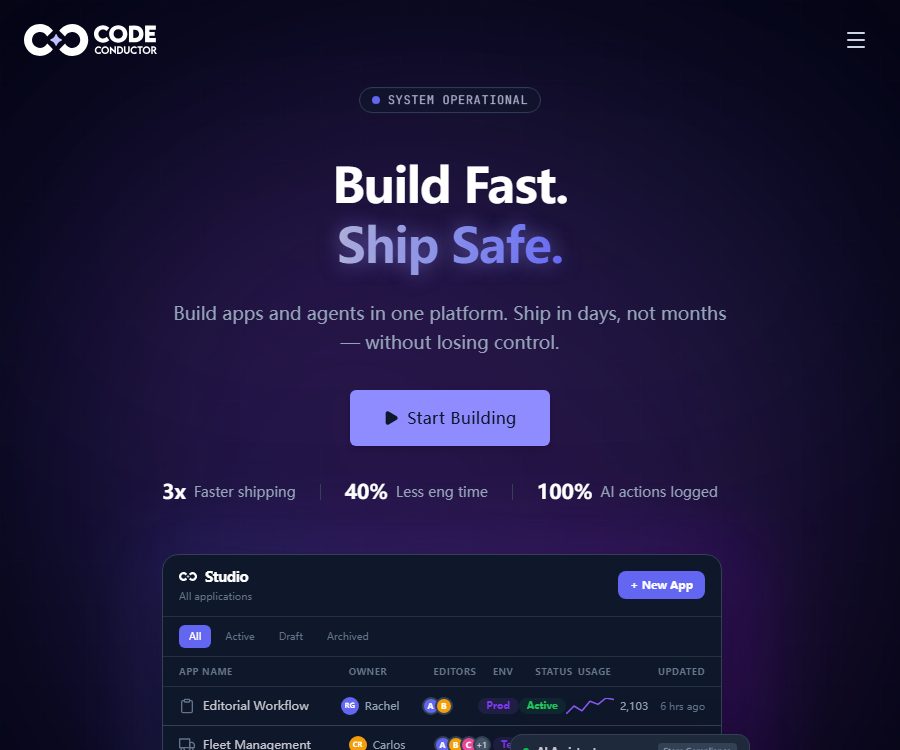
CodeConductor is an enterprise AI applications, agents, and governance platform developed by CodeConductor, Inc.; it was established in 2024 with teams located in the San Francisco Bay Area and Chandigarh, India. It brings application generation, agent orchestration, model routing, policy control, deployment, and monitoring together within a unified control plane.
The product is intended for platform engineering, IT, security, development, and business teams; it focuses on generating exportable, real code and makes use of the organization’s existing Git, cloud, identity, and observability tools. It is not a personal programming assistant that only provides code completion within an editor.
Platform composition
| module | Main function | Enter | Output or value |
|---|---|---|---|
| App Studio | Create full-stack applications using visual components and natural language. | Product requirements, component library, data, and architecture rules | Frontend, backend, CRUD interfaces, and Git commits |
| Copilot Studio | Build an agent with search capabilities, tools, and safeguards. | Instructions, models, knowledge, tools, and process conditions | Agents that are trackable, testable, and can be released in phases |
| Model Router | Select models and data paths based on policies. | Requests, identities, sensitivity levels, as well as cost and latency targets | Controlled routing, fallback, cost, and performance tracking |
| Policy Engine | Apply organizational rules before requesting and publishing. | Identity, workspace, data boundaries, and policy code | Allow, block, mask, approval, and audit results |
| Deployment | Manage development, pre-release, and production environments | Code, configuration, pipelines, and deployment targets | Services in the cloud, VPC, on-premises, or isolated environments |
| Unified Graph | Maintain application, agent, model, and data dependencies | Components, connectors, and operational relationships | Status view, dependency resolution, and data lineage |
Main functions
App Studio application development
- The product team can describe the application to be developed, then use visual components to assemble pages, link data, preview the result, and submit the code.
- It supports importing React, Chakra, Tailwind, Material, or custom components, editing their properties, and synchronizing the theme.
- The front-end logic is serialized into React and TypeScript code and stored in the client’s Git repository, rather than being kept in a proprietary database.
- The backend can be developed alongside the frontend; the page will list Python examples as well as automatically generated CRUD interfaces, with the specific technology stack determined by the deployment plan.
- It supports two-way Git synchronization, Pull Requests, and code reviews; the CodeConductor runtime is not required to remain in place in order to generate code after leaving the platform.
Copilot Studio AI entity orchestration
- The visualization flow is used to arrange the steps of instructions, reasoning, retrieval, tools, and output, as well as to define branches, decision points, and parameters for the step-by-step model.
- The RAG pipeline includes chunking, embedding, indexing, rearrangement, and context management, and it enables the connection between organizational knowledge and vector storage.
- Agents can, within the scope of their permissions, call functions, program interfaces, databases, and multi-step toolchains, not just generate text.
- The execution trace shows input, tools, responses, delays, tokens, and costs, facilitating debugging and post-event auditing.
- Development, pre-release, and production versions can be released gradually through Git configuration, CI/CD checks, rollbacks, and canary traffic.
Model routing and data retrieval
- The Model Router can be connected to OpenAI, Anthropic, Google Gemini, Meta Llama, Azure OpenAI, AWS Bedrock, Mistral, custom interfaces, and local models.
- Routing rules can take into account cost, latency, capacity, historical success rate, data residency, sensitive information, and allowed providers.
- Sensitive requests can be directed to a private VPC or local models, with a fallback mechanism in place when external models are unavailable.
- The data layer supports files, databases, object storage, vector databases, and knowledge bases, and offers mixed retrieval, metadata filtering, and data lineage.
- The unified dashboard records the number of requests, the provider, the reason for routing, errors, fallback situations, and model overhead; the actual metrics depend on the connection configuration.
Policies, Security, and Governance
- The control plane first parses the identity and workspace, then uses OPA policies to check permissions, followed by parsing dependencies, processing requests, and logging the results.
- The policy enables role-based permissions, tenant data isolation, sensitive information masking, a model whitelist, rate limiting, and approval for production deployment.
- App Studio performs security checks on the generated code, including policy validation, dependency scanning, injection testing, and cross-site scripting checks.
- Copilot Studio offers sensitive information detection, toxicity filtering, output policies, topic restrictions, injection protection, and red-team testing before publication.
- Security controls can reduce risks, but they cannot guarantee that the code, models, and configurations are free of defects; therefore, companies still need to conduct independent testing and audits.
Integration with existing technology stacks
- The engineering integrations include GitHub, Jenkins, PagerDuty, Harness, Datadog, Slack, and Terraform.
- Identity connections include Okta and Azure AD, and can be combined with SAML, OIDC, SCIM, and role mapping.
- The connection between data and models is supported for PostgreSQL, Snowflake, Pinecone, Elasticsearch, Firebase, Kafka, Dataverse, S3, as well as various model providers.
- The business connections include Salesforce, QuickBooks, Xero, Plaid, Gong, Zapier, n8n, and others; the specific read and write operations need to be checked one by one.
- CodeConductor’s role is to place connections under a unified set of policies and auditing mechanisms, without requiring companies to replace all their existing systems immediately.
Architecture and request workflow
- The application or agent sends a request, and the control plane determines the user’s identity, workspace, and context.
- The OPA policy determines whether access is permitted based on access levels, data boundaries, model rules, and operation types.
- Unified Graph analyzes the dependencies between applications, data, tools, and models.
- The Model Router selects models and data paths based on policies, capabilities, cost, and latency.
- The isolated data plane processes the requests during execution and returns the results to the application or agent.
- The system logs telemetry data, policy decisions, tool calls, and deployment events for monitoring and auditing purposes.
Complete implementation process
- List the target applications, data sensitivity levels, user roles, existing cloud environments, and the regulations that must be complied with, in order to request a discovery meeting or a structured pilot project.
- Select from the options Standard, Pro, Enterprise, or Strategic, and specify in the quote the number of seats, capacity, environment, and support to be provided.
- Connect identities, Git, data, models, program interfaces, and observability, using non-production credentials with the minimum required permissions first.
- Describe the application and connect components and data in App Studio, or design the agent’s search functions, tools, and branches in Copilot Studio.
- Formulate the requirements regarding permissions, sensitive information, data residency, model usage, and production deployment into actionable policies.
- Tests for functionality, security, load handling, red team attacks, recovery, and manual approval are carried out in the DEV and STAGE environments.
- Produce the final version through a pipeline and phased traffic deployment, while monitoring errors, costs, routing, and audit logs.
- Regularly rotate keys, review connector permissions, assess model changes, and conduct drills for code and data export.
Suitable for users and scenarios
- The goal is to provide a unified AI application platform for all business teams, while preventing the emergence of shadow IT environments led by CIOs and platform managers.
- Engineering teams that need to deliver internal applications quickly using enterprise components and reference architectures.
- The AI team aims to combine knowledge retrieval, database queries, and business actions into auditable intelligent agents.
- A security and compliance team is required to enforce data boundaries, maintain a model whitelist, implement data masking, and handle approval processes for releases.
- Organizations that require a private VPC, local or isolated deployment, and need to control model keys as well as the location where data is stored.
- System integrators that implement platform capabilities for multiple clients, migrate old systems, or develop joint roadmaps.
Prices, plans, and pilots
CodeConductor does not disclose a fixed amount; the pricing is usually determined based on factors such as the infrastructure required, platform capacity, workload volume, governance requirements, and deployment location. For all formal proposals, it is necessary to contact the sales team, and Enterprise and Strategic plans may also involve charging based on capacity or outcomes.
| Package or version | Price | Billing cycle | Core benefits or quota | Suitable for users |
|---|---|---|---|---|
| Structured pilot | Contact sales | Usually 4 to 6 weeks | Targeted at qualified teams, it includes solution support with the goal of delivering functional applications. | Verify value before formal procurement |
| Standard | Custom quote | Contractual agreement | 1 product, which includes 1 backend, 1 frontend, and 1 mobile application; up to 25 features and 10 integrations; 2 developers use CDE and Aria; DEV, STAGE, GitLab, pipelines, code generation, monitoring, and Knolli Starter. | Small teams test key applications in a pilot setting |
| Pro | Custom quote | Contractual agreement | Up to 2 products, with each product allowing up to 100 features and 100 integrations; 10 developers use CDE and Aria; 24/7 support, manual monitoring, SRE, and Knolli Growth | Run multiple production applications in parallel |
| Enterprise | Custom quote | Contractual agreement | No restrictions on products, features, integration options, or developers; deployment is possible in private clouds, VPCs, on-premises, or in isolated environments; it includes built-in models and keys, control mechanisms, audit policies, architect support, a customized SLA of up to 99.99%, as well as Knolli Business. | Regulated and cross-regional organizations |
| Strategic | Custom quote | Contractual agreement | All the capabilities of Enterprise, along with dedicated infrastructure, isolated tenants, a joint roadmap, migration from legacy systems, on-site training, customized business structures, and Knolli Enterprise. | Platform collaboration and transformation projects |
Precautions for the plan
- Standard’s unlimited code generation does not mean that GitLab and the pipelines also have an unlimited number of products, features, or integrations.
- Pro expands products, features, integrations, developers, and support, but the combination limits listed in the table still apply.
- The maximum SLA of 99.99% for Enterprise is a customizable threshold and is not the service level provided by default to all customers.
- Early-stage startups, non-profits, and educational institutions have special programs, but the discount rate must be determined during the sales process.
- No unified and publicly available refund and cancellation policies have been established; these details should be specified in the quote, the main service agreement, and the order.
Deployment and platform format
| Deployment or tools | Current capabilities | Applicable solutions | Precautions |
|---|---|---|---|
| CodeConductor hosted cloud | Shared or platform management environment | Standard, Pro, etc. | Specific areas and capacities are specified in the contract. |
| Customer’s private VPC | The data plane operates close to the customer’s data. | Enterprise and custom solutions | It is necessary to determine the cloud responsibility boundaries and the network design. |
| Local or isolated deployment | Optional control plane and data plane without external network access | Enterprise, Strategic | Operations, upgrades, and model provisioning require separate planning. |
| Hybrid cloud | The central control plane works in conjunction with multi-cloud runtime. | Customized solutions | The delay, retention time, and log location need to be verified. |
| Cloud-based development environment CDE | Standard: 2 people, Pro: 10 people, Enterprise: unlimited | Official plan | Unrestricted use is still subject to the capacity limits specified in the contract. |
| Aria AI VSCode plugin | Provided with the plan, listed as unlimited tokens | Starting from Standard | Differences in seat counts: 2 people, 10 people, or unlimited. |
| Native mobile client | It has not been confirmed this time. | Not yet made public | Creating a mobile application does not mean that the platform has a mobile client. |
Security and compliance status
- Customer data transmission uses TLS 1.2 or a higher version, while AES-256 is employed for encrypting static data.
- Identity control includes SAML, OIDC SSO, role-based permissions, and default minimum permissions; administrators can access or request the export of audit logs.
- HIPAA compliance is indicated by the ability to support relevant workloads, and a BAA is provided to eligible customers; the specific system boundaries must be defined in the agreement.
- The GDPR compliance status, which indicates support for data subjects’ rights, lawful processing, and DPA, does not mean that all compliance obligations are automatically fulfilled once the customer is connected.
- The SOC 2 Type II assessment is still in progress and cannot be considered as an obtained certification.
- The security page guarantees that customer data will not be used to train models, and it employs third-party models under zero-data-retention conditions whenever possible.
- Customers can export applications, code, and data, but the actual process for exiting, the format, timing, and costs must be specified in the contract and tested.
Privacy and data processing
- The privacy policy lists names, phone numbers, email addresses, addresses, job titles, account details, contact preferences, payment information, and data provided by the users themselves.
- The system may also handle IP addresses, browsers, devices, operating systems, pages visited, time spent on those pages, location data, Cookies, and other similar tracking data.
- Payments are processed by Stripe, while the AI functions may send inputs, outputs, and related personal data to OpenAI, AWS AI, Anthropic, and Google Cloud AI.
- The commitment to no training on the security page should be understood in conjunction with the provisions regarding third-party processing outlined in the privacy policy; the purchaser still needs to verify the retention terms and locations for each model.
- Personal information is retained for as long as it is necessary to achieve the intended purposes, usually not exceeding the duration of the account; it is deleted or anonymized once it is no longer needed, with exceptions for backups that require confirmation.
- Users who meet the criteria can request access to, correction of, deletion of, restriction of, objection to, withdrawal of consent, or portability of their data; they can also use privacy options to opt out of the sharing of targeted advertisements.
- The service is not available to users under 16 years of age; the website’s terms require that users be at least 18 years old.
Code ownership, APIs, and open-source status
- The security page indicates that the customer owns its applications, data, and code; App Studio also allows the generated logic to be written into the customer’s Git repository and exported.
- The website terms grant individuals only a limited permission to access the site for non-commercial purposes; any use by businesses must be governed by separate service agreements, data agreements, and orders.
- The platform can generate CRUD interfaces and connect to internal program interfaces; however, no unified developer API or general SDK intended for the public has been confirmed in this case.
- Integration with GitHub, hosting on GitLab, the ability to export code, and the use of open-source frameworks do not mean that the CodeConductor product itself is open source.
- No official public code repository or open-source license for the product was identified in this case; therefore, the platform should be regarded as a proprietary commercial service.
Capacity boundaries
- Policy codes are only effective when the rules are complete and the context is correct; incorrect policies may allow unauthorized access or prevent normal operations from proceeding.
- RAG, model routing, and hallucination detection can improve controllability, but they cannot guarantee that each response is accurate, complete, or suitable for automatic execution.
- The presence of a large number of connectors does not mean that all functionalities are already built in; authentication, field mapping, rate limiting, and error recovery still need to be implemented.
- The generated code must go through regular code review, dependency scanning, testing, and change management processes; it is not sufficient to merely have the platform scanning confirm that everything is fine.
- Cloud, on-premises, and isolated deployments increase the complexity related to networking, upgrades, keys, monitoring, and disaster recovery.
- The efficiency and cost examples provided on the website should not be regarded as guarantees of procurement benefits; companies should use their own baseline and pilot data for evaluation.
Summary
CodeConductor is suitable for organizations that wish to improve both the delivery speed of applications and agents, while also bringing models, data, code, and deployment under unified governance. The focus of the procurement process should be on aspects such as pilot testing, capacity limits, deployment responsibilities, model retention, SOC 2 compliance status, exit procedures, and contract pricing, rather than merely comparing the speed of the interface for generating content.
Tools similar to CodeConductor



 Guigong Network Security Registration No. 45132202000164