






BuildShip
BuildShip – makes AI-driven programming more efficient and simpler.
Tags:AI programming toolsWhat is BuildShip?
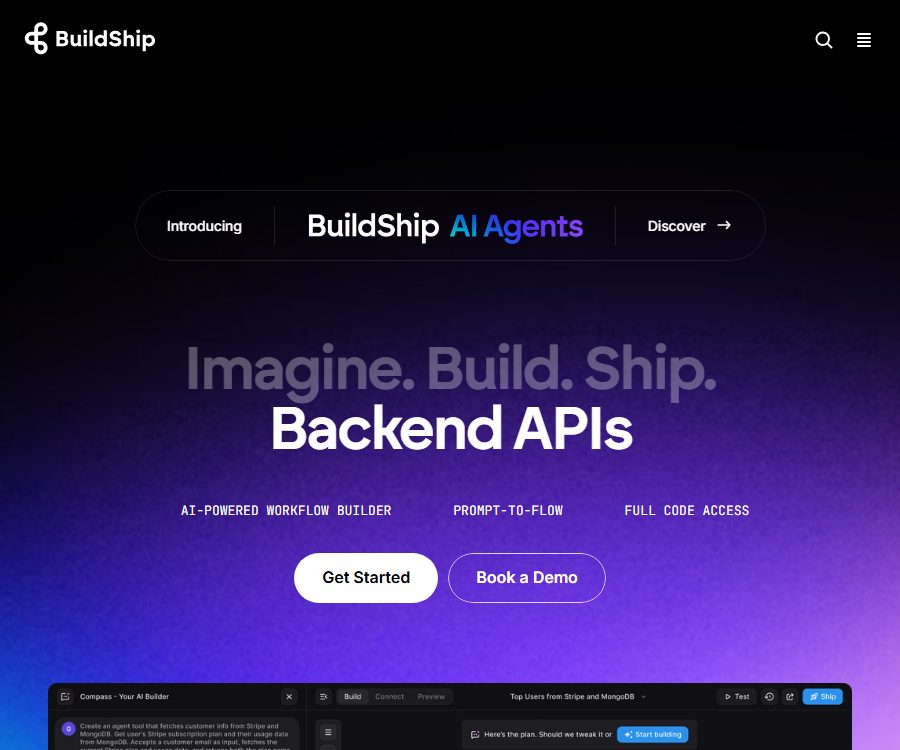
BuildShip is an AI-powered visualization backend and workflow construction platform developed by Rowy Inc.; it allows users to create APIs, automate tasks, set up scheduled operations, develop database logic, and create AI Agent tools directly in the browser.
It combines drag-and-drop workflows, natural language generation nodes with JavaScript or TypeScript code, and is suitable for teams that need to quickly set up a backend without being constrained by the limitations of the available nodes.
Main functions
- Visual workflow: Connect triggers, processing nodes, branches, loops, and outputs on an infinite canvas to create a complete backend process from input to output.
- AI generation process and nodes: It describes the services that need to be invoked, as well as the inputs and outputs; the AI can generate workflows or missing nodes, which can then be opened by the user for inspection and modification.
- API and Webhook: Processes can be published as network interfaces or Webhook backends, supporting common request methods, parameters, request bodies, and structured responses.
- Scheduled and event-triggered: Processes can be started automatically through scheduled tasks, database events, payment events, or other connectors; a single process can be linked to multiple real-time triggers.
- AI Agents and Tools: Create tools and Toolsets with input/output schemas, which can be deployed for use by OpenAI, LangChain, or agents that support function calls and MCP.
- Nodeverse: Allow you to select AI, database, messaging, payment, file, search, and business application functions from pre-built nodes and templates, thereby reducing the time required to develop integrations from scratch.
- Editable code: The JavaScript or TypeScript code associated with each node is visible; autocomplete, a debugger, and logging tools are available, and it’s possible to install packages from the NPM ecosystem.
- Keyless Nodes: Some AI nodes can operate using the pre-authorized balance provided by the platform, without the need to configure a model API key first; it is also possible to switch to using one’s own keys to manage the model account.
- Structured AI output: By using visual Schema configurations to define the fields returned by the model, it reduces the workload on downstream nodes involved in parsing unstructured text.
- File processing: The workflow can receive uploaded files or file addresses, and then pass them to the appropriate models, storage systems, or document nodes for processing.
- Manual confirmation and suspension: The Pause or Sleep nodes allow for the deferral of execution, enabling manual approval, phased deployment, or rate limiting.
- Built-in database and storage: Data tables and file storage spaces are created based on the selected package, providing a place to store lightweight business data, task statuses, and intermediate files.
- Versioning, testing, and monitoring: Supports testing of individual nodes or entire processes, saving of execution examples, viewing of logs, version rollback, as well as status pages and failure notifications.
- Deployment and code export: It can be run with just one click on BuildShip Cloud, or the tool or workflow can be exported as readable JavaScript for execution on local machines or other infrastructure.
What can be created?
- Backend for applications: Provides controlled APIs for FlutterFlow, Bubble, Webflow, Framer, React, Vue, or other front-end frameworks.
- AI applications: orchestrating text, image, voice, vector retrieval, structured data extraction, and multi-model processing workflows.
- Agent tool: It encapsulates operations such as searching, database management, email handling, payment processing, ticket management, and internal system tasks, allowing agents to invoke them according to a specific schema.
- Business automation: Connect forms, CRM systems, Slack, Discord, WhatsApp, Telegram, email, and databases to handle repetitive tasks.
- Payments and e-commerce: Receiving payment or order events, performing verification, saving data to the database, sending notifications, and carrying out subsequent business actions.
- Data pipeline: Reads data from APIs, databases, or files, cleans and transforms it, then writes it to other systems.
- Scheduled tasks: regularly capturing data, generating reports, synchronizing inventory, cleaning up data, or sending alerts.
- Content processing: Performs PDF conversion, image analysis, audio and video generation, summarization, classification, and information extraction.
Input and output
| Phase | Main inputs | Generate results | Suitable for tasks |
|---|---|---|---|
| Trigger | API requests, Webhooks, scheduled times, database or application events | One workflow execution and triggering context | APIs, automation, and scheduled tasks |
| Node processing | Upstream variables, keys, files, data, and prompts | Text, JSON, files, database records, or external operations | AI, data, and business integration |
| Agent tool | Parameter Schema and invocation instructions | Tools’ results that can be consumed by the Agent | MCP and function calls |
| Process output | Results for each node and formatting rules | API responses, messages, records, or files | Integration with front-end systems and external systems |
| Code export | Completed processes or tools | Modular JavaScript and runtime configuration | Local operation and deployment of proprietary infrastructure |
Usage tutorial
- Create workspaces and projects, select the appropriate data areas, and define how the processes are triggered, as well as the inputs, outputs, and procedures for handling failures.
- Start with a blank process, template, or natural language description, and create the shortest feasible path first.
- Add the required nodes and connect the data; use the variable selector to reference triggers, upstream results, environment variables, and Secrets.
- When third-party services are required, OAuth or API tokens should be used; long-term keys should be stored in a secret management system, and not inserted into the frontend or ordinary input fields.
- When no ready-made nodes are available, let the AI generate them; then use JavaScript or TypeScript code to check for requests, exceptions, timeouts, and dependencies.
- Test individual nodes as well as the entire process separately, and save representative samples for normal cases, empty inputs, external failures, permission errors, and timeouts.
- Configure authentication, parameter validation, rate limiting, and security responses for public APIs, in order to avoid relying solely on difficult-to-guess API addresses.
- Click Ship to deploy it to BuildShip Cloud, or export the code, verify it locally, and then deploy it to your own server or cloud platform.
- After going live, monitor logs, latency, concurrency, and point consumption; set up notifications for configuration failures, and use version tracking to manage changes.
Nodes, code, and integration
| Method | How users can use it | Advantages | Precautions |
|---|---|---|---|
| Pre-fabricated nodes | Search for and configure inputs from Nodeverse. | Fast to get started, reduces the need for template code | It is necessary to check the node version and third-party limits. |
| AI-generated nodes | Generate code after describing the interfaces and logic. | Quickly fill in the missing integrations. | Safety, anomalies, and correctness must be reviewed. |
| Custom code | Modify JS or TS directly and install NPM packages. | Offers large expansion space and avoids limitations imposed by platform formulas. | The user is responsible for the supply chain and operating environment. |
| Keyless node | Use the platform balance to invoke the configured AI services. | There is no need to apply for a model key first. | Consumes the platform’s AI balance or quota. |
| Own API Key | Save the service provider’s credentials in Secret. | The bills and model accounts are under the user’s control. | Still subject to service provider terms, rate limits, and geographical restrictions. |
| Code export | Convert tools or processes to JavaScript | Readable, modifiable, and transferable | Some OAuth, memory, and platform service dependencies require separate verification. |
Supported services and platforms
- AI and models: It can be connected to OpenAI, Anthropic, Google, Replicate, Hugging Face, and other model services that offer APIs.
- Databases: Supports Firebase, Supabase, Postgres, MongoDB, as well as other data sources that can be connected via API or custom code.
- Messaging and collaboration: It is possible to create workflows related to Slack, Discord, WhatsApp, Telegram, and email.
- Payments and services: It can be connected to services such as Stripe, SendGrid, GitHub, Google Services, and other similar interfaces.
- Front-end and no-code: It can serve as the back-end for tools such as FlutterFlow, Webflow, Framer, Adalo, Bubble, Bravo Studio, and others.
- Framework: The generated web API can be called by Next.js, React, Vue, and other applications that are capable of sending network requests.
- Hosting: BuildShip Cloud is a serverless environment based on Google Cloud; the exported code can be deployed on Vercel, GCP, AWS, Azure, or in a custom environment.
- Client: The editor is primarily a web application; no official native clients for iOS, Android, Windows, or macOS have been confirmed yet.
Price packages
| Package or version | Price | Billing cycle | Core benefits or quota | Suitable for users |
|---|---|---|---|---|
| Starter monthly plan | 25 dollars | Monthly | 20,000 Credits, 20 activity workflows, 10 Agents, 3 members, 10 tables, 20 concurrent tasks, 50GB of storage, 7 days of logging | Individuals and simple projects |
| Starter annual plan | 225 dollars | Every year | The cost per page is approximately 19 dollars per month; the benefits are the same as those in the Starter plan. | Individuals who use it over a long period of time |
| Pro monthly plan | 79 dollars | Monthly | 100,000 Credits, 150 processes, 50 Agents, 10 members, 50 tables, 100 concurrent tasks, 500GB, 14 days of logs | Growth Team |
| Pro annual plan | 711 US dollars | Every year | The cost per page is approximately 59 US dollars per month, including priority support. | Stable production projects |
| Business Monthly Plan | 599 dollars | Monthly | 300,000 Credits, 300 processes, 100 Agents, 25 members, 100 tables, 300 concurrent tasks, 5TB, 30 days of logs | Automation of core business processes |
| Business annual plan | 5391 US dollars | Every year | The cost per page is approximately 449 US dollars per month, including dedicated support and enhanced monitoring. | Tissues with high consumption |
| Enterprise | Custom quote | In accordance with the contract | Custom quotas, self-hosted or proprietary cloud, Git, environments, regions, compliance, SLAs, and migration support | Large and regulated teams |
The pricing page offers a 7-day trial period, but it does not list in detail whether a payment is required for the trial, whether automatic charges will be made upon expiration, or any other restrictions; it is necessary to check the payment details before starting the trial.
Credits and additional items
| Project | Price or rules | Billing method | Precautions |
|---|---|---|---|
| Regular node | First 3 seconds: 1 Credit | Each time it is executed | After 3 seconds, 1 additional Credit is charged per second. |
| Core control node | No Credits are consumed. | When the conditions are met | Only specific top-level nodes such as Switch, Branch, Loop, Parallel, etc. |
| Add more Credits | 100,000 units, starting at $10 each | Top up as needed | Large amounts may enjoy tiered discounts; the actual discount will be determined based on the slider and the settlement details. |
| Custom domain name | 80 dollars | Every year | Paid packages are available for purchase. |
| No Cold Start | $ | Additional subscription | Used to reduce the delay of the first request |
- Credits are used for the operation of processes, tools, and nodes; they should not be estimated solely based on the number of executions, as nodes that run for extended periods will continue to consume them.
- Keyless AI nodes also utilize the platform’s AI balance or applicable billing; the specific costs associated with the models can be viewed in the node and account settings.
- Concurrency, the number of processes, the number of agents, the number of tables, as well as storage and log retention can all become capacity bottlenecks before Credits do.
- The costs associated with external models, databases, SMS, email, and payment services are not included in the BuildShip package.
- The pricing page may show adjusted amounts and limits; before the official launch, it is necessary to calculate the number of seconds per month as well as the costs associated with third parties based on actual operational data.
Code export, self-hosting, and Git
- Tools or workflows can be exported as modular JavaScript, and run locally via commands or deployed on external platforms.
- What is exported are the logic of user workflows and the code for the various nodes; it does not equate to obtaining the BuildShip visual editor, the cloud control panel, or the source code of the entire platform.
- It is necessary to test each item on its own to determine whether OAuth, managed databases, memory, Keyless nodes, Secrets, and other platform features can operate entirely outside the cloud.
- The price list lists Self hosting, Bring your own cloud, two-way GitHub synchronization, as well as multiple environments and regions as Enterprise features.
- The product release notes describe the JavaScript exports for individual tools and processes as universal capabilities; these correspond respectively to code portability and governance for enterprise-level platform deployment.
- For teams with requirements related to compliance or disaster recovery, the contract should specify the scope of data that can be exported, runtime permissions, a list of dependencies, images, upgrade procedures, and the responsibilities for support.
Main advantages
- Switching between visual orchestration and editable code takes care of non-professional developers while preserving the ability to expand the system.
- In the absence of integration, AI can generate nodes and allow for direct code review, thereby reducing the time needed to wait for the platform to release connectors.
- It can handle APIs, scheduled tasks, database events, and Agent tools simultaneously, making it suitable for integrating various backend tasks within the same framework.
- Nodeverse, templates, and Keyless nodes allow for quick testing of ideas, with the option to switch to custom keys and custom implementations as needed.
- The workflow supports code export, reducing the risk of a single process being completely locked within the hosted runtime.
- Charging based on runtime provides a more detailed level of granularity than fixing a fixed number of tasks, but it is still necessary to take into account the time required for each task as well as the invoices from third parties.
Capabilities boundaries and limitations
- BuildShip is not a complete front-end page builder; the user interface still needs to be created using web, mobile, or no-code front-end solutions.
- AI-generated nodes may contain errors, excessive permissions, insecure logs, or inappropriate dependencies; they must be manually reviewed and tested before being put into use.
- Server keys, OAuth tokens, and user data need to be properly isolated; authentication and the principle of least privilege should not be ignored just because visual tools are being used.
- Long-running tasks, loops, retries, and batch processing that consume Credits per second can rapidly increase costs; it is therefore necessary to set timeouts, as well as limits on the number of batches and failures.
- The free, permanent option is not listed explicitly in the current price table; the page offers only a 7-day trial period, and the previous free version cannot be considered as an ongoing commitment.
- There is no additional charge for No Cold Start; however, the first request may experience a delay due to server cold start if this option is not purchased.
- Log retention is limited to 7, 14, or 30 days; if audit requirements demand a longer retention period, the logs must be exported to an external monitoring system in a timely manner.
- Full Git synchronization, proprietary cloud infrastructure, support for multiple environments and regions, as well as customized security features are primarily available in the Enterprise version.
- The compatibility range of the exported code varies depending on the node dependencies; it cannot be assumed that each managed connector can operate offline or without any changes.
API, SDK, GitHub, and open-source status
| Project | Current status | Explanation |
|---|---|---|
| Workflow API | Support | The process can be published as a network or Webhook interface for applications to call. |
| Agent tool and MCP | Support | The Schema tool can be exported or deployed for use by compatible Agents. |
| Platform management API | Not confirmed yet | No complete, publicly available APIs for managing workspaces and processes in bulk have been identified. |
| Official universal SDK | Not confirmed yet | It is usually integrated through the generated interfaces, schemas, or exported code. |
| Nodeverse GitHub | MIT open source | Includes cloneable nodes, templates, examples, and a contribution portal. |
| Document source code | Public | Issues and improvements can be submitted to the document repository. |
| BuildShip platform | Not fully open source | The visual editor and cloud services are proprietary hosted products. |
| Rowy | Independent open-source projects | Related to the same team, but not identical to the current product source code of BuildShip |
Privacy, Security, and Compliance
- BuildShip Cloud is built on Google Cloud’s serverless infrastructure; according to the documentation, it allows users to select a region for deployment and utilizes single-tenant architectures along with Secret Manager for storing credentials.
- When connecting to Google or other third-party tools, authorization is obtained through OAuth or API tokens; users can revoke this authorization by removing the integration, altering the workflow logic, or adjusting the settings.
- The privacy policy states that the data obtained through the Google Workspace API will not be used to develop, improve, or train general AI or machine learning models.
- The platform may share the information needed to provide services with cloud, analytics, storage, payment, AI, authentication, and marketing service providers.
- A request to delete an account will result in the deactivation or removal of information from the active database, but certain records may be retained for anti-fraud, investigation, law enforcement, and compliance purposes.
- The terms of service state that general service hosting takes place in the United States, while the location where workflows are executed can be chosen depending on the project; the scope of account data and business data involved in each case must be determined separately.
- The Enterprise page lists the compliance capabilities for SOC 2, HIPAA, GDPR, and ISO 27001, and offers options for self-hosting, VPC, access control, and security reporting.
- The General Terms of Service for 2024 state that these services are not designed in accordance with industry regulations such as HIPAA and FISMA, and it cannot be assumed that all self-service packages meet such regulatory requirements by default.
- For medical, financial, and other regulated sectors, it is necessary to obtain the most up-to-date audit reports, DPA agreements, BAA agreements, data flow diagrams, information on sub-processors, and relevant contract documents, as well as to clarify the specific scope of the products involved.
Copyright and commercial usage notes
- Users retain ownership of their own contributions, but their rights regarding feedback and suggestions to the platform vary; confidential business plans should not be submitted as ordinary feedback.
- Users must have the right to input data, code, images, instructions, and third-party content, and be responsible for the legality of the outputs generated by the process.
- The platform pages, trademarks, editor, and service code remain the property of Rowy Inc. or its licensors; the subscription does not grant the right to copy the entire platform.
- The exported user workflow code can be used for deployment, but before commercial delivery, it is necessary to retain the package, terms, and third-party node licenses that were in effect at the time of export.
- The MIT license of Nodeverse applies only to the contents of its respective repository; other NPM packages, APIs, models, and templates may have their own licenses and commercial usage restrictions.
- AI-generated code and content may contain errors or be similar to what already exists; the generated output cannot be considered to have undergone review with regard to patents, copyrights, and open-source licenses.
Cancellation and refund
- In principle, no refunds are given for any purchases, but subscriptions can be canceled at any time from the account.
- Cancelling takes effect at the end of the current paid period; it does not mean that the unused time or remaining credits are refunded immediately.
- The terms do not specify whether unused Credits are carried over, refunded, or retained after a downgrade; it is necessary to consult support before making a purchase.
- The details regarding the 7-day trial period, payment requirements, and automatic renewal are subject to the settlement confirmation page at the time of registration.
- Before disabling an account, it is necessary to export the workflows, code, lists of secrets, databases, and logs, as well as delete any third-party OAuth authorizations that are no longer needed.
Summary
BuildShip is suitable for quickly creating functional APIs, automation tools, AI Agent tools, and application backends; it also overcomes the limitations of pure no-code platforms by offering editable code and export capabilities.
When making a selection, it is important to calculate the number of seconds the nodes will be in operation, the costs associated with third-party services, and the concurrent processing capacity. Additionally, it is necessary to take into account any self-hosting requirements, corporate compliance regulations, log retention policies, and the rules regarding refunds.
Tools similar to BuildShip



 Guigong Network Security Registration No. 45132202000164