






AI Lawyer Lab
AI Lawyer Lab – makes AI programming more efficient and simpler.
Tags:AI programming toolsWhat is AI Lawyer Lab?
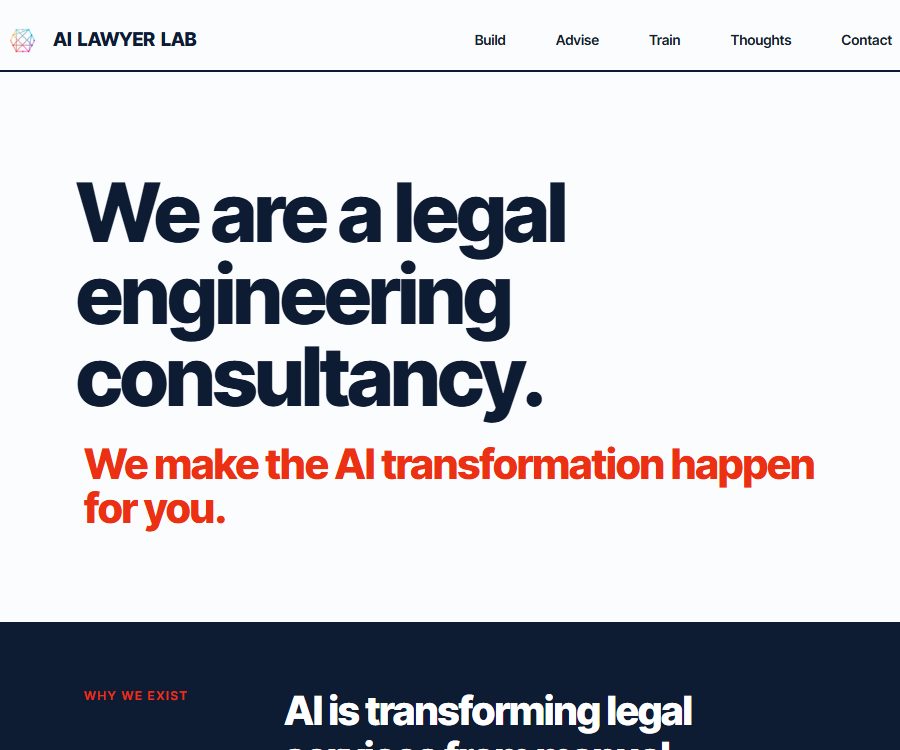
Currently, AI Lawyer Lab functions as a legal engineering consulting firm that assists law firms and legal teams in transforming their expertise into actionable AI workflows. It is not a general legal software that can be used immediately after registration, nor is it a chatbot designed to provide legal advice to individuals.
Early documents often described it as a code-free AI innovation laboratory, but the current official website offers three customized services: Build, Advise, and Train. The information provided in the catalog should reflect the current business model, avoiding reference to outdated software functions and package details.
Three types of core services
Build: Create a semi-automated legal content generation system
The team will first analyze the client’s current legal service processes to establish baseline values for time and cost, and then transform the lawyers’ professional judgments into clear AI instructions. For those tasks that cannot be automated safely, rules for human intervention and quality control points are established.
- It maps the entire workflow from data receipt to the delivery of legal outcomes.
- Extract the client’s own legal experience, rather than replacing it with the knowledge of the consultant.
- Design AI tasks, manual lawyer tasks, and the handover protocols between them.
- Create AI instructions to automate tasks and SOPs to guide manual tasks.
- Implementation is carried out on the customer’s existing AI platform; there is no requirement to purchase new dedicated tools.
- Deliver a production system that customers can maintain on their own and continue to improve.
Advice: Consultation on the transformation to legal AI
This service is intended for law firm management and provides advice on the business opportunities, organizational challenges, and changes in business models brought about by AI. Its feature is that it connects strategic discussions with practical implementation, rather than merely delivering conceptual reports.
- Identify the business scenarios and legal service processes that are suitable for priority transformation.
- Assess the impact of automation on labor division, cost structure, and service pricing.
- Plan the path from pilot projects to routine production.
- Help management understand the capabilities and risk boundaries in a semi-automated environment.
Train: Legal Engineering Training
The training is intended for lawyers and legal professionals who wish to master legal engineering methods. The focus is not on traditional software operation courses, but rather on teaching teams how to break down tasks, write AI instructions, and create repeatable semi-automated processes.
- Understand the difference between legal engineering and the use of ordinary prompts.
- Learn to transform implicit legal experience into clear, testable instructions.
- Design a delivery process that combines AI and human collaboration.
- Establish checkpoints, handover rules, and a mechanism for continuous improvement.
Delivery methods and efficiency commitments
The official website states that a typical project can be completed within three months, and it emphasizes that there is no need to introduce new AI tools or hire specialized IT support. The code-free solutions are compatible with various AI platforms, and the choice of model and system depends on the customer’s existing infrastructure.
The authorities also offer a guarantee of at least a two-fold increase in end-to-end efficiency; in other words, the time required to complete the modified process should be no more than half of the original time, otherwise a refund will be provided. The baseline criteria for this commitment, the measurement periods, the customer’s obligations, and the conditions for refunds are not fully detailed on the public website, and these details must be specified in a contract once a formal partnership is established, with each item being confirmed separately.
Which institutions are suitable?
- Law firms that have acquired AI tools but yet to establish a stable production process.
- A legal department that aims to turn the experience of senior lawyers into an asset for the team.
- A professional team is needed to handle contract revisions, due diligence, research, or document preparation processes.
- Legal service firms that plan to adopt efficiency-oriented pricing methods such as fixed fees.
- It is hoped to develop in-house legal engineering capabilities, rather than relying on outsourcing for a long time.
Prices and cooperation methods
As of August 25, 2026, the official website does not disclose any standard packages, monthly subscription fees, or fixed pricing for specific services; therefore, it is not possible to create fictional price comparison tables. Due to differences in the scope of the projects, the desired workflows, the amount of manpower required, and the existing technical infrastructure, individual quotes will likely be necessary.
The official website provides a free option for preliminary discussions; customers can first describe their business needs and the desired outcomes. The final costs, payment deadlines, guarantees of efficiency, intellectual property rights, confidentiality obligations, and subsequent support shall be determined in accordance with the service contract signed by both parties.
Cooperation process
- Identify the types of legal services that wish to be improved, the existing processes, and the main efficiency issues.
- Schedule an exploratory discussion to determine whether the goal is suitable for being addressed through legal engineering methods.
- Select a workflow with clear boundaries and measurable criteria as the first project.
- Jointly record the current processing time, labor costs, quality requirements, and risk factors.
- Lawyers provide the expertise, and the team converts it into AI instructions, handover rules, and SOPs.
- Test the process on the customer’s existing AI platform, and establish points for manual review and quality checking.
- Use the agreed-upon metrics to compare the effects before and after the transformation, and then decide whether to extend it to other services.
Its difference from general-purpose legal AI software
- It is not a software subscription with unified functions, but rather customized consulting tailored to the customer’s workflow.
- Legal expertise primarily comes from the client’s own legal team.
- The focus of delivery is AI instructions, process rules, SOPs, and an operational production system.
- It is possible to use the customer’s existing AI platforms, without being tied to any single model or software.
- The project takes into account organizational collaboration and business model considerations, rather than focusing solely on individual legal tasks.
Data security and professional responsibility
Legal documents usually contain customer secrets, personal information, trade secrets, and other materials subject to confidentiality obligations. Since the solution may operate on a third-party AI platform chosen by the client, whether the data is used for model training, its storage location, the duration for which it is retained, and the access rights associated with it all depend on the specific implementation environment.
- Give priority to platforms that support enterprise data control, permission management, and audit logging.
- Complete data classification, masking, and vendor security assessment before importing real cases.
- Clarify the boundaries of responsibilities among the client, law firms, model providers, and other parties involved.
- Provide for manual review by lawyers regarding legal conclusions, citations, deadlines, and key facts.
- Do not equate improved efficiency with the inevitability of correct legal outcomes.
API and open-source status
As of this verification, no developer API provided by AI Lawyer Lab to the public was found, nor was there any official open-source repository that could represent its consulting methods or commercial services. Its claim of being code-free refers to the way in which it operates, and it does not mean that the underlying code or the platform’s source code is made available openly.
Product advantages
- Focus on end-to-end production of legal services, rather than isolated AI Q&A.
- Transform the customer’s existing expertise into reusable process assets.
- At the same time, design automatic processes, manual tasks, and quality control.
- There is no need to replace the existing AI platforms, which reduces the costs associated with adding new tools and integrating systems.
- Construction, strategic consulting, and team training can be implemented in combination.
Usage restrictions
- It is a customized consulting service, and it cannot be registered and used immediately like standard software.
- The official website does not disclose prices; the budget and timeline need to be determined on a case-by-case basis for each project.
- The outcome depends on the effort invested by the client’s lawyer, the quality of the information, and the capabilities of the existing platform.
- The scope of application of the efficiency guarantee and the conditions for refunds shall be governed by the formal contract.
- The public page does not provide a complete technical security white paper or standard data processing terms.
Frequently Asked Questions
Is AI Lawyer Lab a legal robot?
No. The current business involves assisting legal firms in designing and implementing AI-driven semi-automated workflows; it does not provide automatic legal advice to individuals directly.
Is it necessary to purchase new AI software?
The official website states that its code-free approach allows users to take advantage of their existing AI platforms, and no additional specialized tools are usually required. However, actual projects may still involve account upgrades, security configurations, or costs related to third-party services, which should be clarified during the planning stage.
Are there public member prices?
No unified subscription plan or public project pricing could be identified. The customer needs to first discuss the scope of the services required in order to obtain a tailored quote.
Is it an open-source platform?
It is not a verified open-source platform, nor is there any public official API available. The no-code approach is merely a method of construction; it does not mean that the resulting service can be freely copied or redistributed.
Tools similar to AI Lawyer Lab



 Guigong Network Security Registration No. 45132202000164