






AI and Process Automation Platform
An AI and Process Automation Platform that makes AI programming more efficient and simpler.
Tags:AI programming toolsWhat is Decisions?
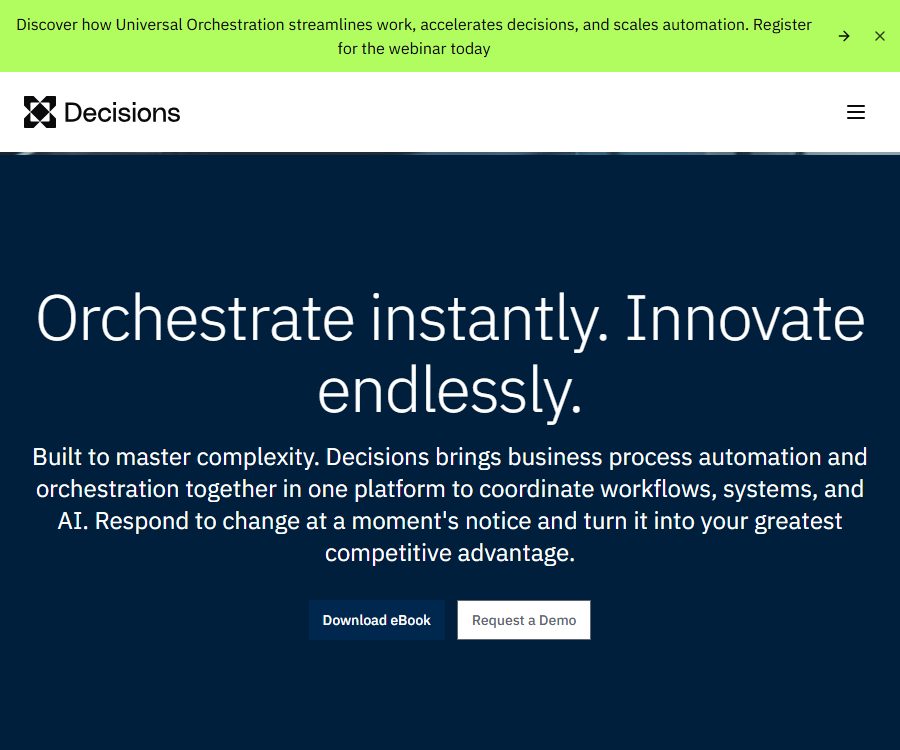
Decisions is a platform for enterprise AI orchestration, business rule management, and process automation, designed to coordinate workflows, systems, people, and AI Agents. It focuses on end-to-end process orchestration rather than merely automating individual tasks.
Organizations can use visual designers to create rules, processes, forms, dashboards, and business applications. AI actions operate under constraints related to approval processes, permissions, rules, and audit trails, making them suitable for use in high-risk corporate processes.
Main functions of Decisions
1. Visualizing workflows
The low-code designer allows for the organization of tasks, conditions, approvals, system calls, and error handling paths. Business users and development teams can view and modify the execution logic within the same flowchart.
2. Enterprise rule engine
The rule engine handles qualification, pricing, routing, approval, exceptions, and other decision-making logic in a centralized manner. Rules can be tested, tracked, and updated independently, which reduces the need to have such logic scattered across multiple applications.
3. AI Agent Orchestration
The platform incorporates AI Agents, models, personnel, and business systems into governed processes, rather than allowing the Agents to operate independently. Companies can set up permissions, enable manual review, implement approval processes, and maintain audit records.
4. Form and application development
Users can create custom forms, pages, dashboards, and business applications for use in processes such as applications, approvals, case management, and operational tasks. The external interfaces can also be connected to the platform’s backend via APIs.
5. Case Management
Dynamic cases can range from initiation to final resolution, with tasks being adjusted as conditions change. Human judgment, rules, and AI outputs can all be utilized in the same case.
6. System integration
The platform offers a variety of pre-built connectors, APIs, and extension mechanisms that enable integration with existing data sources, enterprise applications, RPA tools, and AI models. Complex older systems may still require custom modules.
7. Intelligent document processing
Additional solutions can make use of intelligent document processing to extract and classify forms, PDF files, or business documents. Before being put into use in production, their accuracy must be verified using actual samples, along with an automated correction process.
8. Process Intelligence and Mining
Process intelligence is used to monitor actual tasks, decisions, and Agent activities in order to identify bottlenecks and anomalies. Teams can continuously optimize rules and workflows based on the execution data.
9. Audit and Governance
The platform retains records of operations, decisions, approvals, and status histories, and it supports role-based permissions as well as isolation of different environments. Companies can track why a certain decision was made and who was responsible for reviewing it.
Which organizations are suitable?
- Medium and large enterprises that need centralized management of cross-departmental approval processes and operational workflows.
- Organizations that use AI in regulated environments such as finance, healthcare, and the public sector.
- Teams that wish to extract business rules from the core system and manage them in a visual manner.
- It is necessary to take into account complex processes involving humans, AI Agents, RPA, and enterprise systems.
- Organizations with sensitive data that require options for cloud, hybrid, or on-premises deployment.
Price and version comparison
As of August 24, 2026, Decisions employs a corporate pricing model that takes into account capabilities, usage volume, and deployment scope; it does not charge based on the number of user accounts. A formal quote should be obtained prior to payment, based on the number of cases, the environment, deployment details, and any additional modules used.
| Plan | Public price | Primary positioning and capabilities |
|---|---|---|
| Mid-Market Standard | $ | 1,000 cases per month, unlimited processes and users, forms, rules, governance, as well as development and production environments |
| Foundation | Custom quote | Activate the first batch of enterprise workflows and standard Agent capabilities |
| Growth | Custom quote | Cross-departmental expansion, advanced agents, and governance capabilities |
| Enterprise | Custom quote | High availability, multi-region deployment, strict governance, and business-critical agent processes |
The Standard plan includes a dedicated customer success manager, unlimited users and processes, a custom interface, as well as secure data management. Higher-tier plans add an AI workflow builder, intelligent document processing, process mining, and other enterprise capabilities.
It should be confirmed at the time of quoting.
- How are cases defined, and are reopened, failed, and long-term cases counted repeatedly?
- The unit price or upgrade rules after exceeding 1,000 cases per month.
- Number of development, testing, disaster recovery, and multi-region environments.
- Costs for AI models, document processing, RPA, and third-party connectors.
- Costs associated with local deployment, upgrades, dedicated infrastructure, and high availability support.
- Are implementation, training, migration, and professional services charged separately?
Tutorial on building workflows
- Select a business process that has clear boundaries and quantifiable value.
- Record existing steps, personnel, systems, rules, waiting points, and exceptions.
- Create the main path in the designer, and prioritize completing the failed and manually handled branches.
- Centralize eligibility, routing, and approval criteria in the rule engine.
- Create form and status pages to restrict the data that each role can view and modify.
- Connect to external systems and implement idempotent and compensatory logic for write operations.
- Use historical cases for testing in order to verify rules, permissions, and audit records.
- It is first released in the development environment, and after approval it is deployed to the production environment.
- After going live, monitor the case cycle, error rate, and manual workload.
Tutorial on Introducing AI Agents
- Identify the tasks that are well-suited for AI to handle, as well as those actions that must be decided by humans.
- Restrict the data, tools, and external systems that an Agent can access.
- Place the key business rules in a deterministic rule engine, rather than relying solely on prompts.
- Add manual review for data with low confidence, sensitive data, and high-risk actions.
- Record the model inputs, outputs, tool calls, and the basis for the final decision.
- Adversarial examples are used to test prompt injection, privilege escalation, and incorrect tool calls.
- Set policies for fees, timeouts, retries, and fallback in case of failure.
- Evaluate whether AI truly reduces cycle times and labor costs using process metrics.
Deployment method
- Cloud deployment: It is hosted by the platform environment, and is suitable for teams that wish to reduce infrastructure management tasks.
- Hybrid deployment: Distribute components and data between the cloud and on-premises systems.
- Local deployment: Suitable for organizations with strict requirements regarding data, networking, or regulations.
- The upgrades, backups, monitoring, and responsibility boundaries for different deployment models should be specified in the contract.
- High availability, multi-region, and dedicated environments typically fall under the enterprise level.
Product advantages
- Workflows, rules, forms, AI Agents, and integrations are all unified on one platform.
- There is no charge to users, which makes it easy to spread this process among a large number of business participants.
- Rule engines enhance the consistency, interpretability, and auditability of corporate decisions.
- Supports cloud, hybrid, and on-premises deployment.
- AI Agents can be placed under human approval and corporate rule constraints.
- From simple workflows to case management and enterprise-level orchestration.
Usage restrictions and precautions
- Mid-Market has a high starting price, making it unsuitable for individual use or the automation of small teams.
- Custom quotes make it difficult for companies to accurately estimate the total cost before trying out a product.
- Low-code still requires capabilities in process analysis, data modeling, testing, and platform governance.
- A large number of custom modules can increase the complexity of upgrades and long-term maintenance.
- AI and document processing cannot replace deterministic rules and human responsibility.
- Case measurement, environment, and additional capabilities are the main cost variables.
- Before migrating critical processes, it is necessary to verify performance, recovery options, and vendor exit strategies.
Safety and compliance
The official pricing and security pages list certifications or compliance standards such as SOC 2, HITRUST, HIPAA, ISO 27001, and PCI DSS. Purchasers should request the current certificates, the audit periods, and the specific scope of the products, rather than relying solely on marketing claims.
- Use role-based permissions to restrict design, deployment, approval, and data access.
- The development environment is separated from the production environment, and approval processes are in place for releases.
- Sensitive fields need to be protected during transmission, storage, logging, and export.
- Regularly test backup restoration, failover, and incident response.
- Third-party AI models and connectors require separate security assessments.
- Audit records should have mechanisms to prevent tampering, access controls, and a specified retention period.
API and open-source status
Decisions offers API, SDK extensions, and the ability to create custom modules; developers can thus develop C# Flow Steps, JavaScript controls, and external interfaces. The specific permissions for these interfaces vary depending on the license and environmental settings.
The official GitHub page provides examples of SDKs, control component projects, and utility tools; some of these are distributed under licenses such as MIT, but the source code for the main platform is not made available. Therefore, Decisions should be classified as a proprietary commercial platform that is not open source.
Frequently Asked Questions
Are decisions charged to users?
There is no charge based on the number of user seats; the price is determined primarily by usage volume, capacity, deployment, and scope.
How much is the Standard plan?
The Mid-Market Standard starts at $3,000 per month on an annual billing basis, and includes 1,000 cases per month.
Is local deployment supported?
It supports cloud, hybrid, and on-premises deployment; the specific architecture and costs require a quote for confirmation.
Can AI Agents be scheduled?
Yes. The Agent operates within a governed workflow, allowing for the application of business rules, approvals, permissions, manual review, and auditing.
Is Decisions an open-source platform?
No. The officials only make available SDK examples and some auxiliary projects; this does not mean that the main platform is open source.
Summary
Decisions is suitable for medium to large organizations that need to manage corporate rules, workflows, employees, and AI Agents in a unified manner. It offers a comprehensive set of capabilities and deployment options, but the price threshold, cost calculation based on case volume, implementation costs, and the complexity of customization all need to be carefully assessed before launching a pilot project.
Tools similar to the AI and Process Automation Platform



 Guigong Network Security Registration No. 45132202000164