






Adversa AI
Adversa AI – makes AI programming more efficient and simpler.
Tags:AI programming toolsWhat is Adversa AI?
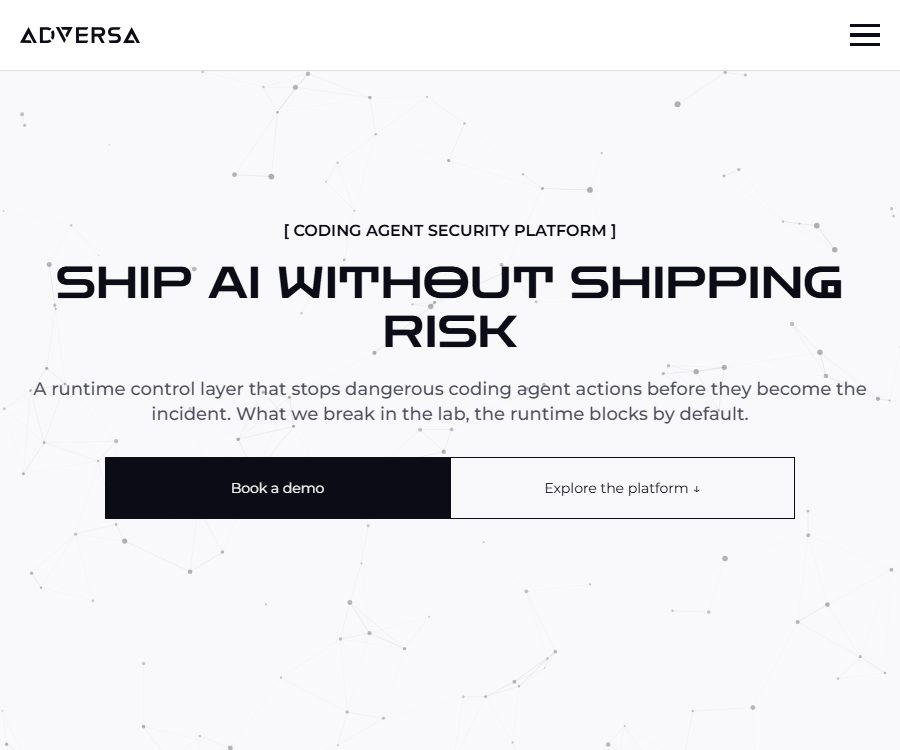
Adversa AI is a runtime security platform designed for enterprise coding agents, aimed at controlling the actions that these agents carry out throughout the software development lifecycle. It pays attention not only to prompts and model responses, but also to tool calls, file operations, network connections, and terminal commands.
The current product is intended for teams that use coding agents such as Claude Code, Copilot, Cursor, and Codex. The platform links consecutive actions into a decision chain, and it issues alerts, requires manual confirmation, or blocks actions before a hazardous sequence can be completed.
Main functions of Adversa AI
1. Visibility of the encoding proxy during operation
The platform keeps track of the model calls, tool calls, file accesses, and external connections made by the proxy agents, and it distinguishes between the actions taken by these agents and those performed by the developers themselves. The security team can see what the agents have done and under what context they took action.
2. Behavior chain analysis
A single action may seem normal, but when multiple actions are combined, they can lead to data breaches or supply chain attacks. Adversa AI creates agent decision trees that link inputs, actions, and their impacts, thereby assessing the risks associated with the resulting chains of actions.
3. Block before execution
When the chain of actions exceeds the risk threshold set by the organization, the platform can prevent its execution before the actions are carried out. Policies can be activated separately for different teams, environments, and risk types; alternatively, warnings can be issued or manual approval may be required first.
4. Default security policy
According to the official description, the platform comes pre-loaded with over 100 strategies based on research into real-world attacks, covering proxy hijacking, credential theft, malicious commands, and harmful toolkits. Companies can also describe rules in natural language; after verification, simulation, version control, and approval, such rules can be activated.
5. Observation mode
Companies can first simply keep track of such behaviors without interrupting the development process immediately. During the pilot phase, it is possible to see which actions would otherwise be blocked, as well as the rate of false positives and the operational overhead, before deciding to introduce mandatory enforcement gradually.
6. AI Red Teams and Threat Intelligence
Adversa AI builds on its expertise in AI red teaming and adversarial research, continuously transforming new vulnerabilities, attack patterns, and security findings into testing and protection strategies. Its coverage includes models, agents, application interfaces, tools, and MCP connections.
7. Audit and compliance evidence
The platform retains records of proxy actions, policy decisions, and blocking evidence, which can be exported for audit and incident investigation purposes. The authorities emphasize that it is compatible with frameworks such as the EU AI Act, NIST AI RMF, OWASP, MITRE, and ISO.
Focus on protecting against risks
- Hint injection or malicious contexts can cause the agent to deviate from its original task.
- The agent reads environment variables, keys, or customer data and sends them outward.
- Accidentally deleting the production database, incorrectly modifying the infrastructure, or running dangerous commands.
- Install contaminated dependencies, skills, or MCP servers.
- Submit sensitive files to public code repositories.
- The agent gradually gains more permissions and broader scope of operations as the task progresses through its various steps.
- Attack chains that span different models, tools, and endpoints are not detected by single-point security solutions.
Which organizations are suitable?
- Companies that are already using a variety of AI coding agents on a large scale within their development processes.
- A security team is needed to provide unified management of the risks associated with Claude Code, Copilot, Cursor, and Codex.
- Regulated industries such as finance, healthcare, and insurance, which require isolated deployment and audit evidence.
- The engineering team hopes to first observe the actual behavior of proxies before gradually enabling blocking mechanisms.
- Organizations that need to conduct AI red team testing, threat modeling, and agent security assessments.
Deployment method
The platform can serve as a secure gateway for routing traffic, and security sensors can also be installed on the developers’ endpoints. The gateway monitors models, tools, and MCP calls, while the endpoint components provide information regarding files, commands, and actions within the continuous integration environment.
- It can be deployed on the customer’s own infrastructure.
- Supports deployment in cloud environments.
- It offers isolated network deployment solutions for scenarios with high regulatory requirements.
- It is possible to selectively receive data from existing large-model gateways, without the need to replace the original gateway.
- The event stream can be integrated with the enterprise SIEM, while the terminal sensors can operate in parallel with existing EDR solutions.
- Pilots usually start in observation mode before gradually enabling blocking according to a strategy.
Pilot and launch process
- Select a development team that is already using an encoding proxy as the pilot group.
- Identify the proxies, model gateways, endpoints, tools, and development environments that need to be covered.
- Agree with the supplier on success criteria, performance overhead, log scope, and data boundaries.
- Deploy the gateway or terminal components and run them in observation mode.
- View the proxy action chain, potential risks, false positives, and actions that would otherwise be blocked.
- Adjust the strategy thresholds to define the ranges for alerts, manual confirmation, and forced blocking.
- First, enable a small number of blocking policies in low-risk environments, and then expand them to more teams.
- Integrate events, audit evidence, and response processes into the existing security operations framework.
Costs and purchase methods
As of August 24, 2026, Adversa AI’s official website does not specify any fixed prices for its free version, standard version, or enterprise version. The current page focuses on offering demo sessions and corporate trials, with the platform still being labeled as in its early stages of development.
Officially, a pilot project usually lasts between 14 and 30 days, and it begins with an observation phase centered around a development team. The final cost is expected to depend on the number of protected users, the number of agents, the method of deployment, the extent of integration, and service support; the exact amount shall be as specified in the supplier’s written quote and contract.
It should be confirmed before inquiring about prices.
- Authorization can be calculated based on developers, endpoints, agents, model invocation counts, or deployed instances.
- Whether a fee is charged for the pilot phase, and whether it can be deducted when making a formal purchase.
- Price differences for deployment on local networks, cloud platforms, and isolated networks.
- Log retention period, storage limit, and excess fees.
- Is there a separate charge for the integration of SIEM, identity systems, gateways, and custom policies?
- Whether technical support, response times, training, and red team services are included in the subscription.
Security and compliance capabilities
The official security page states that it has obtained ISO 27001 certification and SOC 2 Type II audit certification, and that it carries out continuous monitoring of its security controls. Purchasers should still request the current certificates, details of the audit scope, and any compliance documents relevant to the specific deployment scenario.
- TLS is used for transmitting data, while static data is encrypted through cloud key management mechanisms.
- Privileged accounts require multi-factor authentication and their access rights are reviewed regularly.
- Provides access points for data processing agreements, privacy policies, and compliance documents.
- Customers can request access to, correction of, deletion of, or export of their relevant personal data.
- Local and isolated deployments can reduce reliance on public AI interfaces and external networks.
- Event records and policy evidence can be used for internal audits and security investigations.
Product advantages
- Observing the model, tools, and terminal actions simultaneously provides a more comprehensive view than analyzing only the scope of the prompt.
- By understanding multi-step risks through behavior chains, the possibility of missed combined attacks due to single-event rules is reduced.
- It supports a gradual rollout approach that includes observation, warning, manual confirmation, and blocking.
- A unified strategy can be applied across various encoding proxies, reducing the fragmentation resulting from control by a single vendor.
- It supports various enterprise deployment scenarios, including customer infrastructure, cloud environments, and isolated networks.
- By integrating AI red team research, default policies, and audit evidence, it facilitates the work of security teams.
Usage restrictions and precautions
- The product is still in its early stages of use, and its features, coverage area, and commercial terms may change.
- The official website does not disclose standard prices, making it difficult for small and medium-sized teams to estimate the procurement costs directly.
- Runtime controls cannot replace code review, access control, key management, and secure development processes.
- A failed open design can reduce the impact of platform failures on developers, but it may also decrease protection during such failures.
- The collection scope of endpoints and gateways must be aligned with employee privacy, data classification, and regional regulations.
- Excessively strict policies can interfere with normal development, while overly lenient ones may fail to detect dangerous behaviors.
- The extent of coverage for new agents and custom tools should be verified item by item during the pilot phase.
Data and privacy boundaries
The official statement specifies that the platform collects telemetry data on proxy actions, rather than storing the entire codebase, and adds that keys are not stored. Companies should still confirm, through contracts and technical tests, the actual fields, the methods used for data masking, the retention period, the deletion procedures, and the sub-processors involved.
- Identify which model messages, tool parameters, paths, and commands will be included in the logs.
- On the gateway side, filter out the code, keys, and personal information that do not need to be sent.
- Isolate highly sensitive items and use terminal components configured with the minimum required permissions.
- Tiered access is provided for security personnel to prevent audit logs from becoming new sources of data leakage.
- Verify the deletion request process, backup cleanup, and event export process.
Explanation of the open-source status
As of the verification date, no official open-source repository or open-source license for the Adversa AI commercial security platform was found; therefore, the main product should not be labeled as open source.
The official GitHub organization has made available the SecureClaw and security research repositories. SecureClaw is an audit, hardening, and runtime security plugin designed for OpenClaw; it is a separate project and does not imply that the source code of an enterprise platform is made available, nor does it allow for free private deployment.
Frequently Asked Questions
What does Adversa AI mainly protect?
It primarily protects the AI coding agents used by enterprises, as well as related models, tools, files, networks, and terminal operations; it also issues alerts or blocks any dangerous sequences of actions.
Will it replace the existing large-model gateways or EDR solutions?
No. It can read some of the telemetry from existing gateways and operate in parallel with endpoint security products, thereby providing additional context and information for analyzing action chains.
Can we not block the developers for now?
Yes. Pilots usually start with an observation mode, during which only those actions that would otherwise be blocked are recorded and evaluated, before a decision is made regarding the implementation of enforcement measures.
Is there a public price for Adversa AI?
There are no fixed public packages or unit prices; it is necessary to schedule a demonstration in order to obtain a quote based on the scope of deployment and testing.
Is Adversa AI an open-source product?
The commercial platform has not confirmed that it is open source. The SecureClaw version made available officially is a separate OpenClaw security plugin; the two should not be confused with each other.
Summary
Adversa AI is suitable for enterprises that already use coding agents on a large scale and need visibility across different tools as well as control before execution. Its capabilities in terms of behavior chain analysis, progressive blocking, and isolated deployment are quite effective; however, it is necessary to conduct pilot tests prior to purchase to assess coverage, false positives, performance, data boundaries, and the actual cost.
Tools similar to Adversa AI



 Guigong Network Security Registration No. 45132202000164