






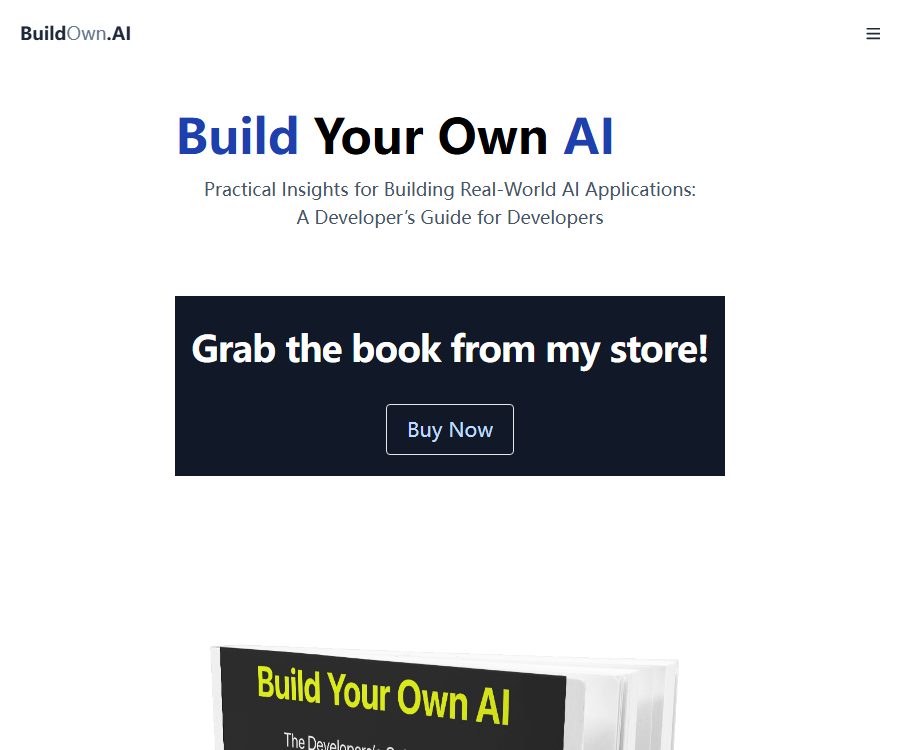
Build Your Own AI
Build Your Own AI – to make AI programming more efficient and simpler
Tags:AI programming toolsWhat is Build Your Own AI?
Build Your Own AI is a book on AI application development along with accompanying learning materials, written by Sebastian Wessel. It explains how to create chatbots, RAG systems, tool calls, and AI agents using TypeScript and real-world examples.
It is not a no-code platform that allows creating applications by simply entering a sentence, nor does it offer subscriptions for hosted models. The official website is primarily used for reading the catalog, previewing chapters, viewing example projects, and purchasing e-books.
A one-sentence summary
Build Your Own AI is a practical tutorial for developers focused on LLMs, emphasizing the understanding of underlying patterns and the creation of controllable AI applications with minimal dependencies.
Author and learning orientation
The author, Sebastian Wessel, describes this book as a practical guide written for developers, suitable for beginners, programmers with some prior experience, and those interested in AI applications. Its purpose is not to focus on scientific research or the training of basic models.
The example uses TypeScript, Bun, and direct network requests, in order to minimize framework abstraction. Readers can apply the underlying concepts to Python, Java, Go, or other languages.
Main topics of study
Fundamentals of large language models
The introductory chapters explain concepts such as language models, knowledge storage, tokenization, and context. The goal is to help application developers understand the input and output of these models, rather than delving into mathematical derivations.
Run the model locally
The book introduces LM Studio and Ollama, helping readers run free models on their own computers. This reduces the reliance on external interfaces and allows one to examine the trade-offs between hardware, speed, and model size.
The first AI application
Readers will start with basic requests, and gradually additional elements such as chat history, system prompts, and behavior controls will be introduced. The examples avoid hiding the underlying logic, making it easier to understand the function of each request field.
Hint engineering
The content covers various modes such as system prompts, reasoning, self-reflection, and code assistant suggestions. Prompts are merely a part of the system; they cannot replace data, evaluation, permissions, or error handling.
RAG retrieval enhances generation
The RAG chapter covers knowledge base creation, vector search, answer evaluation, and retrieval improvements. Readers will learn how to enable models to provide answers based on their own documents, rather than relying solely on parameter memory.
Knowledge graphs and data construction
The book further explains knowledge extraction, knowledge graphs, question-answering datasets, and data review. It is suitable for developers who need to convert unstructured content into searchable knowledge.
Model selection and evaluation
The tutorial compares models such as Llama and Qwen, and discusses factors like temperature, context, and task performance. Model versions change rapidly; readers should use these methods as a framework for evaluation rather than as fixed rankings.
Tool invocation
The section on tool invocation shows how to enable the model to trigger functions and interact with the external environment, while also introducing modern approaches to tool invocation and simplified implementations. The focus is on structured parameters, permissions, and the return of results.
AI programming environment Buddy
The accompanying Buddy project demonstrates an AI-driven IDE in the browser, featuring code generation, file system tools, and project-related knowledge. It is intended for educational purposes and should not be considered a fully developed commercial development environment.
AI agent
Subsequent chapters cover checklist agents, fact agents, and agent extensions. Readers will be able to understand how task breakdowns, loops, tools, and termination conditions are combined.
Fine-tuning and RAG selection
The book provides a foundation for fine-tuning and compares the applicable scenarios of fine-tuning with RAG. Most issues related to knowledge updates are better suited to RAG, while problems concerning format and behavioral stability may require fine-tuning.
Overview of chapter structure
| Phase | Theme | Main achievements |
|---|---|---|
| Foundation | Models, Tokens, Local Execution | Understanding LLM requests and the environment |
| Application | Chat history, system messages | Complete the basic chat application |
| Knowledge | RAG, vector retrieval, knowledge graphs | Build a searchable knowledge base |
| Evaluation | Model, temperature, context | Compare quality and cost |
| Tools | Function calls, file system | Enable the model to perform controlled operations. |
| Agent | Loops, checks, and fact agents | Create a multi-step process |
| Advanced | Fine-tuning and RAG decision-making | Choose the appropriate customization method. |
Which readers is it suitable for
- Front-end and full-stack developers: those who wish to understand AI applications rather than just using pre-packaged frameworks.
- Backend developer: Responsible for implementing chat, RAG, and tool invocation interfaces.
- TypeScript users: wish to learn LLM applications using a language they are familiar with.
- Developers who don’t use Python: want to master portable, universal patterns.
- Independent developers: Prepare to develop local or cloud-based AI prototypes.
- Technical lead: It is necessary to evaluate RAG, agents, and fine-tuning approaches.
Which needs it is not suitable for
- Users who hope to create websites or agents without the need for programming.
- For readers who need complete mathematical derivations and research on basic model training.
- Companies that only wish to purchase hosted chatbot services.
- Teams that need ready-made enterprise permissions, auditing, and service support.
- Projects that aim to put the code into production straight away, without making any security improvements.
Purchase and price
The official website provides links to the author’s store as well as other bookstores where purchases can be made. As of August 24, 2026, the author’s store page requires security verification, and the public pages do not display a unified price that can be checked directly.
Price variations can occur due to different stores, countries, currencies, e-book formats, and promotions. Before making a purchase, it is necessary to refer to the amount displayed on the store’s final page, as well as the taxes, file format, number of downloads allowed, and refund policies.
| Project | Current confirmed information |
|---|---|
| Preview of website sections | The table of contents and some of the content can be read for free. |
| Supporting code | Public view on GitHub |
| E-book prices | It is not possible to confirm this from the official store’s public page for now. |
| Purchase channels | Author’s store and third-party bookstores |
| Subscription fee | No monthly subscription for AI platforms. |
| Additional operating costs | Costs for local hardware or external model interfaces |
Buying books does not include any quota for cloud models, nor does it mean that the third-party services mentioned in the examples are available free of charge. Using local models requires investment in hardware, power, and storage, while using commercial models incurs costs based on the prices set by the suppliers.
Environmental requirements before learning
- VS Code, Zed, or other code editors.
- Bun runtime and package manager.
- Modern web browsers.
- Docker runtime environment.
- Sufficient disk space for the local model.
- It is recommended to have at least 16 GB of RAM; 32 GB or more will provide a better experience.
- For local large models, it is recommended to use a GPU such as the RTX 3080 or one with higher specifications.
It is possible to learn about interfaces and architectures even without a high-performance graphics card, but the speed of local inference will be limited. Readers can use smaller quantized models or external interfaces to complete certain sections.
Recommended learning path
- First, read the introductory sections on models, tokens, and context.
- Install Bun, Docker, and Ollama, and run a small model.
- Complete basic chat requests and save the history of multiple rounds.
- Practice system prompts and structured output.
- Build the first RAG knowledge base using a small number of documents.
- Create test questions to compare the accuracy of retrieval and answers.
- Add a read-only tool for parameter validation and error handling.
- Run the Buddy example to understand file tools and project knowledge.
- Implement a simple agent and set the maximum number of steps and termination conditions.
- Finally, compare the applicable scopes of RAG, prompting, and fine-tuning.
How to use the accompanying code
- Enter the official GitHub organization and select the book example repository.
- Read the README, environment requirements, and license.
- Copy the example of environment variables; do not submit actual keys.
- Run the minimal example chapter by chapter to verify the connection between the local model and the database.
- Modify a parameter and observe the changes in the output.
- Create your own test samples for RAG and agents.
- Do not expose the demonstration code directly to the public internet.
- Used to recheck licenses and dependent licenses before using them in commercial projects.
Official GitHub project
| warehouse | Uses | Key technologies | Current status |
|---|---|---|---|
| book_code_examples | Book chapter codes and data examples | TypeScript | Public, 12 submissions |
| buddy | Demonstration of the AI programming environment in a browser | TypeScript, Vue, Ollama | Public; no official release. |
| tools | Simple LLM tool set | TypeScript | Public; the amount of content is limited. |
| buildown.ai | Book website code | JavaScript | Public |
| .github | Organization Overview | Configuration file | Public |
Special attention should be paid to code licensing.
The license for the book example repository is Creative Commons Attribution-NonCommercial-NoDerivs 4.0 International. This license permits sharing for non-commercial purposes, but prohibits commercial use and limits the distribution of modified versions.
Therefore, “open warehouse” does not meet the definition of typical open-source software, nor can it be used in commercial products by default. When modifications are made, the code is released, or it is used for commercial purposes, separate authorization from the author is required.
Meaning of license
- Viewing and learning code is usually not a problem.
- When sharing original materials, it is necessary to retain the attribution and licensing information.
- The licensed materials must not be used primarily for commercial gain.
- The modified material cannot be shared publicly under this license.
- Third-party dependencies are still subject to their respective licenses.
- Commercial projects should obtain a separate license from the author.
Project advantages
- Focusing on practical applications, without sticking to example prompts.
- It covers the entire workflow involving local models, RAG, tool calls, and agents.
- Using TypeScript is suitable for web developers.
- Reduce framework abstraction to facilitate understanding of the underlying networks and data structures.
- The example code is made available publicly, facilitating debugging by chapter.
- Emphasis is placed on evaluating retrieved answers and comparing different models.
- It is not tied to a single model, cloud platform, or programming language.
Usage restrictions and precautions
- The speed at which content is updated may fall behind the rapidly changing models and interfaces.
- The examples are intended for teaching purposes and do not represent production-grade security or scalability solutions.
- Local models require high amounts of GPU power, memory, and disk space.
- Some tools and model versions may differ from those in the book.
- The code license restricts commercial use and the distribution of derivative works.
- Buddy does not have a officially released version, so it is not suitable as a key development environment.
- The current official price of the e-book cannot be found on the public page.
- Readers still need to add authentication, permissions, monitoring, and data protection.
What needs to be added to go from an example to a production environment
- Account, organization, and role permissions.
- Key management, rate limiting, and cost budgeting.
- It includes prompt injection, unauthorized tool invocation, and data leakage testing.
- Log masking, tracking, alerts, and auditing.
- Offline evaluation set and continuous quality monitoring.
- Retry, fallback, and downgrade when the model is unavailable.
- Processes for data retention, deletion, and user rights.
- Dependency lists, license reviews, and supply chain scanning.
Privacy and security
Running the model locally reduces the amount of text sent to cloud providers, but the application may still write data to logs, vector databases, and browser storage. Developers need to examine the entire data flow.
When learning, do not include customer documents, personal information, and production keys in the example projects. When using external model interfaces, it is necessary to read the supplier’s rules regarding data retention and training.
APIs and product formats
| Project | Situation |
|---|---|
| Product format | Developer books, website previews, and code examples |
| Managed AI platform | Not available |
| Officially generated API | No API for proprietary models is provided. |
| Example interface | Use local or third-party OpenAI-compatible interfaces |
| Code made public | Yes, the official organization has 5 public warehouses. |
| Open-source designation | Some of the code is subject to a limited license that is non-commercial and prohibits derivative works. |
BuildOwn.AI teaches how to call model interfaces, but it is not itself a provider of model APIs. The category classification is more suitable for “AI learning resources” or “developer tutorials”, rather than “AI application generators”.
Basic information
| Project | Content |
|---|---|
| Name | Build Your Own AI |
| Author | Sebastian Wessel |
| Type | Books and code tutorials for AI application development |
| Example language | TypeScript |
| Run the tool | Bun, Docker, Ollama, etc. |
| Main theme | Local models, RAG, tool calls, agents, and fine-tuning |
| Price | The real-time prices in the store have not yet been officially confirmed. |
| Code status | Available for public viewing, subject to restricted licensing. |
| Recommendation score | 4.1 points |
Frequently Asked Questions
Is Build Your Own AI an AI tool?
It is primarily a set of developer books along with accompanying code; it is not an online platform that allows one to create applications directly. Readers need to program and run the models on their own.
Is knowledge of Python required?
It’s not necessary; the book uses TypeScript for explanations and emphasizes that the core patterns can be translated to other languages. Having basic programming experience will make learning easier.
Is a high-end graphics card necessary?
Not all chapters are necessary, but running larger models locally is significantly affected by hardware capabilities. It is recommended to have at least 16GB of memory and to use appropriately quantized models.
How much are e-books?
The author’s store is currently protected by security measures, and the public page does not display a definite uniform price; the actual price should be based on that of the store itself and its payment page.
Can the code be used for commercial purposes?
Commercial use cannot be assumed; the example repositories use a non-commercial license that prohibits derivative works. Commercial projects must obtain separate authorization from the author and check the licenses of their dependencies.
Is the project open source?
The code is available for public viewing, but the licensing restrictions do not meet the conditions for free use and modification that are characteristic of common open-source software. It should be properly labeled as a project for learning open-source code.
Summary
Build Your Own AI is suitable for developers who wish to truly understand the structure of LLM applications, especially those with a background in TypeScript and Web technologies. Its advantages lie in its comprehensive approach and clear examples; however, the cost of purchase, hardware requirements, code licensing, and measures for ensuring production safety all need to be determined in advance.
Tools similar to Build Your Own AI



 Guigong Network Security Registration No. 45132202000164