






Potpie
Potpie, an intelligent tool focused on AI programming
Tags:AI programming toolsTool Introduction
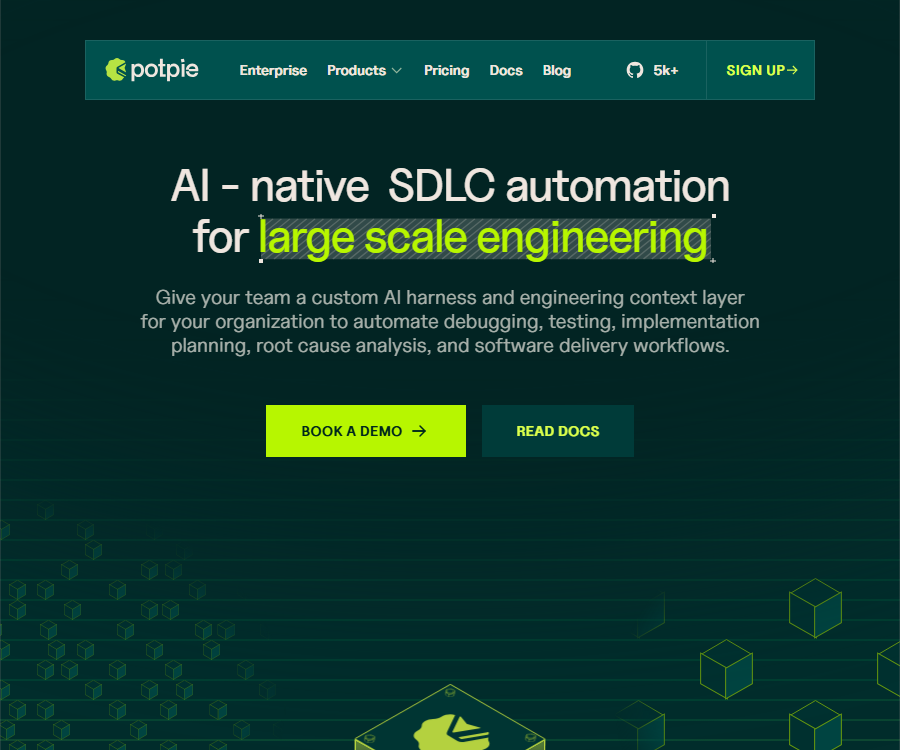
Potpie is a code context mapping and AI development agent platform developed by Momenta Softwares Inc.; it is designed to serve as a specification-driven development tool for large codebases. It organizes code structure, dependencies, version history, project documentation, and engineering tasks into queryable context maps, enabling the agent to understand the project and then carry out tasks such as answering questions, planning, making modifications, and debugging.
Main functions
Code context graph
Potpie indexes repositories, branches, and related project materials, and establishes connections between files, functions, classes, call relationships, and semantic information. Agents can query the graph using keywords, nodes, or natural language, and then retrieve the actual code to answer questions that involve multiple files.
- Suitable for tracking function entry points, dependency chains, implementation locations, and architectural decisions.
- It allows comparing the changes between branches or commits, and analyzing the affected code elements.
- The initial indexing and updates to large warehouses require processing time, and the quality of the results depends on whether the index is complete and up-to-date.
Ask, Build, and Debug workflows
Ask is used to explain code and architecture; Build first analyzes existing patterns before making modifications; Debug traces the symptoms of errors to identify their possible causes and provides targeted solutions. Complex tasks can be broken down by supervisors into smaller sub-tasks assigned to specialized agents, but the resulting outputs still need to go through code review and testing.
- Code Q&A can provide the relevant files and code locations, making it easier for developers to verify further.
- The code generation agent can prepare the changes and create a pull request via GitHub at the user’s explicit request.
- The specification agent can generate technical specifications from requirements or existing code, while the debugging agent is used to analyze error paths and identify points for correction.
Engineering system integration
Potpie can be connected to GitHub, Linear, Jira, and Confluence, allowing code, issues, projects, and documents to be placed within the same context. The product documentation also mentions Slack, Sentry, and VS Code, but the available integrations may vary depending on the deployment version.
- The GitHub integration allows for reading repositories, issues, and pull requests, as well as managing branches and changes within the scope of the granted permissions.
- Tools such as Jira, Linear, and Confluence allow for the retrieval or updating of project information, with the specific actions that can be performed depending on the permissions granted by the administrator.
- VS Code extensions bring code repository chat and editing processes into the editor, connecting to cloud proxies via local tunnels.
CLI, API, and custom proxies
Current open-source architectures give priority to the CLI; it is possible to install corresponding commands or skills for Claude Code, Codex, Cursor, and OpenCode. The API can parse repositories, check the status of indexes, create sessions, send messages, list projects and proxies, and perform semantic code searches.
Usage tutorial
- First, decide whether to use managed enterprise services or a self-hosted open-source version, and set up a separate testing repository in accordance with the organization’s security requirements.
- After installing Potpie, CLI users run the setup wizard and select the local repository, coding assistant, and the project system to which they want to connect.
- The managed user installs the GitHub application and grants permissions only to the target repository; afterwards, they select the repository, branch, and either the Ask, Build, or Debug agent.
- Wait for the index status to be finalized; first consult the architecture or key processes to verify that the responses refer to the correct files and implementations.
- When making code changes, clearly specify the requirements, constraints, and acceptance criteria; check for differences in an isolated branch and run project tests.
- When automation is required, create an API key, assign the minimum necessary permissions to it, store it in a key vault, and rotate it regularly.
Version and usage methods
| Version or entry point | Primary uses | Deployment location | Key requirements |
|---|---|---|---|
| Open-source CLI | Create a context map and provide the coding assistant with tools for searching, recording, and managing engineering contexts. | Local environment | Python toolchain, repository permissions, and credentials for the selected integrations |
| Self-hosted platform | Run web interfaces, proxies, indexing services, and team integration. | Own infrastructure | Container environment, databases, authentication, key management, and model service configuration |
| Managed enterprise platform | Organizational-level code understanding, specification-driven development, and centralized governance | Potpie in the cloud or an agreed-upon environment | Corporate accounts, warehouse authorization, and sales plans |
| VS Code extensions | Ask questions, select items, and request code fixes within the editor. | Local extension plus cloud proxy | VS Code version 1.80 or higher, a Potpie account, and API permissions |
| API | Warehouse parsing, sessions, messages, search, and integration configuration | Managed or self-managed interfaces | API keys and the index of available projects |
Which users are it suitable for
- It is necessary to understand software engineering teams that work on large-scale, legacy, or multi-service codebases.
- A technical leader who aims to reduce the time it takes for newcomers to become familiar with the architecture, as well as to understand implementation details and analysis requirements.
- Enterprise organizations that need to link code changes to project documentation such as Jira, Linear, and Confluence.
- Teams that wish to use self-hosted code agents, extended proxy tools, or to build internal development processes via APIs.
Prices and plans
The current enterprise pricing page does not disclose fixed unit prices; the costs consist of user licenses and platform fees calculated based on the number of users supported, with no additional charge for the existing technology stack. The terms mention the possibility of free and paid plans as well as a Pro version, but the official purchase page does not provide specific prices or limits for these options.
| Package or version | Price | Billing cycle | Core benefits or quota | Suitable for users |
|---|---|---|---|---|
| Open-source version | Software licensing is free; costs for infrastructure and models are to be borne by the user. | No subscription period required | CLI and core code under the Apache 2.0 license, which can be deployed and modified locally. | Developers and teams capable of carrying out maintenance on their own |
| Corporate hosting solutions | Contact sales | In accordance with the contract | Charging is based on user licenses, with a platform fee applied according to the number of users supported; the specific amounts have not been made public yet. | Enterprises that require centralized support and organized deployment |
| Other free, paid, or Pro plans | The authorities have not made this information public yet. | Based on the account or order. | Standard benefits mentioned in the terms but not listed on the current price page | Users who need to try out or verify the data options first |
Product advantages
- The contextual graph connects code structure, history, and engineering documentation simultaneously, making it more suitable for cross-component reasoning than single-file searches.
- Q&A, specifications, building, and debugging share the same project context, thereby reducing the fragmentation of information across different agents.
- The core repository is licensed under the permissive Apache 2.0 license, allowing code review and self-deployment.
- It also provides CLI, a web interface, editor extensions, and APIs to facilitate integration with various development processes.
Usage restrictions and precautions
- An expired index, the absence of private dependencies, or incomplete project documentation can result in key context being omitted from the responses and impact analyses.
- Code generated by agents may introduce security, performance, or compatibility issues, and it cannot replace testing, review, and approval processes before release.
- Connecting GitHub to the task system grants read or write permissions; it is necessary to use the minimum required scope and to isolate production credentials.
- The fact that the open-source version is free does not mean that its use is free; when hosting it yourself, you still have to bear the costs associated with model invocation, computing, storage, authentication, and maintenance.
- The document covers both the old and new architectures; the configuration and capabilities of the CLI version (the preferred one) may not exactly match those of the web proxy version.
Privacy, security, and refunds
The hosting service handles the code, prompts, generated results, authentication tokens, and usage logs; it may also use anonymized input and output data to improve its internal models. The training functionality, which is currently excluded by default in Pro plans, is being introduced gradually. Users who work with sensitive code should first obtain written confirmation regarding the settings, or opt for local or proprietary deployment solutions that meet their organization’s requirements.
The privacy policy states that input data, logs, and feedback may need to be stored for an extended period or even indefinitely for historical, analytical, and training purposes; users can request that this data be deleted, but backups, auditing requirements, and legal obligations may require it to be retained. The platform is not suitable for handling sensitive, regulated data, and access control, as well as network management and patching, are the responsibility of the organization that deploys it.
Payments are generally non-refundable; however, in cases of technical failures, duplicate charges, force majeure, or valid reasons for cancellation, a written request can be submitted within 7 days after the transaction, and the company will decide whether to grant a refund. The processing of such refunds usually takes between 7 and 14 business days, subject to the terms specified in the order contract.
APIs, SDKs, and open-source status
Potpie offers interfaces that utilize API keys for authentication, enabling tasks such as warehouse parsing, status checking, session management, message handling, project management, proxy functionality, and semantic search. There is no separately named universal SDK available at the moment; developers can integrate it directly by referring to the interface documentation.
Both the core Potpie repository and the repository with its own web interface are licensed under Apache 2.0; however, the trademarks of the complete products, hosting services, enterprise features, and third-party integrations are not automatically made available as a result of this licensing. When using self-hosting, it is also necessary to comply with the licenses and terms related to models, databases, authentication, and external platforms.
Frequently Asked Questions
Is Potpie completely free?
Open-source code can be licensed under the Apache 2.0 license, but there are associated costs for deployment, model management, and maintenance. Enterprise hosting services are priced based on the number of users and the scale of the platform; they are not free products with fixed, publicly available prices.
Can Potpie modify the code directly?
The Build or code generation agent can be prepared for modifications, and a pull request can be created upon explicit request. Users should first check the differences in an isolated branch, run tests, and obtain team approval.
Will private code be used for training?
The privacy policy permits the use of anonymized input data to suggest improvements to internal systems; it is stated that Pro mode excludes training data, which is still in the process of being introduced. When dealing with proprietary code, it is necessary to verify the contract terms, data handling options, retention periods, and deployment constraints before uploading it.
Tools similar to Potpie



 Guigong Network Security Registration No. 45132202000164