






Once Upon A Bot
Once Upon A Bot, an intelligent tool focused on AI programming.
Tags:AI programming toolsTool Introduction
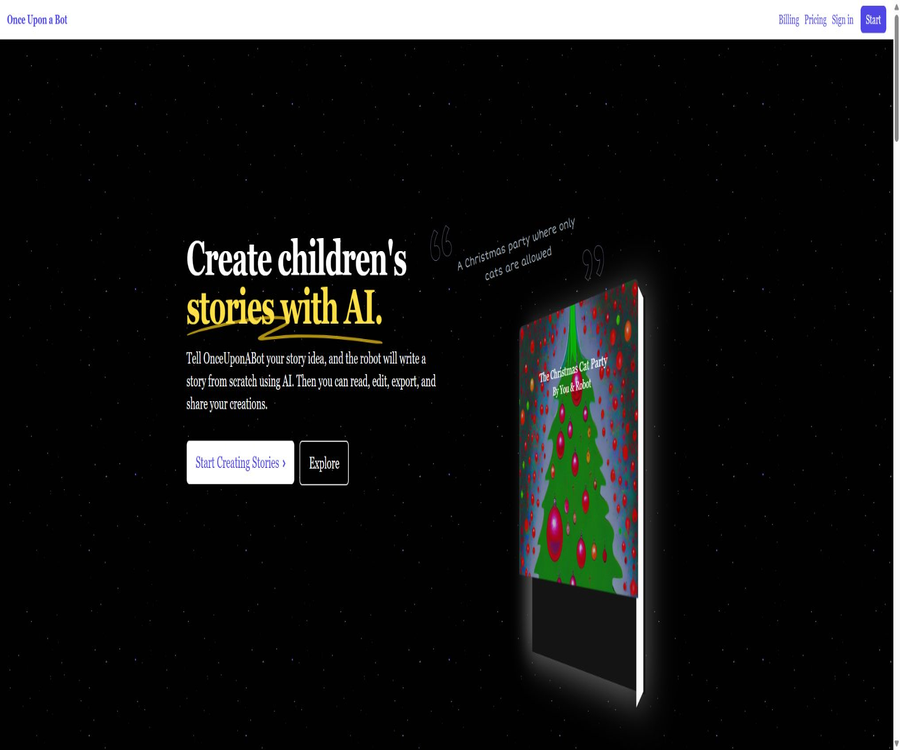
Once Upon A Bot is an online AI tool for creating children’s stories, developed by Charlie Holtz. After the user enters a story idea, the system generates both text and illustrations, and it also offers functions for editing, reading aloud, exporting, and sharing.
Main functions
Story and illustration generation
Users can describe characters, plots, themes, or styles, and the system will generate a story complete with illustrations from scratch. The official website still states that the project makes use of GPT-3 and Stable Diffusion, but it does not indicate whether these are the only or most up-to-date models currently in use.
- Create original stories and accompanying illustrations based on brief prompts.
- The generated text can be modified, and inappropriate images can be redrawn.
- The paid plan includes chapter-based stories and more exclusive content types.
- The generated content may be repetitive, distorted, or inappropriate for minors; it requires review by an adult.
Personalized characters and reading aids
Users can upload photos of people, and the story illustrations will try to depict characters that resemble them; moreover, it is possible to adjust the difficulty level of the text according to the child’s age. The narration mode offers different voice options, making it suitable for reading together with children or for language practice.
- Create personalized characters that can be used in multiple stories through photos.
- Adjust the reading level to change the complexity of vocabulary and narrative.
- Read the story aloud using different voiceovers.
- Photo similarity, voice performance, and difficulty matching are not guaranteed to be entirely accurate.
Multilingual, export, and sharing
The platform allows stories to be created in various languages and automatically translated; users can also export them as PDF files or share them via links. The complete list of supported languages and the quality of translation for each language have not yet been made publicly available.
- Generate or translate children’s stories in a specified language.
- After editing, export the PDF for easy saving or printing.
- Make the work available for others to read through a public link.
- Before sharing publicly, the child’s name, photos, and other identifying information should be removed.
Usage tutorial
- Register an account and first generate results using simple creative tests that do not involve any real children’s privacy information.
- Fill in the role, target age group, theme, values to convey, and elements to avoid.
- When a personalized character is required, upload an authorized, clear photo and specify its scope of use.
- After the story is created, check each page for the text, illustrations, appropriateness for the target age group, and factual accuracy.
- Modify the text or redraw inappropriate images, then listen to the narration again and check the translation.
- After confirming the authorization and privacy settings, select PDF export or link sharing.
Which users are it suitable for
- Parents and caregivers who need to create personalized bedtime stories quickly.
- For teachers and tutors who wish to prepare practice materials at different reading levels.
- Learners who use short stories to carry out activities related to foreign language reading and expression.
- A family creative setting in which the ideas of children can be turned into visual artworks.
- Creators who plan to sell stories should use a plan that clearly includes a commercial licensing agreement and verify its terms.
Prices and packages
| Plan | Public price | Primary interests | Scope of authorization |
|---|---|---|---|
| Start for free | Starting from $0 | Story creation can be tried out; the current free quota available to the public is not specified. | The authorities have not explicitly granted the right for commercial sales. |
| Monthly Plan | $ | Endless stories, audio readings, chapter-based stories, limited categories, and previews of new features | Primarily for personal use. |
| Annual Plan | $ | Similar to the monthly plan, the page indicates a discount of 33%. | Primarily for personal use. |
| Commercial License | $ | Includes a personal payment feature. | Allowing the sale of the created stories |
| Commercial | 50 dollars per month | Dedicated enterprise support for infrastructure, analytics, marketing automation, and custom integrations | The specific commercial rights are determined by the contract. |
The top of the commercial licensing section also indicated $19 per month, but the subscription button clearly showed two options: $29 per month or $19 per month for an annual subscription; there was therefore confusion in the information presented on that page. When purchasing a commercial license, it is necessary to follow the details regarding the payment period, total amount, and licensing terms shown on the settlement page.
The official website provides a free starting point, but the current public page does not specify the number of free stories available, the frequency of resets, or the refund policy. Before making a payment, it is also necessary to clarify the details regarding automatic renewal, the date when cancellation takes effect, the unused time period, and the character limits.
Product advantages
- A complete story creation process that includes text, illustrations, narration, and PDF output.
- Reading levels and personalized characters help to tailor the same idea to specific readers.
- It allows for editing text and redrawing individual images, without the need to regenerate them entirely each time.
- Multilingual creation and sharing links facilitate reading together in both the classroom and at home.
- Commercial licenses are listed separately, providing options for creators who have sales needs.
Usage restrictions and precautions
- When children use it, adult supervision is required; the content generated should not be assumed to be safe or appropriate for their age.
- AI may generate terrifying content, biases, incorrect physical features, or inappropriate scenarios, so it is necessary to review each page carefully.
- Uploading children’s photos poses privacy risks; it is advisable to avoid sharing public links as well as unnecessary personal information.
- Imitating living creators, protected characters, or brand styles can lead to copyright and trademark issues.
- Automatic translation, speech synthesis, and reading levels are merely supplementary tools; they cannot replace the judgment of teachers or language experts.
Privacy and child safety
Registration requires an email address; the personalized character feature processes the photos uploaded by users, and public story links allow anyone who has access to those links to view the content. The official website does not provide clear enough information regarding privacy and child data, so guardians should use real photos and names with caution.
When using it in classrooms or institutions, it is necessary to first obtain the consent of guardians, determine how data will be stored and deleted, address the handling of third-party models, consider age restrictions on accounts, and take into account issues related to cross-border data transfer. If these conditions cannot be met, it is advisable to use fictional characters or materials that do not contain facial features.
Platforms, APIs, and open-source status
Once Upon A Bot is currently a web-based application; users can register for it, create content, read it, and share it through browsers. The developers have not yet confirmed the existence of a native mobile or desktop version, nor have they released any browser extensions.
The enterprise version includes options for custom integration, but the company has not yet released any public API documentation, official SDKs, information regarding interface pricing or rate limits. The source code of the product itself is also not made available, nor is there an open-source license; the use of models such as Stable Diffusion does not mean that the entire platform is open source.
Frequently Asked Questions
Is Once Upon A Bot free?
The official website allows users to start using the service for free, but it does not specify the exact amount allowed on the current public page. Unlimited stories, audio readings, chapter-based stories, and certain other types of content are available only as part of a subscription.
Can the stories that are created be sold?
The official commercial licensing plan includes the right to sell the stories created. Users still need to verify the rights related to characters, brands, uploaded materials, and third parties, and must adhere to the licensing terms at the time of purchase.
Is it suitable for children to use on their own?
Fully unattended operation is not recommended. Adults should review the prompts, the content generated, the use of photos, and the scope of sharing, and make adjustments to any inappropriate text or images.
Tools similar to Once Upon A Bot


 Guigong Network Security Registration No. 45132202000164