






OMQ
OMQ, an intelligent tool focused on AI programming
Tags:AI programming toolsTool Introduction
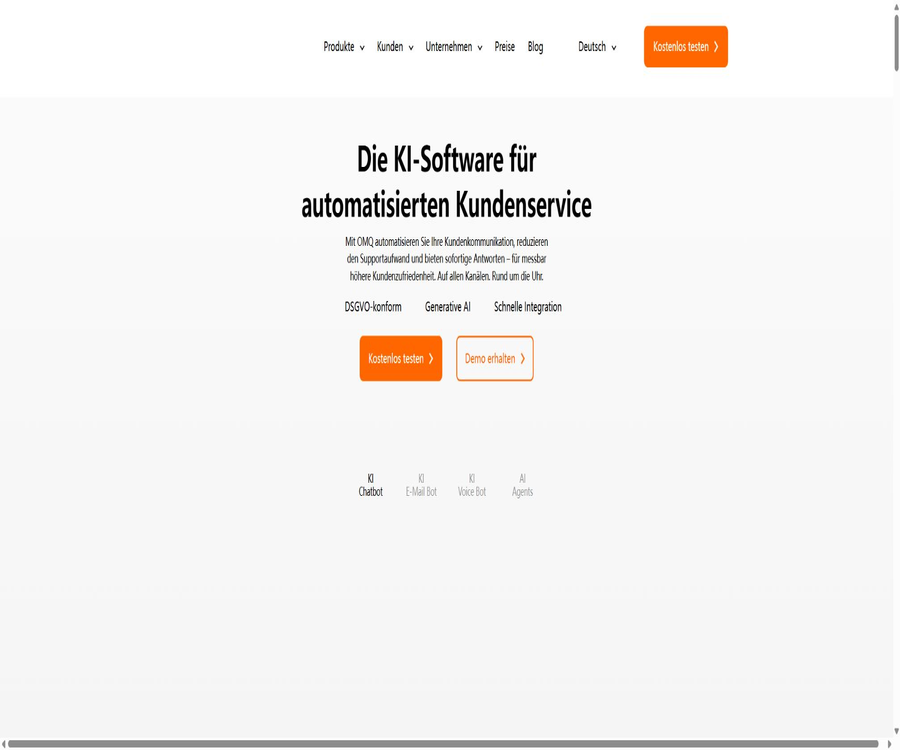
OMQ is an enterprise-level AI customer service automation platform provided by the German company OMQ GmbH, designed for e-commerce, software, education, finance, tourism, and service-oriented organizations. It utilizes a unified knowledge base to provide consistent responses across chat, email, phone calls, help pages, contact forms, and ticketing systems, while also using AI agents to handle certain back-office processes.
Main functions
Unified knowledge base and self-service
The team can import website content and customer service information into a central knowledge base; once updated, this information is synchronized to the connected service channels. The intelligent help page displays relevant content based on the issues encountered and the user’s behavior, while the contact form provides answers before the user even submits a ticket.
- Themes, categories, and standard answers are maintained in the background.
- Enable help pages, chatbots, email, and ticket assistants to reuse the same knowledge.
- It offers automatic translation and reporting features; the number of supported languages depends on the package.
- The knowledge content still needs to be regularly reviewed by business staff to prevent outdated policies from being automatically sent as responses.
Chat, email, and voice robots
The OMQ Chatbot can be deployed on websites and messaging platforms, and it routes complex inquiries to human customer service agents. The email bot analyzes incoming messages and replies automatically to those with identifiable issues, while the voice bot handles repeated questions received over phone calls.
- Chatbots support intent recognition, natural language responses, and manual transfer to a human agent.
- Email bots can generate or send customer service responses from a knowledge base.
- Voice robots can automatically answer common phone inquiries, reducing waiting times.
- Ticket Assistant suggests answers that can be used directly by customer service agents, rather than sending them automatically in all situations.
AI Agent and system integration
An AI Agent can access authorized backend data and carry out tasks such as checking order status, modifying addresses, canceling orders, or processing returns. The ability to perform specific actions depends on the enterprise’s system, permissions, integration methods, and the terms of the contract.
- It can be connected to help desks, email accounts, stores, logistics services, messaging apps, CRM systems, and calendar tools.
- The integrations listed by the official source include Zendesk, Zammad, Shopify, Shopware, Salesforce, HubSpot, WhatsApp, and Microsoft Teams, among others.
- Some plugins are connected using account-specific keys, but this is not equivalent to an open public developer API.
- For high-risk operations, authentication, permission controls, logging, and manual review mechanisms should be in place.
Usage tutorial
- Apply for a 14-day trial or demonstration to identify the channels, volume of requests, and business processes that require automation.
- Import website or existing customer service content, and organize topics, categories, and standard answers in the central knowledge base.
- First, connect to the help page or the testing environment, and use real but anonymized questions to check the coverage of answers.
- Access chat, contact forms, email, ticket systems, or voice channels as needed, and set conditions for manual transfer.
- When an AI Agent is needed, a connection to the backend system is established using the minimum required permissions, and confirmations as well as auditing are implemented for write operations.
- By reviewing the reports, ongoing unresolved issues, incorrect answers, and records of cases transferred to human agents are identified, followed by updates to the knowledge base and processes.
Which users are it suitable for
- A corporate customer service center that needs to maintain consistent answers across websites, emails, chats, and phone calls.
- E-commerce and service companies that have a large number of repeated orders, as well as inquiries related to deliveries, accounts, or contracts.
- Teams that are already using a help desk, CRM, store, or messaging platform and wish to retain their existing systems.
- European organizations that need multilingual self-service options, clear data protection requirements, and corporate support.
- Users with very low demand or those who only need a simple chatbot for personal use may find the initial price and scope of implementation to be excessive.
Prices and packages
| Package | Monthly payment | Average monthly amount for annual payment | Average per month over two years | Main scope |
|---|---|---|---|---|
| Starter | 160 euros per month | 150 euros/month | 130 euros per month | 1 help page, unlimited themes and categories |
| Essential | 490 euros per month | 450 euros per month | 400 euros per month | 1 help page, 1 contact form or chatbot, 3 processes, 1,000 requests and reports |
| Business | 1,300 euros per month | 1,200 euros per month | 1,000 euros per month | 3 help pages, 3 contact forms, 1 chatbot, 1 email bot, 10 workflows, and 5,000 requests |
| Corporate | 3,000 euros per month | 2,800 euros per month | 2,500 euros per month | 10 help pages, 10 contact forms, 3 chatbots, 3 email bots, 25 processes, and 15,000 requests |
| Flex | Contact sales | Contact sales | Contact sales | Combine channels, requests, languages, modules, support, and integrations as needed |
All the prices listed above are official figures excluding value-added tax; the page offers options for monthly, annual, and two-year payments. An additional 100 euros is charged for each extra chatbot, while email bots may incur additional costs for setup, technical integration, and customization.
All available options specify a 14-day trial period, no initial fee, and the ability to start using them immediately. The contract duration, any additional requests, cancellation policies, refunds, and the specific service levels are determined in accordance with the quotation and the terms agreed upon in the contract.
Product advantages
- The central knowledge base reduces redundant maintenance across different channels and ensures consistent answers.
- The products include self-service pages, contact forms, chat, email, voice communication, as well as support through human agents.
- It supports the addition of automation to existing customer service and business systems, without requiring a complete replacement of the technical stack.
- From answering questions to executing background processes, the deployment can be carried out in stages, which facilitates risk control.
- The pricing page reveals the number of requests, the count of components, and the prices for long-term contracts, making it easy to compare different options.
Usage restrictions and precautions
- The automated ratio cited in official promotions represents targets or examples of achievement, and should not be regarded as a guarantee that every organization can attain.
- The quality of the responses depends on the accuracy of the knowledge base, the coverage of the questions, as well as the design for integrating data and transferring cases to human agents.
- Different packages impose significant restrictions on channels, processes, number of requests, languages, and seats; it is necessary to determine the peak volume before scaling up.
- When an AI Agent performs write operations on the backend system, errors can directly affect orders or customer accounts.
- In the areas of finance, insurance, contracts, and personal data, it is necessary to conduct assessments regarding permissions, compliance requirements, retention periods, and vendor evaluation.
Platforms, languages, and privacy
OMQ is based on cloud management platforms and embedded components, and it can be connected to web pages, messaging applications, email services, telephones, help desks, stores, and CRM systems. The official chatbot page states that it supports more than 30 languages, while the Flex package lists up to 32 languages; however, the specific channels and language capabilities need to be confirmed through a demonstration.
The authorities declare that the product meets the EU’s data protection requirements, and they make available relevant documents related to the EU’s artificial intelligence legislation. Companies should still verify the data processing agreements, the locations where data is stored, the sub-processors, the providers of the models, the mechanisms for data deletion, and the scope of security certifications before entering into a contract.
APIs, SDKs, and open-source status
OMQ provides account keys for connecting plugins to enterprise systems, and integration can be carried out as needed. The official team has not yet made available complete API documentation that any developer can use for registration and invocation, nor have limits on usage rates or specific pricing for these APIs; therefore, these capabilities should be viewed as part of product integration rather than as public API services.
The developers have not yet made the source code of the OMQ product or its open-source license available to the public, nor have they confirmed that an official open-source SDK exists. The ability to integrate OMQ with other open-source third-party products such as Zammad does not mean that OMQ itself is open-source.
Frequently Asked Questions
Is there a free version of OMQ?
The authorities do not list any permanently free plans, but the various available options offer a 14-day trial period. To continue using the service, it is necessary to subscribe or contact sales for a quote regarding Flex.
Is it possible to purchase only the chatbot?
For the Essential plan, you can choose between a contact form or a chatbot; additional channels and bots require a higher-tier plan or a customized package. The final components and number of requests will be determined as per the quote provided.
Can OMQ completely replace human customer service?
No guarantee can be provided. Complex, sensitive issues, or those not covered by the knowledge base still require manual transfer, and write operations in the backend should also include verification and error handling.
Tools similar to OMQ



 Guigong Network Security Registration No. 45132202000164