






Neuwo
Neuwo, an intelligent tool focused on AI programming.
Tags:AI programming toolsWhat is Neuwo?
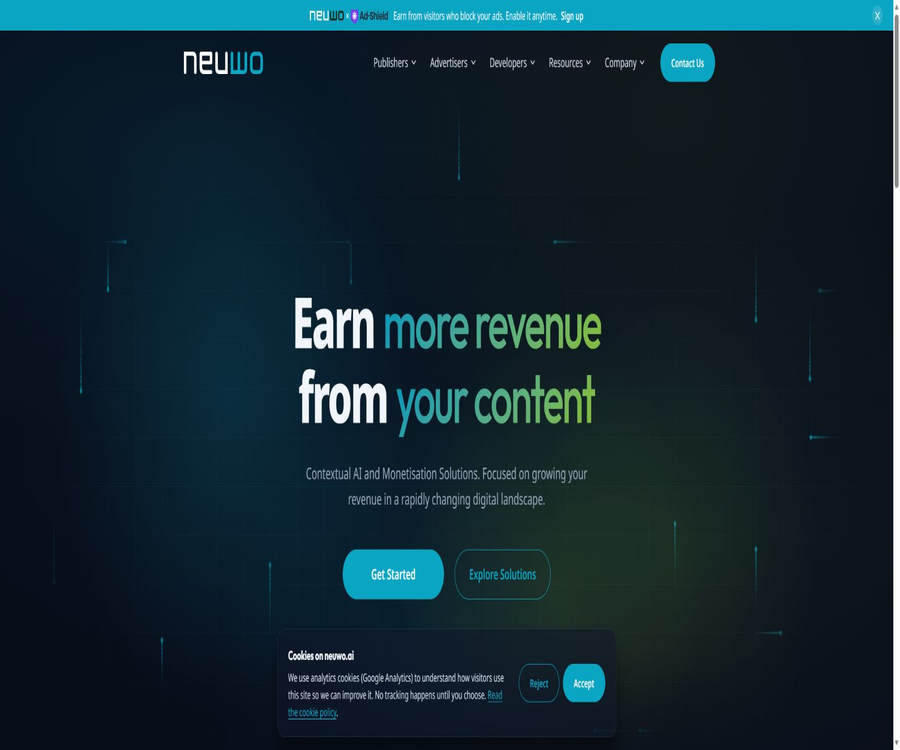
Neuwo is an AI-powered content classification and contextual advertising platform developed by Neuwo Oy in Finland; it is not a code generation tool. It analyzes the semantics of web pages or texts to provide information on topics, standard ad categories, brand safety assessments, as well as custom classifications, which can be used by media outlets, advertising technology companies, and those involved in document processing.
The product emphasizes advertising matching based on content rather than individual identity; it also offers options for publishers to generate revenue, enhanced bidding signals, and custom classification models. Companies can choose to use shared APIs, a private cloud, or on-premises deployment, with the specific capabilities determined by the contract and implementation plan.
Main functions
Semantic classification and automatic labeling
- After entering articles, contracts, reports, emails, or other text, the system analyzes the overall context rather than just matching keywords, and returns relevant tags from over ten thousand pre-defined topics.
- Each topic or category is assigned a relevance score; the caller can set a minimum threshold and a maximum number of results to be returned, thereby filtering out those results with low confidence.
- The Auto-Tagging API can automatically add topics, categories, and metadata to new drafts as well as existing articles, thereby helping the editorial team standardize the tags and search structure on the site.
- The platform claims to support over 100 languages, and it allows for the creation of custom classifiers tailored to specific industries and their unique terminology; however, for actual projects, it is still necessary to assess the accuracy of translation in each language using one’s own dataset.
IAB Classification and Brand Safety
- A standard response can include levels 1 to 3 of the IAB content classification, which describe the topic of the page; it can also include levels 3 to 5 of the IAB audience classification as well as Google Topics.
- The brand safety module returns a score as well as an indication of whether the content is safe, which is used to determine whether an advertisement is suitable to be displayed next to the given content.
- Smart Tags can map topics to events, restrictions, or custom segments based on rules set by the customer; they appear in the responses only once the account is activated.
- Brand safety and audience inference are part of the model’s assessments; they should not be used alone to decide on the commercial handling of sensitive news, political, medical, or legal content. Human review and appeal mechanisms must remain in place.
Bid Enrichment – Enhanced bidding functionality
- Neuwo analyzes the content when users visit a page, and inserts the IAB content and audience classifications into the OpenRTB bidding objects, enabling buyers to place bids based on the semantics of the page.
- The Prebid real-time data module is suitable for publishers who are already using Header Bidding; it allows for setting the auction wait time, relevance thresholds, classification levels, and the maximum number of items per level.
- The Google Ad Manager approach relies on signals provided by publishers for targeting and reporting, and it can be used in conjunction with the Prebid or Neuwo monetization solutions.
- Contextual signals do not require user identification or third-party cookies, but the categorized data is sent to the buyer’s system that receives the bidding requests; publishers still need to verify the advertising workflow in accordance with local privacy regulations.
Publisher monetization and contextual audience
- The Neuwo Monetisation Platform allows Neuwo to deploy advertising tags, manage ad slots, handle demand mediation, perform updates, control visibility, and fill in missing data – making it suitable for media outlets that do not wish to manage their own bidding systems.
- The contextual audience is formed based on the content that readers are consuming, enabling the creation of targeted segments; it does not rely on cross-site tracking of individual identities, and can be used in open web and connected TV initiatives.
- Auto-Tagging also provides semantic signals for recommending related articles, helping media organizations to integrate content discovery, user engagement, and advertising monetization under the same classification system.
- Revenue, fill rate, and bid increases depend on the region from which traffic comes, the content, the advertising slots, buyer demand, and the implementation methods; it is not possible to derive earnings directly from the accuracy of classification.
Classification of corporate documents
- Governments and public agencies can automatically route feedback, planning documents, or decisions to the relevant departments, and apply consistent labels to the records.
- Legal, financial, and medical organizations can use custom classification systems to identify contract terms, risk elements, applications, claims, or clinical documents.
- Research institutions can create interdisciplinary topic indexes for papers, grant applications, and reports; custom models can be optimized starting with as few as around 100 documents.
- For high-risk categories, it is necessary to measure precision, recall, and error cost using a representative test set, and human verification must be carried out; reliance solely on the supplier’s demonstration is not sufficient.
How to choose between the two types of APIs
| Interface | Enter | Operation location | Typical uses | Key points to note |
|---|---|---|---|---|
| EDGE API | Published page address | Browser, Prebid, and bidding process | Web page categorization, Bid Enrichment, real-time advertising signals | It is necessary to specify the allowed domain names of sites; for new addresses, it usually takes 10 to 60 seconds before the result is available. |
| Auto-Tagging API | Main text and optional document metadata | Client server | Categorization before publication, document storage, batch tagging, and custom workflows | By using separate tokens and endpoints, the server keys should not be exposed on web pages. |
The tokens and base endpoints for these two types of APIs are independent of one another and cannot be used interchangeably. Neuwo does not offer self-registration; customers must provide the website or business scenario to be analyzed, and the team will then set up the appropriate endpoints and tokens.
API output and processing logic
| Response section | Included content | Usage method | Boundary |
|---|---|---|---|
| Topic tags | Tag name, unique identifier, and relevance score | In-site tags, search, recommendations, and routing | Thresholds should be set based on the business requirements, and empty results must be handled. |
| Marketing categories | IAB content, IAB audiences, Google Topics, and custom categories | Bidding, reporting, ad targeting, and content management | The version of the classification system and the contract settings may differ. |
| Brand safety | Safety score and indicators | Advertising restrictions and priority for manual review | The context and brand standards vary; it’s not possible to rely solely on binary judgments. |
| Smart Tags | Customer-defined activity or rule tags | Detailed activation and automation processes | It is returned only when the account is enabled and rules have been configured. |
| Error | Authentication, permissions, no data, content unavailable, or service error | Retry, alerting, and degradation handling | The score in the original response may be a string; it needs to have its type converted before comparison. |
API Integration Tutorial
- Specify the use case, website domain name, estimated number of documents, target language, classification system, brand security rules, and deployment location.
- Contact Neuwo to request a pilot program or obtain a quote; this will enable you to get the necessary API endpoints and tokens, as well as to find out which browser domains are allowed.
- Choose either the original REST call or JavaScript, Python, .NET SDK, and store the token in an environment variable or a key management system.
- A set of manually labeled representative texts is used to test topics, IAB categories, brand safety, and custom tags, with the types of misclassifications being recorded.
- Based on the verification results, set the correlation threshold, the number of results to be returned, Smart Tags, and the version of the classification method; simultaneously design fallback procedures for empty result sets, rate limiting, and service errors.
- When the EDGE API encounters a new page that has not yet been analyzed, it waits before attempting to process it again; the server-side text interface, on the other hand, records the document identifier to prevent duplicate processing and data mismatches.
- After going live, continuous sampling reviews are conducted for different languages, sections, and sensitive topics, in order to monitor latency, error rates, classification drift, and the actual impact on advertising revenue or business processes.
SDK, GitHub, and open-source status
| Development tools | Installation or runtime environment | Primary uses | Licenses and restrictions |
|---|---|---|---|
| JavaScript and TypeScript SDKs | Node.js 18 and later, as well as modern browsers | Calling the REST text interface or the EDGE web interface, including type handling and error management. | The official repository is licensed under the MIT license; using the API still requires a commercial token. |
| Python SDK | Python 3.8 and above | Server-side text classification, web analysis, and batch processing | The SDK code is available publicly; it does not include the Neuwo models or server-side components. |
| .NET SDK | .NET 8 or 9, Windows, Linux, macOS | Enterprise applications, dependency injection, asynchronous calls, and logging | The authorization for SDKs and hosted classification services should be understood separately. |
| Prebid module | Prebid.js Publisher Bidding Stack | Classify the context and include it in the OpenRTB request. | Neuwo configuration, API token, and site domain license are required. |
The authorities have made the SDK code and examples available to the public; the JavaScript and TypeScript SDKs are licensed under the MIT license. What is made available in an open-source format are the client connection tools, whereas Neuwo’s proprietary classification models, training data, hosting services, and monetization platforms are not included.
Prices, trials, and purchasing
| Package or version | Price | Billing cycle | Core benefits or quota | Suitable for users |
|---|---|---|---|---|
| According to the document API | Custom quote | By number of documents processed | Text or web page classification: the cost increases linearly with the number of documents. | Teams with fluctuating usage levels or those whose costs need to be calculated based on volume of work |
| Fixed monthly fee API | Custom quote | Monthly | The usage limits, endpoints, languages, and support specified in the contract | Companies with a stable monthly processing volume |
| Private cloud or on-premises deployment | Contact sales | The contract is finalized. | EU data residency, isolated environments, and custom model options | Government, financial, medical, and sensitive data scenarios |
| Bid Enrichment and monetization platforms | Contact sales | The contract is finalized. | Prebid, ad server signals, or ad monetization managed by Neuwo | Digital media and publishers |
| Pilot or demonstration | Contact sales | Project confirmed | For online demonstrations or validation of business data, there is no fixed free quota specified on the public page. | Team for testing accuracy and integration prior to procurement |
The information on the public page indicates that it is possible to choose between a payment based on the number of documents or a fixed monthly fee with a limit on usage, but the unit price, minimum spending amount, extra charges, or free quota are not specified. When obtaining a quote, it is necessary to confirm the commitments regarding response time, the number of concurrent tasks, data retention policies, support services, customization options, and deployment costs.
Refunds, contract cancellation, and compensation for service disruptions are not clearly specified on the public pages. Companies should outline in the order details, main service agreement, and SLA the criteria for project acceptance, the minimum level of accuracy required, procedures for renewal and termination, data deletion, and what to do in case of failure to meet the specified standards.
Suitable for users and typical use cases
- News outlets, magazines, and niche media assign tags to historical content in bulk, and use semantic classification to improve search functionality as well as the recommendation of relevant articles.
- Publishers include IAB topics and brand safety signals in their bidding requests in order to reduce their reliance on third-party identifiers.
- Advertisers and agencies establish rules for inappropriate content or define the target audience, which are then applied in open networks and connected TVs.
- Governments, legal institutions, financial organizations, medical facilities, and research institutes use large amounts of text for consistent classification, routing, auditing, and structured searching.
- Companies that have their own classification systems entrust Neuwo with the training and maintenance of customized models, rather than establishing their own full-scale machine learning team.
Advantages and capabilities boundaries
Advantages
- The same classification can be used to support functions such as edit tags, content recommendation, ad bidding, brand security, and enterprise document processing.
- It supports input in both web addresses and plain text, and offers integration options via Prebid, ad servers, and multilingual SDKs.
- Optional EU data residency, private cloud, and on-premises deployment – suitable for industries with strict requirements regarding cross-border data transfer and isolation.
- The fee is calculated based on the number of documents or a fixed monthly amount, rather than the length of the text; thus, the cost of longer documents can be more easily estimated in the contract.
Boundary
- \"Any language\" and the speed figures are part of the overall description of the platform’s capabilities; they do not indicate that the same performance or latency will be achieved for every language, style, and deployment scenario.
- Classification models are more consistent than generation models, but they are still affected by sarcasm, metaphors, multi-topic articles, insufficient context, and new concepts.
- The IAB audience segmentation is based on contextual signals inferred from the content read, and it does not involve confirming the specific identity, age, interests, or purchasing intentions of individual readers.
- Including classification in the bidding request will be communicated to advertising technology partners; prior to implementation, it is necessary to review the OpenRTB fields, the list of buyers, and any relevant compliance requirements.
- There are no self-service accounts or public prices; individual developers or those conducting small-scale experiments need to engage in sales discussions.
Privacy, Security, and Data Policy
- The Classification API page guarantees that data will be stored within the EU, and it states that customer data will not be used to train public models; private clouds and on-premises deployments enable further isolation of sensitive information.
- The website’s privacy policy describes the contact information and recruitment data, including names, phone numbers, email addresses, and attachments; it states that such information is stored only during customer relationship management or recruitment processes, and can be deleted upon request.
- This privacy policy was released quite early, and it does not provide a sufficient explanation of API details, logs, model optimization, sub-processors, backups, and the retention periods for different types of data; therefore, it cannot serve as a substitute for an enterprise data processing agreement.
- Website analysis cookies are sent to Google Analytics only with the user’s consent; if the user declines, their preference to agree is merely saved in the browser.
- The Prebid module allows all or specific query parameters and fragments to be removed before the analysis address is sent, thereby reducing the risk of tracking parameters or sensitive information leaking in that address.
- Health, legal, financial, or unpublished research data should be preferentially deployed in a private environment, with contracts specifying encryption, access control, event notification, deletion verification, and audit rights.
Platform and application status
The core delivery methods of Neuwo are APIs, publisher website scripts, the Prebid module, Google Ad Manager configurations, and server-side SDKs. There is no official App Store or Google Play application available for ordinary consumers; mobile app stores are not the primary channel through which this company’s products are used.
The historical pages used to cover WordPress plugins, but the current development documentation focuses on API integration and advertising technologies. If WordPress is needed, it is necessary to first check with Neuwo to determine whether the plugins are still being maintained, what versions are compatible, and what level of support is available; one should not rely on the old information when installing them.
Summary
Neuwo is suitable for media outlets, advertising technology companies, and regulated enterprises that require large-scale, repeatable text classification. It can convert topics, IAB classifications, brand safety metrics, and custom rules into structured data, and offers various deployment options ranging from shared APIs to private installations.
Before making a purchase, it is crucial to verify the accuracy using one’s own data, and to clarify the classification methods, latency, data retention periods, prices, SLAs, as well as the processes for manual review. The open-source nature of SDKs reduces the barriers to integration, but the core models and platforms remain proprietary services that require commercial contracts.
Tools similar to Neuwo



 Guigong Network Security Registration No. 45132202000164