






Navan AI
Navan AI, an intelligent tool focused on AI programming
Tags:AI programming toolsWhat is Navan AI?
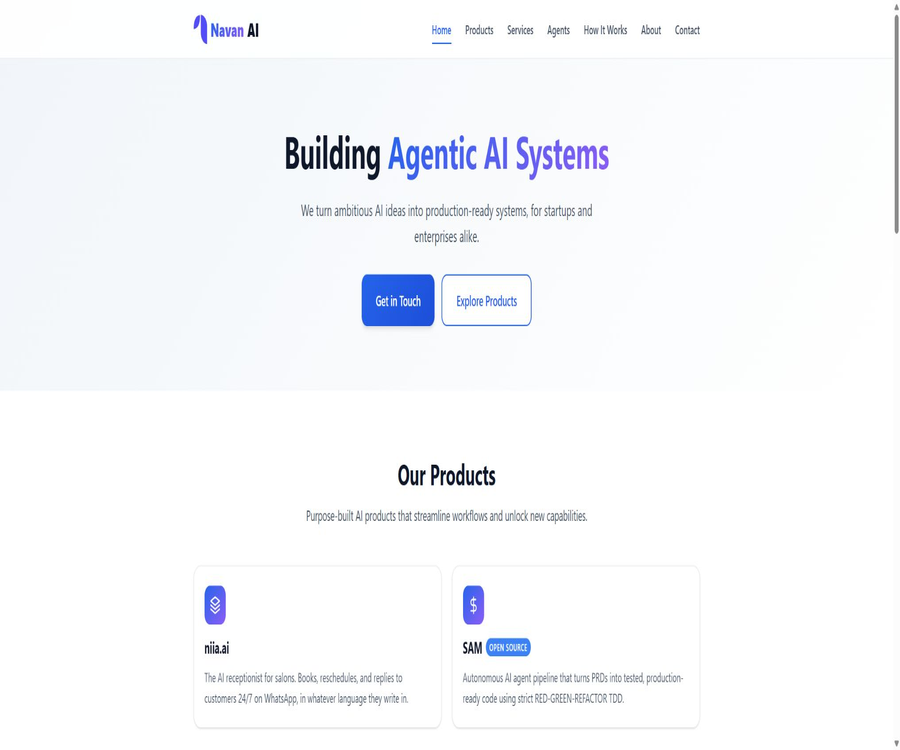
Navan AI is currently a team that offers proxy-based AI engineering solutions as well as customized GenAI application development services, targeting startups and enterprises alike.
It is not the same product as the travel and expense management platform of the same name; the core development tool for this site is SAM, and services such as requirement analysis, proxy architecture setup, implementation, deployment, and ongoing optimization are also provided.
Core product: SAM
SAM stands for Smart Agent Manager; it is a multi-agent development process that transforms product ideas or PRDs into tested, reviewed, and documented software projects.
It is installed in the user’s project through local command-line and proxy configuration, and it makes use of the programming proxy platform chosen by the user; it is not a one-click code generator hosted on the Navan AI website.
The workflow from requirements to code
- quick-prd: It enables the rapid creation of a PRD based on brief ideas; missing information is addressed through clearly stated assumptions, making it suitable for producing a draft that can be discussed first.
- Scope: Conduct a comprehensive assessment through product, experience, and technical aspects, leaving any unresolved issues as open questions.
- Plan: Verify the PRD by first designing typed contracts that span multiple files, and then breaking them down into epics, user stories, acceptance criteria, and dependencies.
- build-tdd: It carries out testing first, followed by a minimal implementation, review, and refactoring for individual user stories; it also adds checks for usability, styling, accessibility, or security depending on the type of project.
- plan-n-build: It combines planning with the implementation of all related tasks, enabling a seamless progression from a complete PRD to code, testing, documentation, and release records.
- Extend: Add new functions after the initial version, update the contract version as well as the records of changes to the story and PRD; suitable for iterating on existing projects.
Strict TDD and quality gates
- Titan first creates failure tests for each acceptance criterion; it moves on to the next stage only when a test fails because the corresponding function has not yet been implemented.
- Dyna generates the minimal implementation required to pass the tests, while simultaneously running the build and testing processes; if failures occur, adjustments are made up to a specified number of times.
- Argus conducts adversarial code reviews focused on security, performance, and maintainability, and carries out refactoring while ensuring that the tests still pass.
- Web projects can continue to be checked by Iris, Cosmo, and Aria for usability, style consistency, and accessibility; security auditing with Sentinel must be enabled explicitly.
- Once the integration story is approved, Lens uses a real browser to create videos, screenshots, as well as evidence from the network and the control panel; Sage then adds change logs and functional documentation.
Auditable project outputs
- PRDs, architecture descriptions, contracts, epics, stories, and status information are stored in the project directory, allowing the team to directly view the assumptions made and the current progress of the project.
- The cross-story interface is first defined as a typed contract, with both the producer and consumer declaring their dependencies, thereby reducing any discrepancies in the definitions of fields or events between the front-end and back-end.
- The status file records the status of each task as ready, in-progress, done, or blocked; once a long-running task is interrupted, a recovery process can be used to continue it.
- Integrated evidence is saved on disk, rather than only a textual statement indicating “test successful”; however, this evidence still needs to be reviewed by the maintenance personnel, and it cannot replace manual verification and production monitoring.
Agent role
| agent | Main responsibilities | Typical input | Main output |
|---|---|---|---|
| SAM | Coordinate the entire process, statuses, and quality checks. | Ideas, PRDs, or existing stories | Phase scheduling and operation status |
| Quill | Quickly create a draft of the product requirements. | Brief ideas and constraints | PRD with explicit assumptions |
| Iris and Atlas | Experience discovery, technical feasibility, and architecture design | Requirements, codebase, and open issues | Improve PRDs, risks, and standardized contracts |
| Titan, Dyna, and Argus | Execute RED, GREEN, REFACTOR | Stories and acceptance criteria | Failed tests, implementation code, and review corrections |
| Cosmo, Aria and Sentinel | Styles, accessibility, and optional security reviews | Web interface and dependencies | List of issues and fixes |
| Sage and Lens | Documents, change logs, and evidence from the actual browser | Implementation has been completed. | Documents, videos, screenshots, and runtime logs |
The current product page still uses seven agents to describe the early processes, while the latest version lists thirteen professional roles and adds capabilities such as Quill, Cosmo, Aria, Sentinel, Upkeep, and Lens.
This is a sign that the site is not synchronized with the code version; in actual use, it is necessary to follow the instructions related to the installed version, as well as the proxy directory and release records.
Installation and Usage Guide
- Prepare Node.js version 16 or higher, and install at least one of Claude Code, Cursor, Gemini CLI, GitHub Copilot, or Google Antigravity.
- First, run the demo included with SAM to view example applications, contracts, stories, tests, and the structure of browser evidence, without invoking any large models.
- Run an interactive installation within the target code library, or select the appropriate platform explicitly; the tool will then write down the configurations for the proxy, workflows, and platform adaptation.
- When a PRD is already available, start by running the plan; in the absence of a requirement document, begin with quick-prd or scope, and review each assumption, open issue, and acceptance criterion one by one.
- Advance the work by using build-tdd in an iterative manner, or carry out tasks sequentially with plan-n-build; for high-risk projects, safety checks should be enabled and thresholds for manual approval should be set.
- The generated contract, source code, tests, dependencies, licenses, and relevant documentation are reviewed; thereafter, the team carries out code review, key configuration, deployment, and verification to ensure everything works properly.
Support for platform and installation differences
| Platform | Access method | Usage features |
|---|---|---|
| Claude Code | Slash command | Call various workflows via SAM commands. |
| Cursor | Agent mentions and rule configuration | Select proxies such as quick-prd, plan, or build-tdd within the editor session. |
| Gemini CLI | Skill Catalog | Install the workflow as a local skill. |
| GitHub Copilot | Integration instructions | Trigger the corresponding workflow via Copilot commands. |
| Google Antigravity | Agency skills | Skill commands that use the SAM prefix |
SAM does not provide any default quotas for models; the actual models that can be used, the context window size, the permissions for tools, and the associated costs are determined by the platform and subscription chosen by the user.
Prices, open-source, and commercial services
| Package or version | Price | Billing cycle | Core benefits or quota | Suitable for users |
|---|---|---|---|---|
| SAM open-source tool | Free | No subscription required | MIT license, including agent definitions, six types of workflows, an installer, examples, and project templates | Developers who are willing to configure programming proxies and review code on their own. |
| Underlying programming agents and models | Decided by the selected supplier. | Subscribe or pay as you go | Model inference, context, tools, and code execution quotas are not provided by SAM. | Individuals and teams that run SAM workflows |
| Custom development by Navan AI | Contact the team to get a customized quote. | In accordance with the project terms or contractual agreements | Discovery related to policies, agent architecture, implementation, deployment, monitoring, optimization, and support | Companies that need to customize GenAI systems |
- The MIT license permits the use, modification, and distribution of SAM code, provided that the license and copyright notices are retained, and the software is provided as-is.
- The open-source nature of SAM does not mean that Navan AI’s customized services, the code delivered to clients, products such as niia, or third-party models are also licensed under the MIT license.
- Operating costs also include the selected AI programming tools, model invocation, testing infrastructure, browser automation, cloud resources, and time spent on code review.
- The current main website does not specify fixed prices for customized services, information on free trials, usage limits, or uniform rules for refunds; these details must be confirmed in the quotation and service agreement.
Suitable for users and scenarios
- Software teams that already have clear acceptance criteria and wish to institutionalize TDD, reviews, documentation, and integration evidence as part of their processes.
- Teams that need to reuse similar development protocols across Claude Code, Cursor, Gemini CLI, Copilot, and Antigravity.
- It is hoped that AI will first sort through the PRDs, contracts, and requirements, after which the engineering team and the technical leaders will gradually approve the products to be developed.
- Enterprise clients who need customized multiple agents, knowledge bases, business system integration, and the deployment of private infrastructure.
Capacity limits and risks
- The product website claims that the process can be carried out without any human intervention, but the production system still requires human oversight for matters such as identifying requirements, designing the architecture, ensuring security, handling licenses, managing data migration, and verifying the results of the deployment.
- TDD can only verify the behavior of tests that have been written; incorrect requirements, missing acceptance criteria, weak assertions, or an unrealistic testing environment can still lead to false confidence.
- SAM writes configurations and generates files for the project; before using it, it is necessary to create a separate branch, check the status of the workspace, and restrict the keys and production resources that the agent can access.
- Different programming agents handle commands, permissions, and context in various ways; the same PRD may result in different implementations on different platforms.
- Dependency analysis and security proxies cannot replace professional penetration testing, compliance assessments, supply chain scanning, and manual code audits.
Privacy, security, and data considerations
- SAM operates primarily in local projects, and its data flow is determined by the underlying programming agents, model providers, code hosting platforms, and user configurations.
- PRDs, source code, logs, and test data may be sent to the selected AI service; before integrating them, it is necessary to review the supplier’s terms regarding training, data storage, geographic location, and corporate data.
- At present, the official Navan AI website does not disclose a complete privacy policy, data processing appendices, security certifications, or unified retention periods that apply to all customized services.
- The SODA sub-product of this platform is responsible for managing GitHub accounts, project and repository metadata, as well as model usage, and it removes personal data within 30 days after a deletion request is made; this policy cannot be considered automatically as the general terms applicable to SAM or all custom services.
- When making purchases, enterprises should establish written agreements regarding code ownership, usage of prompts and outputs, the supplier of the models, where the data will be stored, sub-processors, confidentiality measures, data deletion, responses to vulnerabilities, and termination of service delivery.
Explanation of the brand and its current status
Earlier reports described Navan AI as a no-code computer vision or fashion e-commerce AI platform; currently, its main platform has shifted to agent-based software engineering, with SAM and AI services designed for salons being listed as its key products.
When conducting the evaluation, the current page and the active warehouses should be taken as a basis; historical features, travel platforms with similar names, or e-commerce capabilities available in third-party directories should not be applied directly to the current Navan AI.
Summary
What sets Navan AI apart is not a single code completion model, but rather the ability to organize requirements, contracts, user stories, tests, implementations, reviews, documentation, and browser evidence into reusable multi-agent engineering protocols.
SAM is suitable for development teams that wish to have control over the local code and the underlying models; for custom enterprise projects, it is necessary to clarify the terms related to pricing, data, security, intellectual property, and delivery and acceptance before starting the project.
Tools similar to Navan AI



 Guigong Network Security Registration No. 45132202000164