






ModelsLab
ModelsLab, an intelligent tool focused on AI programming
Tags:AI programming toolsWhat is ModelsLab?
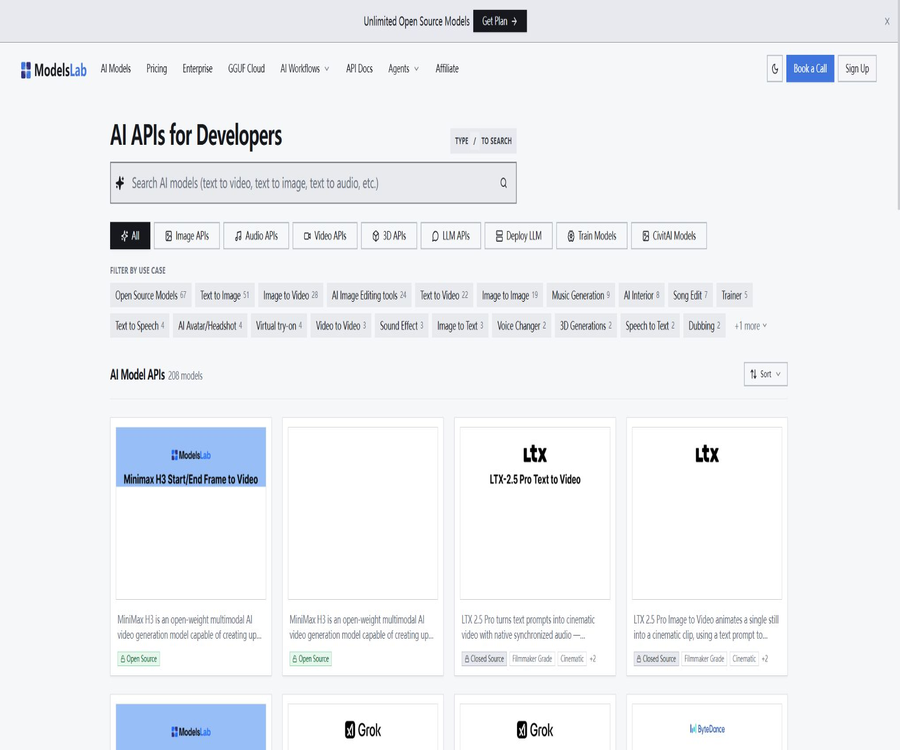
ModelsLab is a multi-modal AI API platform provided by M Studio AI Inc for developers, aimed at connecting various generative models through a unified account, key, and billing system.
It covers images, videos, voice and audio, 3D, chat models, and custom training, and is suitable for integrating generative capabilities into applications, automated processes, and AI agents.
Main functions
Image generation and editing
- Text-to-image: Submit the model ID, prompt, dimensions, number of samples, and seed, and the resulting image will be provided in formats such as PNG, JPG, or WebP.
- Image-to-image generation and local editing: Enter an image link or Base64 data; it is possible to adjust the intensity of changes, redraw specific areas, enlarge the image, enhance its quality, zoom in, and remove the background.
- Model selection: The same interface framework allows the use of Flux, SDXL, Qwen Image, as well as third-party proprietary models; the specific parameters, prices, and licensing terms vary depending on the model chosen.
- Batch processing and asynchronous results: Webhooks and custom tracking numbers can be set to receive callbacks once a task is completed; alternatively, the results can be retrieved by polling the query endpoint.
Videos, audio, and 3D
- Video generation: It supports converting text into videos, images into videos, as well as video conversion; it also offers lip-sync and motion control functions. The output duration, resolution, and audio options depend on the model used.
- Voice and audio: It offers text-to-speech, speech-to-text, sound conversion, sound effects, music, voice dubbing, and certain voice cloning functions; the input can be text, an audio link, or Base64.
- 3D generation: Converting textual descriptions or reference images into 3D assets such as GLB, OBJ, FBX, etc. This process usually takes longer and is well suited for asynchronous processing.
- Large model chatting: It makes use of message arrays that conform to common chat completion structures in order to call various open-source or third-party language models, and it is capable of returning results in a streaming manner, depending on the availability of those models.
Developer and proxy capabilities
- Unified API: One API Key covers all interaction modes; the account dashboard displays usage details, remaining quota for the plan, wallet information, and call history.
- Official SDK: It provides clients in Python, TypeScript or JavaScript, PHP, Dart, and Go, along with request examples, an interactive Playground, and Postman collections.
- MCP service: The generation server exposes images, videos, audio, model discovery, and chat tools to the AI agent; the control plane handles registration, keys, billing, subscriptions, and teams.
- CLI and Agent Skills: The command-line client enables operations related to accounts, models, generation, and billing; the official skills repository allows compatible coding agents to understand common workflows.
- Chrome extension: ModelsLab AI Playground allows for the creation of images, videos, audio content, and messages directly from the browser; it is still subject to the account plan rules and call-based pricing.
Typical inputs and outputs
| mode | Main inputs | Common outputs | Achieve attention |
|---|---|---|---|
| Image | Prompt, reference images, masks, dimensions, and model number | PNG, JPG, WebP, or Base64 | Check the number of samples, resolution, security checks, and parameters specific to the model. |
| Video | Text, initial image or video, duration, and motion description | MP4, WebM, or GIF | The generation process takes a long time; it is preferable to use Webhooks or result queries. |
| Voice audio | Text, sound numbers, source audio, or target audio | MP3, WAV, FLAC, or transcribed text | Voice cloning and dubbing require the permission of the speaker. |
| 3D | Text or reference figures, resolution, and grid parameters | GLB, OBJ, or FBX | It is necessary to verify the topology, texture, scale, and compatibility with the target software. |
| Chatting | Message array, model number, and generation parameters | Text or streaming response | Different upstream models have varying contexts, content policies, and prices. |
API integration process
- Register an account and choose a paid subscription to create an API Key in the console; ModelsLab does not offer any free plans or trials at the moment.
- Select a specific model from the model directory, and first read its input fields, dimensions, asynchronous operation mode, unit price, and upstream licensing requirements.
- Choose either REST requests or the official SDK; the keys should be stored only in the server environment, and not embedded in web pages, mobile applications, or public repositories.
- Construct a minimal test using a small size, a single sample, and a fixed seed, and record the request ID, model ID, execution time, cost, and error response.
- For videos, 3D content, and tasks with slower processing times, Webhooks are used; the callback signatures are verified, retries are implemented, and idempotency as well as task status are taken into account to prevent duplicate charges.
- Before going live, set up concurrent queue settings, timeout parameters, fallback mechanisms for failures, content review processes, alerts for wallet balance levels, and per-user quotas.
- Save the results in your own storage system in a timely manner; if some enterprise endpoints indicate that no custom object storage has been configured, the generated files may be deleted after 24 hours.
Prices and billing
| Package or version | Price | Billing cycle | Core benefits or quota | Suitable for users |
|---|---|---|---|---|
| Basic | 21 dollars | Monthly | 3,250 API calls per cycle, 5 concurrent requests, shared GPU, access to all models | Prototype verification and low-traffic applications |
| Standard | 47 dollars | Monthly | 10,000 calls per cycle, 10 concurrent requests, priority in development support, access to all models | Medium-capacity services that have entered production |
| Open Source Unlimited | 149 dollars | Monthly | Open-source models on proprietary infrastructure allow unlimited generation instances, 15 concurrent requests, priority access to GPUs, and 24/7 support. | Key workloads that make extensive use of open-source models |
| Companies and standalone servers | Custom quote | Contractual agreement | Private GPUs, custom quotas, service commitments, support, and deployment requirements | High concurrency, privatization, or compliance requirements |
The annual plan includes 2 months of free service; the remaining duration of the plan is reset at the start of each billing cycle and is not carried over. All plans give access to the model catalog, but they differ in terms of the number of calls that can be made, the number of concurrent tasks, and the level of support provided.
The subscription fee does not cover all the associated costs. Third-party advanced models such as Google, Kling, and Seedance charge fees on a per-use, per-second, or per-Token basis from a separate payment wallet, and this applies even to the option of using unlimited open-source models.
| Billing layer | Scope of application | The current publicly listed starting price | Key constraints |
|---|---|---|---|
| Package call quota | Basic and Standard basic calls | Included in the monthly fee | Cycle reset, no carryover |
| Open-source models have no usage limits. | Platform-hosted models marked as unlimited. | Included in the $149 package | It is still subject to the constraints of 15 concurrent tasks, fair usage, and model scope. |
| Pay-as-you-go wallet | Third-party advanced image, video, audio, and chat models | Images cost approximately 0.0047 dollars each, videos about 0.02 dollars per second, audio around 0.001 dollars per second, and messaging costs 0.20 dollars per million tokens. | The specific models vary greatly, and the balance in the wallet is not refundable. |
The public refund page outlines options such as refunds after deducting the amount used, full refunds within 24 hours of purchasing a new subscription, and no refunds for certain services; there are also additional restrictions related to renewals, discounts, wallets, and enterprise plans. It is necessary to obtain written confirmation from the support team regarding the applicable rules before making a payment, rather than relying solely on the refund information provided on the pricing page.
Suitable for users and scenarios
- AI Product Team: Use a single account to test various image, video, audio, and chat models, thereby reducing the need to work with multiple suppliers separately.
- Content automation platform: Handles bulk media files, marketing videos, and voiceovers via Webhooks, task querying, and tracking numbers.
- Smart agent developers: Utilize MCP, Agent Control Plane, and Skills to carry out model invocation, account management, and usage monitoring.
- Game and 3D team: Create concept art, environment videos, sound drafts, and preliminary 3D assets, before moving on to the professional production process.
- Enterprise development team: Evaluate enterprise solutions when dedicated GPUs, customized concurrency, service guarantees, or proprietary storage are required.
Platforms, SDKs, and the boundaries of open source
| Components | Provided format | Open-source status |
|---|---|---|
| ModelsLab-hosted API | REST, WebSocket, Webhook, and MCP | Proprietary online services; not open-source platforms |
| Official SDK | Python, TypeScript or JavaScript, PHP, Dart, Go | For code repositories, it is necessary to check the licenses separately; this cannot be used as a basis to determine whether a platform is open source. |
| Agent Skills | Set of skills for compatible encoding proxies | The official repository uses the MIT license. |
| CLI and auxiliary projects | Cross-platform command line and model task queue, etc. | Public warehouses are available; the licenses are specified in the documents of each warehouse. |
| Model weights | A combination of self-hosted open-source models and third-party closed-source models on the platform | Each model has its own license and usage policy. |
Copyright, Privacy, and Security
- The terms of service state that users retain the intellectual property rights to the generated images and can use them for commercial purposes, but third-party models may come with their own separate licensing terms; it is therefore necessary to check the specific model page before using them.
- Users must ensure that the prompts, reference images, audio clips, characters, and training data are covered by legitimate rights; explicit consent is particularly required for audio cloning, face swapping, and simulated character content.
- API Keys provide access to functions related to generation and billing; key management services should be used, these keys should be rotated regularly and their permissions limited. Logs must not contain the full keys, sensitive information, or original private data.
- The privacy policy covers accounts, contacts, transactions, devices, usage data, and cookies, and it allows for requests to access, correct, or delete such data where applicable. For highly sensitive data, it is necessary to first determine the retention period, the location where it will be processed, and the relevant corporate agreements.
- Some endpoints allow the security checks to be disabled, but this does not mean that the content is legitimate or suitable for publication. The service providers still need to implement mechanisms for input validation, output verification, reporting, and deletion.
- The service is provided as it is, without any guarantees regarding accuracy, absence of infringement issues, or continuous availability; for critical operations, it is necessary to be prepared for changes in upstream models, price adjustments, queue congestion, and fallback mechanisms in case of failures.
Advantages and limitations
- A unified key covers multiple modalities and various suppliers; together with SDKs, MCPs, CLIs, and Webhooks, it enables the rapid creation of cross-media workflows.
- The large number of models also increases the costs associated with selection and management; models with the same name can have different versions, parameters, authorization settings, and unit prices, so it is necessary to fix and record the model_id.
- The unlimited quota applies only to self-hosted open-source models from platforms that are explicitly designated; it does not cover all third-party models, nor does it imply unlimited concurrent usage.
- The platform does not offer a free trial; to test the performance of the models, it is necessary to subscribe to the Basic plan at the very least. For high-resolution videos and advanced models, a balance in the wallet is required as well.
- There are differences in the wording on the pricing page, the refund page, and the old version of the terms; production and procurement should be based on the actual settlement amounts, the current version of the terms, and the written contract.
Summary
The core value of ModelsLab lies in its ability to integrate images, videos, audio, 3D content, and chat models within a single developer platform, offering various ways of accessing these functions, from SDKs to proxy control interfaces.
When conducting an evaluation, it is necessary to take into account the subscription quota, concurrency limits, the cost based on usage for the wallet, model licenses, content security, and result storage – rather than focusing only on the monthly plan price.
Tools similar to ModelsLab



 Guigong Network Security Registration No. 45132202000164