






Mindflow
Mindflow, an intelligent tool focused on AI programming.
Tags:AI programming toolsWhat is Mindflow?
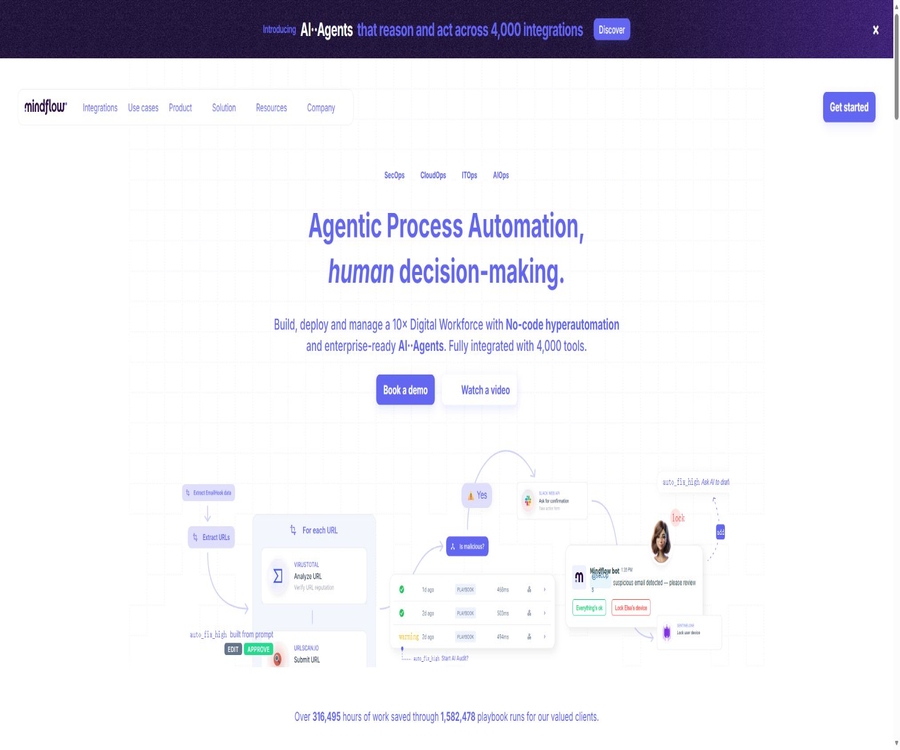
Mindflow is an enterprise agent and no-code automation platform developed by the French company Mindflow SAS; it is designed to serve SecOps, CloudOps, ITOps, as well as cross-departmental operations teams. It integrates workflow engines, AI agents, natural language generation tools, and a wide range of third-party APIs within a single platform.
Mindflow is neither a general-purpose programming IDE nor merely a chatbot. Its value lies in enabling agents to understand the business context, select the appropriate tools for carrying out actions, execute processes, and ensuring human approval as well as complete audit trails before taking high-risk actions.
Main functions
- Code-free process building: It allows for the combination of visual steps such as triggers, conditions, data transformations, loops, approval processes, and actions related to external tools. This approach is suitable for standardizing repetitive operations; however, complex scenarios still require testing of alternative paths and ensuring idempotency.
- Text-to-Automation: Users describe their goals in natural language, and the AI generates the necessary process steps as well as drafts of the workflow. The resulting output must be reviewed carefully with regard to credentials, inputs and outputs, deletion actions, and failure handling before it can be put into use.
- AI Agents: Deploy agents with specific roles and tool permissions to analyze the context, select actions, and carry out tasks. The agent library covers areas such as security, cloud, IT, compliance, finance, data, and business operations.
- AI Rooms: It uses an auditable dialogue interface to handle events that cannot be predefined as part of a fixed workflow; agents can invoke connected tools or initiate custom workflows. Team members share context and approve critical actions.
- Human verification: An approval step must be included before carrying out actions such as isolating devices, disabling accounts, modifying cloud configurations, or processing payments. The approval interface should display the API operation, the object involved, the inputs, and the expected impacts, rather than relying solely on a summary in natural language.
- Integrated catalog: The product claims to support connectivity to over 4,000 services and around 150,000 operations, enabling agents to read data and take actions. The actual endpoints, versions, and authorization scopes of each integration must be checked individually in the catalog.
- Templates and use cases: Pre-built flows are utilized to handle tasks such as alert enrichment, event ticketing, employee onboarding/offboarding, cloud costs, compliance reporting, and security fixes, with subsequent modifications in accordance with organizational standards.
- Teamspace and RBAC: Use workspaces to isolate teams, processes, and credentials, and control permissions for building, running, approving, and managing tasks based on roles. The permission model should correspond to the enterprise identity system and rules for role separation.
- AI Notes and audit logs: They generate automated descriptions of processes, and record the actions taken by agents, as well as the inputs and responses received. These logs are useful for reviewing operations and ensuring compliance, but they may also contain sensitive data; therefore, it is necessary to establish rules regarding access to them and their retention period.
- Relay Agent: It uses relay connections based on Cloudflare Zero Trust to link Mindflow in the cloud with local tools, thereby reducing the exposure of internal systems. Enterprises still need to have control over outbound traffic, certificates, updates, and the resources that are accessible.
- Multi-model orchestration: It is possible to select, compare, or combine different LLMs within a process, assigning high-performance and low-cost models to various tasks. The choice of model affects costs, data pathways, latency, and the stability of the outputs.
Typical workflow
| Scene | Enter | Automated actions | Manually controlled points |
|---|---|---|---|
| Security alert response | SIEM, EDR, or cloud alerts | Enrich IOC, related events, order creation, and suggested fixes | Approval is required before isolating a device or banning an account. |
| Employee resignation | HR or ticket event | Disable identities, terminate sessions, revoke tool permissions | Verify the personnel, date, and exceptional accounts. |
| Cloud configuration repair | CSPM or configuration alerts | Query resources, generate changes, and notify the responsible person. | Review scope prior to production changes |
| Compliance evidence | Control requirements and system records | Collect evidence, organize status, and create reports | The person in charge of control verifies the effectiveness. |
| Handling of unexpected events | Natural language objectives in AI Room | Selecting agents, retrieving context, and proposing actions | Approve high-impact actions |
Setup process
- Select a process that can be rolled back with limited impact, and define the trigger conditions, success criteria, responsible persons, and stop conditions.
- Create a Teamspace and configure SSO, RBAC, approvers, and log access permissions.
- Use the required tools for connection, along with a dedicated service account, minimal permissions, and credentials for an isolated testing environment.
- Start with a template or generate the flow in natural language, and then check each API operation and data mapping one by one.
- Add retry on failure, timeout, rate limiting, idempotent keys, alerts, and manual approval nodes.
- Use simulated or test tenants to run scenarios such as normal operation, missing items, duplicates, delays, and insufficient permissions.
- Enable it on a small scale to observe false triggers, proxy reasoning, operation logs, costs, and the rate of manual intervention.
- Expand the scope through change approval, and regularly review connector permissions, model versions, and workflow owners.
Suitable for users and scenarios
- SOC and incident response teams: enriching alerts, integrating relevant intelligence, creating tickets, and scheduling approved remediation actions.
- Cloud and Platform Team: Handles configuration risks, cost optimization, resource notifications, and cross-cloud operations.
- IT and IAM teams: automation of onboarding, offboarding, password reset, session termination, and device compliance.
- Compliance and Risk Team: Collects evidence of controls, tracks exceptions, and prepares draft reports.
- MSSP and large enterprises: Use isolated work areas and permission controls to serve multiple teams or clients.
- It is not appropriate to delegate irreversible production actions entirely to unverified agents, nor can they replace safety engineering, change management, and business owners.
Prices and packages
| Package or version | Price | Billing cycle | Core benefits or quota | Suitable for users |
|---|---|---|---|---|
| Official website corporate solutions | Contact sales | Agreement in the Order Form | Workspaces, flows, execution volume, connectors, AI – and support available under contracts | Corporate IT and Security Teams |
| AWS Startup Plan | 30,000 US dollars | 12 months | 1 team workspace, up to 5 workflows, limited customization | Startups |
| AWS Team Plan | 50,000 US dollars | 12 months | 1 team workspace, up to 20 workflows; additional capabilities can be purchased. | Medium-sized team |
| AWS Custom Enterprise | 200,000 US dollars | 12 months | The number of workspaces and flows can be customized. | Large enterprises |
The prices listed on AWS Marketplace apply to annual contracts through specific channels, and they may differ from the prices offered on the official website, depending on the region, the scale of procurement, and any additional services. The actual costs, AI usage amounts, execution volume, as well as infrastructure-related expenses, shall be as indicated on the settlement page or in the signed order.
The standard terms specify that the costs are indicated in the Order Form; for subscription periods that have already begun, the full amount must be paid. A reasonable usage limit of 10,000 executions per day is set. The default duration, automatic renewal, and the notice period before non-renewal can be modified through the order, while the rules regarding refunds need to be confirmed with sales or support.
Platforms and integration
| Ability | Covering | Uses | Boundary |
|---|---|---|---|
| Native integration | Claims to offer over 4,000 tools | Calling data and action APIs | Check the specific endpoints on the service page. |
| Operation directory | Approximately 150,000 operations | Build flows and proxy tools | The version and licensing may change. |
| Relay Agent | Cloud to local | Tools for connecting to the internal network | Network and certificate management is required. |
| AI Models | Supports switching between and combining various LLMs. | Classification, summarization, reasoning, and generation | The models, prices, and data rules are different. |
| API and development environment | Enterprise integration and partner capabilities | Extended connections and operations | Limited details are available regarding the public self-service APIs/SDKs. |
API, SDK, and open-source status
- At its core, Mindflow is designed for orchestrating third-party APIs and providing a development environment for enterprises or technical partners; however, the full set of developer APIs, SDKs, and self-service pricing options have not yet been made publicly available.
- The claim of “100% API coverage” mentioned on the product page is a statement regarding its integration capabilities, and it does not mean that it is possible to bypass the permissions, plans, or rate limits imposed by third-party products.
- The official open-source repository or open-source license for the Mindflow platform has not been confirmed; therefore, the workflow engine, agents, and hosting services should be regarded as proprietary software.
- The workflows that customers can export may include logic, API steps, transformations, and non-sensitive configuration elements, but they usually do not contain credentials, execution payloads, files, logs, or the Mindflow technology itself.
Privacy and security
- As the processor or sub-processor of customer content and customer personal data, Mindflow is governed by specific rules set out in the contracts and DPA.
- The privacy policy states that customer data, AI inputs and outputs, or customer-specific settings shall not be used to train or fine-tune general AI models, unless the customer explicitly chooses to do so in writing.
- If the customer connects to their own model account or API Key, the terms, region, and data settings of the selected model provider apply as well.
- The platform is deployed on a single-tenant basis; data at rest and in transit is encrypted using AES-256, and it supports MFA for end users, fine-grained identity management, as well as daily backups.
- Backups are performed on a daily basis and stored for 35 days; the infrastructure makes use of AWS services. When establishing a Relay connection to local systems, the data pathways related to Cloudflare also need to be taken into consideration.
- Mindflow has completed SOC 2 Type I and Type II audits and holds ISO 27001 certification; purchasers should request the current reports and scope documents.
- Account data is typically retained for up to 24 months after the account’s validity period expires, while security and connection logs are kept for 6 to 12 months. Invoices, on the other hand, are usually retained for 10 years.
- The inputs, outputs, credentials, and audit logs of AI flows may contain sensitive information; therefore, data minimization, masking, secret management, and retention controls should be implemented.
Advantages and limitations
- Advantages: It combines a fixed flow, an open AI Room, and professional agents, thus taking into account both predictable processes and unexpected events.
- Advantages: A large directory of connections, human approval, and detailed operation logs make it suitable for enterprise automation across different systems.
- Advantages: single-tenant architecture, security authentication, RBAC, and local relaying – all of which better meet the security requirements of enterprises.
- Limitations: The official website does not list standard prices, and the amounts specified in Marketplace contracts may not be applicable for direct purchases.
- Limitations: Agent output, third-party APIs, as well as the quality of models and data – any of these elements can lead to incorrect actions.
- Restrictions: Reasonable use, LLM costs, connector endpoints, and process capacity are all subject to constraints imposed by the contract as well as by external suppliers.
- Limitations: The core platform is not an open-source product; the full set of APIs, SDKs, and options for self-hosting are not yet available publicly.
Summary
Mindflow is suitable for corporate teams that need to automate tasks using agents across various security, cloud, and IT tools. Before making a purchase, it is necessary to verify the coverage of endpoints, permissions, approval processes, rollback mechanisms, logging capabilities, model costs, and contract fulfillment limits by using actual playbooks, and only then gradually expand the scope of automated operations.
Tools similar to Mindflow



 Guigong Network Security Registration No. 45132202000164