






MathGPT
MathGPT, an intelligent tool focused on AI programming.
Tags:AI programming toolsWhat is MathGPT?
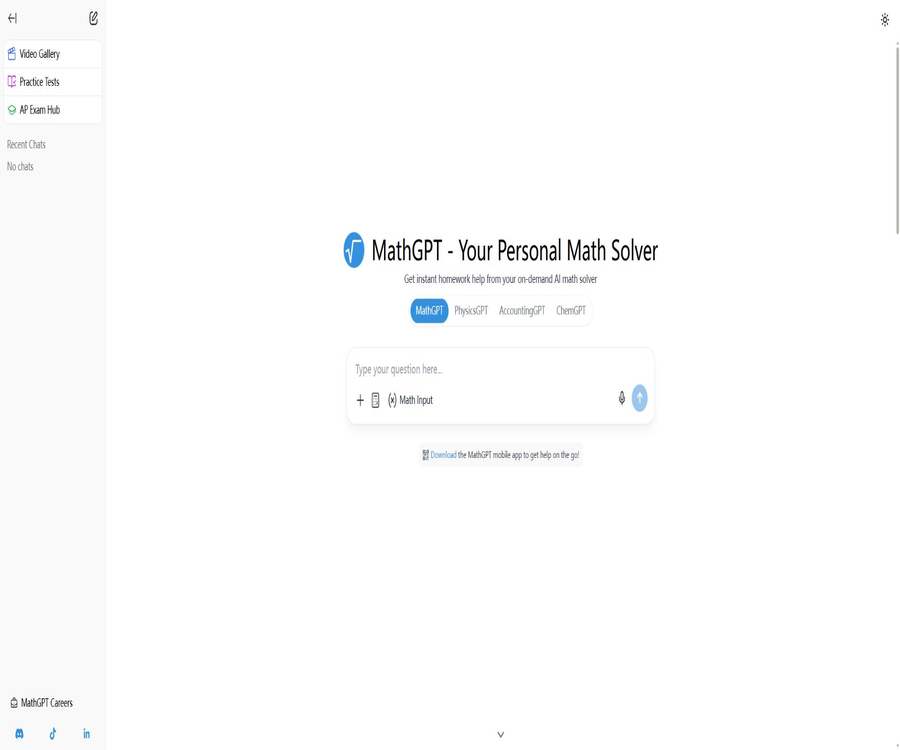
MathGPT is an AI-powered math problem-solving and STEM learning platform provided for students by MathGPT LLC; it was created by two engineering students from Cornell University. This platform can read text or images of problems, generate answers along with step-by-step explanations, and allows students to ask further questions about any steps they do not understand.
The old database labels MathGPT as an AI programming tool, which is not accurate. The current version of this product focuses on calculations in mathematics, statistics, physics, chemistry, accounting, and engineering; it also converts the results of these calculations into animated videos, practice exercises, flashcards, and learning guides.
Main functions
- Solve problems by taking photos: Upload screenshots from a web page or mobile app, or take pictures of the questions written on paper; the system will identify the formulas, text, and graphics and then provide the solution. When taking photos, it is important to ensure that the questions are complete and clear, without any fingers or shadows covering them, and irrelevant parts of the page should be removed.
- Entering text and formulas: Type in the problems, conditions, and quantities that need to be solved; this method is suitable for algebra, calculus, probability, statistics, as well as word problems. For complex formulas, it is necessary to check that parentheses, exponents, square roots, and units are recognized correctly.
- Step-by-step solution: Break down the problem-solving process into multiple steps and explain the formulas or transformations used, to help students identify which step they do not understand. Conditions may be omitted in these steps or calculation errors may occur; in such cases it is necessary to go back to the original problem or use other methods for verification.
- Continuous questioning: Users can ask for the reason behind a certain step, request an alternative method, ask for more examples, or ask that the explanation be simplified. Continuous dialogue is suitable for providing guidance, but errors present in the context may also be carried over into subsequent responses.
- AI animated videos: These create customized explanatory videos with illustrations and audio narration for specific topics or concepts, making them suitable for visual learners who want to review and understand the material. The time required to generate such videos, the number of videos that can be produced, and their availability are limited by the free or paid subscription limits.
- Practice tests: Exercises and interactive quizzes are created based on the topics just learned, to be used for preparation before exams and to identify any gaps in knowledge. Students must determine the difficulty level of these questions themselves; they cannot replace the official question bank provided by the teacher.
- Flashcards and study guides: Concepts, formulas, and key tips for solving problems can be organized into flashcards or study materials, which are useful for spaced repetition. Free users are limited in the number of such items they can create per day, while the Unlimited version offers a higher limit or no such restrictions.
- Basic and graphical calculator: A floating calculator can be opened in the input field; the basic mode is used for performing regular calculations, while the graphical mode allows for function plotting thanks to GeoGebra. This reduces the time needed to switch between applications, but whether its use is permitted during exams depends on the exam rules.
- Mathematical calculation calculator: This tool provides options for performing calculations such as algebra, integration, differentiation, solving quadratic equations, working with limits, fractions, scientific notation, and percentages. It is suitable for quick verification, but it is still necessary to understand the definitions of variables and the conditions under which they apply.
- Other STEM subjects: It supports topics related to physics, chemistry, statistics, accounting, economics, and engineering, and enables calculation and interpretation. The coverage of these subjects does not mean that they can replace experiments, safety regulations, or professional advice.
- Charts and visualizations: Interactive graphs are generated for functions or problems to help in understanding zeros, slopes, extreme values, and trends. Misinterpretations can occur if the graph window, sampling range, and coordinate scales are not appropriate.
Input, processing, and output
| Method | Enter | Output | Precautions |
|---|---|---|---|
| Text-based questions | Question stem, conditions, units, and objectives | Answers, steps, and explanations | Check whether the conditions are complete. |
| Image question | Camera photos or screenshots | The identified problems and their solution processes | Verify OCR, graphics, and symbols. |
| Further questioning | Natural language questions regarding the steps | Additional explanations, alternative methods, or examples | Avoid relying on incorrect assumptions. |
| Video | Topics or mathematical concepts | Animated illustrations and audio explanations | Subject to limits on the number of times and the amount that can be generated. |
| Learning tools | Topics, courses, or solved problems | Practice, flashcards, and study guides | Check the scope and difficulty of the course. |
| Calculator | Expression or function | Numeric, symbolic results, or interactive plots | Confirm the domain and display range. |
Usage tutorial
- Create an account on the website, or install the iOS and Android apps released by MathGPT LLC and log in.
- Choose to take a photo, upload an image, or enter text, making sure to include the question stem, options, diagrams, units, and all given conditions.
- Check the recognition results before submission, paying special attention to negative signs, fraction lines, square roots, subscripts and superscripts, angles, and matrix positions.
- Read through each step of the derivation; do not just copy the final answer. For steps that are not clear, ask for explanations of the formulas and the reasons behind them.
- Substitute the result back into the original equation, check the units, or use a graphical calculator to observe it, and then verify it by comparing it with examples in the textbook or the methods suggested by the teacher.
- After understanding the topic, create a set of exercises, flashcards, or study guides, and complete them independently without looking at the answers.
- If video explanations are used, record the key formulas and points where mistakes are likely to occur, and then use a different type of question to verify whether mastery has truly been achieved.
- Regularly check the remaining daily quota, the subscription channel, and the status of automatic renewal; to cancel the subscription, go to the original purchase channel to do so.
A usage suitable for learning rather than copying answers.
- First, write down the known conditions and the first step separately, then use MathGPT to check the approach.
- Ask the system to explain “why,” and have it provide an exercise with a different value but the same method.
- Deliberately avoid looking at the final answer; focus only on checking the intermediate steps, and then verify it after completion.
- Save the most common errors related to symbols, units, and domains that you make, and create flashcards from them.
- Before exams or assignments, make sure to familiarize yourself with the school’s AI and collaboration rules; do not submit tasks if their use is prohibited.
Prices and packages
| Package or version | Price | Billing cycle | Core benefits or quota | Suitable for users |
|---|---|---|---|---|
| Free version | 0 dollars | Daily limit | According to the official information, there are 15 questions per day, 5 AI videos, 3 study guides, and 3 sets of flashcards; limited access to learning tools is also available. | Occasionally solve problems and use the learning functions. |
| Unlimited monthly plan | 9.99 dollars | Monthly | Higher or unlimited questions, videos, flashcards, study guides, exercises, and access to a calculator – all subject to fair use guidelines. | Students who use it continuously throughout the semester |
| Unlimited annual payment | 83.88 US dollars | Once a year | That amounts to $6.99 per month; according to the published articles, this translates to savings of four months’ worth. | Users who engage in regular study throughout the year |
| In-app purchases for iOS apps | It varies depending on the region and product. | Monthly or annual payment | The store currently lists a variety of products with monthly subscription fees ranging from 9.99 to 14.99 dollars, and annual subscription fees ranging from 49.99 to 99.99 dollars. | Users who pay through Apple |
| In-app purchases for Android apps | Refer to Google Play. | By store products | The app can be installed for free, with in-app purchases available. | Android users |
The Unlimited price indicated on the website articles does not always match the price of the products available in the app store; this price can vary depending on the region, any promotions in effect, previous subscriptions, the distribution channel, and the payment cycle. Before making a payment, it is necessary to refer to the details shown on the actual payment page, including the currency used, the total amount, any trial periods, taxes, and the date of renewal.
Unlimited and refund policies
- The term “Unlimited” as used in these terms refers to reasonable individual, manual use; it does not mean that there are no thresholds, queues, cooling periods, limitations on functionality, or cost controls at all.
- The platform allows for the adjustment of speed limits and quotas; it can reduce the speed, suspend, or block activities that involve automation, shared accounts, resale, attempts to bypass restrictions, or abnormal costs.
- Subscriptions are usually renewed automatically; canceling them only stops future charges, while the service can generally be used until the end of the current billing cycle.
- Fees, points, certain usage periods, and unused features are, in principle, non-refundable and cannot be applied as a credit; no proportional refund is provided either due to technical issues, unsatisfactory output, or cancellation midway, except in cases mandated by law.
- When purchasing through Apple, Google, or other platforms, cancellations and refunds are subject to the rules of those respective stores.
Supported platforms
| Platform | Support methods | Key capabilities | Precautions |
|---|---|---|---|
| Web version | Desktop and mobile browsers | Picture or text-based problem solving, dialogues, learning tools, and calculators | A network connection and account credit are required. |
| iPhone | Official native app | Camera-based problem-solving, chatting, video, graphics, and learning functions | The current store requires iOS 15.1 or a higher version. |
| Android | Official native app | Solving problems via photos, step-by-step guidance, videos, and STEM tutoring | Free installation, with in-app purchases available |
| tablet | Mobile app or web page | View derivations and graphs on a larger screen | The specific interface varies depending on the device and version. |
PocketMath was the name used for the official mobile app of MathGPT; currently, the app stores display the MathGPT brand as the main name. When downloading, make sure the developer is MathGPT LLC to avoid installing another app with a similar name that serves similar purposes.
Which users are it suitable for
- Middle school students and university students who need to gradually understand algebra, geometry, calculus, as well as probability and statistics problems.
- Visual learners who rely on diagrams, audio, or interactive exercises to understand concepts.
- Students who are studying physics, chemistry, accounting, or engineering calculations and need to quickly verify the steps.
- Parents who help their children with homework but prefer to understand the methods first before explaining them.
- It is not appropriate to use it for completing exams, quizzes, or independent assignments where AI is prohibited, nor can it replace teacher evaluation.
Advantages
- It evolves from step-by-step solutions to individual questions to videos, exercises, flashcards, and study guides, creating a fairly comprehensive review cycle.
- Photos, text, sequential conversations, and a built-in calculator are available to suit various question types and devices.
- Graphic computation is supported by GeoGebra, which facilitates a combined understanding of symbolic derivations and the shape of functions.
- It is available on web pages, as well as on iOS and Android, and is suitable for use outside the classroom and during commutes.
- The free tier is sufficient to test the quality of recognition and interpretation, before deciding whether to subscribe.
Capabilities boundaries and limitations
- The terms explicitly acknowledge that AI may generate incorrect, incomplete, or misleading content, and that the final answers and conclusions must be verified.
- Image recognition may misread negative signs, exponents, fractions, angles, or handwritten characters; incorrect questions can render the entire solution invalid.
- Graphs, proofs, open-ended questions, and problems that require specific teaching methods may lead to solutions that do not meet the teacher’s expectations.
- Different courses may use various symbols, rounding rules, significant figures, and unit conventions; the system does not automatically understand all of these scoring criteria.
- “High accuracy” and the number of users are part of the product description; they do not guarantee accuracy for every type of question.
- Unlimited still has restrictions regarding fair use and prevention of abuse; bulk submission, sharing, or resale of scripts may result in a ban.
- Copying answers directly may violate academic integrity rules and also weaken the understanding of concepts.
API, models, and open-source status
MathGPT integrates mathematical engineering into advanced language models; it generates and executes Python code for complex calculations, while also drawing on a large number of previously solved problems through retrieval-based methods. At present, there is no public information available regarding the name of the underlying model, the detailed evaluation methods, public APIs, SDKs, or authentication documents for developers to use.
- No official public GitHub organization or product source code repository for MathGPT LLC has been identified.
- Product codes, models, and question banks do not come with an open-source license, and should therefore be regarded as proprietary services.
- Using Python for calculations, GeoGebra graphics, or third-party models does not mean that MathGPT itself is open source.
- The terms prohibit unauthorized scraping, crawling, automation, reverse engineering, resale, and commercial use.
Privacy, Security, and Content
- The platform handles accounts, subscriptions, payments, communications, preferences, and technical usage data, as well as questions, images, files, and messages submitted or generated by users.
- The information is used to provide functions, personalization, analysis, troubleshooting, security, protection against abuse, billing, support, marketing, and compliance with legal requirements; it may also be handed over to the relevant service providers.
- The platform claims it does not sell personal information for monetary gain, but certain analytical or advertising activities may be considered as selling, sharing, or targeted advertising under certain laws; users can request to opt out.
- Data is retained by service, billing, content storage, security, taxation, and dispute resolution purposes, with no fixed uniform deadline; limited records may still remain even after an account is deleted.
- Data may be processed in the United States and other countries, and the level of privacy protection may vary depending on the user’s location.
- Users can request access to, correction of, deletion of, copying of, restriction on, objection to, or withdrawal from specific advertising campaigns, and can turn off notifications through their device settings.
- The iOS App Store states that purchase history, name, email address, photos or videos, user ID, and interactions with products can be linked to the user; Google Play indicates that it collects personal, financial, and other data, and may also share device identifiers.
- Do not upload full screenshots that contain names, school account details, grades, information about classmates, or credentials for examination systems; before submitting, crop out and cover any unnecessary personal information.
- The service is intended for users aged 13 and above; minors must obtain their guardians’ consent and supervision, as well as abide by school rules.
Content rights and academic integrity
- The user retains ownership of the submitted questions, images, files, and messages, while granting MathGPT the authority to process these contents for the purpose of providing, maintaining, securing, supporting, and improving the service.
- Users must have the necessary rights to submit screenshots of textbooks, exam papers, lecture notes, and works created by others; they must not upload any leaked or restricted content.
- It is forbidden to use such methods in exams, quizzes, or assignments that require independent completion; nor is it allowed to use scripts to bypass questions or volume limits.
- The output of the system cannot replace professional, legal, medical, or financial advice; when dealing with matters related to safety or high-risk decisions, it is necessary to consult qualified experts.
- Save your calculation, verification, and modification processes to ensure that the final submission reflects a genuine understanding rather than unverified answers.
Summary
The core value of MathGPT is to transform the process of solving problems by taking photos into a learning framework that includes steps, follow-up questions, videos, exercises, flashcards, and diagrams, rather than merely providing answers. It is suitable for everyday math and STEM tutoring, but it is important to prioritize accuracy checks, academic integrity, privacy considerations, and differences in subscription options when using it.
Tools similar to MathGPT



 Guigong Network Security Registration No. 45132202000164