






Levity
Levity, an intelligent tool focused on AI programming
Tags:AI programming toolsWhat is Levity?
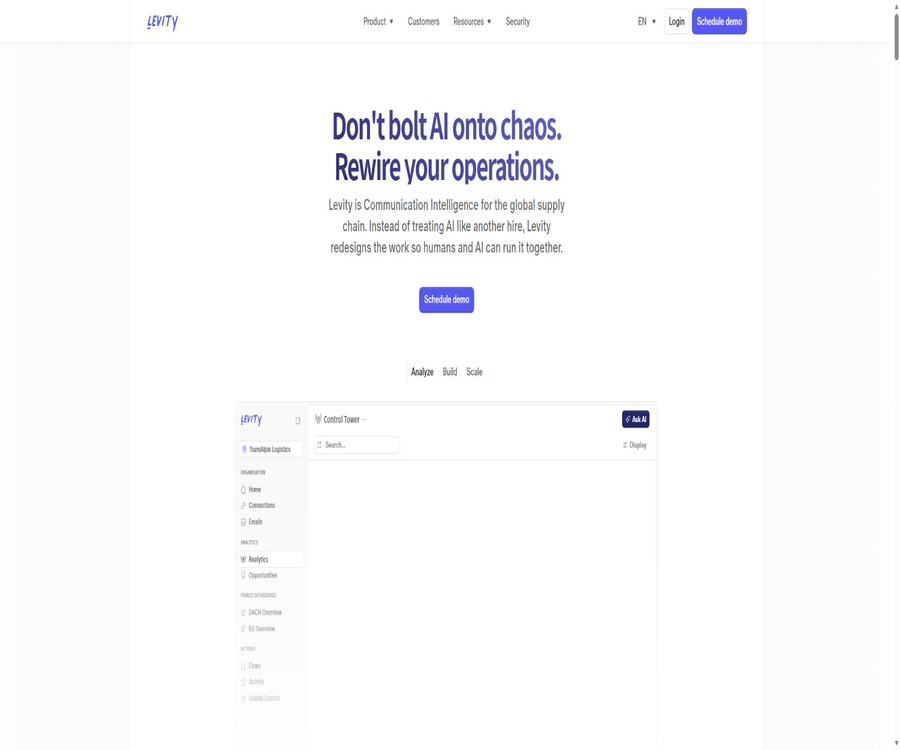
Levity is an enterprise-level AI automation platform developed by the German company Levity AI GmbH; it functions as a tool for Communication Intelligence within global supply chains. It assists freight forwarders, logistics service providers, and large operational teams in handling repetitive tasks that arise from emails, attachments, and internal systems.
Initially, the product was centered around the general-purpose code-free AI Block and Flow tools; today it has clearly shifted focus to analyzing corporate logistics emails, identifying automated opportunities, managing production workflows, and providing custom integrations. When evaluating it, it should be considered based on its current logistics-related features, rather than continuing to describe it as a general-purpose self-service sorting tool for individuals.
Main functions
- Connect to personal or shared email accounts and analyze high-volume communications.
- Convert the email subject, body, and attachments into structured operational data.
- Query email and business data using natural language.
- Identify duplicate requests, handovers, and high-impact automation opportunities.
- Use visual workflow orchestration to manage AI, rules, and system actions.
- Extract quote, order, status, and document fields from emails.
- Connects TMS, ERP, CRM, support, and pricing platforms.
- Add manual review and approval for high-risk steps.
- Use test environments, version control, and rollback mechanisms to manage changes.
- Custom connections are established by implementation engineers, who also carry out ongoing optimization.
Current product positioning
| Phase | Product highlights | Correct understanding |
|---|---|---|
| Early products | Universal code-free AI Blocks, Flow, and pay-per-use pricing | The information on the historical self-service platform does not reflect the current sales offerings. |
| Current products | Logistics email analysis, intelligent communication, and enterprise automation | Designed for complex supply chain operations and a large number of emails. |
| Delivery method | Product platform and implementation experts | It not only provides software accounts but also includes process design and integration tasks. |
| Procurement method | Schedule a demonstration and customize a contract | The public page does not show the current fixed package price. |
Inbox Analytics email analysis
Levity can connect to email services such as Gmail and Outlook, perform backend analysis of the subject lines, body text, and attachments, and transform unstructured communications into trackable metrics. It is designed to handle very large volumes of emails, making it suitable for analyzing the operational workload across multiple teams, regions, and shared email accounts.
- Count the daily number of emails and different business categories.
- Identify topics such as tracking inquiries, booking shipments, quoting prices, claims, and customs matters.
- Compare the ratio of internal to external emails.
- Check response time, backlogs, and unresolved exceptions.
- Create customizable panels by team, region, or process.
- Generate new dashboard components through natural language.
- Use insights to select the next batch of automated processes.
Chat with Your Data
Users can ask questions about email and operational data using natural language, without the need to write SQL queries or wait for the analysis team to prepare reports. The answers can also be saved as components of dashboards that are continuously updated, for use by operations, product, and management teams.
- Find out the most common causes of delays for a particular week.
- Compare the carrier rejection rates or response performance.
- Count the number of booking transactions during a specific period.
- High-volume mailboxes and unresolved exceptions were detected.
- Keep asking for the root causes behind the chart.
- Save common questions as real-time monitoring components.
Automated opportunity identification
Automation Potential analyzes actual emails to identify repetitive tasks, and it estimates the monthly volume of such tasks, the average processing time required, the potential savings, as well as the difficulty of implementation. Based on this analysis, teams can prioritize those processes that have a high impact but require low costs for implementation, rather than choosing AI projects based solely on intuition.
| Candidate process | Identifiable content | Possible automated actions |
|---|---|---|
| Current price quote | Quotation requests, routes, goods, and time requirements | Check the rates and prepare or send a quote. |
| Track and Trace | Shipping status, estimated arrival time, and any abnormalities | Query TMS and respond to the customer. |
| Booking and order entry | Carrier, route, date, rate, and cargo fields | Create or update TMS records |
| Document processing | Invoice, bill of lading, delivery certificate, and attachment fields | Extract data and route it to the target system. |
| Claims and anomalies | Damaged information, missing data, and delayed context | Classify, assign, and trigger manual review. |
Automation Flows
Automation Flows is used to connect triggers, AI actions, business rules, manual checkpoints, and external systems into a functional workflow. The Levity team first identifies the existing steps, edge cases, target metrics, and the systems that need to be connected, before developing the production version.
- Design the logic of the visual interface process.
- Adjust AI prompts and behaviors directly within the process.
- Reuse modules, components, and standard prompts.
- It is reviewed jointly by the heads of operations, IT, and processes.
- Release to production only after verification in the testing environment.
- Save a version and roll back in case of errors.
- Use environment variables to distinguish between test and production configurations.
- Continuously monitor the results and optimize them based on feedback.
Typical logistics automation
| Scene | Enter | Process output | Manually controlled points |
|---|---|---|---|
| Automatic quotation | Customer emails, route, and shipment information | Rate inquiry and quote draft | Approval required for high amounts or special clients |
| Order entry | Booking data in emails or Excel | Create a TMS shipping or shipment record | Checking for missing fields and duplicate orders |
| Status reply | Customer inquiry and shipping number | Read the TMS status and generate a response. | Abnormal shipments and audits of key customers |
| Carrier coordination | Confirmation, rates, and route communication | Update carrier or assignment records | Differences in rates and compliance verification |
| Invoice tracking | Incoming and outgoing emails and attachments | Extract the amount and status, and trigger follow-up. | Disputes, tax matters, and review of abnormal amounts |
Human in the Loop
Levity allows the addition of review nodes in those cases where the confidence level is low, the risk is high, or where business rules require human judgment. The team can first have people verify all the results, and then gradually increase the proportion of automated processing based on the actual accuracy achieved.
- Verify the route, rates, and profit before sending the quote.
- Fill in or correct missing fields before creating the booking.
- Check for abnormal statuses and tone before the customer updates.
- Generate dedicated review interfaces for different scenarios.
- Collect the results of the modifications and use them to drive continuous improvement of automation.
- Set stricter thresholds for high-risk customers, regions, or amounts.
Feedback management
Production automation cannot be achieved through a single deployment; Levity collects users’ corrections, errors, and explicit feedback to identify failure patterns and adjust the processes. Companies should also maintain their own quality metrics, issue classification systems, and approval procedures, to ensure that business rules are not solely defined within the supplier’s settings.
Integration capability
The current integration catalog lists over 50 different connections, covering logistics TMS, ERP, CRM, shared email services, ticketing systems, business intelligence tools, and pricing tools. Levity also allows implementation teams to create custom connections for internal or legacy systems, and it supports real-time reading and writing of business records.
| Category | Representative system | Typical uses |
|---|---|---|
| Email and communication | Gmail, Outlook, SEDNA, Slack, Teams, and Google Chat | Receive requests, generate responses, and send reminders |
| TMS and freight shipping | CargoWise, Turvo, McLeod, MercuryGate, TAI and Transporeon | Read shipping information, create orders, and update status. |
| ERP and enterprise systems | SAP, Oracle, NetSuite, Infor, and IBM AS/400 | Synchronize order, customer, and financial transaction records |
| CRM and Support | Salesforce, HubSpot, Pipedrive, Zendesk, Freshdesk, and Intercom | Manage customers, tickets, and communication context |
| Quotations and information | DAT, Greenscreens category of rate tools, FreightWaves and Triumph | Query market rates and generate quotes |
| Analysis and Data | Power BI, Tableau, Looker, and Snowflake | Shared metrics, dashboards, and analysis data |
| Customized systems | Internal tools and legacy platforms | A two-way connection is designed by the implementation team. |
Provide expert services
Levity adopts a delivery model that combines a platform with Forward Deployed Engineers; these engineers are involved in identifying requirements, carrying out integration tasks, dealing with edge cases, and providing ongoing support after the system goes live. It is more akin to an automation solution for enterprises, rather than a generic tool that can be used simply by clicking a few buttons after registration.
- Choose a process with a large volume of emails and clear metrics.
- Review the current personnel, systems, fields, rules, and exceptions.
- Connect to the email account and establish a baseline of the current status.
- Identify automation opportunities and assess the business impact.
- Levity and the internal IT team define the connection and approval boundaries.
- Replay historical cases and exceptions in the testing environment.
- First, run small-scale production in manual review mode.
- Track accuracy rate, processing time, savings, and error types.
- Gradually increase the proportion of automatic execution, as well as the number of email addresses and regions covered.
Production release and governance
- The testing and production environments are configured separately.
- Keep a record of the retained version and the release history for each modification.
- In case of anomalies, it is possible to roll back to a previous stable version.
- Tips, rules, and components can be reused centrally.
- The company has SOPs, exception rules, and approval thresholds.
- System actions are carried out through controlled interfaces and permission boundaries.
- Key decisions retain input, rules, approval, and result trajectories.
- Verify the actual business metrics before expanding automation.
Current pricing method
The official Levity website does not list any fixed self-service packages or standard prices; the way to place orders is through scheduling demonstrations. The subscription fee, contract duration, volume of usage, number of email accounts, connectors, implementation services, support packages, and professional services are specified in the order documents or task descriptions.
| Purchasing items | Public price | Items that need to be confirmed | Suitable situations |
|---|---|---|---|
| Product subscription | Custom quote | Contract duration, users, email address, usage volume, and scope of functions | Enterprise customers that use the core platform |
| Implement services | Custom quote | Requirement analysis, process development, deployment, and training | Organizations that do not have an internal automation team |
| Custom integration | Custom quote | Number of systems, bidirectional read/write, maintenance, and fault response | Customers using TMS, ERP, or legacy systems |
| Support solutions | Custom quote | Response time, continuous optimization, and dedicated resources | Key production processes |
| Concept validation | Contact sales | Scope, data volume, success metrics, and conditions for going into production | The team that conducted the initial assessment of Levity |
Why can’t historical prices be used directly?
Old pages showing the free version of Sandbox in its early days, as well as the Business version with a monthly cost starting at $100, can still be found on the Internet. However, those pages refer to the era of the General AI Block and do not reflect the current enterprise logistics products. Neither the details provided nor the purchase budgets should consider those historical prices as valid rates for the year 2026.
Contract and payment considerations
- The fees are usually paid in advance before the start of the contract period.
- Taxes and fees are calculated by the payment processor based on the customer’s country of residence.
- Monthly or annual contracts are automatically renewed in accordance with the terms specified in the order.
- By default, a written notice of non-renewal at least 30 days before expiration is required.
- The subscription fees that have already been paid are generally not refundable or deductible.
- An annual contract may entail obligations for the entire year, even if payments are made on a monthly basis.
- Downgrading may result in a loss of content, features, or capacity.
- The formal contract or main service agreement takes precedence over the general terms.
Price comparison before procurement
| Comparison dimensions | Levity needs to be confirmed. | Why is it important? |
|---|---|---|
| Billing unit | Email address, number of emails, workflow, number of executions, or fixed annual fee | The cost curve after deciding on business growth |
| Implementation costs | One-time or included in the subscription | Impact on total cost of ownership in the first year |
| Integrated maintenance | Who is responsible for adapting the new version and fixing bugs? | Changes in TMS have a direct impact on the production process. |
| Support level | Service hours, response, and recovery objectives | The logistics process may operate continuously across time zones. |
| Exit cost | How to export data, processes, and configurations | Prevent SOPs from being locked in the supplier’s system. |
| Success indicators | Saving on labor hours, response time, accuracy, and automation level | Determine whether a project generates quantifiable value. |
APIs and developer capabilities
Levity enables reading from and writing to TMS, ERP, CRM, and internal tools through controlled interfaces, and it can also establish customized connections for clients. However, no public API documentation, open SDKs, or fixed pricing for calls have been identified; the development of integrations should be determined based on the specific needs of each enterprise.
- Identify each business object that needs to be read from and written to.
- Limit the permissions of service accounts and the range of customers they can access.
- Design idempotency and duplicate checks for write operations.
- Define rate limits, timeouts, retries, and error queues.
- Retain field mapping and version change documentation.
- Before production, the system simulates unavailability and partial failures.
GitHub and the open-source status
Levity has a GitHub organization that has undergone domain verification, but its public projects consist mainly of archived third-party branches and example repositories; there is no core code for the platform itself. Levity’s products, AI models, and automation services should be classified as closed-source commercial SaaS solutions.
| Project | Status | Label correctly |
|---|---|---|
| Levity platform | Closed-source commercial products | Whether it is open source is marked as no. |
| Current automation process engine | Core code is not publicly available. | Self-hosted deployment is not allowed. |
| Official GitHub organization | It exists. | Having open warehouses does not mean that the core products are open source. |
| Archive model branch | Historical technology projects | Do not treat it as the current model code. |
| Public SDK | Not verified. | Custom integration requires confirmation with the implementation team. |
Security and Authentication
Levity lists its ISO 27001 and SOC 2 Type II certifications publicly, and provides a Trust Center for companies to review. Sensitive user data is encrypted both during transmission and when stored statically; authentication is handled by WorkOS, and the platform does not store user passwords directly.
- The network connection uses encrypted transmission.
- Sensitive data is encrypted when stored.
- The infrastructure operates in private cloud environments such as AWS, Google Cloud, and Microsoft Azure.
- Payments are processed by services such as Stripe and Paddle.
- It supports the assessment of enterprise identities and role-based access control.
- Security reports and control materials can be requested from the Trust Center.
- Security vulnerabilities can be reported through the support channels.
Privacy and data protection
As the entity operating in Germany, Levity AI GmbH has service contracts that include data processing agreements in line with Article 28 of the GDPR. Customers must ensure that they have the right to submit emails, attachments, customer data, and other personal information for processing by the platform.
- Before connecting to the email account, determine the controller, processor, and legal basis.
- Explain to employees and customers the scope of automatic analysis.
- Connect only the email accounts and folders required to achieve the implementation goals.
- More stringent permission and retention rules are applied to special categories of data.
- Verify the sub-processor, data region, and cross-border mechanism.
- Agree on the return, export, and destruction after the contract ends.
- Obtain the necessary consent or authorization in the professional confidentiality sector.
Customer data and model improvement
The terms of service allow Levity to process customer content in order to provide, maintain, and improve services, address security issues, and carry out customer instructions. Enterprises should specify in the orders, DPA agreements, and security reviews the model provider, the scope of feedback for learning purposes, data isolation, and whether it is permissible to use production environments to correct and improve specific workflows.
Which users are it suitable for
- A freight forwarder who deals with a large number of customer emails on a daily basis.
- Logistics teams that wish to automate quote generation, booking, and status tracking.
- Operations departments that need to connect their email systems to TMS or ERP.
- Large enterprises that manage multiple countries, offices, and shared email accounts.
- Controlled processes that require manual review, auditing, and governance for release.
- Digital teams that aim to identify opportunities for automation using data first.
- Organizations that need engineers to work on complex legacy systems.
Product advantages
- The current products focus on real logistics emails and supply chain processes.
- A closed loop is formed, ranging from analysis and opportunity identification to automation and continuous improvement.
- It can connect emails, attachments, and various business systems into a cohesive workflow.
- It offers over 50 ready-made connections and supports custom integration.
- The manual review nodes can be adjusted gradually based on the level of risk.
- Testing environments, versions, and rollback mechanisms are suitable for production governance.
- Experts are involved in the development and deployment of complex processes.
- It holds ISO 27001 and SOC 2 Type II certifications.
Restrictions and Precautions
- The current focus is on logistics companies, not general personal automation tools.
- There is no publicly listed standard price; a sales assessment is required.
- The effectiveness of going live depends on the quality of the emails, as well as the clarity of the system interfaces and processes.
- Custom integration increases implementation time and long-term maintenance costs.
- AI extraction and classification still require exception handling and human supervision.
- Public APIs, SDKs, and self-service developer solutions are not specified.
- The public GitHub repository does not include the current core platform.
- The historical Sandbox option and the price starting at $100 are no longer suitable as current prices.
- The payment terms and exit obligations under annual contracts need to be carefully examined.
Procurement and Pilot Inspection Checklist
- Choose a process for which the volume of emails, processing time, and error costs can be quantified.
- Prepare real fields, SOPs, edge cases, and historical cases.
- Confirm all email accounts, TMS systems, ERP systems, and pricing tools that need to be connected.
- Define targets for accuracy, response time, time saved, and automation rate.
- Distinguish between the enterprise business rules and the responsibilities of the Levity execution layer.
- Design requirements for manual approval, permissions, auditing, and rollback.
- Check the total costs for subscription, implementation, integration, support, and any overages.
- Review the DPA, sub-processors, data areas, and terms of use for the models.
- Agree on the conditions for piloting the transition to production, expansion, and early withdrawal.
- Suggest feasible solutions for exporting process configurations, logs, and business data.
Frequently Asked Questions
Is Levity still a general-purpose no-code AI tool?
The current main focus has shifted to Supply Chain Communication Intelligence, with an emphasis on logistics email analysis, TMS integration, and production automation. The earlier general AI modules still exist as part of the historical record, but they should not represent the current scope of the product.
How much is Levity?
Currently, there are no fixed public package prices; it is necessary to schedule a demonstration, and the quotation is determined based on factors such as email usage, processes, volume of operations, as well as the scope of integration and services provided. The older version, which started at 100 dollars per month, is not suitable for the current enterprise logistics solutions.
Is programming required?
Operators can participate in the design using visual workflows and natural language, but the connection of complex systems is usually carried out jointly by Levity’s implementation engineers and the customer’s IT team. It is not a simple self-service tool that requires no technical involvement at all.
Which systems are supported?
The platform lists over 50 types of connections, covering Gmail, Outlook, major TMS systems, ERP systems, CRM systems, service desks, business intelligence tools, and freight pricing tools. Internal and legacy systems can be connected through custom integrations.
Is Levity open source?
No, the core platform and models are part of closed-source commercial services. An official GitHub repository does exist, but it contains mainly public archived branches and example projects; these cannot be used for self-hosting Levity.
What are the security certifications?
Levity offers ISO 27001 and SOC 2 Type II certifications, and it complies with the GDPR data protection requirements. Specific reports, data areas, sub-processors, and scope of control shall be reviewed in the company’s Trust Center.
Summary
Levity is suitable for companies that wish to transform large volumes of logistics-related emails into analyzable data and actionable workflows. Its value lies not only in sorting emails, but also in identifying opportunities for automation, linking TMS systems with ERP systems, incorporating manual approval processes, and ensuring the smooth operation of these processes through expert support.
When purchasing it, it should be viewed as an enterprise software and implementation project, rather than a low-cost self-service SaaS solution. The key to success lies in clear SOPs, real-world case studies, controlled system permissions, quantitative metrics, and effective governance mechanisms – rather than simply adding an AI agent.
Tools similar to Levity



 Guigong Network Security Registration No. 45132202000164