






Inductor
Inductor, an intelligent tool focused on AI programming
Tags:AI programming toolsWhat is an inductor?
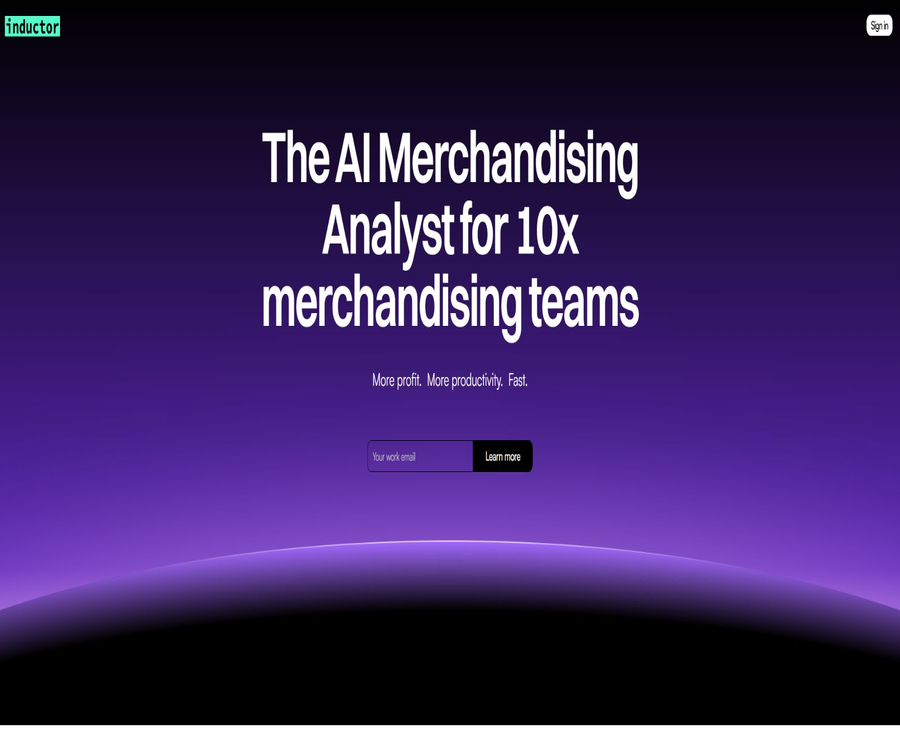
Inductor is an AI analysis tool designed for retail and e-commerce product management teams; it positions itself as an AI Merchandising Analyst. It aims to use specialized AI agents to help these teams improve the speed of decision-making, operational efficiency, and profit margins.
This positioning is different from its earlier platforms for the development and evaluation of LLM applications. To understand Inductor, it is necessary to take into account the current products in use; the developer features available in 2024 cannot be considered as the current capabilities.
A one-sentence summary
Inductor is an AI-based product management analyst designed for product planning, retail operations, and e-commerce teams; currently, it relies on work email addresses to gather more information about products.
Current product status
On the current page of Inductor, only the product overview, the login link, and a form for contacting the company regarding the product are available; complete feature pages, price information, or instructions for self-registration are not provided.
| Project | Current confirmed status | Meaning of selection |
|---|---|---|
| Product positioning | AI Product Operations Analyst | Team for retail and e-commerce products services |
| Use the entrance | There is an entry point for existing customers to log in. | An account invitation or business setup may be required. |
| Ways to find out | Work email for submission | Suitable for corporate team consultations and presentations |
| Public price | Not yet made public | The budget needs to be confirmed separately. |
| Public feature documentation | Not yet made public | It is not possible to infer current functions based on older versions of the data. |
| APIs and Integration | Not yet made public | It needs to be verified during the demonstration phase. |
| Free trial | Not yet made public | It cannot be marked as a permanently free tool. |
Main positioning
Service Product Operations Team
Inductor is aimed at merchandising teams, rather than chatbots designed for ordinary consumers. Its target users typically need to conduct continuous analysis regarding products, sales, inventory, prices, promotions, and business performance.
Provide assistance in the form of an AI analyst.
The product uses the “AI Merchandising Analyst” to describe its function, which means it functions more like an analytical assistant integrated into the workflow of the product team. As for whether it can automatically carry out tasks such as price adjustments, restocking, or product listing, no details are available at present.
Emphasize profits and productivity
The current value proposition focuses on increasing profits, improving work efficiency, and speeding up analysis processes. The specific metrics, methods for evaluating effectiveness, and customer cases have not been made public; therefore, companies should conduct trials to verify these aspects on their own.
What can be reasonably expected at the moment?
Based on its product positioning, it is clear that Inductor focuses on analysis related to product management; however, this does not mean that it covers all functions related to retail planning. The following are the capabilities that should be carefully verified when making a selection, but it is not guaranteed that all of them will be available.
- Does it support analyzing sales performance by product, category, channel, region, and time?
- It is possible to identify anomalies, opportunity products, risks of unsold inventory, and changes in profits;
- Does it support natural language queries, as well as the automatic generation of analysis results and action recommendations?
- Whether it covers product portfolio, pricing, promotions, inventory, and lifecycle management;
- Can it be connected to the enterprise’s existing data warehouses, e-commerce platforms, ERP systems, or BI systems?
- The analysis recommendations should be traceable to clear indicators, data ranges, and calculation methods;
- AI suggestions should be sent for approval, rather than directly modifying critical business data.
Usage process
Apply to learn about the product
- The request was submitted using the company’s work email, with details on the retail format, team size, and key issues outlined.
- Prepare to improve the processes related to product management, such as sales reviews, identification of abnormalities, analysis of product combinations, and promotional strategies.
- During the product demonstration, confirm the data connection method, permission model, scope of analysis, and output format.
- Select a category or channel with clear business boundaries for a pilot project, and retain the step of manual review.
- The results of the pilot project are evaluated based on profit, turnover, stockouts, slow-selling products, analysis time, and the rate of adoption of recommendations.
Log in with an existing account
Customers who have already registered can access the application through the product login page. At present, there is no public process for registering personal accounts; therefore, new users should not consider the login page to be an option for free and open registration.
Suggestions for corporate pilot programs
- First, clarify the business issues, the reference period, and the success metrics, to avoid evaluating solely whether the responses are fluent.
- Select a sanitized, limited dataset to confirm the fields, granularity, currency, time zone, and return criteria.
- Have product experts establish standard answers or acceptable ranges of judgment for a set of real-world problems.
- Test the normal situation, promotional fluctuations, new products, stockouts, outliers, and data missing scenarios separately.
- Check whether each conclusion can explain the basis for the calculations, and have the business staff confirm the action recommendations.
- After evaluating permissions, auditing, data deletion, and system integration, decide whether to expand the scope of use.
Which users is it suitable for?
- The product planning, procurement, and category management teams of retailers and brand owners;
- E-commerce operation teams that need to continuously analyze product performance, profits, and inventory levels;
- Business analysts who wish to reduce the time required for preparing reports and conducting post-operational reviews;
- Digital teams are evaluating the integration of AI agents into the product management processes;
- Enterprises that possess comprehensive data on products, transactions, and inventory, and are able to carry out controlled pilot projects.
In what situations is it not very suitable?
- I’m just looking for a free chat tool for shopping or product selection, intended for individual users;
- Teams that need to view the fixed public prices immediately and make purchases online on their own;
- Enterprises that lack stable master data for products, consistent transaction criteria, and proper permission management;
- A procurement process that requires the product to make all of its APIs, deployment architecture, and compliance reports publicly available;
- It is hoped that AI can make high-risk business decisions directly, without the need for human approval.
Product advantages
- The focus is on the product management team, and the use cases are more specific than those of general chatbots.
- Using AI analysts and agents as the product format, it focuses on ongoing business operations rather than one-time queries.
- Pay attention to both profits and team efficiency, which facilitates the design of pilot projects based on key business metrics.
- There is a separate login page for the application, which indicates that the product is more than just a page with conceptual information.
Usage restrictions and risks
- There is very little publicly available information, making it impossible to independently determine the specific scope of functions and the level of maturity of the product.
- There is no disclosure of package options, quotas, contract durations, or implementation costs, resulting in an opaque procurement budget.
- There are no public data connectors, APIs, deployment methods, or information regarding the scope of support services available.
- There are no public details regarding privacy, security, data retention, and model training;
- AI analysis may be affected by dirty data, inconsistencies in measurement methods, seasonality, and abnormal promotional activities.
- Suggestions regarding profits, prices, procurement, and inventory can affect business outcomes, and therefore require manual approval and auditing.
Prices and packages
The price information was verified on August 23, 2026; the actual amounts, taxes, exchange rates, and discounts may vary, and the final figures will be those displayed on the settlement page.
At present, Inductor does not disclose any information regarding the package names, fixed prices, free usage quotas, or trial periods for its commercial products. The page suggests submitting an email address to obtain more details, which is a approach more akin to the sales and customization processes used by enterprises.
| Version or fee item | Current price | Billing cycle | Equity or quota | Suitable for users |
|---|---|---|---|---|
| Product management for goods | Not yet made public | Not yet made public | It needs to be confirmed through a demonstration. | Retail and E-commerce Team |
| Free trial | Not yet made public | Not yet made public | No public commitments have been made. | Companies that wish to verify the effectiveness first |
| Implementation and data access | Not yet made public | Confirm by project | The scope depends on the complexity of the system and the data. | Companies that need to integrate existing systems |
| Corporate support | Not yet made public | Confirmed per contract | The service level and scope of support need to be confirmed. | Production environment customers |
The early developer platform used a monthly pricing model based on the number of users, but this is not the same as the pricing for the current product offerings. When making purchases, it is necessary to use the current rates, with subscription fees, implementation costs, data connection fees, and support costs listed separately.
Questions to confirm before making a purchase
| Evaluation dimensions | Suggested questions to ask | Why is it important? |
|---|---|---|
| Scope of business | Which product management tasks are already supported? | Prevent positioning from being treated as a complete list of functions. |
| Data requirements | Which tables, fields, granularity levels, and historical time periods are required? | Decide on the deployment costs and analysis quality |
| System integration | Which data warehouses, ERP systems, e-commerce platforms, and BI tools are supported? | Determine whether custom development is required. |
| It is recommended to carry out it. | Can it only generate insights or can it also trigger business actions? | Decision-making on approval and risk control design |
| Permission audit | Does it support role-based permissions, operation logs, and single sign-on? | Protect sensitive business data |
| Model strategy | Which models are used and whether the data is employed for training | Affects privacy, cost, and stability |
| Service assurance | Availability, response time, and failure handling commitments | Determine whether it is suitable for the production process. |
| Exit mechanism | Data export, deletion, and contract termination processes | Reduce the risk of supplier lock-in |
Privacy and data security
A product management system may handle sensitive data such as sales figures, costs, gross profits, inventory levels, as well as information related to supplier and customer behavior. Inductor does not currently provide any verifiable privacy policy or security whitepaper on its public pages; therefore, companies should not upload production data until the contract terms and control measures have been confirmed.
Data clauses that it is recommended to verify
- Data storage locations, cross-border transmission mechanisms, and data processing roles;
- Transmission, static encryption, key management, and backup methods;
- Employee access control, principle of least privilege, logging, and notifications for security events;
- Whether customer data is used for training, evaluating, or improving shared models;
- Retention period for hints, uploaded data, analysis results, and logs;
- Time limits for exporting and deleting data after the contract is terminated, as well as proof of deletion;
- Scope of subcontracting for third-party models, cloud services, and analysis tools.
Business control recommendations
During the pilot phase, it is preferable to use anonymized, aggregated, or simulated data, and the range of products and organizations that are visible should be limited. Recommendations regarding prices, purchasing, and inventory must be approved by authorized personnel.
APIs, SDKs, and system integration
The current product for commodity management does not provide public APIs, SDKs, connectors, or technical documentation. Whether batch import, real-time synchronization, connection to data warehouses, single sign-on, and result writing are supported must be verified one by one during a product demonstration.
| Technical capabilities | Public status | Verification suggestions |
|---|---|---|
| REST or GraphQL API | Not yet made public | Request for interface directory, throttling, and authentication details |
| Data warehouse connection | Not yet made public | Verify read-only connection, network, and incremental synchronization. |
| ERP and e-commerce connector | Not yet made public | Check the support systems, field mappings, and synchronization frequency. |
| Single sign-on | Not yet made public | Identity verification protocols, role mapping, and exit recovery |
| Result export | Not yet made public | Confirm format, batch export, and data ownership |
| Private deployment | Not yet made public | Confirm the options for cloud, dedicated environment, or customer environment. |
GitHub and the open-source status
The current product platform for Inductor does not have any publicly available core code repository that can be identified, and it cannot be considered an open-source product. The team previously released LLM toolkits and Text-to-SQL examples, but those old projects do not represent the code, SDKs, or licenses associated with the current product platform.
| object | Phase | Public status | Judgment |
|---|---|---|---|
| Current product management platform | Current products | Core code is not publicly available. | The product is not open-source. |
| Early LLM developer platforms | Historical products | It once provided a CLI, Python API, and web interface. | It cannot be used as a basis for current functions. |
| Text-to-SQL example | Historical Open Projects | The project link was once made public. | Having example code available under an open source license does not mean that the entire platform is open source. |
Product transition instructions
In 2024, Inductor was primarily aimed at teams developing LLM applications, offering workflows such as prototyping, testing suites, automated evaluation, experimentation, logging, and production monitoring. The current page is now directed at AI analysts working in product management teams; therefore, the features of the old version should be considered part of historical records.
| Comparison items | Early Developer Platform | Current product management solutions |
|---|---|---|
| Target users | LLM Application Development and Product Team | Retail and e-commerce product management team |
| Core tasks | Testing, evaluating, experimenting with, and monitoring LLM applications | Supporting product operation analysis and improving team efficiency |
| Public tools | CLI, Python API, and web interface | Login page and product information form |
| Public pricing | It was once described as being based on users on a monthly basis. | Not publicly available at the moment |
| Applicability of data | For understanding historical products only. | The selection should be based on the current product demonstrations and the contract. |
Differences from general AI assistants
| Dimension | Current position of the inductor | Universal AI assistant |
|---|---|---|
| Target scenario | Product operation and business analysis | Writing, Q&A, and general office tasks |
| Target users | Retail and E-commerce Products Team | Individuals and various knowledge workers |
| Data requirements | Corporate product and business data may be required. | It is usually based on dialogue input and general knowledge. |
| Effect evaluation | Profit, efficiency, and operational metrics | Answer quality and task completion level |
| Deploy procurement | Enterprise assessment and targeted activation may be employed. | Common self-registration and standard subscription options |
Basic information
| Project | Content |
|---|---|
| Tool name | Inductor |
| Current location | AI Merchandising Analyst |
| Tool type | Retail AI, product operation analysis, enterprise AI agents |
| Primary users | Retail and e-commerce product management team |
| Access method | Use the work email to learn more about the product; existing customers can log in. |
| Public price | Not yet made public |
| Free trial | Not yet made public |
| APIs and SDKs | The current products are not yet available publicly. |
| Open-source status | The current platform is not open-source. |
| Chinese support | Not yet made public |
Frequently Asked Questions
What product is Inductor now?
It is currently an AI-based product management tool designed for retail and e-commerce teams, with a focus on profitability and team efficiency. It should no longer be classified simply as a general LLM evaluation platform.
Can individual users register directly?
The current page provides a form for work email addresses as well as a login option for existing customers; there is no public process for individuals to register on their own. New users need to first submit the company’s contact information in order to get more information.
Is Inductor free?
Currently, there is no public free version, trial period, or fixed subscription plan available. It is not possible to classify it as free or based on user subscriptions solely based on the information from older versions.
Can it automatically adjust prices or restock?
At present, there are no public details available at this level of granularity. Whether it is possible to generate suggestions, carry out actions, or integrate with approval processes must be confirmed through a product demonstration.
Which retail systems are supported?
The current products do not provide a list of available connectors. Companies should verify whether their existing ERP systems, e-commerce platforms, data warehouses, and BI systems can be connected, as well as the requirements regarding synchronization frequency and the fields to be used.
Are APIs provided?
The current product for managing goods does not come with public API documentation. The earlier developer platform did provide APIs and CLI tools, but this does not mean that the current version of the product still offers those same interfaces.
Is Inductor open source?
The current platform is not an open-source product. The early public examples or toolkits referred to specific historical projects only; they do not mean that the core code of the platform used for business operations is made available publicly.
How to assess the actual effectiveness?
Controlled pilot tests should be conducted using actual product data, with a comparative analysis of indicators such as time taken, rate of anomaly detection, acceptance rate of recommendations, gross profit, turnover, and stockouts; manual review should also be retained.
Summary
Inductor has shifted from an LLM application platform aimed at developers to AI analysis products designed for retail and e-commerce teams. Its market position is clear, but the available public information is not sufficient to determine its specific features, pricing, integration capabilities, and security aspects.
A suitable approach for evaluation is to provide the company’s work email address, obtain the current demonstration materials and contract documents, and then use a well-defined scenario related to product management as a pilot project. When making a selection, it is important to clearly distinguish between the current product and the older developer platform, in order to avoid relying on functions and pricing that are no longer valid.
Tools similar to Inductor



 Guigong Network Security Registration No. 45132202000164