






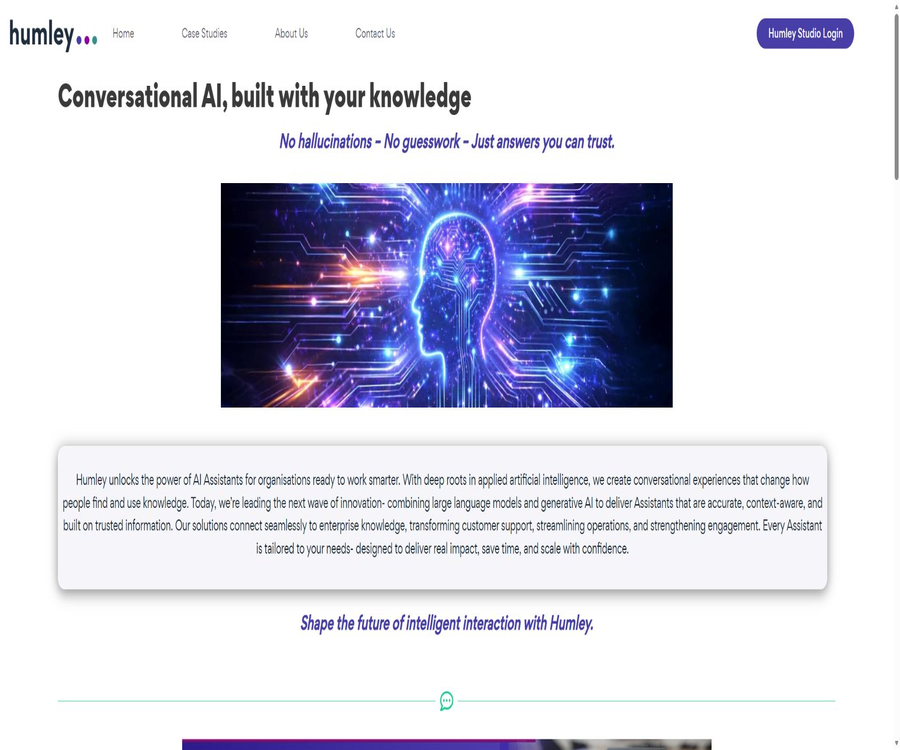
Humley - Conversational AI for Enterprise
Humley – Conversational AI for Enterprise, an intelligent tool focused on AI programming
Tags:AI programming toolsA one-sentence summary
Humley is a conversational AI platform that creates digital assistants based on enterprise-controlled knowledge; it can be used for customer self-service, employee inquiries, assistance from human agents, and telephone voice automation.
Tool Introduction
Humley is operated by the British company Humley Limited; its focus is on enabling organizations to create reliable AI assistants using their own documents, data, and processes. It does not merely provide answers – it can also connect to CRM systems, ticketing systems, RPA tools, as well as messaging and communication platforms, thereby helping users retrieve business-related information or initiate specific actions.
The current official website emphasizes accuracy, context awareness, and controlled knowledge, with the slogan being to avoid speculation and illusions. Any generative system can still make mistakes; therefore, companies should regard these principles as goals for their products, and verify their actual effectiveness through testing, references, access controls, and fallback mechanisms.
Core products
| Products | Primary users | Channels for use | Core values |
|---|---|---|---|
| Digital Assist | Customers, employees, and residents | Websites, messages, mobile devices, etc. | 24/7 self-service Q&A and process handling |
| Agent Assist | Manual agents at the contact center | Agent work interface and real-time calls | Provide consistent answers from the same knowledge base |
| Telephone Assist | Users who call in | Common numbers or dedicated hotlines | Self-service for natural speech and human assistance for complex issues |
| Think | Content administrators and business experts | Humley Studio | Generate FAQ drafts from websites, SharePoint, and PDFs |
| Humley Connect | Companies that already have robot platforms | Integration and Process Layer | Retain the front-end robots and enhance enterprise connectivity. |
Digital Assist
Digital Assist enables the dissemination of corporate knowledge and business processes via web chats, mobile devices, messaging platforms, or custom interfaces; users can pose questions naturally and receive answers. By connecting to backend systems, it is also possible to query orders, submit requests, or initiate workflows.
Agent Assist
Agent Assist provides the same reliable knowledge base that is used by automated assistants to human agents, enabling them to find consistent answers quickly during live calls or chats. It helps to reduce the time required for information retrieval, but agents should still verify identities, accounts, and provide recommendations for high-risk situations.
Telephone Assist
Telephone Assist enables customers to communicate naturally with an AI voice assistant via regular numbers or hotlines outside regular business hours, to resolve common issues and to pass complex cases on to the relevant team. Voice recognition, identity verification, and emergency routing require separate stress testing.
Think knowledge organization
Think uses generative models to extract FAQs, suggested answers, and training data from sources such as websites, SharePoint, and PDF files, and it allows for the setting of a brand-specific tone. Business experts can edit and approve content in Studio, thereby reducing the time required to manually review large amounts of documents.
Humley Connect
Companies that already have chatbots but lack system integration can use Humley Connect to connect to CRM systems, support tools, and enable process automation. When making a selection, it is necessary to determine the session status, identity, as well as the boundaries regarding errors and responsibilities between the existing bot and Humley.
Knowledge base and answer governance
Humley’s core idea is to have assistants rely on knowledge approved by the organization, rather than generating content freely based on general models. Companies can upload data, documents, and media to create materials, train understanding capabilities, and edit responses as well as manage projects in Studio.
| Knowledge section | Platform capabilities | Human liability | Common risks |
|---|---|---|---|
| Collection | Connect websites, documents, and enterprise systems | Confirm scope, permissions, and copyrights | Expired or sensitive materials end up in the knowledge base. |
| Generate | Think organizes FAQs and training materials. | Review of facts, tone, and exceptions | Model generalization error |
| Edit | Studio Management FAQs and Experience | Assign content owner | Conflicts arise due to multiple people making changes. |
| Publish | Deploy to multiple channels | Set identities and scopes by channel | Internal incorrect answers are exposed to the outside. |
| Monitoring | View reports and session performance | Analyze unresolved issues and feedback | Focusing only on the auto-resolution rate while ignoring quality. |
| Update | Continuous improvement of knowledge and understanding | Establish review and expiration dates | Changes in regulations and policies have not been synchronized. |
Being credible does not mean being absolutely correct.
Controlled knowledge can reduce unfounded responses, but the documents themselves may be incorrect, contradictory, or outdated, and the model might misinterpret the context. Key answers should indicate the applicable conditions, version, and options for manual updates.
Multiple channels and system integration
Communication channels
Humley supports a combination of websites, mobile applications, voice services, SMS, WhatsApp, Slack, Microsoft Teams, and custom channels. The actual availability depends on third-party platform permissions, regional regulations, and the purchased package.
CRM and ticketing system
Assistants can be connected to CRM systems, customer service platforms, Case Management tools, and internal data systems, allowing them to obtain relevant context as well as carry out controlled tasks. Read and write permissions should be configured separately; ordinary FAQ sessions should not have the ability to modify customer data by default.
RPA processes
The platform can invoke RPA robots such as UiPath to convert natural language requests into backend processes, such as queries, reservations, updates, or submission of applications. For asynchronous tasks, Webhooks can be used to provide updates on progress, but it is necessary to handle issues related to repeated triggers, failure compensation, and timeouts.
APIs and SDKs
The terms of service state that Humley provides a unified API and front-end digital assistant SDK, which facilitate the integration of this experience into customers’ own applications. Interface permissions, usage rates, versions, data location, and support period must be specified in the official order and technical proposal.
| Connection category | Example | It can be completed. | Key governance aspects |
|---|---|---|---|
| Websites and mobile devices | Webchat and custom applications | Q&A, self-service, and process entry points | Cross-site scripting, session identity, and accessibility |
| Team messages | Slack and Microsoft Teams | Employee knowledge and support desk | Channel and member permissions |
| Public messages | WhatsApp and SMS | Customer notifications and self-service | Agreement, templates, and regional restrictions |
| Voice | Telephones and contact centers | Natural speech Q&A and transfer | Recording, identity, and emergency escalation |
| Business system | CRM, ticketing, and Case Management | Query records and execute tasks | Field-level permissions and auditing |
| Automation | RPA and Webhook | Trigger the backend robot process | Idempotency, compensation, and manual approval |
Typical use cases
Customer support
Digital assistants can handle common questions, order inquiries, product information, and basic processes, while forwarding complex, sensitive, or unsolvable conversations to human agents. The goal should not be merely to reduce the number of contacts; it is also necessary to monitor the rate of successful resolution, customer satisfaction, and instances of errors being escalated.
Employees and HR services
Employees can access information on policies, holidays, benefits, onboarding procedures, and internal processes, which helps to reduce the need for HR to answer questions repeatedly. When it comes to information related to salaries, health, or discipline, strict identity verification and document-level permissions are required.
IT Help Desk
Assistants can answer common IT questions, help with troubleshooting, and initiate password resets, ticket creation, or RPA processes. Any action that alters accounts, devices, or access rights must be verified twice.
Local governments and public services
The Council Q&A Assistant provides residents and staff with information on policies, services, and procedures; it can also be integrated with telephone services. The public sector must pay attention to accessibility, language coverage, as well as mechanisms for handling complaints and correcting incorrect information.
Finance, Insurance, and Healthcare
The platform can be used for controlled access to information, for handling claims or providing guidance on services, but it cannot make final decisions regarding medical care, credit, or insurance without authorization. In areas with a high impact, the reasons behind such decisions must be documented and subject to manual review.
Usage process
- Determine whether it is intended for customers, employees, residents, or human agents.
- Select the first use case that is low-risk, occurs frequently, and involves relatively stable knowledge.
- Inventary of websites, SharePoint, PDFs, databases, and business processes.
- Remove duplicate, expired, conflicting, and sensitive content.
- Use Studio and Think to create and review FAQs and training materials.
- Connect to the necessary channels and systems, and apply the principle of least privilege.
- Test regular, fuzzy, malicious, privacy-related, and unanswered questions.
- Set up manual transfer, call rejection, authentication, and error fallback.
- Release it to a small group of users first, and then optimize it based on the feedback.
- Continuously update knowledge, evaluate models, and utilize audit tools.
Process for launching a phone assistant
- Confirm the number, working hours, and call forwarding policy.
- Design authentication and sensitive information masking.
- Covers accents, noise, interruptions, and silent scenes.
- Establish a fast route to human agents for urgent queries, complaints, and vulnerable users.
- Check the recording notification, retention, and access permissions.
- Conduct tests for peak concurrency, disconnection, and dependency failures.
- After going live, sample calls are taken to monitor misidentification rates and the quality of call transfers.
Current price
Humley’s current main pricing page follows a two-phase approach: Experiment and Rollout. The Experiment phase is used for development and evaluation, while Rollout is intended for official release to actual customers. Companies may also incur costs related to implementation, connectors, volume of conversations, seats, and additional services.
| Plan | Price | Primary interests | Appropriate stage |
|---|---|---|---|
| Experiment | 200 pounds per month | Access to all features, expert assistance and guidance, 30-day free trial | Prototype, evaluation, and internal validation |
| Rollout | Contact sales | Includes Experiment capabilities, deployment to real customers, and standard support. | Official production and large-scale deployment |
30-day free trial
The pricing page shows that Experiment offers a 30-day free trial, which is ideal for testing the import of knowledge, the quality of answers, integration, and team collaboration. Before starting the trial, it is necessary to determine whether payment is required, whether automatic renewal will take place, and what will happen to the data once the trial is over.
Instructions for the old package page
The official website still has an older package page that shows four tiers: Start-Up, Scale-Up, SME, and Pro; billing is based on conversations, projects, users, and excessive engagement. As its structure differs from that of the current main pricing page, it should be considered as historical information for reference only, rather than a price that can be purchased directly.
| Old package | Monthly fee for old pages | Amount of dialogue included | Projects and users | Excessive Engagement |
|---|---|---|---|---|
| Start-Up | 100 pounds | 500 per month | 1 project, 3 users | 0.25 pounds each time |
| Scale-Up | 300 pounds | 2500 per month | 2 projects, 5 users | 0.15 pounds each time |
| SME | 600 pounds | 7,500 per month | 5 projects, 7 users | 0.10 pounds each time |
| Pro | 1100 pounds | 15,000 per month | No limit on projects, 10 users | 0.09 pounds each time |
Additional users
The old version of the document listed additional fees of 15, 12, 10, or 7 pounds per month for extra users, but it is not clear whether these fees are still in effect under the current order terms. It is necessary to obtain the latest Order Form in order to understand the definitions of \"Conversation\" and \"Engagement\", as well as the rules regarding alerts for exceeding limits and the maximum charging amounts.
Which organizations are suitable?
- A contact center that offers reliable self-service based on corporate knowledge is needed.
- Organizations that wish to have consistent answers on their website, in messages, and over the phone.
- Customer service teams that require real-time knowledge support from human agents.
- Companies that wish to quickly compile FAQs from documents and have them reviewed by experts.
- Service teams that need to connect CRM, ticketing systems, and RPA processes.
- Large companies that provide internal shared services such as HR, IT, and finance.
- Local governments that require resident inquiries and round-the-clock services.
- Companies that place importance on British suppliers, GDPR compliance, and customized implementation.
It is not very suitable for which users
- Ordinary users who simply want to create a personal chatbot for free.
- Micro-teams that require complete self-service, with no need for procurement or implementation.
- There are no organizations that have compiled any credible knowledge materials.
- Only users who need to chat using general large models without connecting to business systems.
- Buyers who require the official website to provide completely transparent information on production costs and pricing.
- Platform teams that must obtain a complete open-source backend and maintain it on their own.
- Companies that hope to have AI fully replace human judgment in high-risk scenarios.
- Organizations that lack privacy, identity management, permissions, and manual transfer processes.
Product advantages
- Centered on the enterprise’s controlled knowledge, it is suitable for scenarios where consistency in answers is required.
- Digital, Agent, and Telephone Assist share the same knowledge base.
- Think can generate draft FAQs from websites, SharePoint, and PDFs.
- Studio enables business experts to manage content and experiences with low-code.
- It supports web, messaging, mobile, voice, and enterprise team channels.
- It can be connected to CRM, ticketing systems, Case Management, and RPA.
- Unified APIs and front-end SDKs are provided for enterprises to integrate.
- The current Experiment price and the 30-day trial are relatively clear.
- The old feature page, which supports 13 languages, displays basic information in multiple languages.
- Suitable for customer support, employee services, and public sector scenarios.
Restrictions and Precautions
- The absence of hallucinations is a goal of the product, but it cannot be considered an absolute guarantee of accuracy.
- Expired documents, conflicts, or incorrect permissions can still lead to incorrect answers.
- To obtain the price for a production rollout, you need to contact sales; the full cost is not transparent.
- The old package page has a different price structure from the current one, and written confirmation is required.
- Third-party models, messages, and connectors are subject to their respective policies and availability.
- Speech recognition can be affected by accent, noise, and line quality.
- System write operations require additional authentication, approval, and rollback.
- Multiple channels increase the complexity of session state and permission synchronization.
- The use of phone recordings and chat records must be accompanied by a privacy notice.
- Connecting RPA may misinterpret natural language as genuine system actions.
- The old page mentioned 13 languages, but the quality of each language currently needs to be evaluated practically.
- There is no public version with the complete source code, nor a self-hosted community version.
Privacy and security
Humley may handle text, visual, and audio content uploaded by customers, as well as corporate knowledge, account information, end-user sessions, identity data, and transaction data. The terms of service require customers to provide their own privacy policies for end-users, and to collect, store, and transmit data in a secure manner in compliance with the law.
| Data or permissions | Risk | It is recommended to exercise control. |
|---|---|---|
| Knowledge document | Internal sensitive information is exposed through external Q&A. | Document-level permissions, publication approval, and regular reviews |
| Session records | Contains personal, account, and health information | Minimum retention, masking, and access logging |
| Voice recording | Voice, phone numbers, and identity information | Advance notification, encryption, and deletion upon expiration |
| Connector | Third parties reading or modifying business data | Thorough assessment of each connection, minimum permissions, and revocation |
| RPA tools | Accidental triggering of irreversible processes | Parameter verification, manual approval, and compensation |
| Third-party AI | User-generated content is sent to the model service provider. | The contract specifies no training, as well as certain regions and reservations. |
| APIs and SDKs | Key leakage and unauthorized access | Key store, scope, throttling, and rotation |
Third-party AI service providers
The terms of service mention the possible use of OpenAI, IBM Watson, and other technology providers, and state that the shared content is intended solely for the services required by Humley. Companies should specify the current sub-processors, data locations, retention periods, items excluded from training, and event notification procedures in the DPA.
Safety measures
The terms state that encryption, firewalls, and reasonable commercial practices are used to protect personal information stored on the servers, but it is not possible to guarantee that authorized connectors will not access such personal data. Customers must still verify themselves that each connector complies with PCI DSS, privacy regulations, and industry requirements.
Website Privacy Policy
The privacy policy, which is made public, was last updated some time ago; it primarily outlines the information related to inquiries and contacts on the website, and promises that personal data will not be sold nor retained for longer than necessary. Customers of the platform should obtain more detailed information about the products through formal orders, DPA agreements, and the latest security documents.
GitHub and the open-source status
During verification, no official GitHub repository linked to the official website was found, nor were there complete self-hosted source codes or open-source licenses available. The fact that Humley provides APIs and SDKs does not mean that the platform is open source; commercial products should be marked as closed source in the relevant directories.
| Components | Status | Explanation |
|---|---|---|
| Humley Studio | Commercial hosting platform | Build, train, deploy, and report |
| Digital Assist | Commercial products | Multi-channel automated dialogue |
| Agent Assist | Commercial products | Real-time knowledge assistance for live agents |
| Telephone Assist | Commercial products | Telephone voice automation |
| Unified API and SDK | Provided for customers | The availability of an interface does not mean that the source code is available. |
| Official GitHub | No clear product entry point was found. | Third-party projects with the same name cannot be used as a substitute. |
| Self-hosting | Contact sales for confirmation. | The official website does not offer a community deployment version. |
Basic information
| Project | Content |
|---|---|
| Tool name | Humley |
| Operating company | Humley Limited |
| Location of the company | United Kingdom |
| Tool type | Enterprise conversational AI and digital assistant platforms |
| Core products | Digital Assist, Agent Assist, and Telephone Assist |
| Content capabilities | Think and Humley Studio |
| Main scenarios | Customer support, HR, IT, public services, and contact centers |
| Experiment | 200 pounds per month, 30-day free trial |
| Rollout | Contact sales |
| Develop interfaces | Unified API and front-end SDK |
| Is it open source? | No |
| Privacy framework | UK requirements related to GDPR |
Frequently Asked Questions
What is Humley?
It is a corporate conversational AI platform that enables the creation of digital assistants for customers, employees, agents, and phone calls, using controlled knowledge, and it connects various business processes.
Can Humley avoid hallucinations?
The platform reduces illusions through reliable knowledge and controlled responses, but any AI may still misinterpret the material or context. Testing must be carried out before deployment, along with the provision of a human fallback option.
Is phone customer service available?
Supported. Telephone Assist offers voice self-service via common numbers or dedicated lines, and transfers complex conversations to a human team.
Can it assist human agents?
Yes. Agent Assist provides agents with answers from the same knowledge base during real-time customer interactions, thereby reducing the time needed for manual searches.
How to import knowledge?
Think can generate FAQs and training drafts from websites, SharePoint, PDFs, and other materials, which are then edited and approved by business experts in Studio.
What is the price of Humley?
On the current main pricing page, the cost for Experiment is £200 per month, with a 30-day trial period; for production Rollout, please contact sales. The old four-tier pricing structure is intended only for historical reference.
Is there a free version?
The current page offers a 30-day free trial; there is no explicit option for a permanently free subscription. The terms regarding the end of the trial and data processing must be confirmed at the time of registration.
Which channels are supported?
It can cover various channels such as web pages, mobile devices, messaging services, team collaboration tools, and voice calls; the specific connectors and regions supported are determined based on the order placed.
Is there an API?
There is a unified API and a front-end digital assistant SDK that can be integrated into enterprise applications and connected to backend systems. The details of these interfaces are usually provided to customers.
Is Humley open source?
No. No official source code repository or open-source license was found; the availability of APIs and SDKs does not mean that the entire platform is open source.
Is it suitable for the public sector?
It is suitable for common questions and answers from residents and employees, but it must meet the requirements regarding accessibility, privacy, complaints, record-keeping, and human intervention.
Summary
Humley is suitable for organizations that wish to utilize a set of controlled corporate knowledge resources for both customer self-service, human agents, and telephone services. Its Think, Studio, connector, API, and RPA capabilities make it a more complete service automation platform than ordinary FAQ robots.
When making purchases, it is essential to verify the accuracy of responses, the level of access to knowledge, the possibility of switching to human assistance, voice recognition capabilities, approval processes for writing operations, and the overall cost. The prices associated with the current Experiment and Rollout options should take precedence over those on the old package pages; moreover, the responsibilities related to all third-party models and connectors must also be specified in the contract.
Tools similar to Humley – Conversational AI for Enterprise



 Guigong Network Security Registration No. 45132202000164