






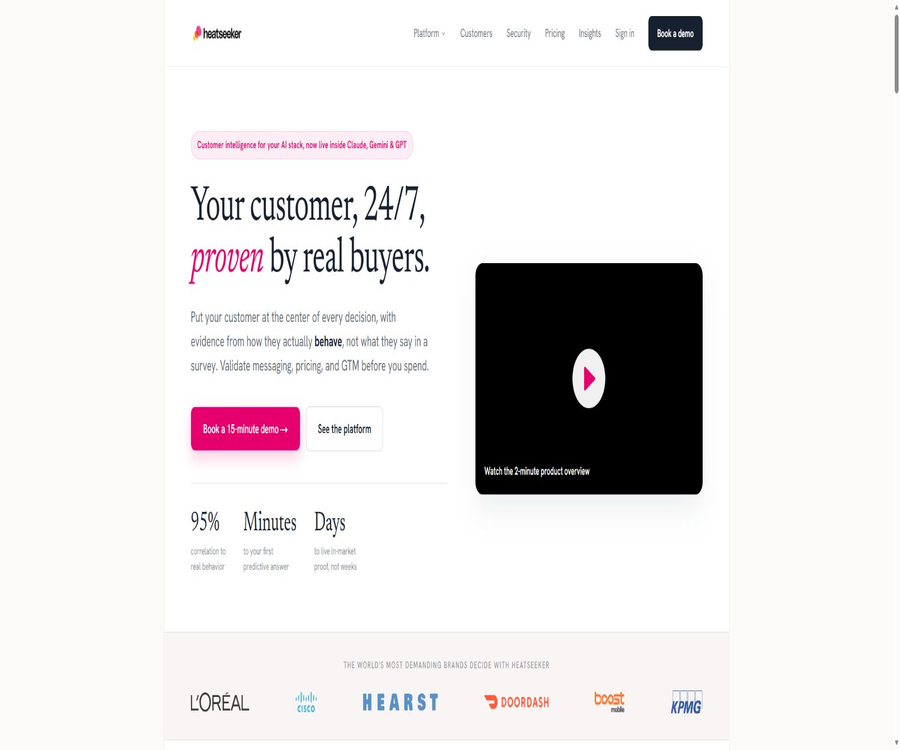
Heatseeker · Decide on what customers do, not what they say
Heatseeker · Determine what customers do, rather than what they say; an intelligent tool focused on AI programming.
Tags:AI programming toolsA one-sentence summary
Heatseeker is an enterprise-grade AI platform for market research and decision validation; it first uses synthetic audiences to make rapid predictions, and then relies on actual market advertising experiments to observe buyer behavior, thereby assisting teams in assessing information, features, pricing, and market directions.
Tool Introduction
Heatseeker is provided by Heatseeker Inc. and its Australian subsidiary, and it is aimed at CMOs, brand, growth, consumer insight, and product marketing teams. It brings together first-party business data, synthetic personas, advertising experiments, and statistical analyses within the same customer context.
The platform focuses on addressing strategic issues related to verification, rather than simply optimizing ad clicks. Ads serve as tools for observing real-world behavior, and the outcomes should provide a basis for making decisions regarding the audience, value propositions, purchasing motivations, or product direction.
Core working principle
| Components | Enter | Handling method | Main output |
|---|---|---|---|
| Synthesis engine | CRM, transaction, research, and marketing data | Create and inquire about synthetic characters or run synthetic experiments | Fast prediction, role-based responses, and confidence information |
| Real Market Engine | Strategic issues, creative variations, and target audience | Conduct controlled experiments on real advertising platforms | Behavioral performance, winning variants, and detailed results |
| Customer Context Layer | First-party data and previous experiments | Continuously synchronize, summarize, and accumulate organizational knowledge | Unified customer view and reusable decision context |
| Calibration and evaluation | Sample size, effect size, and experimental consistency | Compare synthetic judgments with actual behavior. | Confidence score, audit information, and chain of evidence |
| Integration of AI tools | Workspace data and natural language questions | Through chat integration or MCP queries | Insights on experiments, audience, roles, and competitors |
Main functions
Synthetic audience and role prediction
The platform can transform a company’s own customer, transaction, research, and marketing data into queryable synthetic personas. Teams can explore hypotheses or compare options within minutes, but the synthetic responses still need to be calibrated using real-world behavior.
Real-world market experiments
Heatseeker enables the planning, creation, and launch of advertising experiments targeted at real audiences, with user behavior typically being observed in platforms such as Meta or LinkedIn. These experiments can make use of the brand’s own identity, or, where appropriate, anonymous testing using similar brands.
Strategic testing template
The platform supports research on topics such as value propositions, purchase motivations, functional preferences, strategic directions, and language market suitability. The help center also provides common testing procedures related to benefits, functions, and value propositions.
Suggestions for target audience identification
AI will suggest regions, interests, and target audience criteria based on the objectives of the experiment, after which the user can conduct manual checks and adjustments. Meta experiments allow for further customization by specifying parameters such as country, region, city, postal code, behavior, job title, age, and gender.
Result target selection
For experiments, one can choose between directional ranking, high-precision ranking, directional demographics, or high-precision demographics. The greater the emphasis on precision and detail, the more samples, time, and resources are usually required.
Scores, improvements, and confidence levels
The results page explains the performance of each variant based on the buyer engagement score, the degree of improvement relative to the baseline, and the confidence level. Actions with a high level of intent are given more weight than ordinary clicks; therefore, it is not possible to assess commercial value solely based on the click-through rate.
Segmented audience analysis
The same set of scoring, improvement, and confidence information can be applied to regions, ages, positions, or custom groups. Teams can determine whether a particular solution is the best overall or only effective for specific groups of people.
Auditable experimental evidence
The platform displays information such as the number of samples used in experiments, the definition of the target audience, the targeting criteria, statistical significance, or confidence intervals, and it is possible to trace back to the specific experiment number. The purchaser should still request an explanation regarding the statistical methods used, how abnormal traffic is handled, and the minimum sample size requirements.
Customer Context Layer
CRM data, transaction information, loyalty details, marketing performance metrics, and existing research can all be integrated into a unified customer view; predictions and experiments conducted over time are also accumulated. The frequency of updates varies depending on the scheme, ranging from manual input to weekly or daily scans.
AI Chat and MCP
Pro allows access to Heatseeker data through chat tools of the Claude, Gemini, and GPT types; Scale offers proxy-based access, while Enterprise provides a comprehensive enterprise MCP solution. Users can use natural language to query information regarding experiments, ad performance, audiences, roles, and the activities of competitors.
Which users are it suitable for
- Chief Marketing Officer: Obtain auditable evidence of performance before making significant investments in a brand or its growth.
- Brand marketing team: It brings forth bold ideas, defines the brand’s position and uses appropriate marketing language, thereby reducing the risks associated with a direct launch.
- Performance marketing team: Identifies the commitments and audiences that truly drive high-intent actions.
- Consumer Insights Team: Integrates traditional research, first-party data, and real-world market experiments into the same process.
- Product and Market Team: Determine function priorities, purchase motivations, and willingness to pay.
- Consulting firms and agents: Design and carry out experiments for clients within the scope of their own subscriptions.
- Large, cross-regional enterprises: use SSO, MCP, multiple workspaces, and more frequent market scanning.
Typical use cases
| Business issues | It is recommended to conduct testing. | Available judgments | Precautions |
|---|---|---|---|
| Which value proposition is more effective | Value proposition experiment | Behavioral manifestations and confidence levels of different commitments | Keeping the current plan as a baseline makes it easier to explain. |
| What benefits do customers value the most? | Interest preference test | The real benefits that attract people with a high level of intent to respond | Do not equate short-term clicks with long-term value. |
| Is the functionality worth investing in? | Functional testing | The relative impact of different functions on audience interest | Interest does not equal the actual development costs or the amount required to retain it. |
| Is the price acceptable? | Brand-based willingness to pay test | Actual responses under different price signals | It is necessary to comply with price, advertising, and consumer protection laws. |
| How to express oneself when entering a new area | Language market matching experiment | More effective wording and positioning for various regions | Automated results still require review in light of local culture and laws. |
| How are the activities of competitors changing? | Context scanning and MCP queries | Comparison between competitor ads and one’s own positioning | Public events do not represent the complete strategy of competitors. |
Basic usage process
- First, identify a high-risk decision issue that can be addressed through market behavior, and define the success criteria.
- Verify that the organization has the authority to provide CRM, transaction, research, and advertising data, and remove any unnecessary sensitive fields.
- Select the workspace, role grouping, and refresh frequency to establish the customer context layer.
- First, use synthetic characters to explore hypotheses and reduce the number of options that need to be tested in the real market.
- Select the experiment template, desired outcome, target audience, creative variations, and baseline, then manually review the AI suggestions.
- Connect to the ad-friendly environment, review the brand, conduct stealth tests, set the budget and compliance parameters, and then publish.
- Observe scores, improvements, confidence levels, detailed differences, and sample information; do not terminate prematurely due to early fluctuations.
- Convert the winning solution into a business decision, and record the target audience, limitations, and the schedule for subsequent re-evaluation.
Enterprise procurement verification process
- Submit a request for a demonstration using a realistic and well-defined question, asking that both the synthetic and real experimental engines be shown.
- Confirm the plan price, contract duration, auto-renewal notice period, points consumption, and price per additional point.
- Check the scope of media fees, including the experimental platform, country, workspace, number of roles, and data refresh frequency.
- Request the security report, data processing agreement, list of sub-processors, and instructions regarding data retention and deletion.
- Use historical experiments for backtesting, compare the platform’s predictions with the organization’s known results, and record any discrepancies.
- Start with a single project or a controlled work area, confirm its value, and then expand the data volume and annual investment.
Prices and packages
Heatseeker charges based on experimental decisions and annual credits, rather than per seat. The prices listed below are as of August 23, 2026; annual plans are still subject to adjustments depending on the volume of data, the number of roles, and the frequency of use, with the final amount determined by the order placed.
| Package | Public price | Billing cycle | Points and main benefits | Suitable for users |
|---|---|---|---|---|
| One-off Project | 29,000 dollars | Three months at a time | 50 points, one real-world market test, media fees, and a team workspace | First, verify a team that makes high-risk decisions. |
| Base | 55,000 dollars | Every year | 100 points, real experiments, synthetic validation, grouping of 3 to 5 characters, Drive data center, unlimited seats | Medium-sized teams that require annual verification of their capabilities |
| Pro | 105,000 dollars | Every year | 200 points, 5 to 10 character groups, weekly market scans, AI chat integration, two workspaces | Teams that continuously research and utilize mainstream AI assistants |
| Scale | 185,000 dollars | Every year | 350 points, 10 to 20 character groups, daily scanning, proxy access, SSO, five workspaces | Large enterprises that integrate verification into their daily decision-making processes |
| Enterprise | Contact sales | Annual customization | 500 points or more, unlimited workspace, SSO, enterprise MCP, and dedicated customer success support | Organizations with complex data, governance challenges, and large-scale usage volumes |
How to calculate the integral
| Quantity items | Public consumption method | The cost includes | Confirm before purchasing |
|---|---|---|---|
| Real-world market experiments | Each ad variant is worth at least 1 point. | The score takes into account the corresponding expenditure on advertising media. | Whether additional points are awarded for different countries, objectives, and samples |
| Synthetic audience | 1 point for every 500 responses from characters | Synthetic Q&A and experimental processing | Are charges applied for complex queries, reruns, and failed requests? |
| Annual package | 100 to 500 points or more | Unlimited team seats | Whether points are carried over and the price per additional purchase |
| Additional points | Additional items can be added at any time as part of the package. | The account team will give a reminder when the limit is approaching. | The minimum purchase amount and contract discounts are not disclosed. |
| Media costs | The public plan states that it already includes it. | Advertising spending used for real experiments | Fees for creative and professional services that exceed the standard range |
A single-project arrangement can be converted into an annual plan, but the public page does not indicate the amount that will be deducted. Although there is no limit on the number of seats in an annual package, there are still significant differences in terms of the workspace, role grouping, scanning frequency, and level of integration.
Refunds and renewals
Orders are automatically renewed within the agreed timeframe, and companies must submit a written request to cease renewal before the end of that period. Unless there is a serious breach by the platform that is not resolved within 30 days or unless required by law, the fees are generally not refundable.
Platform support and integration
| Platform or integration | Current capabilities | Package restrictions | Use reminders |
|---|---|---|---|
| Web platform | Create workspaces, experiments, roles, and result analysis | Available upon order | There are no public, free self-service accounts available. |
| Google Drive | Synchronize data with the customer’s context layer. | Available starting from Base. | Set minimum permissions and file scope before connecting. |
| Meta | Run real advertising experiments and configure the target audience. | Based on experiments and orders | Enterprise administrator and corresponding permissions for business assets are required. |
| Conducting market experiments targeting professional audiences | According to order and region | Advertising policies and target criteria may change. | |
| Assistants such as Claude, Gemini, and GPT | Query workspace evidence | Pro offers an AI chat layer. | The third-party assistant’s own data policy remains applicable. |
| Proxy-based integration | Allow the agent to utilize prediction and verification capabilities. | Available from Scale. | Permission boundaries, auditing, and manual approval are required. |
| Enterprise MCP | Full context queries are available for enterprise clients. | Enterprise | Credentials should not be included in shared prompts or logs. |
| SSO | Enterprise identity and access control | Scale and Enterprise | The specific agreements and directory synchronization are based on the order details. |
What can MCP be used to query?
- List and switch between the Heatseeker workspaces to which users are granted access.
- Query the performance of experiments and variants that are running, completed, or published.
- Read advertising metrics such as click-through rate, cost per lead, and historical activity.
- Explore existing audience research, character profiles, and demographic segments.
- Compare with the activities of competing products to analyze the relationship between their advertisements and one’s own market position.
- The evidence from the platform is brought into the AI dialogue, but the final business decisions are still reviewed by the user.
Data security and privacy
The security page states that the platform has passed a SOC 2 Type II audit; static data is encrypted using AES-256, while transmission takes place over TLS. The platform also offers role-based access control, logging, and enterprise SSO. When making a purchase, it is necessary to obtain the current audit report along with information on its scope, rather than relying solely on the badges displayed on the page.
The platform handles corporate account information, first-party customer data, consumer form data, and data related to advertising interactions; it may also come into contact with sensitive information provided voluntarily by users. It is the responsibility of the customers to ensure that any data uploaded, as well as any advertising targeting and consumer research activities, are carried out on a legal basis and with the necessary consent.
| Matters | Public rules | Points for businesses to note |
|---|---|---|
| First-party data | Logical isolation is employed to serve customers. | Verify tenant isolation, backup, and administrator permissions. |
| Model training | The security page states that third parties are not trained nor are the models shared. | The privacy policy shall stipulate that enhanced training can be carried out with consent or in accordance with the law, and this should be included in the contract. |
| De-identified data | It can be used to improve products both during and after the service period. | Understand de-identification methods and exit mechanisms |
| Data residency | It can be processed in the United States, Australia, the European Union and other regions. | Select the region and cross-border coverage in accordance with regulatory requirements. |
| Sub-processor | The list can be provided upon request; changes are usually notified in advance. | Obtain the latest list during the security review. |
| Data deletion | It can be deleted or anonymized when it is no longer needed; a request can also be made. | The contract specifies the deadline, backup deletion, and verification requirements. |
| Terminate export | A 30-day retrieval period is provided upon submitting a written request. | Plan the format, responsible parties, and migration drills in advance. |
| Advertising and consumer data | It may constitute a sale or sharing in the context of targeted advertising. | Handling regional privacy preferences, notifications, and opt-out requirements |
The parameters for AI data require confirmation through a contract.
The security page guarantees that the company’s first-party data will not be used to train third parties or to develop models, while the privacy policy permits the use of personal information to improve and train AI systems, provided that consent is obtained or legal authorization exists; aggregated or anonymized data can also be used for this purpose. The applicable rules may differ between the two documents, and priority rules should be clearly specified in orders and DPA agreements for sensitive purchases.
Experimental ethics and compliance
- Advertising experiments must comply with the policies of the platforms on which they are published, as well as with rules regarding consumer protection, privacy, and anti-discrimination.
- Experiments with hidden or similar brands cannot be used for deception, impersonation, or to collect data that is not related to the testing.
- Sensitive fields such as population, health, race, and sexual orientation should not be uploaded in the absence of a clear necessity.
- When segmenting by position, region, age, or interests, it is necessary to check whether this leads to unfair exclusion.
- Price experiments require that the displayed prices, the amounts charged, and the actual commitments match each other, in order to avoid misleading price signals.
- AI-generated ideas, character responses, and statistical analyses all require human review; they cannot replace professional judgment.
- The experimental conclusions should include information on the samples, baseline values, time, and confidence intervals, in order to prevent their reuse over an extended period without taking those conditions into account.
Product advantages
- Place the synthetic predictions alongside the actual buyer behavior within a validation loop.
- First-party data and results from previous experiments can be accumulated over time, rather than starting the research from scratch each time.
- The results display the score, improvement, confidence level, and detailed differences at the same time, which facilitates auditing.
- The annual plan does not charge based on the number of seats, and the costs associated with users involved in cross-departmental collaboration are clear.
- Media expenditures are counted toward the experimental score, thereby eliminating the need for a separate process to manage small advertising budgets.
- MCP and AI chat integration allow verified evidence to be incorporated into everyday AI workflows.
- SSO, SOC 2, encryption, DPA, and data residency criteria are suitable for use in corporate procurement evaluations.
Usage restrictions and precautions
- The minimum public investment for a single project is $29,000, which makes it unsuitable for individuals and users who require minimal support.
- The annual price is just a starting point; the final price is influenced by the range of data, the number of roles, and the frequency of operation.
- Synthetic characters amplify the deviations in the input data, and cannot replace real-world market experiments.
- The platform claims that its predictions have a 95% correlation with actual behavior, but it does not provide a complete, independent assessment on its public page.
- Real advertising experiments are still affected by platform scrutiny, the quality of traffic, seasonality, competitors, and media environment.
- A winning strategy in a single experiment does not guarantee long-term revenue, customer retention, or effectiveness across different regions.
- Points are consumed based on the variations and answers given by the characters; complex research tasks may run out of points faster than what is indicated in the package table.
- The scope of refunds is limited, and annual orders may be automatically renewed; written reminders should be set up for purchases.
- After termination, the window for retrieving data is only 30 days; it is therefore necessary to export the data in advance and verify its readability.
- There are detailed differences between privacy policies and security guidelines in terms of their use in training, and these differences should be specified in the contract.
- The public terms only guarantee a commercially reasonable level of availability, without any standardized quantitative SLAs.
API, GitHub, and open-source status
No public Heatseeker REST APIs, SDKs, open-source code repositories, or self-hosted versions have been found. What the platform offers are MCP and enterprise integrations that are governed by workspace permissions and commercial plans; they should not be described as free public APIs.
The Heatseeker platform, its algorithms, interface, and documentation are the property of the company and its licensors; it is a closed-source commercial service. Customers retain ownership of their own data, but they grant the platform the permission to process such data in order to provide services, and the anonymized or aggregated data may also be used to improve the product.
Basic information
| Project | Content |
|---|---|
| Tool name | Heatseeker |
| Operating entity | Heatseeker Inc.; the order may also be placed by the Australian subsidiary. |
| Tool type | AI market research, synthetic audience, and real-world market experimentation platforms |
| Primary use | Validation of value proposition, purchase motivations, features, pricing, and market messaging |
| Main terminals | Enterprise Web platform, AI chat integration, and MCP |
| Experimental channel | Meta, LinkedIn, and the market environment as specified in the order |
| Price pattern | One-time projects, annual subscriptions, experimental credits, and corporate customization |
| Is a free version available? | No public free self-service version was found. |
| Whether a public API is provided | No findings were detected. |
| Is it open source? | No |
| Minimum age for users | 18 years old or the higher local legal age |
| Security capabilities | SOC 2 Type II, static and transmission encryption, role-based permissions |
Frequently Asked Questions
Is Heatseeker a survey tool?
No. It can handle research data and create synthetic characters, but its key difference lies in observing behavior through actual advertising experiments, rather than merely collecting the verbal responses of respondents.
Is there a free version of Heatseeker?
No free, public-facing self-service version has been found. The current options available are 15-minute demonstrations, projects costing $29,000 per instance, and annual enterprise solutions.
Does the listed price include advertising costs?
The pricing page states that the points from real-market experiments already include the corresponding media expenses, so there is no need to allocate a separate budget for standard advertising. Special regions, additional professional services, and costs related to creative elements that go beyond the standard scope still need to be specified in the order.
What can a point do?
In real experiments, each ad variant starts with at least one point, while synthetic audiences consume one point for every 500 responses. The total amount of points used in a study depends on the variants, grouping, repetitions, and the experimental design.
Can it be connected to ChatGPT or Claude?
Authorized Heatseeker workspace evidence can be retrieved through AI chat or MCP. Pro offers chat access, while Scale provides proxy capabilities; the full enterprise MCP options are listed under the Enterprise package.
Is the platform’s prediction always accurate?
No guarantee can be provided. The platform offers confidence levels and calibrates its outputs through actual experiments, but the terms require customers to verify the AI-generated results; furthermore, no assurance is given that all data and outcomes will be complete, accurate, or reliable.
Will customer data be used to train models?
The security page states that first-party data will not be used to train third parties or to share models, but the privacy policy allows for the improvement and training of AI systems when consent is given or when it is permitted by law. Companies should specify in contracts the boundaries for the use of raw data, personal data, aggregated data, and anonymized data.
Is Heatseeker open source?
No. No official open-source products, public SDKs, or self-hosted solutions have been found; MCP integration is also a feature available in commercial workspaces.
Summary
Heatseeker is suitable for brands and large marketing teams that need to rely on real market evidence to make high-value decisions. Synthetic predictions help to speed things up, while actual experiments are used for calibration; the customer context layer ensures that evidence continues to be accumulated within the organization.
Its procurement requirements and contract complexity are quite high; it is not sufficient to rely solely on the positive results shown in the demonstrations. Before signing a contract, it is necessary to verify the statistical methods, budgeting for points, scope of media coverage, criteria for training, data retention policies, automatic renewal options, as well as procedures for refunds and contract termination. Testing should begin with a scenario that can be reproduced.
Similar to Heatseeker · It is a tool that helps you determine what customers actually do, rather than what they say.



 Guigong Network Security Registration No. 45132202000164