






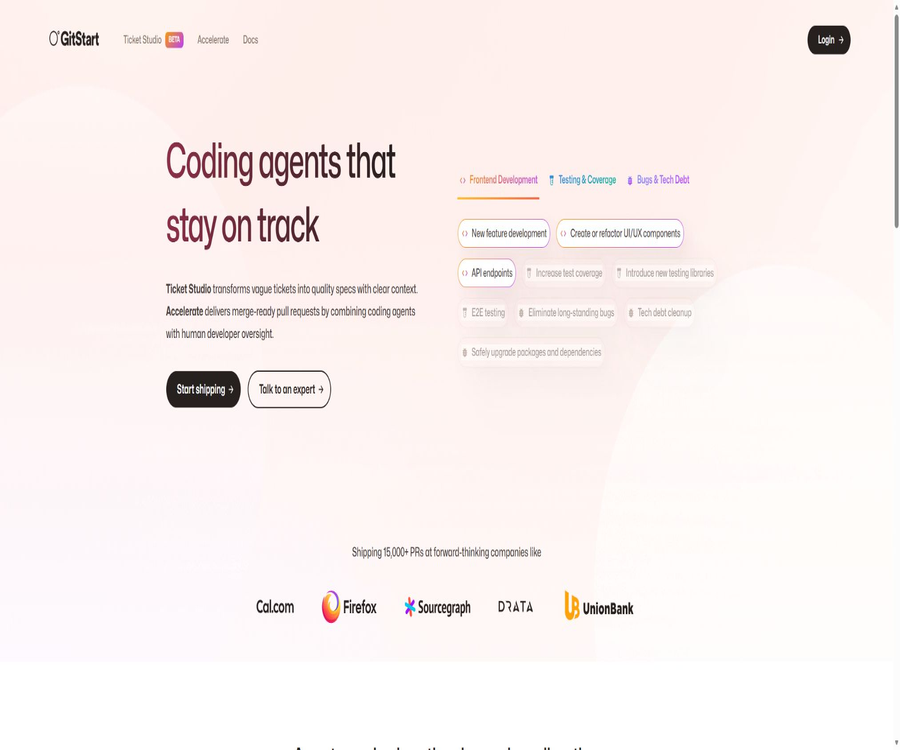
GitStart
GitStart, an intelligent tool focused on AI-driven programming.
Tags:AI programming toolsA one-sentence summary
GitStart is a flexible development platform that converts software tickets into review-ready Pull Requests; it relies on AI programming agents and human developers working together to assist teams with handling new features, testing, bugs, code restructuring, and dependency updates.
Tool Introduction
GitStart is operated by Murcul, Inc., and it is designed for software teams that already have code repositories, ticketing systems, and in-house review capabilities. It is not a regular code completion plugin; rather, it is a hosted service that covers everything from requirement clarification, code access, implementation, testing to the submission of PRs.
The current product consists of Ticket Studio, which is still in the Beta phase, and Accelerate, which is used for delivering code. The former helps to transform vague ideas into actionable specifications, while the latter enables AI agents to work together with actual developers to create code.
The customer remains responsible for deciding which repositories to share, approving the valuation of each pull request, reviewing the code, and carrying out the merge. The outputs of GitStart cannot bypass an organization’s own architecture, security, testing, and deployment mechanisms.
Main products
Ticket Studio
Ticket Studio extracts information from the code repository, designs, documents, past conversations, and team knowledge bases, and asks questions regarding any missing information. It generates more complete ticket specifications that can be used by internal engineers or coding agents for execution.
Accelerate
Accelerate receives the completed tickets, and by combining AI-driven coding with the oversight of human developers, it generates the production code, tests, and Pull Requests. The official website states that five quality checks are carried out during the delivery process, but customers still need to conduct their own verification.
GitSlice
GitSlice creates a controlled copy that is separate from the original repository, allowing clients to share only the code directories or segments related to a specific task. This limits access and reduces the need for the proxy to retrieve irrelevant code; however, configuration errors can still result in the exposure of unnecessary content.
Main functions
Requirement clarification and specification generation
Users can enter rough ideas, user stories, or requirements; the AI chatbot will then ask specific questions to create a structured task outline. The specifications should include objectives, boundaries, acceptance criteria, design attachments, and any known limitations.
Code repository and design context
Ticket Studio can read the existing code stored in GitHub or GitLab, and integrate it with designs from Figma, information from Notion, and knowledge available in Slack. When granting permissions, it is necessary to apply the principle of least privilege to avoid making the entire organizational space accessible by default.
Ticket system synchronization
Official support is available for Jira, Linear, and GitHub Issues; for Azure DevOps, it is necessary to contact the team for confirmation. Import rules can be filtered by project, team, repository, status, owner, or tag.
Hybrid development using AI and human effort
The encoding agents are involved in the implementation process, while a dedicated development team is responsible for oversight, correction, and ensuring quality. This approach combines the speed of AI with human judgment, but the delivery timeline remains influenced by the clarity of the requirements, the technical complexity, and the speed of feedback.
PR valuation and approval
GitStart charges based on PRs rather than the number of development hours; it uses machine learning and human judgment to estimate the complexity. Customers can approve, reject, or discuss the estimated cost, and the final cost will be within the approved range.
Code, testing, and feedback
The service can handle front-end, back-end, mobile-related tasks, as well as unit testing and end-to-end testing; it also synchronizes the PR links back to the tickets. Customers can request specific modifications until the agreed acceptance criteria are met.
Progress and notifications
The status of tickets, the developer in charge, and the progress of PRs can be viewed in GitStart as well as in the ticketing system connected to it. Notifications can be sent via email or Slack, and for some cases, approvals or rejections can be made directly within Slack.
Development tasks suitable for processing
| Task type | Suitable for input | Expected delivery | Key points of review |
|---|---|---|---|
| New features | User stories, design, and acceptance criteria | Implement code, test, and submit PRs | Architecture, boundaries, and regression |
| UI components | Figma, existing components, and responsive requirements | Add or refactor components | Visuals, accessibility, and reusability |
| API endpoint | Interface contracts, permissions, and data models | Endpoint implementation and testing | Security, verification, and compatibility |
| Test coverage | Target modules, risks, and testing framework | Unit or E2E test PR | Assertion quality and stability |
| Defect fixing | Repro steps, logs, and expected results | Fixes and regression testing | Root causes and side effects |
| Technical debt | Scope, target architecture, and immutable behavior | Reconstruct PR | Behavioral consistency and migration risks |
| Dependency upgrade | Target version, compatibility constraints, and testing requirements | Upgrade and adaptation PRs | Security, file locking, and destructive changes |
Supported technology stack
| Category | Technologies listed by the authorities | Usage suggestions |
|---|---|---|
| Frontend | React, Vue.js, Nuxt.js, Next.js, Angular, TailwindCSS | Provides component specifications and browser compatibility information. |
| Backend | Node.js, C#, Python, Django, Ruby on Rails, PHP, and Laravel | Describe the runtime environment, database, and interface contracts. |
| Mobile version | React Native, Flutter, Swift, and Kotlin | Provide equipment, system versions, and release requirements. |
| Testing | Cypress, Playwright, Jest, and Mocha | Define test levels, coverage objectives, and stability rules. |
| Stack not listed | It is necessary to contact the authorities for confirmation. | First, verify the capabilities using small, non-critical tickets. |
The complete process from ticket to PR
- Register an organization, fill in the team details, and invite members who need to participate in the review.
- Connect the code repository to the ticketing system, granting permissions only to the necessary projects, repositories, and directories.
- Schedule a 45-minute introductory meeting to confirm the technology stack, quality standards, and communication methods.
- Create requirements in Ticket Studio, or import tickets from Jira, Linear, and GitHub Issues.
- Fill in the background information, acceptance criteria, design specifications, testing requirements, and the areas that are not allowed to be modified.
- Click on Hand Off to submit the ticket, and review one or more PR estimates provided by GitStart.
- After approving the reasonable costs, track development, conduct automatic checks, provide manual oversight, and carry out testing.
- Review the PR, run internal CI, security scans, and acceptance tests, and propose specific changes.
- After confirming the code and the final cost, merge them together and revoke any external access permissions that are no longer needed.
Usage tutorial
Complete the first connection.
- First, select warehouses with low risk and small tasks with well-defined boundaries as pilots.
- Create an organization in the GitStart console, and set up billing and internal approvers.
- When connecting to the warehouse, exclude production keys, customer data, certificates, and unrelated directories.
- Connect to the ticketing platform and define the scope of import using the gitstart tag or custom rules.
- Configure Slack or email notifications to specify who can hand off and approve estimates.
- The branch strategy, CI, coding style, and testing and security requirements are confirmed during the onboarding meeting.
Create high-quality work orders
- Clearly outline the business objectives, current behaviors, desired behaviors, and what is not included.
- Attached are the reproducible steps, design, interfaces, sample data, and the locations of the relevant code.
- Express the acceptance criteria as results that can be observed or tested, avoiding abstract terms.
- Answer the questions raised by Ticket Studio and correct the incorrect context it has extracted.
- Break down large requests that span multiple systems, so that each PR can be reviewed and rolled back independently.
- Before Hand Off, the specifications are confirmed jointly by the product and technology leaders.
Review and merge the delivered PRs
- First, compare the complexity estimate with the scope of the task; if anything is unclear, reject it and state the reason.
- Check the PR description, code changes, dependencies, migrations, testing, and final cost.
- Run CI, static analysis, dependency scanning, and manual acceptance in an isolated environment.
- Pay special attention to reviewing permissions, input validation, concurrency, error handling, and data migration.
- Put forward verifiable modification requirements for the issues, rather than giving only vague evaluations.
- After all access controls have been passed, they are combined, and the deployment metrics as well as the rollback conditions are monitored.
Which users are it suitable for
- Product teams with a mature code review process: convert tickets with well-defined boundaries into PRs.
- Project managers who need flexible capacity: to increase delivery capacity in the short term without having to hire additional staff immediately.
- Teams with insufficient test coverage: Add unit tests and E2E tests to the existing modules.
- Teams with a long history of technical debt: dealing with refactoring, dependency upgrades, and minor defects.
- Organizations using Jira, Linear, or GitHub Issues: maintain the existing ticket workflow.
- Companies that place importance on code access boundaries: use GitSlice to reduce the external visibility range.
Typical use cases
- The product team’s specifications have been defined, but the internal engineers are busy with roadmap-related tasks.
- Migrate old components to the new framework, while adding automated regression tests.
- Complete the API endpoints, input validation, testing, and documentation, and submit them to the internal team for final review.
- Long-pending minor defects are continuously converted into separate PRs based on priority.
- Use Ticket Studio to transform vague requirements into specifications that can be executed by multiple coding agents.
- Only task-related code segments are shared, thereby reducing the risk of exposing the entire repository during external collaboration.
Product advantages
- It covers requirement clarification, estimation, coding, testing, and PR, rather than just generating code snippets.
- AI agents, in conjunction with a dedicated team of human developers, help to correct issues related to drift, context, and quality.
- It provides direct access to common warehouse, ticketing, design, knowledge, and communication systems.
- The client retains control over ticket delivery, code scope, cost approval, and integration.
- GitSlice separates the working copy from the original repository and allows for fine-grained sharing of directories.
- The deliverables and the intellectual property related to the code from the pilot phase belong to the customer in accordance with the relevant terms.
- The security documentation states that SOC 2 Type II controls are in place, and due diligence materials are provided.
Usage restrictions and precautions
- Accelerate does not disclose a fixed price for its packages; the budget must be determined based on the contract and an assessment of each PR.
- Billing by PR does not mean that there is only one PR per ticket; a single ticket can be broken down into multiple billing items.
- Ticket Studio is still marked as Beta, and its features, integrations, and free-tier policies may change.
- Changing the description of a synchronized ticket can take several hours, and internal tickets that have been handed off cannot be edited directly at the moment.
- Both AI and developers may misinterpret requirements or introduce defects; therefore, customers must conduct independent code reviews.
- Connecting to warehouses, Figma, Notion, Slack, and ticketing systems expands the scope of data access.
- GitSlice reduces the scope of exposure, but it cannot replace key cleanup, branch protection, and log auditing.
- The service is provided as it is, and the terms do not guarantee continuity, security, error-free operation, or satisfaction of all requirements.
- Cancellation usually results in no refund, and the organization must also proactively revoke GitStart’s access to the repository.
Prices and billing methods
As of August 22, 2026, GitStart does not list the unified price in US dollars for Accelerate on its public pages. Fees are calculated based on the registration terms or any other agreed-upon scheme, as well as on the amount of usage measured by GitStart; payments are made through automatic periodic deductions.
| Products or fees | Public price | Billing method | Core rights and interests | Suitable for users |
|---|---|---|---|---|
| Ticket Studio Beta | First 30 days free | The current page states that a bank card is not required. | Context collection, question clarification, and specification generation | Teams that wish to improve the quality of tickets |
| Accelerate | Contact sales or arrange it after registration. | Rated based on usage and PR assessment | AI and humans work together to deliver code and conduct testing | Companies that need flexible R&D capacity |
| Taxes and fees | Not included in the service fee | Charged separately according to the applicable region. | Taxes, duties, or other government fees | All paid customers |
Each ticket may give rise to one or more PRs; GitStart first estimates the complexity of each PR and seeks the customer’s approval. Once this is done, the final cost is displayed, with the official statement that this amount should remain within the initial estimate.
Payment, cancellation, and refunds
| Matters | Public rules | Precautions |
|---|---|---|
| Payment methods | Bank card or ACH monthly Stripe bill | The actual method is determined based on the account and contract details. |
| Automatic deduction | Charges are deducted based on the billing cycle and usage amount. | Set internal budgets and approvers |
| Approval of valuation | It can approve, reject, or request a re-evaluation. | Do not approve if the scope is not clear. |
| Refund | Refunds are generally not provided. | The written agreement may stipulate otherwise. |
| Cancel | Contact Client Success | Also revoke access to the code repository. |
| Fee change | Notify at least 30 days in advance | Monitoring contracts and billing notifications |
| Data processing | After cancellation, the code copies are deleted within a reasonable time frame. | The reasonable time limit does not specify a number of days. |
Integration and platform
| Category | Supported items | Primary uses |
|---|---|---|
| Code hosting | GitHub, GitLab | Read the authorization code and deliver PR |
| Ticketing system | Jira, Linear, GitHub Issues | Import, synchronization status, and PR links |
| Extended ticket | Contact Azure DevOps for confirmation. | Integration of enterprise project management |
| Design | Figma | Read visual and interaction requirements |
| Knowledge | Notion | Update team documents and context |
| Communication | Slack, email | Status, valuation, and PR notifications |
| Customer Console | Web | Organization, warehouse, ticket, and invoice management |
| Native mobile version | Not verified. | Primarily through web pages and integrated workflows |
Security and code ownership
According to the official security documentation, GitStart makes use of large models through the Microsoft Azure infrastructure; customer code and intellectual property are not used to train public models. Code and tickets are converted into vector embeddings for semantic search, and they are filtered and isolated by customer, instance, and repository.
The customer retains ownership of the original code, and the deliverables created by GitStart for the customer also remain the exclusive property of the customer in accordance with the terms stipulated. The way in which authors are listed in the Git history does not alter the ownership of intellectual property as defined in the contract.
- Only the warehouses and directories required to complete the tasks are shared, and the GitSlice rules are reviewed on a regular basis.
- Delete the production credentials and use dedicated development environment variables as well as short-lived tokens instead.
- Enable branch protection, mandatory CI, dependency scanning, and two-person review.
- Grant the minimum permissions to Jira, Linear, GitHub, Figma, and Slack.
- During the supplier due diligence process, request the current SOC 2 reports, penetration test results, and security policies.
- Upon completion or cancellation of the task, all integrations are removed and it is confirmed that the code copies have been deleted.
Privacy and data processing
The privacy policy outlines data such as accounts, contact information, billing details, devices, usage statistics, error reports, connection tokens, chat messages, forms, and support tickets. Payment-related data is handled by Stripe, while GitStart retains records of invoice numbers, customer names, and billing addresses.
Personal information can be used to provide services, support, billing, authentication, analysis, security, and marketing purposes; it may also be handled by third-party service providers responsible for hosting, storing, analyzing it, and performing other related tasks. The policy provides mechanisms for making requests to access, correct, delete, transfer, object to, or restrict such processing.
- Error reports may contain the contents of the files used at the time the issue occurred; it is necessary to first determine the scope of the data to be uploaded for diagnosis.
- Third-party connections transmit account identifiers, access tokens, and data related to user authorization.
- Public blog or community content can be read by others, saved, and stored in caches for a long time.
- Personal information will be retained for as long as it is necessary to provide services, fulfill legal obligations, and resolve disputes.
- Code deletion is based on a reasonable time period rather than a fixed number of days, and corporate contracts should specify SLAs clearly.
- Sensitive projects require separate NDA and DPA agreements to be signed, as well as a verification of the current sub-processors.
APIs, GitHub, and open source status
| Project | Current conclusion | Explanation |
|---|---|---|
| Customer integration | Provide platform connectivity | Connect to warehouses, tickets, and communication tools via the console |
| Public customer API | No complete publicly available document was found. | The terms state that API does not equate to an open, universal development interface. |
| Official SDK | Not verified. | There are no public commitments regarding supported languages and versions. |
| Official GitHub organization | It exists. | Display the GitStart identity and some publicly available repositories |
| GitStart platform source code | Not open source | Ticket Studio, Accelerate, and GitSlice are hosted commercial products. |
| Public warehouse license | Evaluate on a per-warehouse basis | The fact that it is offered by an official organization does not mean that all of the code can be used freely. |
| Self-hosting | Not provided | Enterprise integration still relies on the GitStart service and teams. |
Do not mistake the third-party GitStart command-line repository with the same name for this product. To determine whether the code is usable, it is necessary to access the official GitStart repository and check the licenses there.
Basic information
| Project | Content |
|---|---|
| Tool name | GitStart |
| Operating entity | Murcul, Inc. |
| Tool type | AI programming agents, ticket-to-PR conversion, and flexible development services |
| Core products | Ticket Studio, Accelerate, and GitSlice |
| Main platforms | Web console and third-party integration |
| Code hosting | GitHub, GitLab |
| Ticketing system | Jira, Linear, GitHub Issues, and Azure DevOps – verification is required. |
| Design and Knowledge | Figma, Notion, and Slack |
| Billing mode | Based on the amount of PR usage as stipulated in the contract. |
| Public fixed price | None |
| Ticket Studio experience | Free for the first 30 days in the beta phase; no bank card required |
| Official GitHub | Yes |
| Is the platform open source? | No |
| Code training | Officials state that it is not used for training public models. |
| Minimum age | 13 years old |
| Date of information verification | August 22, 2026 |
Recommendation score
Recommendation score: 4.2 / 5. GitStart creates a closed loop that connects requirement specifications, code context, cost estimation, AI-driven coding, human oversight, and PR submission; it is suitable for teams that wish to increase their productivity without compromising their internal quality standards.
There is a lack of transparency in terms of pricing, and integrating such systems involves accessing code repositories as well as various collaboration tools. It is most suitable for organizations that already have well-developed systems for handling tickets, CI processes, security audits, and supplier management.
Frequently Asked Questions
What is GitStart?
It is a hosted development service that converts software tickets into Pull Requests; its implementation, testing, and modifications are carried out jointly by AI coding agents and human developers.
Is GitStart the same as an AI code editor?
It’s not the same. It operates around organizing work orders, warehouse authorizations, pricing, and PR delivery; it is not an instant completion plugin in the local editor.
Is Ticket Studio free?
The current beta version offers a 30-day free trial, with no requirement for a bank card. The specific price after the trial period is not listed on the public page.
How does Accelerate charge?
A pricing method based on usage and PR values is adopted, rather than a fixed price determined by development hours. The public page does not specify a fixed dollar amount per Credit or per type of PR.
Is the fee charged only after merging?
The current terms emphasize billing based on the agreed-upon plan and the amount of service used; the process requires customer approval for the PR estimate. The specific conditions that trigger charging are determined by the customer’s current contract and the rules in the console.
Which ticketing systems are supported?
Explicit support is provided for Jira, Linear, and GitHub Issues. For Azure DevOps, it is necessary to contact the official team to determine the details of integration.
Will customer codes be used to train public AI models?
Official security documents and terms state that this will not happen. The code and tickets can generate embeddings intended solely for semantic search, and these embeddings are isolated from the boundaries of the customer’s environment and the repository.
To whom does the code generated by GitStart belong?
The terms stipulate that the customer retains the rights to its own source code, and the deliverables created by GitStart also remain the exclusive property of the customer, including during the trial or proof-of-concept phase.
Is GitStart open source?
The core platform is not open source, nor is there a publicly available self-hosted version. The developers maintain a GitHub organization as well as some public repositories, but the licensing terms for each of these repositories need to be examined separately.
Can it be canceled and a refund issued?
You can contact Client Success to cancel, but the payment is usually not refunded unless there is a separate written agreement. After cancellation, the customer also needs to revoke their access rights to the GitStart repository.
Can GitSlice ensure absolute security of the code?
No. It can restrict the scope of sharing and isolate working copies, but customers still need to eliminate keys, set minimum permissions, audit access, and implement their own security measures.
Is it suitable for entrepreneurs who don’t have engineers?
It is usually not ideal. The client still has to define the requirements, assess the architecture, review the code, approve the costs, and take responsibility for the deployment; the absence of a technical leader increases the risks related to quality and security.
Summary
GitStart is suitable for mature engineering teams that wish to transform a backlog of tickets into a controlled delivery process; it is especially useful for handling new features, testing, defects, code restructuring, and dependency upgrades. Ticket Studio helps improve the quality of the input data, while Accelerate is responsible for moving tickets from one stage to another within the development process.
Before making a purchase, it is advisable to start with a small, non-critical warehouse as a pilot to determine the pricing per PR, quality standards, data boundaries, deletion timelines, and service commitments. Regardless of how AI and human elements are combined, the customer’s own responsibilities for code review, security testing, and deployment must not be overlooked.
Tools similar to GitStart



 Guigong Network Security Registration No. 45132202000164