






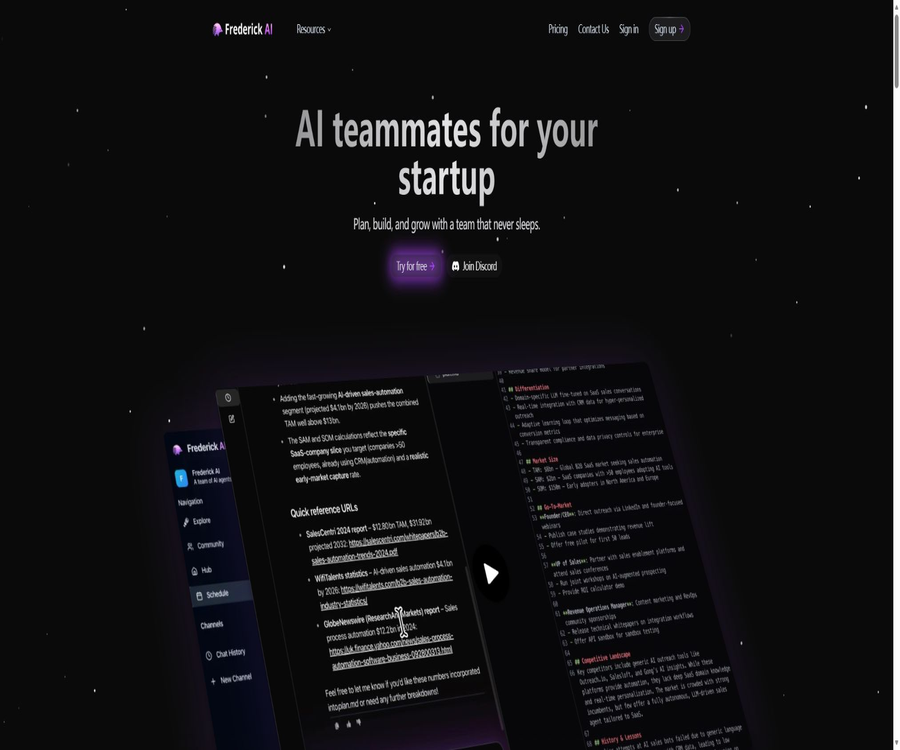
Frederick AI
Frederick AI, an intelligent tool focused on AI programming.
Tags:AI programming toolsWhat is Frederick AI?
Frederick AI is an AI work platform designed for entrepreneurs, independent developers, and small businesses. It combines code development, web management, market research, and growth marketing into a set of collaborative AI tools.
The focus of current products is no longer merely on testing entrepreneurial ideas, but rather on helping teams to advance their business throughout the stages from planning and development to customer acquisition. Users can save information such as company background, plans, research results, images, and documents in a single workspace, enabling different intelligent agents to reuse this context.
A one-sentence summary
Frederick AI enables entrepreneurs to use natural language to control code, browsers, and backend agents in order to carry out application development, market research, web-related tasks, and activities aimed at driving growth.
Core product architecture
| module | Key capabilities | Typical tasks | Execution characteristics |
|---|---|---|---|
| Coding Agent | Building and modifying software | Landing pages, internal tools, complete product | Execute end-to-end in a code sandbox |
| Browser Agent | Operate a real website | Click, fill out the form, submit, retrieve data | Execute multi-step processes within a browser sandbox |
| Background Agents | Scheduled or continuous task execution | Monitoring, publishing, researching, updating | The paid tier supports periodic execution. |
| Editor Workspace | Share long-term context | Company information, plans, research, documents | For reuse by different tasks and agents |
| Market Insights | View market and competition information | Spatial analysis, competitor monitoring, opportunity assessment | The free version has limitations, while the paid version offers full functionality. |
Code Agent
The Coding Agent can be used to create landing pages, internal tools, and complete products based on textual specifications. Examples of applications in public scenarios include SaaS MVPs with login functions, dashboards, APIs, and databases, as well as customer portals, e-commerce stores, and data dashboards.
What products can be created?
- The startup’s official website, product description page, waiting list page, and release page.
- A pricing page that includes package comparisons, feature tables, and a Q&A section.
- An onboarding process that includes registration, email verification, guided steps, and user profiles.
- A SaaS prototype with authentication, a dashboard, a database, and business interfaces.
- Customer accounts, orders, invoices, or a data access portal.
- Product catalog, checkout, payment, and order management interface.
- Project management, internal CRM, email marketing, and analytics dashboards.
Apply build boundaries
Natural language generation can significantly reduce the time required to develop prototypes, but it does not guarantee that the resulting output will have production-grade quality. Systems related to payments, permissions, sensitive data, concurrency, and compliance still require manual review of the code, testing of dependencies, and implementation of monitoring mechanisms.
Browser Agent
The Browser Agent enables navigation through real web pages, clicking buttons, filling out forms, extracting data, and completing multi-step tasks. It is suitable for scenarios where no APIs are available, manual login is required, or there are repetitive processes that involve multiple pages.
Web automation scenarios
- Submit the company’s information to the startup product catalog and record the results.
- Fill out the application form for accelerators, incubators, or grants.
- Extract structured data from payment systems, customer management, knowledge bases, and analysis platforms.
- Check competitor pages, packages, content, and market changes.
- Complete data entry, downloading, and organization in the authorized account.
High-risk operations require manual confirmation.
Browser agents are able to carry out actions on external websites on behalf of users; therefore, tasks such as submitting requests, sending data, making purchases, deleting content, and adjusting account settings should not be carried out entirely without human oversight. It is necessary to check the terms of service of the target website, the access rights, and the requirements regarding data processing before proceeding.
Background agents and scheduled tasks
Background Agents can carry out tasks on a scheduled basis, such as preparing weekly reports for investors, analyzing competitors’ prices, publishing SEO articles, running tests, or monitoring the status of a website. The Plus and Pro versions support periodic background tasks, while the free version only offers one-time executions of such tasks.
Tasks suitable for automatic execution
- Periodically summarize market, competitor, and customer trends.
- Draft and publish approved articles according to the content calendar.
- Check website availability, performance, and key processes.
- Organize operational metrics and generate draft routine reports.
- Repeatedly retrieve business data from authorized platforms.
Shared workspaces and memory
The Editor Workspace is used to store business context, plans, research materials, images, and files. Users can record information about target customers, product positioning, and key differences, so that subsequent coding, research, and marketing tasks can rely on the same data.
Suggested company information to keep
- Product positioning, value proposition, and promotional statements that should not be used.
- Target customers, industry, region, language, and purchasing role.
- Brand tone, visual rules, common terminology, and examples.
- Verified features, pricing, roadmap, and competitive advantages.
- Approvers, operations restrictions, account permissions, and publishing processes.
Market research and business validation
Frederick AI can analyze the competitive landscape, user issues, and opportunities in the market in which the company operates, and it saves the results of these analyses within the project. Market Insights is available for limited use in the free version, while the Plus and Pro versions offer full functionality.
From initial validation to ongoing operation
Earlier versions placed more emphasis on idea validation, business plans, and landing pages, while the current version integrates these functions into broader agent workflows. The catalog descriptions should focus on current AI assistants, software development, web tasks, and growth strategies.
Growth marketing and creative content
Public scenarios on the platform include SEO articles, newsletters, social media content, promotional materials, and brand assets. The agent can first analyze topics and trends, and then generate drafts, content calendars, or visual materials.
List of marketing capabilities
- Research keywords and write extensive search content.
- Publish articles to the content management system as planned.
- Research topics, and write as well as format email newsletters.
- Create a content calendar for professional networking, messaging, and image-sharing platforms.
- Create brand assets such as social media images, presentation templates, and email headers.
- Study the market and draft the startup financing pitch document page by page.
Tutorial on Creating Entrepreneurial Projects
- Register and create a project, and describe the product, customers, and the problems to be solved in one sentence.
- In the shared workspace, add the target market, brand tone, existing materials, and prohibited items.
- First, use the research task to identify the customer’s pain points, as well as competing products and alternative solutions.
- Write back the conclusions that have been manually verified into the project context.
- Select a code, browser, or backend agent to carry out the first task with clear boundaries.
- Check the results, adjust the context, and document reusable acceptance criteria.
Tutorial on building an MVP using AI
- Reduce the MVP to a core role, a key process, and a measurable goal.
- List the pages, data fields, permissions, external services, and error handling requirements.
- Let the Coding Agent first generate the information architecture and implementation plan before starting the construction.
- Check registration, permissions, the database, payment processes, and key business logic in stages.
- Use test accounts to verify normal, failed, unauthorized, and duplicate submission scenarios.
- Real users are enabled only after confirming the domain name, logging, backups, security, and privacy.
Tutorial for running browser tasks
- Specify the websites and accounts that have access allowed, as well as the specific results that need to be achieved.
- Create accounts with the minimum required permissions, and remove any unnecessary payment and management rights.
- Have the agent execute in preview mode first to check the field mapping and page paths.
- Manual confirmation is required before final submission, sending, or any irreversible action.
- Save records of successful, failed, and rejected operations to avoid duplicate processing.
- Regularly check website rules, page changes, authorizations, and unauthorized logins.
Tutorial on setting up periodic tasks
- Choose repetitive tasks that have stable frequencies, clear inputs, and the ability to recover from failures.
- Indicate the data range, output format, deadline, and acceptance criteria in the workspace.
- Set the execution frequency, time zone, recipients of notifications, and the handling method in case of failure.
- During the first run, perform manual verification step by step; do not leave it unattended for an extended period of time.
- Add approval steps for publishing, account modification, and external sending.
- Review the task value, credit points consumed, error rate, and permissions on a monthly basis.
Which users are it suitable for
- Independent entrepreneurs: need to carry out research, development, and marketing without a complete team.
- Early-stage startup teams: Quickly develop MVPs, landing pages, and internal operational tools.
- Product manager: Verify the process, create functional prototypes, and gather market information.
- Growth and Content Team: Conducts bulk research, plans, and creates marketing assets.
- Small business owners: Automatic handling of web data entry, data aggregation, and routine reporting.
- Code-free users: Those who wish to create web pages and business applications using natural language.
- Developers: Use agents to accelerate the creation of template code, tests, and internal tools.
Typical use cases
- From market issue research to the launch of the candidate list page.
- Build a SaaS MVP with authentication, a dashboard, and a database.
- Create customer portals, internal CRM systems, or project management tools.
- Automatically collects competitor prices and generates a summary of changes.
- Prepare applications for startup directories, accelerators, and grant programs.
- Generate weekly reports on investor updates and operational data.
- Continuously create SEO articles, newsletters, and social media content.
- Extract authorized data from tools that never have exposed interfaces.
Product advantages
- Place code, web operations, research, and marketing in the same workspace.
- Sharing memories reduces the cost of reinterpreting the company’s background for each task.
- Browser agents can handle web processes that lack open interfaces.
- The backend agent allows a single prompt to be turned into a periodic task.
- It can cover a wide range of scales, from landing pages to full-stack applications and internal tools.
- The free plan does not require a credit card; you can first use a small amount of credit to test the level of compatibility.
- The public plans clearly list the credit points, storage space, number of applications, and differences in capabilities.
Usage restrictions and precautions
- The free tier provides 15 AI credit points only at the time of registration; these 15 points are not replenished on a monthly basis.
- Each credit tier expires at the end of the month, and any unused credit limit cannot be accumulated over time.
- The specific amount of AI credit points consumed varies depending on the length of the task, as well as the models and tools that are used.
- The free-tier browser and code sandbox have limitations; the backend agent can only be used once.
- The software generated may contain security, permission, dependency, and business logic errors.
- Web automation may encounter verification codes, page changes, access restrictions, and third-party terms.
- Automatically published research and marketing content may still pose risks related to facts, copyright, or branding.
- The privacy policy is rather general; it does not specify whether the project data is used for model training.
- The public terms mainly cover website content, without specifying details regarding the generated code and its ownership.
- No public product interfaces or official software development kits for developers were found.
- No official code repository has been found that can prove the open-source nature of the entire Frederick AI platform.
Current package price
| Plan | Monthly price | AI credit points | Storage | Number of applications | Suitable for users |
|---|---|---|---|---|---|
| Free | $ | 15 o’clock at registration | 1 GB | 2 | Interest-based projects and experiences |
| Plus | $ | 1,000 points per month | 10 GB | No restrictions | Start-up entrepreneurs and developers |
| Pro | $ | 2,500 points per month | 30 GB | No restrictions | Business owners who need to accelerate growth |
The price verification date is August 22, 2026. The official website indicates that an annual payment can save 24%, but the publicly available information does not specify the exact total cost for an annual payment; therefore, the estimated amount is not presented as the official price.
Comparison of package features
| Functions | Free | Plus | Pro |
|---|---|---|---|
| Private projects | Support | Support | Support |
| Custom domain name | Support | Support | Support |
| Remove the Frederick identifier. | Support | Support | Support |
| Add credit points for purchase | Support | Support | Support |
| Market Insights | Finite | Complete | Complete |
| Browser sandbox | Finite | Support | Support |
| Browser session memory | Support | Support | Support |
| Code sandbox | Finite | Support | Support |
| Backend agent | Only once | Periodic execution | Periodic execution |
| Priority support | Not listed | Support | Support |
| Founder email support available | Not listed | Support | Support |
How to choose a package
| Demand | Suggested solution | Reason for selection |
|---|---|---|
| I just want to determine whether the product is suitable. | Free | No credit card required; 5 trial attempts and basic functions are available for testing. |
| Create no more than two small projects. | Free | There are 2 applications, but the credit points and sandbox capabilities are limited. |
| Continuously develop multiple projects. | Plus | No application restrictions, full sandbox, and 1,000 points per month |
| Periodic operation research or marketing tasks | Plus | Supports periodic background agents. |
| The team has a high level of usage for building and scaling. | Pro | 2,500 points per month and 30 GB of storage |
| The usage levels fluctuate significantly. | Paid last month and recorded | First, measure the actual credit points consumed for each type of task. |
How to understand AI credit points?
AI credit points represent the amount of computing resources and intelligence capabilities available within the platform; they are not equivalent to a fixed number of articles, pages, or applications. Users should keep track of the actual consumption related to code compilation, browser tasks, research activities, and background processes.
| Cost variables | Why does it change? | Control method |
|---|---|---|
| Task complexity | The more steps, files, and context there are, the greater the processing load. | Break it down into small tasks and set acceptance points. |
| Repeatedly modify | Each round of redoing will continue to consume the quota. | Define the specifications first before generating. |
| Browser is running | Page waiting, retries, and multiple sites will prolong the task. | Limit websites, paths, and timeout periods |
| Background frequency | The more frequent the cycles, the greater the number of monthly executions. | Set the frequency based on business value. |
| Project context | Large files and long histories may increase the processing load. | Only retain valid information. |
Supported platforms and delivery methods
| Platform or method | Support status | Uses |
|---|---|---|
| Official Web Site | Support | View products, use cases, and prices |
| Web applications | Support | Create projects, run agents, and manage files |
| Browser sandbox | Supported; the free tier has limitations. | Execute real web page tasks |
| Code sandbox | Supported; the free tier has limitations. | Build and test applications |
| Background execution | Support | One-time or periodic tasks |
| Custom domain name | Each option is listed as supported. | Publish a brand page or app |
| Native Windows or macOS applications | No official release was found. | Focused on the web interface. |
| Native iOS or Android apps | No official release was found. | Focused on the web interface. |
| Public product interfaces | No findings were detected. | It should not be assumed that a programmable invocation platform is available. |
API, GitHub, and open-source status
As of the time of verification, the official website does not disclose the prices of the product APIs, SDKs, or interfaces intended for developers, nor is there an official GitHub organization that can verify identities. Third-party repositories with the same name cannot be considered as the official code for Frederick AI.
| Project | Current status | Conclusion |
|---|---|---|
| Frederick AI platform | Managed business services | The product itself is not open source. |
| Public API | No official documentation was found. | Do not claim to support it. |
| Official SDK | No findings were detected. | Do not treat internal or third-party code as an SDK. |
| Official GitHub | Not confirmed | Projects with the same name do not necessarily represent the official version. |
| Generate project source code export | The official website’s public page does not provide clear information on this. | Verify in a real project before purchasing. |
| Third-party service integration | The scenario page mentions payment, email, and business tools. | Configure according to specific projects and verify credential permissions. |
Privacy and data processing
The personal information listed in the privacy policy includes name, email address, phone number, and other data provided by the user voluntarily. The system may also automatically collect IP address, browser type, operating system, pages visited, referring pages, date and time, as well as Cookie data.
This information can be used to provide and improve services, facilitate communication with accounts, enable personalization, support marketing efforts, conduct statistical analyses, and meet legal requirements. Service providers may access the information necessary to carry out their tasks for purposes such as hosting, data analysis, or marketing.
| Data category | Potential content | Usage suggestions |
|---|---|---|
| Account information | Name, email, phone number, and contact information | Fill in only the information that is necessary for the business. |
| Project context | Plans, research, images, documents, and company information | Do not upload unrelated confidential information. |
| Code and application data | Source code, configuration, test data, and business rules | Remove production keys and real personal data |
| Browser tasks | Website content, form fields, and operation records | Use a test account with the minimum required permissions. |
| Technical log | IP, devices, browsers, and access patterns | Confirm the region and reservation requirements |
| Marketing data | Subscriptions, interactions, and preferences | Use unsubscribe options and comply with marketing permissions. |
AI training, retention, and deletion
The current privacy policy does not specify whether user inputs, project files, the generated code, or browser sessions are used for training models, nor does it outline a fixed period for data retention. It is necessary to consult the platform regarding these terms before processing any client confidential or personal data.
The policy allows users to request access to, correction of, or updating of their personal information, as well as to unsubscribe from marketing emails; the policy regarding children states that the service is not intended for individuals under 13 years old. The policy does not specify in detail, within the public text available, the time frame within which backups are deleted after a record is removed.
Intellectual property and rights of output
The terms of use state that the text, graphics, logos, images, audio and video materials, as well as software on the website are owned by the platform or the content providers; they may not be copied, modified, or republished without written permission. These terms primarily deal with the content of the website.
The terms do not clearly specify the ownership of the user-provided input, the code generated by the agent, as well as the design and marketing content, nor do they outline the permissions for commercial use of these elements. Before launching a product or delivering it to customers, companies should obtain written confirmation and verify the licenses related to any third-party materials and open-source components used.
Suggestions for safe use
- Only the minimum data required for a task is saved in the shared workspace.
- Keys, payment credentials, and production database credentials should not be written directly into prompts or files.
- Create restricted, revocable dedicated accounts for browser agents.
- Manual approval is required for operations such as external release, submission, and sending.
- Check the dependencies, permissions, input validation, and error handling in the generated code.
- Use fictional or anonymized data to test registration, payment, and the customer portal.
- Export important code, content, and business data to avoid having only copies within the platform.
- It logs the agent’s execution history, credit point consumption, and abnormal operations.
Basic information
| Project | Content |
|---|---|
| Tool name | Frederick AI |
| Product positioning | AI teammates and work platforms designed for startup companies |
| Core competencies | Code agents, browser agents, backend agents, shared workspaces, and market insights |
| Primary users | Independent entrepreneurs, early-stage teams, small businesses, and product developers |
| Price pattern | Free plan, monthly subscription, annual discount, and additional purchases with credit points |
| Free quota | 15 AI credit points upon registration |
| Is registration required? | Creating projects and running tasks require |
| Main platforms | Web |
| Custom domain name | The package list column is supported. |
| Public API | No findings were detected. |
| Official SDK | No findings were detected. |
| Is the product open source? | Not open source |
| Official GitHub | Not confirmed |
| Date of entry into force of the privacy policy | January 2, 2024 |
| Applicable Law | Australian law |
| Price verification date | August 22, 2026 |
Recommendation score
Recommendation score: 4.2 / 5. Frederick AI connects entrepreneurship research, software development, website management, and growth strategies, making it attractive to founders who lack a complete team of specialists.
It should be noted that the free quota is very limited, the consumption of credit points is not clearly indicated, and the policies regarding privacy and terms do not provide sufficient details on AI training, ownership of the generated content, or how to delete projects. For actual business operations, it is advisable to start with low-risk projects first.
Frequently Asked Questions
What does Frederick AI do?
It provides code, a browser, and backend agents that can help startup teams build applications, carry out web-related tasks, research the market, and create content to drive growth.
Is Frederick AI free?
There is a free option: the cost is $0 and no credit card is required, but only 15 AI credits are provided at the time of registration, allowing for up to 2 applications; moreover, some sandbox capabilities are limited.
How much are Plus and Pro?
The Monthly Plus plan costs 25 dollars per month and includes 1,000 points as well as 10 GB of storage; the Pro plan costs 50 dollars per month and includes 2,500 points along with 30 GB of storage.
Is there a discount for an annual payment?
The official website indicates that an annual payment can save 24%. Since the total cost of an annual payment is not clearly stated on the public page, it is necessary to verify the actual amount, taxes, and renewal period at the time of settlement.
Do credit points accumulate?
It does not accumulate over time. The package schedule shows that the credit points expire at the end of the month; therefore, it is necessary to choose a plan based on the actual amount of work required.
Is it possible to build a complete application?
It is possible to create a full-stack application that includes a landing page, as well as authentication mechanisms, dashboards, APIs, and databases; however, before going live, manual testing for security, permissions, and functionality is still required.
Can a website be operated automatically?
Yes. The Browser Agent can navigate web pages, click elements, fill out forms, extract data, and carry out multi-step tasks; however, captcha codes, website rules, and high-risk submissions may require manual handling.
Is scheduled tasks supported?
Supported. Plus and Pro allow for the periodic execution of background agents, while Free only offers a one-time opportunity to run background tasks.
Can marketing content be created?
Yes. Public contexts include SEO articles, email newsletters, social media content, brand assets, and financing pitch materials.
Can a custom domain name be linked?
The current package list includes custom domain names under the Free, Plus, and Pro categories. Binding restrictions, certificates, and the number of domains must be verified in practice within a project.
Are APIs provided?
As of the time of verification, no public API or developer documentation for Frederick AI products was found; therefore, it should not be assumed that it is possible to invoke these agents through programs.
Is Frederick AI open source?
No. The platform provides hosted business services, and there is no official open-source repository that can verify identities and represent the entire product.
Does the generated code become the property of the user?
The public terms do not specify in detail who owns the code and content generated by the agents. It is necessary to consult the platform before making a commercial release, and to check the materials, dependencies, and licenses involved.
Will the project data be used to train AI?
The current privacy policy does not clearly state whether hints, documents, code, and browser sessions are used for model training. Written clarification must be obtained in cases involving confidential data.
How long are the data stored?
The public privacy policy does not specify a fixed retention period, nor does it indicate when backups are deleted after a project is removed. Enterprise users should confirm this before making a purchase.
Is it suitable for non-technical entrepreneurs?
It is suitable for rapid verification and development, but non-technical users still need to understand the scope of the product, data permissions, and acceptance criteria; it is best for critical systems to be reviewed by developers.
Summary
Frederick AI is suitable for entrepreneurs who wish to carry out market research, product development, and growth strategies with a small team. The code, browsers, and backend agents, along with shared workspaces, enable different stages of the process to be connected within the same context.
It is recommended to start by testing a low-risk project using the free version, and then choose between Plus or Pro based on the actual amount of credit consumed by the code and web tasks. For production applications, it is necessary to conduct additional reviews regarding security, data, output rights, platform dependencies, and manual approval processes.
Tools similar to Frederick AI



 Guigong Network Security Registration No. 45132202000164