






FlowHunt
FlowHunt, an intelligent tool focused on AI programming.
Tags:AI programming toolsA one-sentence summary
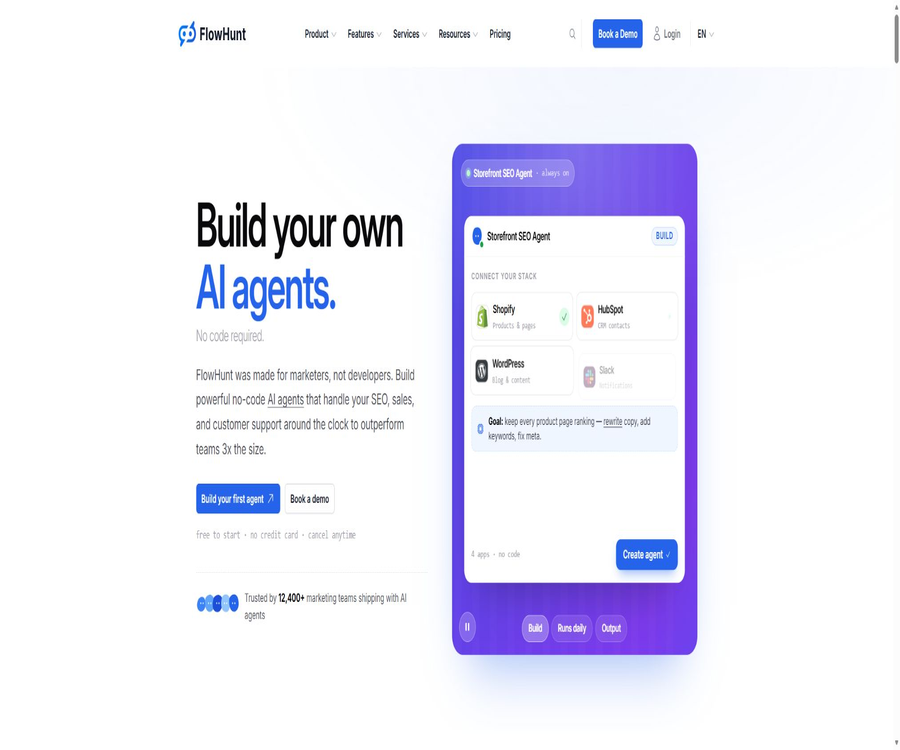
FlowHunt is a code-free AI agent platform that focuses on visual workflows; it enables the connection of models, tools, knowledge bases, memories, triggers, and external business systems in order to create chatbots, multi-agent teams, and automated tasks.
Tool Introduction
FlowHunt is provided by the Czech company AiMingle, s.r.o.; Quality Unit, s.r.o. is responsible for some of the infrastructure, billing, and support functions. The platform is intended for use by marketing, SEO, sales, customer service, operations, and development teams.
Users can start with agents and process templates, or they can build the processes step by step using the drag-and-drop editor. The resulting processes can be executed through a chat interface, web components, scheduled tasks, Webhooks, REST APIs, MCP, or business integrations.
Core components
| Composition | Main function | Typical content | Control is required. |
|---|---|---|---|
| AI Agent | Independently select tools and steps based on the goals. | Models, goals, tools, memory, and knowledge | Permissions, budget, and approval |
| Flow | Define the visualization path from input to output | Triggers, components, conditions, and results | Error branches and retries |
| Agent Team | Enable supervisors to collaborate with professional agents. | Planning, research, writing, review, and execution | Responsibilities and manual checkpoints |
| Knowledge Base | Provide private context to answer the question. | Websites, documents, and predefined Q&A | Updates, permissions, and references |
| Chatbot | Publish the conversational Flow to users | Pop-up windows, embedding, forms, and feedback | Identity, abuse, and transfer to humans |
| Integration | Read and write to external business systems | CRM, e-commerce platforms, analytics, collaboration tools, and content platforms | Minimum permissions and revocation |
| Trigger | Start tasks automatically based on events | Plans, Webhooks, chat, and page events | Idempotency, frequency, and cost |
| Observability | Check the behavior of the agent at each step. | Execution timeline, tool calls, outputs, and integration | Sensitive logs and retention |
Main functions
Visual Flow editor
Users can drag and drop components such as models, prompts, search functions, documents, data extraction tools, data processing elements, and output tools, and then use connections to define the order of execution. For complex processes, it is still necessary to understand data structures, error handling, and the limitations of the models.
Single-agent and multi-agent teams
A single agent can possess goals, models, tools, and memory, while multi-agent processes are planned by a supervisor, executed by specialized roles, and then integrated. Team collaboration is suitable for complex tasks, but it increases the number of calls, delays, and energy consumption.
Agents and template library
The current product page displays over 120 pre-built agents, while the pricing page lists more than 100 workflow templates. Users can use these templates directly, or copy them and replace the models, tools, data, and approval steps as needed.
Knowledge base and RAG Q&A
FlowHunt allows websites, individual web pages, documents, and manually organized Q&A pairs to be added to the workspace knowledge base, enabling intelligent search and generation of responses. The package imposes limits on the number of websites, documents, and Q&A pairs that can be included.
AI chatbot
The conversational Flow can be transformed into a chatbot that can be shared or embedded on websites, and its appearance, welcome messages, context variables, and forms can be customized. Both the messages sent by the bot and the tool calls it makes incur costs related to the respective models and processes.
Marketing and SEO automation
The platform offers templates for keyword research, content summaries, article writing, metadata management, page audits, and content updates; it can also be integrated with WordPress, Shopify, Search Console, and various analysis tools. The growth forecasts provided in the example cases should not be considered as guarantees of actual results.
Sales and customer service bots
Agents can retrieve leads from customer relationship systems, prepare personalized outreach messages, answer questions from website visitors, or transfer conversations to human agents. Approval rules and frequency limits should be set for automated messaging, updating customer records, and processing orders.
Scheduled tasks and Webhooks
Flow can be initiated on a daily, weekly basis or according to some other schedule; it can also be triggered by external events via Webhooks. Repeating events, retry attempts in case of failures, and long-running loops can all lead to unintended operations and cumulative costs.
Memory and shared context
Agents can utilize working memory, long-term memory, and team-shared memory to store project facts, preferences, and historical results. Users can view, edit, or erase these memories, and they can set expiration dates for the content.
Operation records and cost monitoring
Each time it is run, information such as tool calls, messages, outputs, timing, and scores can be viewed, which facilitates review and debugging. Budgets and alerts should be set at the agent, project, and workspace levels within the production process.
Model selection and custom models
FlowHunt supports multiple languages and image models; the pricing page indicates that up to around 50 models can be used, and it also allows the use of custom models. The context handling, tool calls, data processing, and cost per transaction vary significantly among different models.
External systems and MCP
The platform offers more than 100 common integrations and allows connection to systems that are not built-in, via Webhook, REST, and MCP. External tools may result in actual data writes when invoked by agents; therefore, credentials must be separated according to their specific uses.
Create the first AI agent
- Register an account and access the trial workspace to check the 5 trial credits as well as the package limitations.
- Select a template from the agent library that is similar to the target, or create an empty Flow in the visual editor.
- Specify the goal, inputs, success criteria, and prohibited actions, then select the model and maximum output.
- Add the necessary tools, knowledge bases, and memories; do not grant permissions to all external systems at once.
- Test each branch with normal, missing, erroneous, and malicious inputs, and check the scores and execution records.
- Add manual approval before the step of performing external writes; only after approval can it be released or scheduled.
Create a knowledge base chatbot
- Create a separate workspace to isolate the robot from data belonging to other customers or projects.
- Import authorized websites, documents, and FAQs, and set the update frequency.
- It connects the chat input, search, model, and response components, with priority given to using knowledge-based content.
- Set options for unanswered questions, low confidence levels, sensitive questions, and routing to a human agent.
- Create a Chatbot and configure its appearance, welcome message, privacy notice, and session variables.
- Embed a test page to check the mobile version, error events, feedback, costs, and manual intervention.
Establish scheduled automated workflows
- Specify the task frequency, data source, output location, maximum runtime, and monthly budget.
- Starting with the planning trigger, it connects the capture, analysis, generation, review, and notification components.
- Set a unique business key for external records to prevent the same event from being processed multiple times.
- Set timeouts, retry counts, and failure queues for crawling, models, and third-party interfaces.
- First, run a small sample manually to calculate the actual points per transaction based on the transaction records.
- Confirm the approval and rollback methods before starting the plan, and continue to monitor the operation history.
Multi-agent project tutorial
- Break down the goal into clear responsibilities such as research, planning, execution, review, and release.
- Designate a supervising agent to be responsible for task allocation, ensuring that specialized agents only have the tools they need.
- Set boundaries for shared knowledge and memory to prevent different clients or projects from interfering with one another.
- Define the deliverables, completion criteria, maximum number of iterations, and conditions for exiting in case of failure.
- Manual confirmation is required before sending messages, publishing content, modifying the store, or updating the customer system.
- Check each character’s tool calls, outputs, and scores from the runtime timeline, then optimize the team.
Which users are it suitable for
- SEO team: Automatically conducts keyword research, page audits, generates reports, and updates content.
- Content marketing team: Links research, writing, editing, and the publishing process via content management systems.
- E-commerce team: Reads Shopify products and orders to assist with description optimization and customer support.
- Sales team: Identifies leads from the customer relationship system, prepares outreach activities, and updates records.
- Customer service team: Deploy website bots equipped with a knowledge base, forms, and the option for manual transfer to a human agent.
- Operations team: Uses scheduled tasks, Webhooks, and multiple agents to handle repetitive tasks.
- Developers: Through REST API, Python SDK, JS API, and the MCP integration platform.
- Companies and agencies: Use workspaces, roles, white labeling, and private deployment services to manage multiple teams.
Typical use cases
- Daily SEO monitoring: Crawl pages and search data, generate a list of issues, and assign tasks for corrections.
- Scheduled content engine: Research topics, write articles, generate metadata, and send it for review.
- Website knowledge robot: Answers product-related questions, collects information, and forwards requests to human customer service.
- Product optimization: Products are retrieved from the store, their descriptions are reviewed and, upon approval, they are written back.
- Sales research: Aggregates company and contact information to prepare personalized briefs for sales staff.
- Customer email summary: Filter important emails and send daily summaries to the collaboration platform.
- Code and release communication: Reads GitHub changes and generates a review-ready update log.
- Internal process assistant: Connects documents, tables, tickets, and approval systems to handle operational tasks.
Product advantages
- Visualization components lower the barrier to writing code for agent orchestration from scratch.
- Single agents, teams, chatbots, and batch automation can all be managed on the same platform.
- The template library covers marketing, SEO, sales, customer service, operations, and engineering tasks.
- Websites, documents, and Q&A knowledge bases can be placed in the same Flow as tool calls.
- It supports multiple models, custom models, APIs, MCP, Webhooks, and a wide range of integrations.
- The runtime timeline recorder keeps track of tasks, outputs, and scores, facilitating debugging and cost tracking.
- Isolate teams and uses by workspace, and provide access permissions for different roles.
- Companies can choose from cloud, Docker, Kubernetes, white-label solutions, and custom components.
Usage restrictions and precautions
- The 5-point free trial offers a 7-day period of use; it is not a permanent free subscription.
- The number of messages or tasks on a page is estimated based on an average workflow; complex tasks may require multiple points at once.
- The points are reset at the end of each billing cycle and are not carried over; any unused balance does not accumulate to the next cycle.
- Multiple agents, deep grasping, expensive models, and loops can rapidly increase costs and delays.
- Templates are merely a starting point; they cannot replace the updating of knowledge, the design of permissions, fact-checking, or error handling.
- Automatic publishing, sending messages, modifying stores, and updating customer records have real business implications.
- External models and integrations have their own data rules; FlowHunt’s policies cannot replace the terms set by the suppliers.
- Web scraping may encounter issues such as login requirements, dynamic pages, anti-scraping measures, copyright problems, and expired content.
- Each package imposes limits on the number of workspaces, members, Flows, bots, websites, documents, and Q&A sessions.
- Access will be blocked immediately after the account is canceled, and the content will be deleted according to the standard procedure and cannot be restored; it is therefore necessary to export the important data first.
- Users are responsible for the legality of the content they upload and that is generated by AI, as well as for intellectual property rights and the consequences of its publication.
- The platform receives a global, non-exclusive, royalty-free, sublicensable, and transferable license to use user-generated content; sensitive content must be assessed first.
Package and monthly pricing
As of August 22, 2026, FlowHunt offers 5 points along with a 7-day free trial; the website states that no bank card is required. The regular subscription is available on a monthly basis, and the payment is made in euros; any taxes and fees are specified on the purchase page.
| Package | Monthly price | Integral per cycle | Work area and members | Estimate the task volume | Suitable for users |
|---|---|---|---|---|---|
| Free trial | 0 euros | 5 points | Trial workspace | It depends on the complexity of the process. | Validate models, templates, and integrations |
| Starter | 50 euros per month | 50 points | 1 workspace, with 1 member per workspace | Up to about 5,000 messages or tasks | Individuals and simple processes |
| Pro | 120 euros per month | 120 points | 5 work areas, with 10 members in each area | Up to about 12,000 messages or tasks | Small teams and business integration |
| Premium | 500 euros per month | 500 points | 10 work areas, with 100 members in each area | Up to about 50,000 messages or tasks | Large-scale complex processes |
| Enterprise | 1,500 euros per month | The number of columns on the page is unlimited. | Infinity workspaces and users | According to the enterprise plan | Private deployment and customized services |
The amount of work required is not fixed; each interaction may consume only a small number of points or several points. Before choosing a package, it is advisable to run a small sample using the actual process first, and then calculate the average and peak values based on the cost report.
Annual payment: Comparison of resources and support
| Package | Monthly price equivalent to annual payment | Flow per workspace | Chatbot | Website/document/Q&A | Support and deployment |
|---|---|---|---|---|---|
| Starter | 46 euros per month | 5 | 5 | 2 websites, 5 documents, 50 Q&A entries | Self-service and basic support |
| Pro | 110 euros per month | 20 | 20 | 15 websites, 50 documents, 100 Q&A entries | Team features: some assistance is available at an additional cost. |
| Premium | 458 euros per month | 50 | 50 | 30 websites, 100 documents, 200 Q&A entries | Priority support, consultation, and white-label eligibility |
| Enterprise | 1,500 euros per month | Infinity | Infinity | Infinity | Cloud or on-premises deployment, dedicated support, and customization |
The annual payment page shows the equivalent monthly price; the actual total amount to be charged for the year and the contract terms shall be confirmed at the time of settlement. White-label solutions, customized MCPs, custom components, setup services, and training may require additional pricing.
How to calculate the integral
FlowHunt uses Credits to represent the costs associated with models, data extraction, generation, and automation; 1 credit is roughly equivalent to 1 dollar in terms of cost, but it does not represent a fixed exchange rate that can be converted into cash. The final amount charged for a particular operation depends on the model used, the input and output data, the number of tools employed, and the complexity of the process.
| Operation example | Public reference cost | Main variables | Control method |
|---|---|---|---|
| Capture a single web page | About 0.01 points | Number of web pages, updates, and parsing | Focus only on newly added or changed content. |
| Index a document | Usually 0.01 points or less | File length and processing | Remove duplicates and limit irrelevant files. |
| Generate articles of 1,500 to 2,000 words. | Approximately 0.05 to 0.15 points | Models, research, context, and length | Restricting models and outputs |
| Generate an SEO briefing | Approximately 0.03 to 0.08 points | Search results and analysis depth | Fix the number of results |
| Generator description | Approximately 0.01 to 0.03 points | Enter length and model | Use a lightweight model. |
| Complex multi-agent operation | It is possible to exceed multiple points. | Roles, loops, tools, and retries | Budget limit and maximum number of iterations |
These figures are only used for estimation purposes and do not represent fixed prices. Users can view their actual expenses through Transactions, History, Cost Reporting, balance limits, and alerts, and purchase additional credit packages as needed.
API, SDK, and web embedding
The platform offers REST APIs and API key management, enabling the management of AI projects, flows, chatbots, documents, tables, points, custom models, as well as various integrations. Its functionality is quite extensive; production keys should have a limited validity period and should be separated by environment.
The web Chatbot also provides a JS API that enables control over opening and closing, passing of Flow variables, triggering of Chat Hooks, as well as monitoring of 11 different types of events, including sessions, messages, forms, feedback, tool calls, and errors.
| Development approach | Primary uses | Authentication or access | Precautions |
|---|---|---|---|
| REST API | Managing FlowHunt resources and executing processes | API Key or Bearer token | Permissions, versions, rate limiting, and error handling |
| Python SDK | Calling open interfaces from Python | Python 3.9 and later, along with account credentials | Clients are generated automatically; the version must match that of the service. |
| JS Chatbot API | Control web bots and events | Embedded scripts and Chatbot configuration | Do not expose management keys at the frontend. |
| Webhook | Run Flow via external events | Sharing credentials or signatures | Replay protection, idempotency, and retry |
| MCP | Allow the agent to use external tools or modify processes. | Configure by account and connection | Write operations require approval. |
| Custom components | Business capabilities not available upon joining the platform | Premium or enterprise service options | Development and maintenance may incur additional fees. |
MCP capabilities
FlowHunt can connect to external MCP servers; it also provides MCP capabilities specific to FlowHunt accounts, enabling agents to read or modify business processes. The price matrix specifies the number of calls or the scope of usage for different plans, and the actual quotas are indicated on the billing page.
MCP enhances the operational capabilities of generic agents, but it also increases the risks associated with permissions. Production connections should be differentiated between read-only and write access; work areas and tools should be restricted, and manual confirmation should be required for actions such as deletion, publishing, payment, sending messages, and making external updates.
GitHub and open source
The official GitHub repository of Quality Unit releases flowhunt-python-sdk, which is a Python client generated automatically based on OpenAPI specifications. The repository requires Python 3.9 or higher, and it is licensed under the GPL-2.0 license.
This SDK is used to connect to the FlowHunt-hosted APIs; it does not include a visualization platform, a backend for running agents, model services, or complete source code for private deployment. FlowHunt’s core products should be regarded as closed-source commercial services – the fact that the SDK is open source does not mean that the entire platform is open source.
| object | Public status | License or delivery method | Correct understanding |
|---|---|---|---|
| FlowHunt cloud platform | Closed source | Subscription service | The core product is not open source. |
| Python SDK | Public | GPL-2.0 | Automatically generated API client |
| REST API | Public access | By package and points | Having an open interface does not mean the source code is also open. |
| JS Chatbot API | Public documents | Web embedding interface | Used to control managed robots |
| Deployment with Docker and Kubernetes | The company provides | Commercial contracts | Private deployment is not the same as open source. |
| Custom components and MCP | Can be developed or customized | A separate quote may be provided. | Verify code rights and maintenance item by item. |
Deployment, white labeling, and data areas
| Method | Applicable packages | Main features | Confirm before purchasing |
|---|---|---|---|
| FlowHunt Cloud | Various paid plans | Hosted and updated by the platform | Region, Backup, Availability, and Exit |
| EU region | Main locations of public clouds | The Frankfurt data center is primarily used. | The specific models may still span different regions. |
| The United States or a single region in Europe | Optional services | Customers can choose where the data will be stored. | Contracts and sub-processor scope |
| Docker private deployment | Enterprise | Deploy to the customer’s environment | Model export, upgrade, and support |
| Private deployment of Kubernetes | Enterprise | For large-scale infrastructure | Capacity, monitoring, keys, and disaster recovery |
| White label | Premium and Enterprise | Custom domain names, logos, colors, and emails | Brand, billing, and end-user terms |
Safety and privacy
FlowHunt states explicitly that databases and backups containing sensitive customer data are encrypted; access to production systems, networks, and keys is restricted, and firewalls, intrusion detection systems, penetration testing, and a vulnerability-bounty program are employed. The public cloud data is primarily stored in Frankfurt, within the European Union.
The Flow, inputs, outputs, and data used in the customer’s workspace are intended to improve the quality of the services provided; they are not used for targeted advertising or shared with third parties for commercial purposes. The privacy policy states that large models such as OpenAI, Grok, and Amazon Bedrock do not store or reuse user data, but the actual handling of such data depends on the model chosen and the way it is integrated.
| Data or control | Public rules | User actions |
|---|---|---|
| Generate content history | It can be stored for up to 1 year. | Regularly export key products |
| Cached data | Up to 14 days | Do not rely on cache recovery. |
| Backup | Amazon S3 stores it for 30 days | The deletion request takes the backup window into account. |
| User deletes it voluntarily | All data can be deleted and cannot be recovered. | Export first before deleting. |
| TikTok token | Saved during connection; deleted upon disconnection or number removal | Revoke it immediately when not in use. |
| Role permissions | Administrators, editors, members, and visitors | Assign permissions on a minimum basis. |
| API Key | A validity period can be set. | Split by environment and system |
| Security incidents | The processor undertakes to notify the controller within 48 hours. | The scope and channels confirmed in the contract |
- Provide the agent only with the data, web pages, documents, and credentials required to complete the task.
- Create separate work areas for customers, departments, and the environment to prevent the mixing of knowledge and memories.
- Before connecting to OpenAI, Google, CRM systems, e-commerce platforms, or social media sites, check their respective data policies.
- Do not include long-term keys in Flow, prompts, front-end scripts, or runtime logs.
- Establish legal foundations for personal data processing, as well as procedures for notification, deletion, and access requests.
- When exporting operation records, customer data, tokens, and private conversations in the link are deleted.
- When registering or making a payment, the email hash may be sent to Google and Meta for measuring ad conversions.
- When making purchases for business use, it is necessary to verify the data areas, sub-processors, model training, disaster recovery measures, and exit strategies.
Content rights and commercial use
Users retain ownership of the intellectual property rights associated with the content they create, upload, or store. AI-generated images and content can be used for commercial purposes, and FlowHunt does not claim ownership over such AI-generated content. Users must still ensure that their content does not violate copyright laws, trademark regulations, as well as privacy and portrait rights.
The user grants FlowHunt a global, non-exclusive, royalty-free, sublicensable, and transferable license for the use, copying, derivation, display, and distribution related to the services and its business. For content that is confidential or subject to strict authorization restrictions, it is necessary to first confirm whether such use is acceptable.
Basic information
| Project | Content |
|---|---|
| Tool name | FlowHunt |
| Operating entity | AiMingle, s.r.o. |
| Infrastructure and billing service providers | Quality Unit, s.r.o. |
| Location of the company | Prague, Czech Republic |
| Tool type | Code-free AI agents, workflows, chatbots, and automation platforms |
| Key capabilities | Visualize Flow, Agent Teams, knowledge base, memory, integration, and monitoring |
| Price pattern | 7-day trial, subscription, points, and enterprise customization |
| Trial quota | 5 points |
| Is registration required? | It is necessary. |
| Chinese support | Models that support Chinese are available as an option; the platform interface is primarily in English. |
| Platform | Web interface, API, web chatbot, and enterprise private deployment |
| REST API | Provide |
| Python SDK | Available for Python 3.9 and later versions |
| MCP | Support |
| Is the core product open source? | Not open source; the Python SDK uses GPL-2.0. |
| Main regions of public cloud | Frankfurt, EU |
| Price verification date | August 22, 2026 |
Recommendation score
Recommendation score: 4.4 / 5. FlowHunt brings together visual agents, multi-agent teams, knowledge bases, chatbots, automation, APIs, MCP, and operational monitoring in a single platform – it is suitable for teams that wish to move from experimental approaches to actual business processes.
The main shortcomings are the high initial subscription cost, the estimated number of messages, and the fact that the costs and complexity associated with handling complex workflows increase rapidly. User content licensing, external model processing, and actual data writing operations also require enterprise-level management.
Frequently Asked Questions
What is FlowHunt used for?
It is used for building AI agents, chatbots, and automated workflows without the need for coding; it can connect models, knowledge bases, memory systems, tools, scheduled tasks, as well as external business systems.
Is FlowHunt free?
There is no long-term free plan; a 7-day trial is available with 5 credits. The regular subscription starts at 50 euros per month for the Starter plan.
Is a credit card required for the trial?
The current agent page indicates that it is possible to start using the service for free, without the need for a credit card. The terms offered on the registration page may change; therefore, it is necessary to check whether any payment method is required before submitting the registration.
How many tasks can one integration handle?
There is no fixed amount. Simple messages may require only a small amount of credits, while complex multi-agent systems, grabbing tasks, and expensive models can consume multiple credits at once.
Will the points be carried over?
No. The points associated with the package are reset at the end of each billing cycle, and any unused balance is not carried over to the next cycle.
Which AI models are supported?
The platform supports multiple languages and image models; the price page indicates that around 50 such models are available, and it is also possible to connect custom models. The exact list and regional availability depend on the workspace in use.
Is it possible to create multiple agents?
Yes. Users can create hierarchical teams with managerial and specialized roles, and share tools and information, but the maximum number of iterations, budget limits, and write permissions should be restricted.
Can it be embedded on a website?
Yes. The conversational Flow can be released as a web Chatbot, and the JS API allows for controlling switches, context, events, and custom triggers.
Does FlowHunt offer an API?
REST APIs are provided, covering projects, Flows, chatbots, documents, tables, points, custom models, and integrations. To determine whether a particular package is available and what the limits are, please refer to the current comparison table.
Does FlowHunt offer MCP?
It supports connection to MCP servers, and also provides MCP capabilities for FlowHunt accounts. Since MCP can be used to trigger writes and process modifications, minimum permissions along with manual approval should be employed in production environments.
Is FlowHunt open source?
The core platform is not open source. The official Python SDK is licensed under GPL-2.0, but it merely serves as a client that calls commercial APIs.
Can it be deployed privately?
Enterprise offers private deployment using Docker or Kubernetes, and it is also possible to choose different data locations. Deployment, model access, upgrades, support, and licensing require a corporate contract.
Can AI-generated content be used for commercial purposes?
The terms permit the commercial use of AI-generated images and content, but the user is responsible for any third-party rights and the consequences of publishing such content. The user must also accept the platform’s broad licensing terms for their content.
Will the data be used to train large models?
The platform’s policies state that the connected large-model services do not store or reuse user data, and it is emphasized that the agents’ memory is not used for training purposes. Companies should still obtain written confirmation regarding the specific model, region, and custom configurations they have chosen.
What happens to the data after it is canceled?
Cancellation will result in an immediate suspension of access, and the content will be deleted following the standard procedures, with no possibility of restoration. The history of generated data can be retained for up to one year: it is cached for 14 days and backed up for 30 days; therefore, important data should be exported in advance.
Summary
FlowHunt is ideal for upgrading model-based Q&A systems into business intelligence agents that incorporate knowledge, tools, memory, triggers, and audit logs. Templates, a visual editor, APIs, and MCP enable use cases ranging from code-free experimentation to enterprise-level private deployments.
Upon implementation, it is advisable to use 5 points for a trial to determine the actual cost, after which integration of models, agents, and other components can be added gradually. In a production environment, it is necessary to establish budgets, minimum permissions, manual approval processes, data isolation, mechanisms for handling failures, as well as reliable external backups.
Tools similar to FlowHunt



 Guigong Network Security Registration No. 45132202000164