






Flatlogic
Flatlogic, an intelligent tool focused on AI programming.
Tags:AI programming toolsA one-sentence summary
Flatlogic is a software development company and a platform for creating AI applications; its users can download free templates for web and mobile use, and they can also use AI to generate CRM, ERP, SaaS, and internal tool solutions whose source code can be deployed, modified, and downloaded.
Tool Introduction
Flatlogic has evolved from a company that provided front-end and back-end template services to a platform for AI software development and custom engineering solutions. Its current offerings include a free template library, a development environment based on the Flatlogic Platform, virtual machines for hosted development via AppWizzy, as well as custom development services provided by human experts.
When using a generator, users define the application through prompts, technology stacks, and data models; the AI then continuously modifies the code and deploys it to a dedicated cloud environment. The generated code can be downloaded under license based on specific plans and templates, but the generator itself remains a closed-source commercial service.
Three ways of use
| Route | Deliverables | Price method | Suitable for users |
|---|---|---|---|
| Free templates | Front-end or full-stack template source code | Templates are free and can be used according to the warehouse license. | Developers, students, and prototype projects |
| AI Application Generation Platform | Executable applications, source code, and hosting environments | Subscription points, model usage, host costs, and fees for certain templates | Startups, product teams, and agents |
| Custom development services | Requirements, design, engineering, deployment, and maintenance | Quotation by project or for long-term cooperation | Companies with complex operations or without a development team |
Free template library
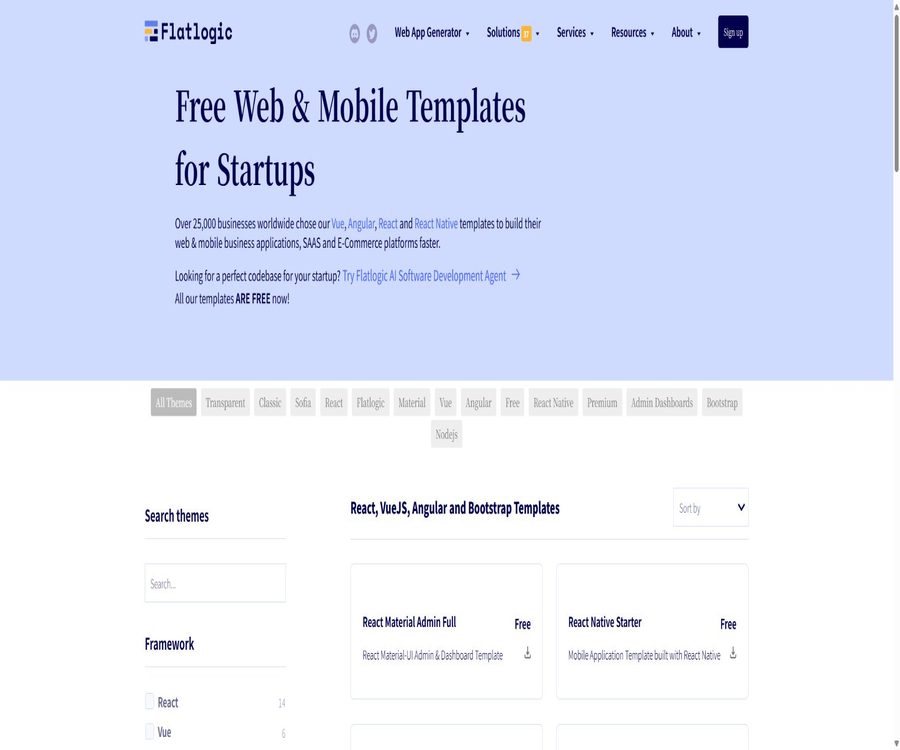
The template page shows that all current templates are available for free; they cover categories such as React, Vue, Angular, Bootstrap, React Native, Node.js backends, administration panels, e-commerce, and accounting. Some projects consist only of the frontend part, while others include Node.js and PostgreSQL.
| Template category | Common technologies | Suitable scenarios | Select a reminder |
|---|---|---|---|
| Admin dashboard | React, Vue, Angular, or Bootstrap | Dashboard, operational backend, and data management | First, check the framework version and maintenance status. |
| Full-stack backend | Front-end frameworks, Node.js, PostgreSQL | Users, roles, forms, and business data | It is necessary to review the authentication, migration, and deployment configurations. |
| E-commerce template | React, Node.js, and databases | Products, categories, accounts, and order interfaces | Payment, inventory, and taxation need to be handled by the user themselves. |
| React Native | React Native | Mobile app prototype | Verify native dependencies and store requirements |
| Bootstrap and HTML | Bootstrap 4 or static frontend | Traditional backend and rapid prototyping | Old dependencies may need to be upgraded. |
| Community full-stack template | Next.js or React, Node.js, PostgreSQL | Create business applications using generators | The warehouse cannot run directly; there are conflicts in the license specifications. |
Main functions of the AI application generator
Generating business applications from prompts
After the user describes the business objectives, roles, pages, and processes, AI generates the first version of the application. It is suitable for CRM, ERP, SaaS, customer portals, administration backends, and internal tools, and is not limited to creating static pages only.
Data models and business entities
The project allows for the definition of tables, fields, relationships, roles, and permissions; thereafter, a generator is used to create databases, backend interfaces, forms, and lists. Complex approval processes, financial rules, and consistency across different systems still require verification by engineers.
AI continuously modifies the code.
After the initial version is generated, it is possible to request additional features, make changes to the pages, or fix issues using natural language. The usage of the model is converted into points based on the number of output tokens, as indicated; in cases where the AI solution does not meet the requirements, it is possible to request a refund of those points under the rules of the Pro plan.
Full source code and repository
The platform offers code preview, and it enables downloading of the source code or pushing it to GitHub based on scheduled timelines and template criteria. Access to the source code is usually granted on a per-application basis; each additional application must meet its own licensing and credit requirements.
Development and stable environments
The Pro plan provides development and staging environments, allowing applications to be deployed on the Flatlogic cloud with just one click. Points are deducted based on the number of active days of the virtual machine, and billing is done on a per-day basis for starting or renewing it; no refund is given on an hourly basis.
Dedicated development virtual machine
AppWizzy offers customer-controlled virtual machines with various CPU and memory specifications, as well as desktop configurations designed for coding tasks. Users own the content within the virtual machines, but they do not possess the underlying hardware, base images, or platform software.
Multiple models and built-in keys
By default, AI requests are routed through AppWizzy’s multi-provider proxy, and credits are deducted according to the model’s pricing structure. Some features also allow users to log in to their own ChatGPT account or provide a third-party model key; in such cases, the costs associated with the model, its terms of service, and data control are calculated separately from the platform’s fees.
Collaborators and private applications
The free plan allows for the creation of up to 3 public applications; the Pro plan enables the creation of an unlimited number of private applications, with a maximum of 2 collaborators per application. The Enterprise plan offers the possibility to arrange for more collaborators, resources, and training based on the organization’s needs.
Custom domain names and deployment
Pro and Enterprise versions offer a stable environment, the ability to use custom domain names, as well as more comprehensive hosting options. For production applications, it is necessary to set up monitoring, backup systems, key management, email functions, payment processing, and disaster recovery mechanisms on one’s own.
Custom development services
When the application involves complex workflows, legacy system migrations, third-party integrations, or ongoing maintenance, it is possible to hire a Flatlogic team to carry out the necessary work. The subscription to the self-service platform does not include custom development hours as part of it.
A tutorial for getting started using templates
- In the template directory, filter projects by React, Vue, Angular, React Native, Bootstrap, or full-stack categories.
- Open the presentation and details to check the page, framework, dependencies, backend, database, and the most recent maintenance date.
- Go to the corresponding GitHub repository to check the LICENSE, README, Issues, and build commands; do not rely solely on the free indicators in the dependency directory.
- After copying the source code, install the required dependencies in an isolated environment, run a security scan, and upgrade any old packages that pose known risks.
- Replace the brand, sample data, and default accounts, and add authentication, permissions, logging, as well as testing and deployment processes.
Tutorials on creating applications using AI
- Register an account and choose a free template or a paid option that suits your project; first, check its source code and commercial license.
- Use a brief description to outline the users, business entities, core processes, permissions, reports, and external systems.
- Select the technology stack and define data entities, fields, and relationships, so that the generator can create the first version of a functional application.
- Test registration, login, permissions, CRUD operations, and key processes in the development environment, and then submit modifications to the AI in batches.
- Check the differences in the code resulting from each AI modification, the amount of energy consumed, and the regression results; do not submit overly complex tasks at once.
- Download or push the source code, set up your own repository, implement automated testing, backup, and deployment processes, and then move to production.
Deployment and launch process
- Select a Micro, Small, Medium, Large, or Desktop virtual machine based on the load, and estimate the score based on the number of active days.
- Separate development and production environments should be set up, with database management, key management, email handling, storage, and third-party interfaces all being handled independently.
- Perform tests for dependency execution, permissions, input validation, sessions, uploads, logging, and database migration.
- Configure domain names, data transmission encryption, monitoring, alerts, regular exports, and independent backups.
- After going live with a low traffic volume, monitor errors, performance, points, and server costs before deciding whether to scale up or migrate to a self-managed environment.
Tutorials for using model accounts or keys
- Confirm the model providers and key-based methods supported by the current feature, and read the provider’s data and billing rules.
- Configure the credentials in the key settings specified by the platform or within a controlled virtual machine; do not include them in the source code or in public repositories.
- Use short tasks without sensitive data to test model selection, permissions, cost allocation, and log content.
- Set budgets, rates, project scope, and rotation periods for keys, and regularly check third-party bills.
- When leaving the platform, deleting projects, or changing members, revoke the old credentials and check for any remnants in the virtual machines and logs.
Which users are it suitable for
- Front-end developers: Use free React, Vue, Angular, or Bootstrap templates to quickly create backend interfaces.
- Entrepreneurs and product managers: Create prototypes of CRM, SaaS, or internal tools, and then hand them over to developers for further development.
- Small and medium-sized enterprises: Convert tables and manual processes into business systems with permissions, databases, and reports.
- Development agent: Reusing templates and generators reduces the time required to create the initial version, while still allowing for the delivery of the source code.
- Students and non-profit organizations: Use free plans, open-source repositories, or apply for specific discounts.
- Established enterprises: Use Enterprise services or manual support to handle custom logic, deployment, and long-term maintenance.
Typical use cases
- Admin dashboard: Creates users, roles, permissions, forms, data tables, and operational dashboards.
- Lightweight CRM: Manage contacts, companies, sales stages, activities, and follow-up records.
- Internal ERP modules: establish workflows for inventory management, approval processes, procurement, operations, and reporting.
- SaaS prototype: Create multi-tenant, account, subscription interfaces and a management console, along with production-grade billing.
- Customer or partner portal: offers secure login, documents, status information, and self-service options.
- Modernization of old projects: Rebuild certain processes using new front-ends and data models, and then proceed with gradual migration and integration.
- E-commerce and accounting prototypes: Start with existing full-stack templates, but customize the tax, payment, and financial compliance aspects as needed.
Product advantages
- The free templates cover a variety of mainstream front-end and full-stack technologies; it is possible to view the source code directly, rather than using only a visual editor.
- AI generators are built around business entities, permissions, and databases, and are more suitable for data-driven internal systems.
- Applications can be deployed, previewed, and their source code can be downloaded; or one can access GitHub, which reduces the barriers to migrating from fully closed platforms.
- Development and stable environments, dedicated virtual machines, and hosts of various specifications provide a continuous pathway from prototyping to deployment.
- It supports platform proxy models, individual ChatGPT accounts, or custom keys, allowing for separate control of the costs associated with the models.
- For more complex delivery requirements, one can turn to manual engineering services without having to replace the technical partner entirely.
- The official GitHub repository contains a large number of public templates, which facilitate the inspection of actual code, its maintenance, and management of licenses.
Usage restrictions and precautions
- The free plan is available only for personal use; for commercial purposes, a paid plan or a license corresponding to an appropriate template is required.
- Generators can quickly establish a foundation, but they do not guarantee that business rules, security, performance, and compliance meet production requirements.
- Subscriptions, additional points, and points that have already been used are generally not refundable; failed AI requests can only be compensated in the form of points.
- In addition to the Pro subscription fee, there may be costs associated with model tokens, active virtual machines, one-time template licenses, and third-party models.
- The framework versions of the free templates differ in terms of maintenance frequency and licensing, so the entire directory cannot be considered to be under the same licensing scheme.
- The Community template’s promotional page states that it is licensed under MIT, but the actual LICENSE in the repository is GPL v3 with the Flatlogic Template Exception.
- Customer control of virtual machines does not guarantee the availability of recoverable user backups; it is necessary to create separate backups of the source code, databases, and uploaded files.
- Paused virtual machines are usually put into cleanup process at least 7 days in advance, with about 1 day of buffer time for operations; they may be deleted sooner in case of security issues or violations.
- Platform or AI providers may keep complete requests, responses, or fragments in their operation records; sensitive code and keys should not be submitted directly.
- The costs and privacy aspects related to self-owned model accounts or keys are governed by third-party rules, while subscription fees and hosting costs will still be calculated as usual.
- The product page uses both the Flatlogic and AppWizzy brands; the contracts, intellectual property rights, and entities responsible for billing need to be determined separately.
Subscription plan
As of August 22, 2026, the Flatlogic Platform charges fees based on subscription credits, model usage, hosting, and template licenses. The annual payment option offers a 20% discount; below are the public monthly pricing rates.
| Package | Monthly price | Monthly points | Applications and Collaboration | Scope of use |
|---|---|---|---|---|
| Free | $ | 5 | Up to 3 public applications | Testing, personal use, and prototypes; only free templates |
| Pro 25 | 20 dollars | 25 | No restrictions on applications; up to 2 collaborators per application. | Private applications, development and stability environments, business projects |
| Pro 60 | 50 dollars | 60 | Same as Pro benefits | Projects with a higher degree of AI modification |
| Pro 125 | 100 dollars | 125 | Same as Pro benefits | Continuously develop multiple applications |
| Enterprise | Custom quote | Customization | No restrictions on applications and custom collaboration | Dedicated deployment, priority support, and custom logic |
Pro points can be accumulated across months, and a maximum of 50 refunds are available for instances of poor AI performance. Cancellation or downgrading does not result in a refund for the current billing cycle; however, subscription renewal can be stopped in future cycles.
Cost per unit of AI models
The cost of the model is calculated based on every 1 million tokens; prompts and outputs have different unit prices which are then converted into points. The list of models and their rates change frequently, and the data shown below corresponds to the information as of the verification date.
| Model | Suggested price | Output price | Applicability judgment |
|---|---|---|---|
| GPT 5.6 Sol | 5 dollars | 30 dollars | High-cost complex tasks |
| GPT 5.6 Terra | 2.50 dollars | 15 dollars | Moderate to high intensity development |
| GPT 5.6 Luna | 1 dollar | 6 dollars | General development at lower costs |
| GPT 5.5 | 5 dollars | 30 dollars | High-cost complex tasks |
| GPT 5.4 | 2.50 dollars | 15 dollars | General development |
| GPT 5.4 Mini | 0.75 dollars | 4.50 dollars | Routine modifications |
| GPT 5.4 Nano | 0.20 dollars | 1.25 dollars | Low-cost, lightweight tasks |
| GPT 5.3 Codex | 1.75 dollars | 14 dollars | Code task |
| GPT 5.2 Codex | 1.75 dollars | 14 dollars | Code task |
| Gemini 3.5 Flash | 1.50 dollars | 9 dollars | Rapid development tasks |
| Gemini 3.1 Pro Preview | 2 dollars | 12 dollars | Preview model |
| Gemini 3 Pro Preview | 2 dollars | 12 dollars | Preview model |
| Gemini 3 Flash Preview | 0.50 dollars | 3 dollars | Quick model preview |
| Gemini 3.1 Flash-Lite Preview | 0.25 dollars | 1.50 dollars | The default low-cost preview model for the page |
CVM and template costs
| Host specifications | Points per active day | 30 active days | Suitable scenarios |
|---|---|---|---|
| Micro: 2 cores, 1GB | 0.10 | 3 | Small sites and lightweight services |
| Small: 2 cores, 2GB | 0.20 | 6 | MVP and conventional business applications |
| Medium: 2 cores, 4GB | 0.40 | 12 | Applications with high memory requirements |
| Large: 2 cores 8GB | 0.80 | 24 | Memory-intensive applications |
| Desktop 8GB: 4 cores, 8GB | 1.20 | 36 | Cloud-based coding desktop, with 50GB of disk space |
| Desktop 16GB: 4 cores, 16GB | 1.60 | 48 | Larger development tasks |
Most of the old templates are now available for free, but the platform’s pricing page still lists a few paid templates; for example, SAAS Engine costs 399 dollars one-time. The licensing cost for templates is separate from the hosting credits, so it is necessary to check the specific project page before making a choice.
Source code, licenses, and GitHub
The official Flatlogic GitHub repository offers a large number of templates for React, Vue, Angular, Node.js, as well as for backend and e-commerce applications; many of these repositories are licensed under the MIT license. In 2025, the company announced that 28 of the previously paid templates would be made available free of charge and with their source code made public, but each repository should still comply with the respective LICENSE terms.
The repository description for the Community full-stack template states that it is licensed under MIT, but GitHub identifies the actual license as GPL v3, with the Flatlogic Template Exception applied. This exception allows the generated code to be distributed under custom terms, provided that the generated code does not contain the essential parts of the template package.
| object | Open-source status | License or rights | Precautions |
|---|---|---|---|
| Flatlogic Platform | Closed source | Subscribe for access | The user does not acquire the intellectual property rights to the generator itself. |
| Old public template | Most open source | Common MIT; verify per repository. | Free does not mean there are no requirements regarding attribution or licensing. |
| Community full-stack template | Open source | Actual GPL v3 with template exception | Conflicts with the warehouse MIT description. |
| Generate application source code | It can be downloaded according to the plan. | The single application license and the template terms apply together. | Additional applications may require separate activation. |
| Customers write the content themselves. | Customer control | Subject to constraints imposed by its own rights as well as those of third parties. | The platform’s infrastructure must not be mixed up with anything else. |
| AppWizzy Generator | Closed source | Owned and licensed by AppWizzy Inc. | Flatlogic is responsible for the website and some of the operational services. |
Privacy and data security
Flatlogic handles accounts, bills, device logs, source code, repositories, files, prompts, AI responses, terminal data, virtual machine contents, as well as metadata related to AI usage. AppWizzy manages multiple model agents and is responsible for online payments, while Flatlogic Poland takes care of the website, support services, and some custom development tasks.
By default, AI requests are sent to the model provider chosen by the user through the AppWizzy proxy; these requests can include source code, files, tool inputs and outputs, as well as images and audio. Operation records may also contain the full requests, responses, or preview snippets in certain functions.
- Do not include production keys, customer passwords, or unnecessary personal data in prompts, source code, or logs.
- When a custom key is used, the model provider handles requests in accordance with its own terms, settings, and billing procedures.
- Third-party credentials in virtual machines are considered customer-owned data; they should be stored in a key management system and rotated regularly.
- The platform claims to use access control, network isolation, transmission encryption, as well as static encryption supported by the cloud.
- Analytical, functional, and advertising cookies that are not essential require the user’s explicit consent; essential login and security cookies, on the other hand, are always enabled.
- Closing an account does not immediately delete all billing, security, support, and legal records; requests for access to such data can be made separately.
- VM backups do not guarantee the inclusion of specific items, nor do they ensure that the data remains up to date or can be restored by customers; production data must be backed up separately.
- AI providers may retain request content according to their own rules, and enterprises need to examine data control on a per-model basis.
Basic information
| Project | Content |
|---|---|
| Tool name | Flatlogic |
| Main products | Free templates, Flatlogic Platform, AppWizzy for developing virtual machines, and custom development |
| Tool type | AI application generator, front-end templates, and software development services |
| Common applications | CRM, ERP, SaaS, portals, internal tools, and management backends |
| Front-end technologies | React, Vue, Angular, Bootstrap, and React Native |
| Common backends | Node.js, PostgreSQL, Linux, Apache, MySQL, and PHP |
| Price pattern | Free plan, Pro subscription, point usage, hosting, and enterprise quotes |
| Free plan | 5 points, 3 public applications, for personal use |
| Is registration required? | A generator requires an account; GitHub templates are available for direct use. |
| Chinese support | No clear Chinese interface was found. |
| Download source code | Supported, subject to constraints imposed by plans, points, and template licenses. |
| Whether API is provided | Interfaces that can be integrated into applications are available; no public APIs for platform management were found. |
| Is the product open source? | The platform is not open-source, while multiple template repositories are open-source. |
| Primary contract and revenue recipient | Flatlogic Poland, LLC and AppWizzy Inc. have divided the tasks between them. |
| Price verification date | August 22, 2026 |
Recommendation score
Recommendation score: 4.1 / 5. Flatlogic offers free source code templates, AI-generated solutions, a dedicated development environment, source code delivery, and human support; it is suitable for teams that want to launch data-driven business applications quickly without being fully confined to no-code platforms.
The main drawback is that the total cost consists of various components such as subscriptions, models, hosts, and templates; the free plan is not suitable for commercial use. Privacy-related aspects involve the platform, AppWizzy, and the model providers. License conflicts related to Community templates also require developers to conduct careful verification before distributing them.
Frequently Asked Questions
What does Flatlogic do?
It offers free web and mobile templates, an AI business application generator, hosted development virtual machines, and custom software services that can be used for CRM, ERP, SaaS, portals, and internal tools.
Are Flatlogic templates free?
The current template directory is indicated as being entirely free of charge, but each repository has its own open-source license, maintenance status, and scope of functionality. It is necessary to check the actual LICENSE before using them in commercial projects or redistributing them.
Is the Flatlogic Platform free?
There is a free plan that provides 5 points per month and allows the creation of 3 public applications; this plan is suitable only for testing, personal use, and creating prototypes. For commercial use, the Pro or Enterprise version is required.
How much is the Pro plan?
The monthly fees, based on points, are 20 dollars for 25 points, 50 dollars for 60 points, and 100 dollars for 125 points. Additional charges may apply for hosts, model usage, and individual template licenses.
Do the points expire?
Points for the Pro plan can be accumulated on a monthly basis, while the rules regarding free access to other plans are specified on the account page. It is necessary to check the rules for point retention and service continuity after canceling the subscription before taking any action.
Is a refund given if AI fails?
Subscriptions or points are generally not redeemable for cash. Pro allows for the request to have the used credits converted back into points in cases of up to 50 instances of poor AI performance; whether such a request is approved is determined by the platform’s rules.
Can I download the complete source code?
It can be downloaded to or pushed to GitHub according to plans, templates, and scoring criteria. Access to the source code is granted on a per-application basis, and it remains subject to the constraints imposed by templates, dependencies, and the licensing terms for the generated applications.
Can it be deployed on one’s own server?
Once you have access to the licensed source code, you can create your own deployment process. Before making the migration, it is necessary to verify the database, storage, keys, and third-party services; platform virtual machines or base images cannot be considered as purchased assets.
Is Flatlogic an open-source product?
The core generation platform is not open source, but the official GitHub repository provides many templates. It should be stated that \"the platform is closed source, while some templates are open source\", rather than labeling the entire Flatlogic as open source.
What license does the Community template have?
The warehouse describes it as MIT, but the actual license is GPL v3 with the Flatlogic Template Exception. Before modifying the template or generating code, one must follow the full text of the license and any written instructions provided.
Which AI models are supported?
The current price page lists various GPT and Gemini models, with pricing based on the number of output tokens as indicated. The model names, default settings, and rates may change; it is necessary to check the real-time data in the account when making a selection.
Can I use my own model key?
Some features allow access to a personal ChatGPT account or the use of supported model keys. The costs associated with third-party models are separate from the platform subscription and hosting fees, and users are responsible for protecting their own credentials.
Will the platform see the code and prompts?
By default, requests are routed through AppWizzy’s multi-model proxy; the platform handles the request content and operational metadata, with some records containing the full content or only fragments of it. Sensitive items should have as little context as possible, and the rules set by the model providers should be taken into account.
Are there automatic backups for virtual machines?
It cannot be relied on. The terms clearly state that there is no guarantee that infrastructure snapshots will include a particular virtual machine, that they will remain up to date, or that they can be used by customers to restore services; users must export and create backups on their own.
Is it suitable for people who know nothing about programming?
It can assist non-developers in creating prototypes, but the development of production applications still involves data modeling, permissions, security, testing, and maintenance. Important business systems should be reviewed by experienced developers.
Summary
The value of Flatlogic lies in its ability to connect together verifiable template source code, AI-driven application generation, cloud-based development environments, and human engineering services. Users can start with free templates or prompts, and gradually gain control over the code and its deployment.
Before use, it is necessary to calculate separately the costs related to subscriptions, models, hosts, and templates, as well as to verify the licenses for each warehouse. When sensitive code is involved, it is also important to assess AppWizzy agents, third-party models, virtual machine backups, and data deletion rules, in order to avoid focusing solely on the speed of generation.
Tools similar to Flatlogic



 Guigong Network Security Registration No. 45132202000164