






Evidently AI
Evidently AI: an intelligent tool focused on AI programming.
Tags:AI programming toolsA one-sentence summary
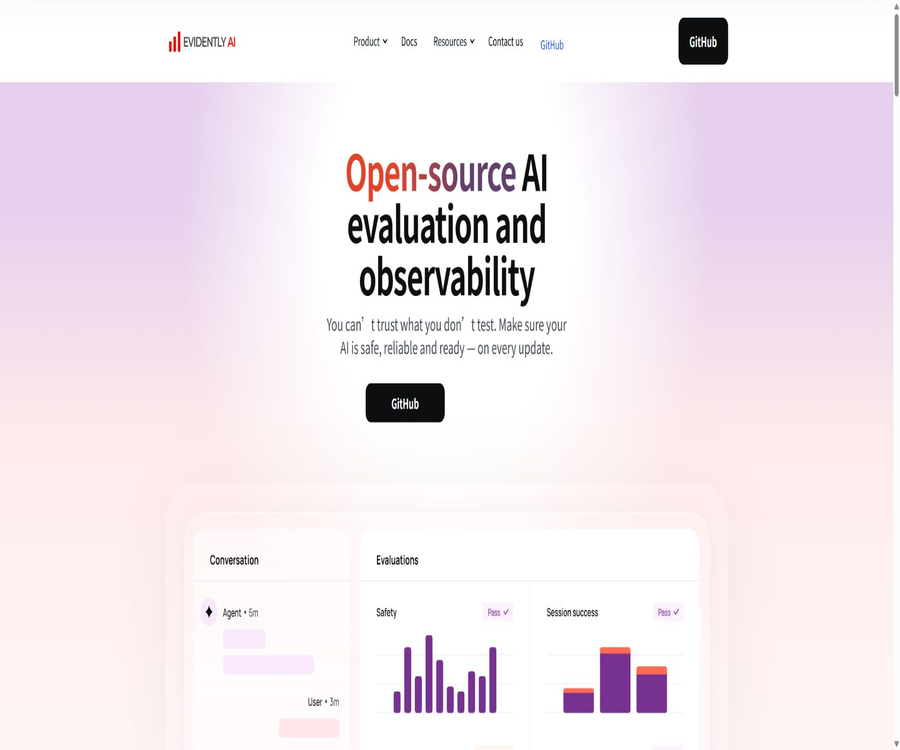
Clearly, AI is an open-source framework for AI evaluation and observability, which enables the assessment of the quality of LLMs, RAG systems, AI agents, data pipelines, and traditional machine learning models in experiments, regression tests, and production monitoring.
Tool Introduction
Obviously, Evidently AI is maintained by Evidently AI, Inc.; its core product is the Evidently library, which can be installed in a Python environment, along with a lightweight monitoring platform that can be deployed independently.
It is not responsible for training the underlying models; instead, it converts inputs, outputs, labels, and reference data into metrics, reports, test results, and trend panels, thereby helping teams identify issues such as hallucinations, declining retrieval quality, data drift, performance regression, and data quality problems.
Current product composition
| Components | Current status | Primary uses | License or delivery method |
|---|---|---|---|
| Obviously, Python libraries | Officially available | Run evaluations, generate reports, and test suites | Apache 2.0 open source |
| Obviously an open-source platform | Officially available | Self-hosted projects, datasets, reports, tracking, and monitoring interfaces | A basic version is provided along with the open-source library. |
| Tracely | Officially available | Near-real-time tracking data of LLM applications collected using OpenTelemetry | Apache 2.0 open source |
| Evidently Enterprise | Commercially available | Advanced code-free evaluation, collaboration, security, and scalable deployment | Contact sales for private deployment |
| Evidently Cloud | The SaaS service has been discontinued. | Historical trusteeship platforms | It should no longer be presented as a free cloud package. |
Main functions
1. Reports: Evaluation reports
Reports are used to calculate and aggregate data, as well as to determine quality metrics for machine learning and LLMs; they are suitable for experimental analysis, debugging, baseline comparison, and batch testing in production.
- Use predefined quick combinations to set a set of common evaluation metrics.
- Add individual metrics or custom Python metrics per task.
- View the interaction results in the Notebook, or export them as JSON, Python dictionaries, and HTML files.
- Compare the current data with the reference data to analyze changes in distribution, quality, and model performance.
2. Test Suites – Sets of tests
Test Suites add pass/fail criteria to the reporting metrics, and can be used for data validation, model regression testing, and quality checks in continuous integration processes.
- Set threshold conditions of greater than, less than, or other values for the indicators.
- Some test conditions are automatically generated based on reference data, reducing the effort required for initial setup.
- Use the test results to make decisions regarding releases, rather than just displaying charts.
- Repeat the same test after updating the model, prompts, or retrieval path.
3. Evaluation of LLMs, RAG, and agents
Evidently can analyze chatbots, RAG, Copilot, AI agents, and other generative applications. Teams can combine rules, classifiers, similarity methods, and LLM reviewers.
| Evaluation directions | Content that can be checked | Typical uses |
|---|---|---|
| Fact and illusion | Factuality, statement consistency, and suspicious responses | Reduce unfounded outputs |
| Search quality | Contextual relevance, the relationship between the answer and the retrieved material | Evaluate the RAG link |
| Safety and privacy | PII, toxicity, sensitive words, and hazardous outputs | Establish security requirements for going live |
| Format and rules | Length, regular expressions, keywords, tone, and structure | Check compliance with business standards. |
| Semantics and language | Semantic similarity, emotion, linguistic, and text features | Compare multiple models or prompts |
| Custom evaluation | Any hints, models, rules, or Python logic | Implement business-specific scoring criteria |
4. Traditional machine learning evaluation
In addition to generative AI, Evidently also supports classification, regression, sorting, recommendation, and table data quality analysis, making it suitable for linking experimental evaluation with production monitoring.
| Task type | Indicators or checks representing something | Required data |
|---|---|---|
| Classification | Accuracy, precision, recall, ROC AUC, and confusion matrix | Predictions, labels, and optional reference data |
| Regression | MAE, ME, RMSE, error distribution, and bias | Numerical predictions and true labels |
| Sorting and RAG | NDCG, MAP, MRR, and hit rate | Queries, sorted results, and relevance information |
| Recommendation system | Novelty, diversity, popularity bias, etc. | Recommendation lists and user interaction data |
| Data quality | Missing, duplicate, range, category, and relevance | Current dataset and optional reference datasets |
| Data drift | Statistical tests and distribution distances | Current batch vs. benchmark batch |
5. Data drift and data quality
The platform can compare the current data with reference data to identify changes in field distribution, missing values, duplicate values, new categories, and abnormal ranges. Drift does not necessarily mean that the model has failed; it still needs to be interpreted in conjunction with labels, business metrics, and model quality.
6. Monitoring panel
The self-hosted UI allows saving evaluation snapshots per project, and it enables the creation of monitoring dashboards that show metrics and test results over time. The open-source version is suitable for lightweight deployments; the team is responsible for handling access control, backups, upgrades, and scaling.
7. Tracking and production evaluation
Tracely is used to capture the inputs, outputs, and intermediate steps of LLM applications, thereby enabling the transformation of production processes into analyzable datasets. Advanced timing evaluations, alerts, and code-free workflows are part of the capabilities offered by the commercial platform.
8. Synthetic data and prompt optimization
The current ecosystem includes capabilities for generating synthetic data and optimizing prompts, which can be used to create normal, boundary, or adversarial examples; these examples can then be used to compare different combinations of prompts, models, and parameters. Generated examples cannot replace real user data or manual red-team testing.
The workflow from experimentation to production
- Identify the specific risks that need to be verified, such as hallucinations, retrieval relevance, data drift, or a decline in classification performance.
- Prepare the current data, reference data, prediction results, labels, or LLM interaction records, and define the meaning of the fields.
- Select the preset and generate a report with metrics; first, examine the distribution, failed examples, and abnormal groups.
- Convert key metrics into Test Suites with thresholds, thereby creating quality checkpoints that can be run repeatedly.
- Re-evaluate after making changes to the prompts, models, data, or code, and compare the differences in the results.
- Write the reports to a self-hosted Workspace, and use the Dashboard to continuously monitor trends and test status.
- Link failure outcomes to troubleshooting, rollback, retraining, or manual review processes.
Installation and Getting Started with the Open Source Version
The current project requires Python 3.10 or a higher version, which can be installed using Python’s package manager. For production projects, it is necessary to specify a particular version, and it is important to read the change notes and conduct regression tests before making any upgrades.
- Create an independent Python environment and prepare a Pandas dataset or data that can be converted into a table.
- Install the Evidently package; if LLM evaluation, Spark, or cloud storage is required, select the corresponding optional dependencies.
- Define data fields, current data, and optional reference data, and select preset or individual indicators.
- Run the Report and view it in the Notebook, or save it as HTML, JSON, or a Python dictionary.
- Add test conditions for key metrics, and include the Test Suite in continuous integration or batch processing tasks.
- First, verify the calculation costs and field mappings using sample data, and then integrate it with production data.
Self-hosted monitoring tutorial
- Create a Workspace, choosing to use a local directory, a SQL-based database, or an object storage system compatible with S3.
- In the evaluation task, the Report snapshots, tracking data, or datasets are written to the specified Workspace.
- Start the Evidently UI service and verify that it can read the project data in the Workspace.
- Create projects and Dashboard panels, and select the metrics and tests that need to be monitored on a continuous basis.
- Add reverse proxies, authentication, encryption, backup, logging, and resource limits in the production environment.
- Run batch evaluations on an hourly, daily basis, or whenever new tags arrive, and route any anomalies to the team’s response process.
Which users are it suitable for
- Data scientist: Compares changes in data, models, and features, and generates shareable analysis reports.
- Machine Learning Engineer: Integrate quality testing into the training, deployment, and batch processing pipelines.
- LLM application developers: Assess the quality of outputs from chatbots, RAG, agents, and Copilot.
- MLOps and platform team: Self-hosted unified evaluation results, tracking, and monitoring panels.
- AI product managers and quality teams: define quality criteria, examine failed samples, and track version regressions.
- Regulated enterprises: Deployed in a private environment, with additional permissions and collaboration features provided by the commercial version.
Typical use cases
- Run a fixed evaluation set before releasing new prompts or models to prevent significant regression.
- Compare the contextual relevance, factual accuracy, and quality of responses among various RAG retrieval approaches.
- Monitor the changes over time in the distribution of production data, the rate of missing values, and model performance.
- Check LLM responses for personal information, toxicity, sensitive words, and formatting errors.
- Generate batch quality reports for classification, regression, sorting, or recommendation systems.
- Generate boundary and adversarial test inputs to expand the coverage of traditional manual test sets.
- Aggregate the evaluation snapshots in a self-hosted dashboard for review by the development, product, and governance teams.
Product advantages
- The same framework covers generative AI, traditional machine learning, and data quality simultaneously.
- It offers over 100 built-in evaluation metrics, and allows the use of Python to create custom indicators for specific business needs.
- Report is suitable for exploration, while Test Suite is appropriate for automated access control; the two modes can be used in conjunction.
- The core libraries and underlying platform are licensed under the permissive Apache 2.0 license, allowing them to be run in local and private environments.
- The report can be retained in the Python environment, or it can be exported as structured data or HTML.
- By default, batch monitoring allows only the aggregated summaries and test results to be saved, thereby avoiding the need to save all original predictions repeatedly.
- Official repositories, documentation, examples, and community resources are quite comprehensive, which facilitates developers in troubleshooting and making enhancements.
Usage restrictions and precautions
- Evidently provides evaluation tools rather than correct answers; poorly designed metrics, thresholds, and reference data can be misleading.
- LLM reviewers may exhibit biases, randomness, and additional model costs, requiring calibration through manual annotation.
- Data drift merely indicates a change in the distribution; it cannot on its own prove that the model’s performance has declined.
- Open-source platforms do not include the features of the commercial version such as authentication, role-based permissions, alerts, scheduled tasks, and full no-code capabilities.
- The original Evidently Cloud is no longer available as a SaaS service; old blogs, old login pages, and certain remaining documents may cause confusion.
- Self-hosted teams are responsible for handling the costs related to infrastructure, security, backups, upgrades, availability, and scaling.
- Python libraries are suitable for technical personnel; for non-technical teams, setting up and interpreting metrics can be challenging in the absence of a commercial platform.
- Before processing production prompts, responses, and personal data, it is necessary to implement minimization, data masking, access control, and define retention periods.
Price and version
As of August 22, 2026, the official documentation states clearly that Evidently Cloud is no longer available as a SaaS product; therefore, it is no longer possible to rely on the previous free cloud plans or old payment tiers.
| Version | Price | Deployment method | Key capabilities | Suitable for users |
|---|---|---|---|---|
| Obviously, Python libraries | Free | Local or proprietary infrastructure | Over 100 evaluations, reports, test suites, and custom metrics | Individual developers and technical teams |
| Obviously an open-source platform | The software is free; users are responsible for providing their own infrastructure. | Self-hosting | Basic projects, datasets, tracking, result storage, and monitoring dashboard | Teams that can manage themselves |
| Tracely | Free | Integrate into applications and host data autonomously | LLM tracing based on OpenTelemetry | LLM Application Development Team |
| Evidently Enterprise | Contact sales | Private cloud or on-premises deployment | Code-free evaluation, alerts, scheduled tasks, permissions, scalable backend, and dedicated support | Companies that place emphasis on safety, collaboration, and scalability |
| Evidently Cloud | No longer available | Historical hosting service | The cloud-based features available on the old pages cannot be considered part of the packages that are currently available for purchase. | Not applicable |
Open-source software does not incur any license fees, but costs are associated with databases, object storage, computing resources, logging, as well as maintenance. There is no fixed price for the commercial version; it is necessary to contact sales to determine the cost based on the scale of deployment and the required support and security features.
Comparison between the open-source version and the commercial version
| Ability | Open-source version | Business Enterprise |
|---|---|---|
| Tracking, over 100 evaluations, reports, and tests | Support | Support |
| Monitoring Dashboard and Custom Metrics | Support | Support |
| JSON reports, raw data, tracking, and dataset management | Support | Support |
| Synthetic data and prompt optimization | Support | Support |
| Code-free data generation, evaluation, and Dashboard | Not supported | Support |
| Side-by-side result comparison and alerts | Not supported | Support |
| Scheduled tasks | Not supported | Support |
| Authentication and role permissions | Not supported | Support |
| Dedicated support, onboarding training, and scalable backend infrastructure | Community support and self-management | Provided according to the business plan |
Supports environment and input/output.
| Project | Support status | Explanation |
|---|---|---|
| Python | 3.10 and above | The core environment for the primary database, evaluation, and custom metrics |
| Jupyter Notebook | Support | Interactively view Reports and debugging metrics |
| Command line and Web UI | Support | Launch the self-hosted monitoring platform and demonstration projects |
| Windows, macOS, and Linux | Depends on the Python environment | For production deployment, it is necessary to verify the dependencies and container environment on one’s own. |
| SQL-based storage | Support | Workspace backends such as SQLite and Postgres can be used. |
| Object storage compatible with S3 | Support | It can be connected to Amazon S3, GCS, MinIO, and others. |
| Native mobile applications | Not provided | Self-built services can be accessed via a browser, but not through mobile apps. |
| Enter | Output | Explanation |
|---|---|---|
| Pandas tables and text data | Datasets with metrics and Reports | Suitable for offline experiments and batch evaluations |
| Current set and reference set | Drift, mass, and difference analysis | It is necessary to ensure that the field definitions and time windows are comparable. |
| Predictions and labels | Classification, regression, sorting, and recommendation metrics | When there is a delay with tags, it is necessary to monitor the proxy metrics separately. |
| LLM prompts, responses, context, and tracking | Quality, safety, and retrieval evaluation | Sensitive content should be desensitized first. |
| Report results | JSON, Python dictionaries, HTML, and platform snapshots | It can be used for automated decision-making or manual inspection. |
| Test Suite | Pass or fail result | Suitable for continuous integration and release gatekeeping |
API and integration capabilities
Obviously, it is first and foremost a Python library API that can be used in Notebooks, scripts, continuous integration processes, Airflow-like orchestration tasks, as well as custom evaluation pipelines. Self-hosted platforms also provide interfaces for writing to and reading evaluation results.
- Place the Report and Test Suite in the training, validation, or deployment pipeline.
- Batch monitoring is triggered by scheduled scripts, task schedulers, or tag-based events.
- Send the structured results to existing logs, alerts, dashboards, or governance systems.
- Use Tracely to capture the inputs, outputs, and intermediate calls of LLM applications.
- Connect object storage to remote Workspaces via a compatible file system interface.
- Custom Python metrics are used to encapsulate internal corporate rules, classifiers, or external evaluation models.
GitHub and open source
Obviously, the core repository is publicly maintained and is licensed under the Apache License 2.0. As of August 2026, the repository had around 7,800 stars; its latest official version is 0.7.21, released on March 10, 2026.
Apache 2.0 permits use, modification, and distribution, but when redistributing the material it is necessary to retain the license as well as any related copyright, patent, and attribution statements, and to indicate that the file has been modified. Trademark rights are not automatically granted under an open-source license.
| Official open-source projects | Uses | License |
|---|---|---|
| evidently | Core frameworks for the evaluation, testing, and monitoring of ML and LLMs | Apache 2.0 |
| tracely | LLM application tracking based on OpenTelemetry | Apache 2.0 |
| community-examples | Examples of evaluation and monitoring | Apache 2.0 |
| aws_alerting | Examples of integration related to AWS alerts | Apache 2.0 |
| ml_observability_course | Machine Learning Observability course materials | Apache 2.0 |
Privacy, Telemetry, and Security
When generating reports in a Notebook or script using only Python libraries, the official documentation states that telemetry data from open-source products is not collected. When the self-hosted Monitoring UI is launched, anonymous usage telemetry is enabled by default, but it can be disabled by using the DO_NOT_TRACK environment variable.
- UI telemetry includes information on the operating system, Python and tool versions, time, anonymous user identifiers, and function usage events.
- Officials state that they will not collect the content of datasets, field names, parameters, code, or data patterns.
- Self-hosting does not equate to automatic security; open-source platforms lack built-in authentication and role-based permissions, which the team must implement on its own.
- The original LLM tracking data may contain customer text, personal information, and business secrets; therefore, rules for data masking, access control, and deletion should be established.
- The privacy policies of the official website and the historical cloud services also cover email addresses, names, companies, Cookies, usage data, and location data obtained with permission.
- When deploying in a corporate environment, it is necessary to verify the data processing protocols, sub-processors, logging mechanisms, encryption methods, backup procedures, vulnerability response strategies, and support frameworks.
Basic information
| Project | Content |
|---|---|
| Tool name | Evidently AI |
| Development company | Evidently AI, Inc. |
| Tool type | AI evaluation, LLM observability, and machine learning monitoring |
| Core language | Python |
| Data type | Table data and text data |
| Core competencies | Reports, Test Suites, over 100 metrics, tracking and monitoring UI |
| Price pattern | Open-source free version and enterprise-customized pricing |
| Is registration required? | The open-source version does not require it; for commercial communication, it is necessary to contact the official team. |
| Is it open source? | Yes, the core library uses Apache 2.0. |
| Cloud SaaS | Service has been discontinued. |
| Main deployment | On-premises, self-owned servers, private cloud, or enterprise local environment |
Recommendation score
Recommendation score: 4.6 / 5. Evidently covers LLMs as well as traditional machine learning; it provides a seamless connection between metrics, reports, testing, and monitoring, making it suitable for technical teams that wish to have control over data and evaluation processes.
The main drawback is that open-source deployment requires investment in engineering and operational tasks; the code-free and collaborative features that are available for non-technical users are found only in the commercial version. After Cloud exits the SaaS market, the team will also need to reassess the hosting costs and migration options.
Frequently Asked Questions
Is AI obviously free?
The core Python libraries, Tracely, and the basic platform can be used for free, under the Apache 2.0 license. Self-hosting still incurs costs related to servers, storage, maintenance, and security.
Can Evidently Cloud still be registered and used?
The latest official documentation clearly states that Cloud is no longer available as a SaaS product. The free cloud packages mentioned on older pages or articles should no longer be considered part of the current offerings.
Is it possible to evaluate LLMs and RAG?
Yes. The platform supports evaluations based on factual accuracy, search relevance, semantic similarity, PII presence, toxicity, format, as well as custom LLM assessments; it also allows for comparing different models and prompt phrases.
Is it possible to monitor traditional machine learning models?
Yes. Evidently supports classification, regression, sorting, recommendation, data quality assessment, and detection of data drift, and it allows batch results to be saved in a self-hosted Dashboard.
Is it necessary to upload data to an external cloud?
Open-source libraries and platforms can run entirely within one’s own environment. Whether to use external LLM reviewers, remote databases, or object storage depends on the team’s own configuration.
Does the open-source monitoring interface offer login and permission management?
The official comparison table shows that the open-source version does not include authentication and role-based permissions; when it is used in external environments or with multiple users, gateways, identity services, and network policies are needed to implement proper access control.
Does Evidently collect model data?
Officials state that self-hosted UI telemetry does not collect the content of datasets, field names, parameters, or code; nor does it send any telemetry when reports are generated using Python libraries alone. UI anonymous telemetry is enabled by default, but can be disabled through configuration.
Can Evidently clearly be used as a quality gate for continuous integration?
Yes. By including the key metrics in the Test Suite and setting thresholds, it is possible to obtain pass or fail results whenever the model, prompts, or data are updated.
What has been added to the Enterprise version for business use?
The business version adds features such as code-free data generation and evaluation, code-free dashboards, side-by-side comparison, alerts, scheduled tasks, authentication, role-based permissions, an extended backend, and dedicated support. For pricing details, please contact sales.
Summary
Clearly, AI is suitable for teams that wish to define the quality of AI through code, to convert offline evaluations into regression tests, and to continuously monitor LLMs and machine learning systems in their own environments.
The current approach should focus on open-source, self-hosted solutions or Enterprise-level private deployments, rather than relying on the previous cloud-based package models. When implementing such solutions, it is necessary to take into account factors such as the validity of metrics, manual calibration, data governance, and operational security.
Tools similar to Evidently AI



 Guigong Network Security Registration No. 45132202000164