






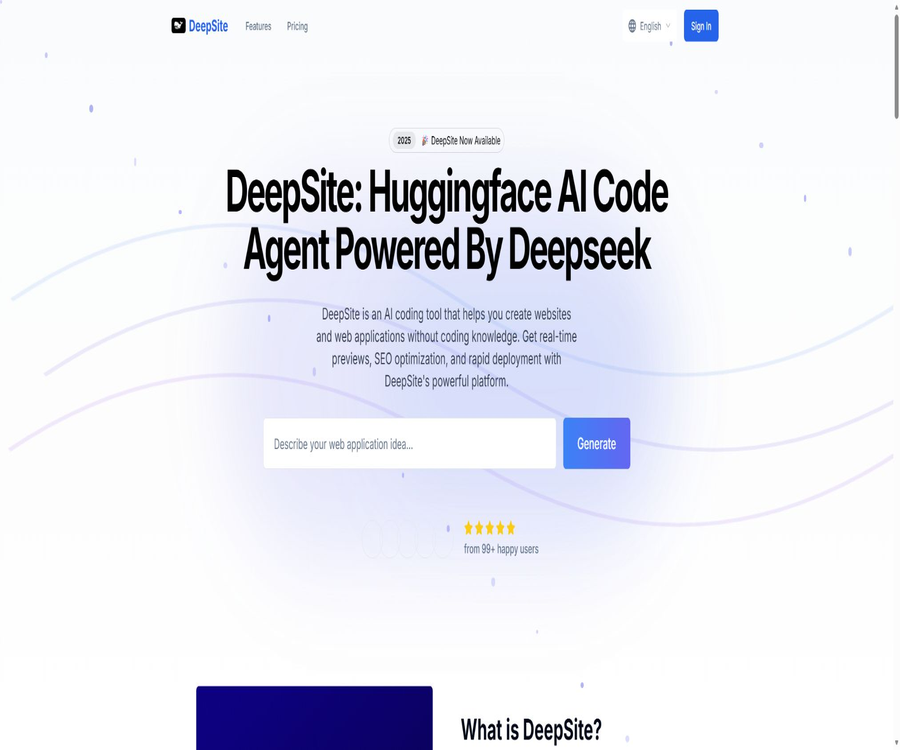
DeepSite :Huggingface's new AI Coding Agent
DeepSite: Huggingface’s new AI coding agent, an intelligent tool focused on AI-driven programming.
Tags:AI programming toolsA one-sentence summary
DeepSite v4 is an open-source ambient programming tool based on the Hugging Face ecosystem; users can use natural language to create multi-page websites or Web applications, and they can preview, modify, download, and deploy these projects in a browser.
Tool Introduction
DeepSite first attracted attention as an experiment in web page generation powered by DeepSeek; the current version is DeepSite v4. It is maintained by the Hugging Face staff account enzostvs, and the source code is made available on its official Space, with the MIT license indicated in the project’s metadata.
It is not a standalone, paid SaaS product within Hugging Face’s unified commercial product line, nor can it be simply referred to as an official Hugging Face coding agent. A more accurate description is that it is an open-source community project hosted on Hugging Face Space, which makes extensive use of its authentication, Hub, and inference services.
Current version and product boundaries
| object | Current status | Operator or maintainer | Method of judgment |
|---|---|---|---|
| DeepSite v4 Space | Running | Hugging Face Staff account: enzostvs | It is possible to view the Space source code and submission history. |
| DeepSite open-source code | Public | Space warehouse maintainer | The project metadata is under the MIT license. |
| The Hugging Face platform | Business platforms | Hugging Face | Provides billing for accounts, Hubs, Spaces, and inference. |
| DeepSite project generation | Ownership and transparency are set according to the user’s preferences. | The user who created the project | Check repository visibility before deployment |
| deepsite.site, the website with the same name | Operate independently | The page claims to be created by enthusiasts. | It cannot be considered the official Space pricing page. |
| Old GitHub desktop repository link | It cannot be verified at the moment. | Unknown | It should not be used as a basis for official downloads. |
Main functions
Natural language generation websites
After the user describes the objectives, style, content, and interactions of the page, DeepSite utilizes optional models to generate the front-end project. It is suitable for landing pages, portfolios, demonstration sites, and interactive prototypes; it can also be used to create multi-page projects with navigation and dynamic routing.
Multi-page projects
The v4 homepage explicitly supports Multi Pages, allowing the creation of multiple interconnected pages along with proper navigation. For complex projects, it is still necessary to specify a sitemap, the responsibilities of each page, and common components in the instructions, in order to prevent the model from missing anything.
Code editing and real-time preview
The current source code includes components such as the Monaco Editor and CodeSandbox Sandpack, which can be used to edit code and view its output. A preview does not mean that the code meets the requirements regarding accessibility, performance, security, and compatibility across different browsers.
Automatic deployment and free hosting
DeepSite v4 is promoted as supporting automatic deployment, and it allows projects to be released using Hugging Face’s infrastructure. The free hosting resources, as well as aspects related to downtime, traffic volume, and visibility, are subject to Hugging Face’s platform policies; this does not mean that unlimited production-level hosting is available.
Project download
The current project code includes all the dependencies required for compression and downloading, and the repository commits also document the project’s download capabilities. After export, it can be further edited locally, placed under version control, and migrated to another hosting environment that supports the corresponding front-end technologies.
Hugging Face integration
DeepSite logs in using a Hugging Face account, and it leverages the Hub along with Inference Providers to carry out model invocation and project management. Creating and deploying models may require granting write or management permissions for the repository; it is important to carefully examine the scope of such requests before granting permissions.
Currently supported models
The metadata for the DeepSite v4 project currently lists the DeepSeek, Qwen, Kimi, GLM, and MiniMax series of models. This list of models changes as new versions of Space are released, and their actual availability is also influenced by the inference providers, account quotas, as well as regional and service constraints.
| Model | Series | Suitable for tasks | Precautions |
|---|---|---|---|
| DeepSeek-V3-0324 | DeepSeek | Web page generation and code modification | It belongs to an earlier version; when comparing, pay attention to the context and stability. |
| DeepSeek-V3.2 | DeepSeek | Universal coding and project iteration | Availability depends on the current reasoning route. |
| Qwen3-Coder-30B-A3B-Instruct | Qwen | Code generation and instruction editing | Complex projects still require manual testing. |
| Kimi-K2-Instruct-0905 | Kimi | Generation of long instructions and page structures | The version name corresponds to a specific snapshot. |
| GLM-4.7 | GLM | Universal codes and interactive design | The output style may differ from that of other models. |
| MiniMax-M2.1 | MiniMax | Front-end code and content generation | The quota and response speed vary depending on the provider. |
Input and output
| Type | Enter content | Output result | Applicable method |
|---|---|---|---|
| Text prompt | Requirements, pages, style, and interaction guidelines | Website or Web application code | Create a project from scratch |
| Subsequent modification instructions | Changes required for the existing page | Updated file and preview | Improve round by round |
| Image materials | Brand images, reference images, or content images | Visual content applied to the page | Follow the actual entry point on the current interface. |
| Project file | The multi-file project generated currently | Editable code and running preview | Technical users check the structure. |
| Download and export | Complete project | Compress project files | Local development or migrated deployment |
| Hub deployment | Project code and repository settings | Accessible Space applications | Online sharing and demonstration |
Complete workflow
- Use your Hugging Face account to access DeepSite v4 and check the login authorization scope.
- First, specify the type of website, target audience, list of pages, brand style, and the interactions that need to be implemented.
- Select the currently available model to create the first version of the project, and wait for the code and preview to be ready.
- Check the layout, text, mobile version, navigation, and forms page by page; don’t just rely on screenshots of the home page.
- Iterate by making small-scale modifications to the instructions, in order to avoid losing existing functions due to the need to regenerate the entire project each time.
- In the code view, check dependencies, external resources, data interfaces, and error handling.
- Download the project to save a copy, and then decide whether to deploy it to a public or private repository.
- Complete security, performance, SEO, accessibility, and cross-device testing before official release.
Tutorial for beginners
- Express the requirements as page objectives, rather than simply entering just the name of the industry.
- List the clear page structure, including the home page, feature pages, pricing page, and contact page.
- Specify requirements for color, font style, spacing, buttons, and card design.
- It indicates which buttons should trigger a navigation, which forms need to be submitted, and how the content should be displayed on mobile devices.
- After the first version is created, only one area is modified at a time, and a preview is used to ensure that no other pages are affected.
- Download the final project to your local device, and replace the sample text and placeholder data with actual content.
- Before binding a domain name or migrating hosting, verify the build commands, environment variables, and data services first.
How to write high-quality prompts
A good set of instructions should include constraints related to the business aspects, structure, visual design, and behavior. Instead of asking for a \"beautiful website,\" it is better to specify the target audience, the main goals for conversion, the different sections of the page, the color scheme, the interaction elements, and what content should be avoided.
- Goal: Specify whether the website is used for acquiring customers, showcasing works, validating products, or for internal demonstrations.
- Pages: Lists each page along with its core content, preventing the model from guessing the information structure on its own.
- Visual: Specify preferences for color, style, density, rounding, shadows, and animations.
- Components: clear navigation, hero section, feature cards, price table, FAQ, and footer.
- Interaction: Explanation of buttons, filtering, pop-ups, forms, status, and error feedback.
- Responsive: It must function properly on desktops, tablets, and mobile devices.
- Technical boundaries: Specify whether external dependencies, backend interfaces, and third-party resources are allowed.
- Acceptance: Specifies inspection criteria such as no overflow, no dead links, and keyboard operability.
Which users are it suitable for
- Product Manager: Quickly turn textual requirements into interactive product prototypes.
- Startup team: Create landing pages, event pages, and early product demonstrations.
- Designer: Verify the page structure and visual layout, then export the code to the engineering team.
- Front-end developer: Creates the initial interface and components, followed by engineering-level refactoring.
- Students and beginners: Observe how prompt instructions are transformed into front-end files and page structures.
- Content creators: Create portfolios, profile pages, and simple interactive displays.
- Open-source researchers: View the Space code, run it locally, and study the multi-model web generation process.
Typical use cases
- Create multi-page official websites and early demonstrations for new products quickly.
- Convert the campaign copy into a marketing landing page that can be shared online.
- Create a personal portfolio, resume website, photography showcase, or course homepage.
- Generate dashboards, administrative backends, and interaction flow prototypes for internal reviews.
- Compare the style and stability of the front-end code generated by different open models.
- After exporting the project, add real APIs, authentication, and a database locally.
- Share experimental applications and model demonstrations through Hugging Face Space.
Product advantages
- The path from natural language to multi-page projects is straightforward, making it suitable for quickly testing ideas.
- Coding, previewing, downloading, and deploying are all integrated within a single browser workflow.
- It supports various open models, so there is no need to rely exclusively on a single version of DeepSeek.
- The Space code is made public and licensed under the MIT license, which facilitates auditing, learning, and further development.
- It is closely integrated with Hugging Face accounts, Hubs, and inference services.
- Non-technical users can first communicate their requirements through a preview, while developers can still take care of the coding.
- The ability to work with multiple pages and to enable automatic deployment is more suitable for creating complete prototypes than generating just a single HTML fragment.
Usage restrictions and precautions
- Generating code does not mean it is ready for production; security, performance, SEO, and accessibility still need to be checked.
- The free amount of reasoning capacity is very limited, and it can be exhausted quickly when generating complex projects one after another.
- Queuing, throttling, or failures of model and inference providers can affect the generation speed.
- Automatic deployment may create public repositories or public applications; it is necessary to check their visibility before publishing them.
- Do not include keys or sensitive real data in prompts, project files, or environment variables.
- Backend capabilities such as forms, payments, logging in, and databases require additional development and security reviews.
- Third-party images, fonts, code, and dependencies generated by the model may pose licensing risks.
- Open-source projects evolve rapidly, and there can be disruptive changes to their interfaces, models, and deployment processes.
- There are many websites with the same name; third-party packages, documents, or download bundles should not be confused with official Space content.
- The old desktop repositories in the original database cannot be confirmed to be valid at present; it is not recommended to install programs from unknown distribution pages.
Price and quota
As of August 22, 2026, DeepSite v4 Space does not offer separate Pro or team subscription plans. The actual costs are mainly related to the quotas provided by Hugging Face Inference Providers; meanwhile, replicating the Space on one’s own may incur expenses related to Hugging Face account plans, as well as hardware and storage costs.
| Project | Current reference price or quota | Billing method | Explanation | Suitable for users |
|---|---|---|---|---|
| DeepSite v4 makes Space public | No separate subscription price available | Use the platform’s inference quota. | After logging in, generate it based on the available models and quotas. | Experience and lightweight prototypes |
| Inference quota for free Hugging Face accounts | $ | Monthly quota | Additional Credits must be purchased once the quota is used up. | A small trial amount |
| Hugging Face PRO | $ | Monthly payment | Includes a higher level of reasoning capacity and Space capability. | Individual developers who conduct frequent experiments |
| Hugging Face Team | Starting at $20 per month | Monthly payment by seat | Includes organizational management and a reasoning quota per seat | Collaborative team |
| Additional use by Inference Providers | Charging by model and provider | Pay-as-you-go | Hugging Face does not charge an additional fee. | Ongoing generation beyond the quota |
| Copy Docker Space | It depends on the account and hardware. | Subscription plus hourly fee for hardware | Creating a computational Space usually requires a paid plan. | Self-deployment and modification |
Free accounts are entitled to only 0.10 dollars in inference credits for the current month, and the free hosting option shown on the page does not mean that model inference is completely free indefinitely. The actual billing amount should be checked in the Hugging Face account as well as on the pricing page of the current inference service provider before it is generated.
Third-party website packages with the same name
deepsite.site is not the official pricing page for DeepSite v4 Space; at the bottom of its page it clearly states that it is an independent website created by enthusiasts. The Pro and Pro Max options listed on this site represent only the prices set by that independent website, and they cannot be used to determine whether Hugging Face Space charges a fee or not.
| Third-party packages | The page displays the monthly price. | Main limit | Capabilities already available | Predictive ability |
|---|---|---|---|---|
| Pro | 10 dollars | 200 Premium Model sessions per month | Private projects, screenshot to code conversion, URL to code conversion, Figma to code conversion, and export options | Not listed |
| Pro Max | 30 dollars | 700 Premium Model uses per month | Pro: all features, priority handling, and early access | MCP and 50 Sota Model sessions per month |
This third-party site does not clearly indicate on its main pages the relationship between the entity operating it and the official project authorities; before making a purchase, it is necessary to review the terms of service, policies regarding refunds, the sources from which models are obtained, data processing procedures, and the channels available for customer support. The MCP and Sota quotas marked as “coming soon” cannot be considered as features that are already available.
Supported platforms
| Platform or method | Support status | Explanation |
|---|---|---|
| Web browser | Support | The entrance is used primarily. |
| Hugging Face Space | Support | Logging in, creating, as well as managing the core environments for projects and deployments |
| Windows | Supports browsers and local source code | No official desktop installation package was found. |
| macOS | Supports browsers and local source code | The source code needs to be run in a Node environment. |
| Linux | Supports browsers and local source code | Suitable for development and self-hosting |
| Mobile browser | The page can be accessed responsively. | Complex code editing is better suited for desktop devices. |
| Git repository | Support | Version control is available for Space codes and the projects they generate. |
| Standalone desktop application | Not confirmed | Old warehouse links cannot serve as a reliable source for downloads. |
Local deployment
DeepSite v4 currently uses Next.js, React, TypeScript, the Monaco Editor, and Hugging Face JavaScript components. The project runs via Docker Space; for local development, it is necessary to set up a Node environment, along with the required dependencies, as well as Hugging Face OAuth configuration and authentication keys.
- Clone the current code from the Hugging Face Space repository, and first read the license and the latest commits.
- Install project dependencies and verify that the Node version is compatible with the lock file.
- Create an environment variables file and fill in the Hugging Face OAuth client details, callback address, and authentication key.
- Start the project in the development environment, and first verify login, model invocation, project saving, and previewing.
- Build the production version and check for dependency vulnerabilities, key leaks, and exposed callback configurations.
- Choose to deploy using Docker, a private server, or by copying a Space, and set the appropriate visibility for the repository.
- Model inference billing, databases, persistence, and backup are configured separately, with no reliance on temporary disks to store important data.
Privacy and security
When using online Space, prompts, code, and model requests may pass through Hugging Face as well as the selected inference provider. Whether data is retained, who is responsible for billing, and whether to use a custom provider key depend on the account settings and the specific policies of the provider.
- Do not directly include API keys, passwords, private keys, and customer data in prompts or front-end code.
- When logging in, check the write and management permissions for the Hugging Face repository requested by DeepSite.
- Immediately after creating a project, verify whether the repository and Space are public, protected, or private.
- Perform security scans relying on AI-generated results, and lock down the tested versions.
- Before going live, check for cross-site scripting, open redirects, form abuse, and exposure of client keys.
- For third-party models, verify the data retention policies, usage for training, as well as regional and commercial terms separately.
- During public demonstrations, do not connect to production databases or internal systems with write permissions.
- Local deployment can still invoke remote models; having something run on the local machine does not mean it is completely offline.
API, code, and open-source status
The source code for DeepSite v4 is made available publicly; the Space metadata is licensed under the MIT license, allowing developers to view, copy, and modify the code. The fact that the application is open source does not mean that the DeepSeek, Qwen, Kimi, GLM, and MiniMax models it uses are also licensed under the MIT license – the licensing terms for each model must be checked separately.
| object | Open state | License or billing | Explanation |
|---|---|---|---|
| DeepSite v4 application source code | Open source | MIT | It can be viewed, copied, and modified. |
| DeepSite Online Space | Public operation | Subject to the terms of Hugging Face. | It is not a commitment to provide an independent, open-source API service. |
| Hugging Face Inference Providers | Commercial reasoning routing | Pay-as-you-go and Credits | Platform routing or a custom provider key can be used. |
| The generated website code | The user needs to check it. | It depends on the content generated and the dependencies. | Verify third-party licenses before commercial use |
| The listed open models | Evaluate model by model | The licenses vary. | The MIT coverage model weights of DeepSite cannot be used. |
| deepsite.site platform | Open source not confirmed | Independent commercial terms | It should not be confused with the official Space source code. |
Basic information
| field | Content |
|---|---|
| Tool name | DeepSite v4 |
| Maintainer | Hugging Face staff account enzostvs and contributors |
| Tool type | AI website generation, atmosphere programming, and front-end prototyping tools |
| Main inputs | Natural language requests and instructions for modifying projects |
| Main output | Multi-page Web projects, previews, and downloadable code |
| Operation platform | Hugging Face Space and local source code |
| Account requirements | Full online use requires logging in via Hugging Face. |
| Price pattern | Space does not offer a separate subscription; inference is billed based on Hugging Face’s quotas. |
| Free quota | It depends on Hugging Face’s monthly credits. |
| Current version | v4 |
| Key technologies | Next.js, React, TypeScript, Monaco, and Sandpack |
| Official source code | Hugging Face Space repository |
| Open-source license | MIT |
| Official desktop application | Not confirmed |
| Chinese support | The model can generate text in Chinese; the interface and appearance are as per the current version. |
Recommendation score
Its rating is 4.1 out of 5 points. DeepSite v4 is suitable for quickly creating multi-page websites, features a relatively open architecture and allows for the export of front-end prototypes; its open-source code, along with its integration with Hugging Face, facilitates research by developers.
The main drawbacks are the rapid updates to the project, the limited amount of free inference credits available, and the fact that third-party websites with similar names can lead to confusion regarding sources and prices. For production websites, it is more suitable as a starting point rather than a replacement for thorough engineering reviews.
Frequently Asked Questions
What is DeepSite?
DeepSite v4 is an open-source AI website and application generation project that runs on Hugging Face. Users can generate multi-page front-end code using prompts, and they can preview, download, or deploy it.
Is DeepSite an official product of Hugging Face?
It is maintained by a Hugging Face Staff account and makes use of Hugging Face’s infrastructure; more precisely, it is an open-source Space project on the platform. Not all commercial websites with the same name should be considered official Hugging Face services.
Is DeepSite free?
Public Spaces do not have a separate subscription fee, but creating them consumes Hugging Face’s inference credits. Free accounts come with only a limited number of credits per month; once those are used up, it is necessary to purchase additional credits or opt for a paid plan.
Is the $10 package offered on deepsite.site the official price?
This is not the official pricing for DeepSite v4 Space. The website claims to be created by enthusiasts; it should therefore be regarded as an independent platform, and its operator, terms of service, and payment-related risks must be assessed separately.
Is DeepSeek the only option available at the moment?
No, the v4 metadata lists the DeepSeek, Qwen Coder, Kimi, GLM, and MiniMax series of models. The actual list and availability may change as the Space and inference providers make updates.
Is it possible to create a multi-page website?
Yes, version 4 explicitly supports multiple pages, dynamic routing, and navigation. For complex projects, it is still necessary to provide a sitemap first and check the links and their status page by page.
Can the code be exported?
The current version supports project downloading; after export, it can be further developed locally or migrated for hosting. Before deployment, real data, a backend system, security measures, and testing need to be in place.
Is DeepSite open source?
The application code for DeepSite v4 Space is licensed under the MIT license. The models it calls upon, as well as third-party dependencies and the generated content, each have their own licenses; therefore they cannot all be considered to be under the MIT license.
Can it run locally?
It is possible to clone the Space source code and run it in a Node environment, but it is necessary to configure Hugging Face OAuth and authentication details. The local interface can still make calls to remote inference services.
Is there an official desktop application?
As of the time of verification, no official desktop installation package for DeepSite v4 could be found, and the old GitHub link to the database could not be verified either. It is recommended to use a browser or to run the software directly from the public source code.
Can the website generated be used for commercial purposes directly?
It is not recommended to use it for commercial purposes without first conducting a review. It is necessary to check the code, dependencies, images, fonts, as well as the licensing terms for the model outputs, and to carry out assessments regarding security, performance, SEO, accessibility, and privacy.
Is it suitable for users who don’t know how to program?
It is suitable for creating prototypes and simple presentation sites, but logging in, deployment, domain names, forms, and integration with actual business systems may still require technical assistance. Important projects should be reviewed by developers.
Summary
DeepSite v4 integrates multi-model code generation, browser-based editing, real-time previewing, project downloading, and Hugging Face deployment into a streamlined process for creating websites quickly. Its open-source nature along with its multi-page capabilities make it suitable for learning, prototyping, and early product testing.
When using it, it is crucial to identify the correct maintenance provider’s Space, and to include parameters such as the amount of reasoning allowed, the visibility of the repository, and code review in the process. For third-party paid services with the same name, it is necessary to verify their operating conditions and terms separately; they should not be confused with DeepSite v4.
Tools similar to DeepSite: Huggingface’s new AI coding agent



 Guigong Network Security Registration No. 45132202000164