






Data Science without Code
Data Science without Code – an intelligent tool focused on AI programming
Tags:AI programming toolsA one-sentence summary
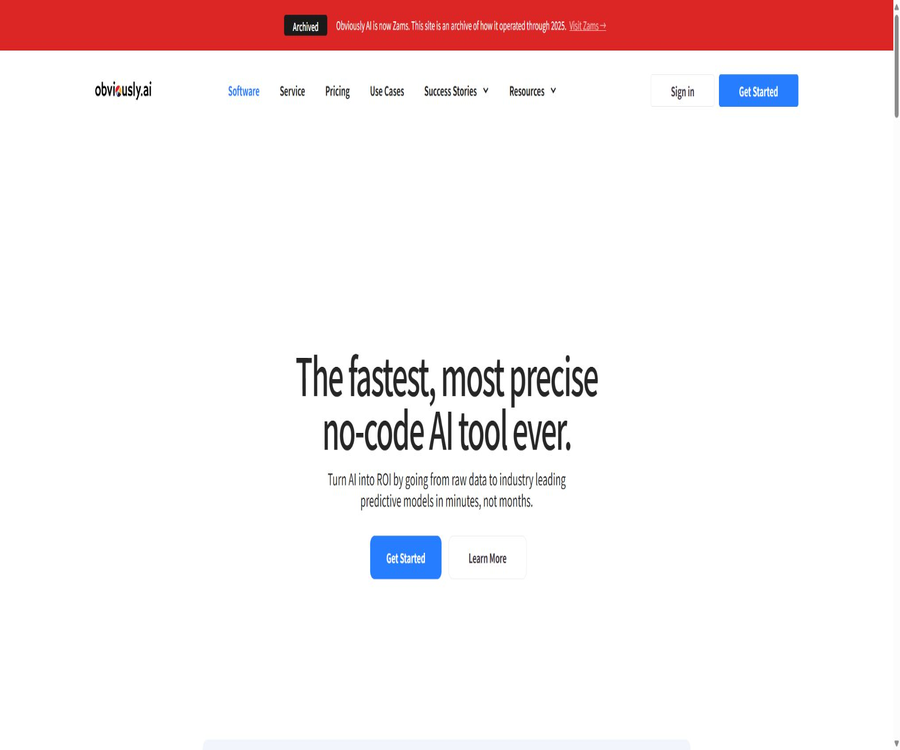
Obviously AI is a code-free machine learning platform designed for non-technical business teams; it enables the conversion of historical table data into classification, regression, time series, and clustering models, and allows predictions to be deployed on web pages, in automated systems, or within business applications.
Tool Introduction
Obviously AI is operated by Obviously AI, Inc. based in San Francisco, USA; it initially focused on code-free predictive analytics. Its current offerings now include capabilities such as Agentic AI, AI Agents, RPA automation, regular reporting, and custom large models.
The platform offers pure software solutions, as well as packages that include software along with dedicated AI strategists and data scientists. Business professionals can create models on their own, while complex tasks such as data cleaning, merging, auditing, and model development can be handled with the assistance of experts.
Overview of Core Competencies
| Ability | Typical input | Main output | Suitable questions |
|---|---|---|---|
| Classification | Historical table with categorized results | Categories and probabilities | Churn, conversion, fraud, and repayment |
| Regression | Continuous numerical target data | Numerical prediction | Sales volume, price, cost, and profit |
| Time series | Data containing time and historical indicators | Future numerical trends | Demand, revenue, and inventory forecasting |
| Clustering | Feature data without a target column | Similar groups | Customer and behavior segmentation |
| AI Agent | Business documents, instructions, and tools | Executable proxy process | Q&A, analysis, and business automation |
| RPA automation | Model results and trigger conditions | Subsequent business actions | Notifications, updates, and task assignment |
| REST API | Single or batch records | Online prediction results | Integration with internal systems |
Main functions
Code-free model building
Users upload data and select the columns that are to be predicted; the platform then handles the combination of algorithms and the selection of parameters. This reduces the barriers to modeling, but it does not replace business definition, data governance, and result verification.
Classification prediction
Classification models are used to predict discrete outcomes, such as whether a customer will churn, whether a lead will convert, or whether there is a risk associated with a transaction. The probabilities generated by these models are suitable for sorting and stratification; they should not be regarded as definitive facts.
Regression prediction
Regression models predict continuous values, which can be used for sales volume, dynamic prices, transaction sizes, costs, and profits. The definition of the target value, outliers, and future unknown variables can significantly affect the error.
Time series forecasting
The time series functionality predicts future values based on historical data arranged in chronological order. Training and validation must follow this temporal sequence; future data must not be introduced into the past samples.
Clustering and grouping
Cluster models identify similar records in the absence of explicit labels, and can be used for customer segmentation and the analysis of behavior. The names of these groups and their business significance require manual interpretation; statistical similarities cannot be equated with actual identity categories.
One-click deployment and web applications
Once the model is ready, it can be made available through a shareable web application that allows users to enter data and receive predictions. When sensitive business data is involved, the link should not be made public; access controls and permissions must be established first.
Model dashboard and monitoring
The paid plans include a model Dashboard, as well as tools for fine-tuning and monitoring, which allow users to view performance and keep track of any changes in production. Monitoring metrics, alert frequencies, and rules for automatic retraining should be verified before making a purchase.
RPA and conditional automation
The platform can initiate subsequent actions based on the predicted probability, and it can be integrated with Zapier-style workflows. Actions with a high impact should require manual approval, have amount limits, and include a mechanism for reversal.
AI Agents and Custom Large Models
The current pricing page lists AI Agents and Custom LLMs as part of the free software features, and it also highlights Agentic AI in the paid plans. The public page does not provide a complete explanation regarding the model providers, knowledge materials, tool permissions, and the usage limits for each plan.
Regular reports
The SMB and Enterprise versions allow for the creation of Recurring Reports, which generate predictions and business metrics on a scheduled basis. These reports must indicate the data range, the version of the model used, as well as any errors, so that results from older models are not mistaken for up-to-date information.
Dedicated data science support
The software combined with expert solutions involves pairing AI strategists with data scientists who have postgraduate qualifications, through instant messaging or video collaboration. The scope of services, response times, available working hours, and deliverables must be specified in a contract.
Complete modeling workflow
- Define a measurable business problem and determine how the predictive results will be used.
- Organize the historical data to ensure that each row represents the same business entity or time unit.
- Remove leakage targets, identifiers that have no business significance, and sensitive fields that should not be processed.
- Upload a CSV file or connect to an enterprise data source, then select a classification, regression, time series, or clustering task.
- Train the model and examine the sample size, feature impact, error, and validation results.
- Manual review and business backtesting are carried out using real samples that have never been involved in training.
- Choose Web Application, Batch Prediction, REST API, Reports, or Automated Deployment.
- Continuously monitor for data drift, business performance, and unfair outcomes; retrain or disable the model when necessary.
Getting started guide
Build a classification model
- Prepare a CSV file containing historical results, such as whether each customer ended up churning or not.
- Check that the target columns contain only well-defined categories, and standardize null values, spelling, and time ranges.
- Upload the file and select the target columns, excluding fields that are created only after the results are generated.
- After training, check the accuracy, recall, confusion matrix, and class imbalance.
- High, medium, and low risk levels are determined using business-approved thresholds, rather than by fixed probability values of 50%.
- First, provide predictions to a small team, then compare the actual results and make adjustments.
Build a time series model
- Select a fixed daily, weekly, or monthly granularity and fill in the missing time points.
- Prepare a sufficiently long historical period to mark holidays, promotions, and structural changes.
- Avoid randomly shuffling the data; keep the data from the most recent period for backtesting.
- Compare model predictions with simple seasonal means or moving average baselines.
- Set a reasonable range for the output, and do not present the single-point prediction as a guarantee.
- Continuously check for errors using the new data, and retrain after environmental changes occur.
Deploy predictions via API
- Complete model validation and confirm that the current solution includes a REST API.
- Create separate credentials, which are stored only in the server-side key system.
- Construct the request based on the training fields, ensuring that the name, type, and unit remain consistent.
- Record the model version, input summary, prediction, latency, and error code.
- Add timeout, retry, rate limiting, and fallback procedures in case of unavailability.
- Start with a grayscale approach, verify the business benefits and error costs before increasing the traffic volume.
Which users are it suitable for
- Business analyst: It is possible to validate predictive models without having to write machine learning code.
- Sales team: Predict lead conversion, transaction volume, and the risk of customer churn.
- Marketing team: Identify highly responsive groups and organize tailored activities for them.
- Operations team: Predicts demand, inventory, production volume, and service demands.
- Finance and risk control team: Auxiliary scoring systems are established, but decisions regarding high-risk situations still require strict oversight.
- Startups: Use the free version or the Startup plan to test a single AI use case.
- Enterprise data team: Deployed via private cloud, SSO, auditing, and custom data sources.
Typical use cases
| Scene | Suggested model | Main output | Manual inspection |
|---|---|---|---|
| Customer churn | Classification | Churn probability | Intervention costs and collateral damage |
| Sales forecast | Regression or time series | Amount or future trends | Promotions and seasonal changes |
| Clue sorting | Classification | Conversion probability | Fairness and data leakage |
| Dynamic pricing | Regression | Suggested price | Regulations, profits, and customer impact |
| Fraud screening | Classification | Risk probability | False alarms and manual review |
| Customer segmentation | Clustering | Similar groups | Group explanations and sensitive attributes |
| Automatic follow-up | Model plus RPA | Trigger a notification or task | Revoke and approve |
Prices and packages
The following are the plans currently available on the official website as of August 22, 2026. The free version specifies a clear data limit; for the Startup, SMB, and Enterprise versions, only the capacity and benefits are indicated, with no pricing in dollars shown. To obtain the current quote, it is necessary to register or contact sales.
| Package | Price | Billing cycle | Core limit | Suitable for users |
|---|---|---|---|---|
| Free | $ | Free to use | 1 seat, 1,200 predictions, 10MB file, up to 10,000 lines | Individuals, enthusiasts, and non-profit organizations |
| Startup | Contact sales | Not disclosed | Up to 1 use case, 100MB file, up to 1 million lines | Start-up teams that verify single business use cases |
| SMB | Contact sales | Not disclosed | Up to 3 use cases, 1 GB of file size, up to 100 million lines | Extended models and automated small and medium-sized enterprises |
| Enterprise | Custom quote | In accordance with the contract | Up to 5 use cases, 10GB files, up to 250 million rows | Organizations that require governance, private clouds, and customization |
The official website also allows users to choose between Software Only and Software + Data Scientist, but the publicly available price page does not indicate the difference in cost between these two options. The monthly prices listed in the old blog are historical data and cannot be used as current purchase prices.
Comparison of package features
| Functions | Free | Startup | SMB | Enterprise |
|---|---|---|---|---|
| Code-free software | Support | Full access | Full access | Full access |
| Prediction model | Classification, regression, time series, clustering | Confirm per the plan | Predictions and Agentic AI | Predictions and Agentic AI |
| AI Agents and Custom LLMs | Listed on the price page | Confirm per the plan | Support | Support |
| REST API | Listed on the price page | Confirm per the plan | Support | Support |
| RPA automation | Listed on the price page | Confirm per the plan | Support | Support |
| Model fine-tuning and monitoring | Not listed | Confirm per the plan | Support | Support |
| Expert support | Email support | Dedicated strategists and data scientists | Dedicated strategists and data scientists | Dedicated strategists and data scientists |
| Advanced governance | Not listed | Optional or to be confirmed per contract | Optional or to be confirmed per contract | Key support |
Limits of the free version
- The free version provides only 1 user account, so it cannot be considered a solution for team collaboration.
- One prediction is counted for each time the model’s result is returned, per row or per record.
- The free quota allows for 1,200 predictions; uploading multiple rows at once will quickly deplete this quota.
- The price page displays both information on 1 million rows of training data and information on up to 10,000 rows of data, which results in ambiguity.
- The free version only supports CSV data sources and does not include custom data connections.
- The maximum size for a single file is 10MB; wide tables or text fields may reach this limit earlier.
- Advanced governance, SSO, auditing, data residency, and private cloud are not part of the free public offerings.
Platform support and integration
| Platform or method | Support status | Primary uses | Notes |
|---|---|---|---|
| Web page version | Support | Upload, modeling, prediction, and management | Main operation entry point |
| CSV | Free version support available | Training and batch prediction | The only explicit data source in the free version |
| Custom data source | Paid advanced features | Connect to enterprise systems | It is necessary to confirm the specific connector. |
| REST API | Support | Real-time forecasting and product embedding | The prediction is calculated on a record-by-record basis. |
| Zapier and automation | The official website indicates support. | Trigger actions based on probability | Third-party fees are charged separately. |
| Power BI and Looker | The official website lists it as the output direction. | Display predicted data | The connection method needs to be verified. |
| Slack and Microsoft Teams | Used for expert collaboration | Contact strategists and data scientists | It is not a model deployment platform. |
| Private cloud | Advanced or enterprise capabilities | Meets the requirements for isolation and governance. | Implement in accordance with the contract |
Product advantages
- It covers common table modeling tasks such as classification, regression, time series, and clustering.
- There is no need to write training code; the business team can quickly determine whether the data has predictive value.
- The model can be integrated into business processes through web applications, batch results, REST APIs, and automation.
- Paid services can include AI strategists and data scientists to assist with data cleaning and validation.
- It offers a comprehensive range of deployment options, from free personal usage to private clouds and data hosting.
- The official website provides information on security aspects related to SOC 2 Type II, GDPR, HIPAA, and CCPA.
- It offers model monitoring, logging, and auditing capabilities, making it suitable for production governance.
Usage restrictions and precautions
- The absence of coding does not mean that no data science expertise is required; goal definition and validation remain at the core of a project.
- Biases, leaks, and outdated relationships in the training data are amplified by the model.
- A high accuracy rate does not guarantee compliance with regard to all groups, fairness, or business costs.
- The amount for paid plans is not disclosed; the budget must be confirmed through a sales quote and a contract.
- There is a discrepancy in the way the number of training rows and the number of rows processed are described on the free pricing page.
- The specific usage limits for AI Agents, custom LLMs, and RPA have not been made public.
- Dynamic pricing, credit, recruitment, healthcare, and fraud scenarios require additional regulations and manual review.
- Third-party data sources and automation introduce new permissions, costs, and points of failure.
- Once the model is in operation, it is necessary to monitor for data drift; one cannot rely on the results of the initial training over an extended period of time.
Privacy and data security
The privacy policy was updated in February 2025; it states that the platform collects data related to accounts, contact information, authentication details, payment information, device information, usage patterns, and cookies. Personal information is generally not retained for more than 90 days after an account is closed, for the purposes outlined in the policy, but legal requirements, backup needs, and disputes may result in its continued retention.
The security page indicates that customer data is stored on Google Cloud, transmission takes place via TLS, and static data is encrypted using AES-256. The page also lists certifications such as SOC 2 Type II, GDPR, CCPA, as well as the possibility of signing a HIPAA BAA; regulated customers should still request the latest reports and contract attachments.
- Before training, remove names, email addresses, ID numbers, and other unnecessary sensitive information.
- Use separate, minimal-privilege credentials for APIs, data sources, and automation.
- When making purchases, enterprises need to determine the location where the data will be stored, as well as the entities responsible for backup and secondary processing.
- Before using medical data, verify the BAA eligibility and the actual scope of services.
- The high-risk model saves the data version, features, thresholds, approvers, and output logs.
- Verify whether the model and uploaded data are used for platform training or product improvement.
- Access should be revoked promptly and deletion requested after leaving the job, when a project is completed, or when an account is closed.
Model governance and responsible use
- Record the purpose, prohibited uses, responsible person, and update cycle for each model.
- Separate the training set, validation set, and final test set properly by time or business entity.
- At the same time, evaluate accuracy, recall, false positive cost, and group differences.
- For high-impact decisions, predictions are used only as auxiliary signals, and the execution is not fully automated.
- Establish mechanisms for manual complaints, error correction, and rollback.
- Regularly compare the production input with the training data, and monitor any decline in performance.
- Re-validate after changes in the external environment; do not continue to use the old thresholds blindly.
API, SDK, and open-source status
Obviously, AI provides REST APIs that allow individual records or batches of records to be sent to the deployed models, with the results displayed in external applications. The official website does not currently disclose the complete endpoints, rate limits, error codes, or official multi-language SDK documentation.
As of the time of verification, no official GitHub organization belonging to Obviously AI, Inc., no source code repository for its core platforms, and no open-source licenses were found. The fact that REST APIs are accessible and models can be deployed does not mean that the product is open source.
Basic information
| field | Content |
|---|---|
| Tool name | Obviously AI |
| Original directory name | Data Science without Code |
| Development company | Obviously AI, Inc. |
| Location of the company | San Francisco, United States |
| Tool type | Code-free machine learning, predictive analytics, and AI automation platforms |
| Core model | Classification, regression, time series, and clustering |
| Price pattern | Free version plus sales quote |
| Registration requirements | An account is required; the registration page asks for a work email address. |
| Main platforms | Web and REST APIs |
| API | Provides REST API |
| Official SDK | No public SDK was found. |
| Official GitHub | No verifiable organizations were found. |
| Is it open source? | No |
| Enterprise security | SSO, auditing, data residency, and private clouds, etc. |
Recommendation score
The recommendation score is 4.2 out of 5 points. Obviously AI brings together common prediction models, deployment tools, automation features, and expert support in one platform, making it suitable for businesses that do not have a full-fledged data science team.
The main shortcomings are the lack of transparency in current pricing, the absence of details regarding certain new capabilities and quotas associated with Agentic AI, as well as inconsistencies in the criteria related to the number of items available in the free version. Before deploying highly impactful models, professional validation and ongoing management are necessary.
Frequently Asked Questions
Is AI obviously free?
There is a free version that includes 1 user license, 1,200 predictions, unlimited models, 10MB of storage space, and the ability to process up to 10,000 rows of data. The page also mentions 1 million rows of data available for training; the exact details can be checked in the account settings.
Is programming knowledge required?
Creating a basic model does not require programming; users can upload data and select targets through a web interface. However, API integration, data governance, and complex deployment processes still need the involvement of technical experts.
Which prediction tasks are supported?
It explicitly supports classification, regression, time series analysis, and clustering, and can handle tasks such as customer churn prediction, conversion rate analysis, price determination, sales volume assessment, demand forecasting, and customer segmentation.
How is a prediction counted?
Each time a row or record is sent to the model and a result is returned, it is counted as one prediction. Uploading 100 rows in bulk and obtaining results for all of them counts as 100 predictions.
Is an API provided?
REST APIs are provided to enable the integration of predictions into applications, internal tools, or websites. The specific rates, authentication requirements, and payment limits must be confirmed in the account settings or contract.
Is Chinese supported?
The official website does not provide a complete Chinese interface nor detailed explanations regarding the Chinese text processing capabilities. Tables that consist of numbers and categories can be tested, but for Chinese text fields, it is necessary to first verify the encoding and its performance.
Will the data be used for training?
The Privacy and Security page does not provide clear, unified instructions regarding the use of customer data for training purposes. Companies should establish rules for training, retention, and deletion through a DPA or contract.
Is AI obviously open source?
It is not open source; no official repository for the core source code or license has been found. The provision of APIs and Web application deployment does not equate to making the model or platform code available.
Is it suitable for high-risk decisions?
It can be used as an auxiliary tool for analysis, but in areas such as credit, recruitment, healthcare, insurance, and fraud, it is not sufficient to rely solely on automated predictions; compliance checks, explainability, and human review are necessary.
Summary
Obviously, AI is suitable for teams that wish to quickly create prediction models using historical data in tabular form, and to integrate these models into their business operations through APIs, automation, or dashboards. The free version can be used for small-scale testing, while the paid versions offer expanded capabilities in terms of use cases, capacity, expert support, and governance.
Before going live, it is necessary to confirm the pricing, data limits, new Agent functions, API quotas, and data processing terms; furthermore, an independent test set must be used to prove the reliability and fairness of the model in real-world operations.
Tools similar to Data Science without Code



 Guigong Network Security Registration No. 45132202000164