






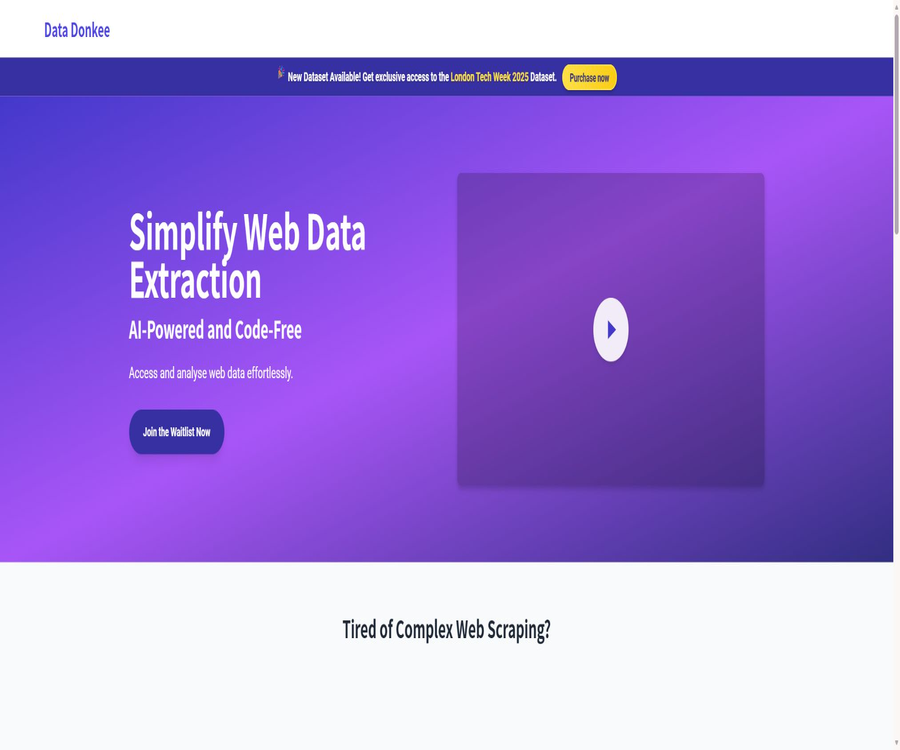
Data Donkee
Data Donkee, an intelligent tool focused on AI programming.
Tags:AI programming toolsA one-sentence summary
Data Donkee is an AI Web Agent designed for code-free web data extraction; users define their requirements in natural language or using JSON Schema, and the system then generates the necessary extraction scripts to produce structured data.
Tool Introduction
Data Donkee aims to address issues such as the slow development of traditional crawlers, high maintenance costs when websites change, and the difficulty in handling complex dynamic pages. It emphasizes separating the definition of data fields from the actual data extraction process, allowing business users to first describe what is needed.
As of August 22, 2026, the official website still offers registration on a waiting list as the main way to access the service; there is no option for self-registration, no product control panel, no standard package options, and no official API documentation. Therefore, it should be classified as a product in early access stage, rather than a mature SaaS solution that is already fully available for commercial use.
Overview of Core Competencies
| Ability | User input | System processing | Output |
|---|---|---|---|
| Natural language requirements | Target website and data details | Understanding the crawling task | Extraction plan |
| Schema constraints | Fields, types, and required rules | Organize results by structure | Consistent data objects |
| AI Web Agent | Page and task objectives | Navigate and locate content | Target field |
| Code generation | Natural Language and Schema | Create reusable scraping programs | Reduce the cost of redundant reasoning. |
| Dynamic site processing | Complex page structure | Autonomous navigation and extraction | Structured records |
| Download results | Task completed. | Cleaning and organizing | Analyzable data files |
Main functions
Describe data requirements in natural language
Users can directly specify the target website, filtering criteria, page range, and the fields required, without having to write selector or crawler code first. The requirements need to be specific; otherwise, the system may retrieve incorrect pages or misinterpret the meaning of the fields.
JSON Schema defines the structure
The example on the official website uses JSON Schema to describe the total number of results, countries, domain names, and arrays of products; it also specifies the data types and whether certain fields are required for titles, prices, currencies, and product identifiers. While Schema helps to standardize the format, it cannot guarantee the accuracy of the source data.
Automatically generate crawling programs
The platform states that AI will create customized scraping programs based on specific requirements, and that reusable code is used to reduce the costs associated with subsequent processing. The public page does not specify whether the generated code is delivered to the users, what operating environment it is used in, or whether it can be deployed independently.
Complex page navigation
The Web Agent is described as capable of handling complex website structures autonomously. Whether it can reliably manage tasks such as logging in, verification codes, infinite scrolling, regional restrictions, and pages designed to counter automation still needs to be tested in practice on the target site.
Structured data output
Upon completion of the task, the cleaned-up, structured results can be obtained and downloaded for analysis, market research, or system import. The official website does not specify the supported file formats, the maximum number of records per export, nor the retention period for the exported data.
Large-scale extraction
The product is designed for cross-site and large-scale data processing, and it aims to reduce the costs associated with repeated AI tasks by generating reusable code. The throughput, concurrency levels, proxy network capabilities, retry mechanisms for failures, and service levels have not yet been disclosed.
Sale of ready-made datasets
The official website also provides a link to an independent digital product store, where datasets related to participants in London Tech Week 2025 are currently available for purchase. These are one-time-use data products; they are not the same as Web Agent subscriptions, which are still in the pending stage.
Standard usage process
- Verify that there are legitimate grounds for acquiring, storing, and using the target data.
- Define the page scope, update frequency, filtering criteria, and the ultimate business purpose.
- Describe the task in natural language and clarify the meaning of each field.
- Create a JSON Schema to define types, required fields, arrays, and whether null values are allowed.
- First, run tests on a small number of pages and manually verify the results by comparing them with the original pages.
- Add records for deduplication, outliers, timestamps, and referral pages.
- Expand to full tasks, and monitor failures, site changes, and data quality.
- Set retention and deletion deadlines based on usage, so that captured data is not stored indefinitely.
Task Design Tutorial
Designing product data scraping
- List the product ID, title, brand, price, currency, inventory level, and capture time.
- The specified price should return only a number, with the currency placed in a separate field.
- Distinguish between the price displayed on the list page, the price on the details page, the discounted price, and the member price.
- Use a small number of products to test variants, out-of-stock situations, pagination, and duplicate records.
- Retain the referral page and the timestamp of the crawl to facilitate tracking in case of price changes.
- Manual review is implemented for abnormally low prices, empty titles, and incorrect currency formats.
Create reliable schemas
- First, draw the final table, then convert each column into a field.
- Select the correct type for dates, numbers, boolean values, text, and arrays.
- Only those fields that are essential for the business are set as required.
- In the field description, indicate the unit, examples, allowed values, and exclusion rules.
- Define a strategy for handling missing data by using null values, so that the model does not invent values on its own.
- Save the Schema version to prevent sudden failures in downstream parsing after task updates.
Verify the crawling results
- Samples are randomly selected from different page types and compared item by item with the web pages.
- Check whether pagination, lists, details, pop-ups, and lazy loading are missing.
- Calculate the proportions of null values, duplicates, type errors, and unreasonable values.
- Re-test after the website has been updated, the login status has changed, or the region has changed.
- The reasons for failure are categorized as access, navigation, parsing, and Schema issues.
- It is only used in reports or for automated decisions once the preset accuracy level is achieved.
Which users are it suitable for
- Market researchers: Collect information on available products, companies, and events.
- E-commerce team: Manage changes in prices, inventory levels, and product catalogs.
- Data analyst: Quickly establish structured data input.
- Startup team: Verifying data requirements in the absence of full-time crawler engineers.
- Consulting and Competitive Intelligence Team: Aggregates public information using a unified schema.
- Machine learning team: Creates curated datasets for research projects.
- Development team: Assess the maintenance costs associated with using AI-generated, reusable scraping logic.
Typical use cases
| Scene | Main fields | Update frequency | Key risks |
|---|---|---|---|
| E-commerce price monitoring | Products, prices, currency, inventory | Daily or more | Terms of access and misinterpretation of prices |
| Organization of event materials | Company, Position, Topic, Date | Before and after the event | Profile and marketing consent |
| Property research | Location, area, price, status | Daily | Repeated property listings and regional regulations |
| Recruitment trends | Position, skills, location, posting date | Weekly | Expired positions and personal information |
| Table of Contents | Title, author, date, category | Regularly | Copyright and full-text reuse |
| Supplier Directory | Name, category, region, contact method | Monthly | Accuracy and basis for commercial use |
Price and status
Data Donkee’s Web Agent does not yet have a publicly announced standard price; users can only add themselves to a waiting list to gain early access to it. The statements on the official website regarding scalability and low costs are part of the product’s positioning, and they cannot replace actual pricing based on pages, records, tasks, or the amount of computation required.
| Products | Current price | Open method | Explanation |
|---|---|---|---|
| AI Web Agent | Not disclosed | Add to the waiting list | There are no standard packages, trial quotas, or payment instructions. |
| London Tech Week 2025 attendees dataset | 5000 dollars | One-time purchase at independent stores | Separate from Web Agent subscription |
| Custom or enterprise extraction | Not disclosed | It may be necessary to contact the team. | The official website does not have a formal pricing page. |
Public dataset stores use third-party digital product platforms for transactions. Before making a purchase, it is necessary to verify the content of the files, the number of records, the date of update, the source of the data, the scope of the license, the conditions for refunds, and compliance with privacy regulations; one should not rely solely on the product name to assess its value.
Check before purchasing and trying out
| Check items | Degree of transparency on the official website | Issues that need to be confirmed |
|---|---|---|
| Availability | Waiting phase | When to activate it, and whether an invitation is required |
| Billing | Not disclosed | By page, record, task, or runtime |
| Limit | Not disclosed | Concurrency, number of pages, file size, and excess fee |
| Format | Only structured downloads are supported. | JSON, CSV, or other formats |
| Access capability | General description | Logging in, dynamic pages, verification codes, and regional restrictions |
| Data retention | Not disclosed | Expiration dates for input data, results, logs, and backups |
| Service assurance | Not disclosed | Availability, support, recovery, and refund in case of failure |
| Code ownership | Not disclosed | Can the crawler generation tool be downloaded or self-hosted? |
Product advantages
- Describe tasks in natural language to lower the barrier for non-technical users to get started with scraping.
- It supports JSON Schema, which allows for the predefined validation of fields and data types.
- It is emphasized that the creation of reusable scraping programs can help reduce the costs associated with invoking AI on each occasion.
- The goal is to cover complex, dynamic websites as well as large-scale data extraction.
- The process is simple: there are only three main stages, from describing the requirements to downloading the results.
- The founder publicly stated that he has many years of experience in enterprise data projects.
Usage restrictions and precautions
- The product is still in the pending release phase, and its features, interface, and business model may change.
- There are no public prices, free quotas, support documentation, API, or service levels.
- The official website states that the absence of illusions in the results does not constitute a guarantee of zero errors.
- Complex websites, verification codes, and anti-automation measures can cause tasks to fail.
- After the website structure changes, even if the code is reusable, maintenance and regression testing are still required.
- A correct structure does not guarantee accurate content; key fields still need to be checked manually.
- Scraping public pages can also violate a website’s terms of service, copyright laws, database rights, or privacy regulations.
- Before purchasing ready-made datasets, it is necessary to verify the source, licensing, validity period, and the basis for personal information.
- Do not use tools to bypass login processes, paywalls, verification codes, or access controls.
Compliance and responsible crawling
- Read the service terms, crawling rules, and documentation of the public interfaces of the target website.
- Give priority to using the official API, downloading open data, or obtaining written authorization.
- Control the frequency of requests and concurrency to prevent disruption to the website’s normal operation.
- No retrieval of private information, payment details, or sensitive personal data after logging in.
- Only save the fields that are essential for business operations, and set access permissions and expiration dates.
- Respect copyright, trademarks, database rights, and restrictions on the redistribution of content.
- Before using it for contact marketing, verify consent, cancellation options, and regional laws separately.
- Record the channel, time, schema, and processing steps to facilitate corrections and auditing.
Privacy and data security
The official website does not provide accessible links to an independent privacy policy, terms of service, or information regarding data processing. Since scraping tasks may involve the target pages, Schema data, results, and personal information, companies should not upload sensitive data in the absence of written documentation.
- Ask where the task inputs, capture results, generated code, and log files are stored.
- Confirm the access levels for platform employees, model suppliers, and infrastructure providers.
- Verify whether the data is used for model training, product improvement, or other customer tasks.
- Request encryption, permissions, backup, incident notification, and deletion procedures.
- Use public and low-sensitivity datasets during the trial phase.
- After exporting, delete the cloud copy promptly and protect the local file.
- When personal data is involved, an assessment of the legal basis, purpose limitations, and the rights of the data subjects must be carried out.
API, GitHub, and open-source status
As of the time of verification, the Data Donkee official website does not provide any API references, SDKs, command-line tools, or options for obtaining developer keys. JSON Schema is the standard for task input, but it does not mean that the platform offers programmed interfaces.
No official GitHub organization, source code repository, or open-source license that can be attributed to Data Donkee was found. The website mentions that AI can generate reusable code, but this does not mean that users can download such code or that the platform itself is open source.
Basic information
| field | Content |
|---|---|
| Tool name | Data Donkee |
| Tool type | AI web data extraction and code-free crawlers |
| Product stage | Waiting list and early access |
| Core input | Natural language requirements and JSON Schema |
| Core output | Cleaned structured data |
| Main platforms | Web |
| Web Agent price | Not disclosed |
| Public data products | London Tech Week 2025 attendees dataset |
| Dataset price | 5000 dollars |
| Public API | No findings were detected. |
| Official SDK | No findings were detected. |
| Official GitHub | No findings were detected. |
| Is it open source? | No |
Recommendation score
The recommendation score is 3.4 out of 5. The task design, which involves natural language processing along with JSON Schema, is clear; the reusable code concepts also help to reduce the costs associated with extracting data from web pages repeatedly.
Since the product is still in the waiting stage, there is no public information available regarding its price, privacy policies, terms of service, technical limitations, or stability. It is more suitable for use in testing purposes with non-sensitive tasks while it is still in this waiting phase; it is not appropriate for use in critical production projects.
Frequently Asked Questions
Has Data Donkee been officially launched?
It has not been fully opened yet; the main button on the official website is still to add oneself to the waiting list. No public self-service console that can be accessed directly has been found.
Is programming required?
The product is designed for use without the need for programming; users can express their requirements in natural language or using schemas. Understanding field types and data quality still helps to significantly improve the results.
What is JSON Schema?
It is a standard that describes data fields, types, hierarchies, and requirements regarding whether certain fields are mandatory. Data Donkee uses this standard to define the structure of the data captured.
Is Data Donkee free?
The official website does not disclose the free quota for Web Agent or the available paid plans. Being on the waiting list does not entail permanent free access.
Can it capture dynamic websites?
The official website states that Web Agent is designed for complex, dynamic structures, but it does not specify the capabilities and limitations of the browser. It is advisable to use a small sample from the target site for verification.
Will the results be accurate?
Not necessarily. Schema can improve format consistency, but page understanding, field mapping, content timeliness, and errors in the source site still affect the results.
Are APIs provided?
No public API documentation or key application was found. The official website provides JSON Schema; it should not be mistaken for an API that is already available in REST format.
Is Data Donkee open source?
It is not open source; no official source code repository or license has been found. Nor are there any public instructions regarding the technical approach used to create the crawling program.
Summary
Data Donkee simplifies web scraping by allowing users to describe their requirements, define a schema, and generate the extracted and downloadable results; it is suitable for businesses and data teams that wish to reduce the amount of work involved in writing custom scrapers.
The most important assessment at present is that it is still in the trial phase. Before it is put into official use, it is necessary to verify each aspect such as the price, the quota, website compatibility, code ownership, as well as compliance with privacy regulations and data policies.
Tools similar to Data Donkee



 Guigong Network Security Registration No. 45132202000164