






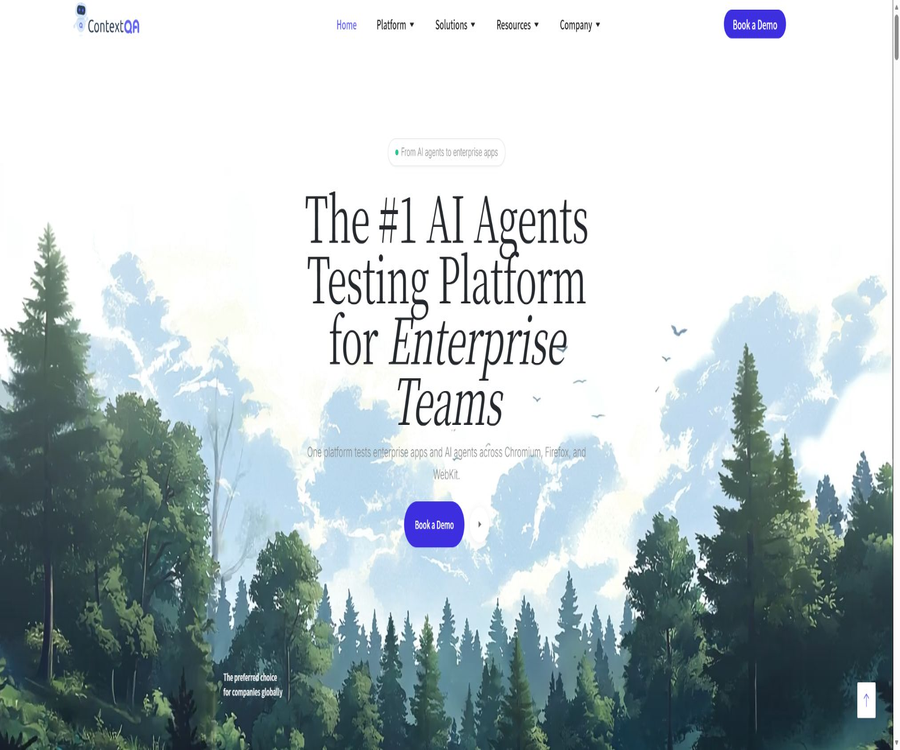
ContextQA
ContextQA, an intelligent tool focused on AI programming.
Tags:AI programming toolsA one-sentence summary
ContextQA is an AI-driven platform for automated software testing; it enables the creation of tests from natural language descriptions, requirement documents, design drafts, and interface specifications. Tests can be executed across web applications, mobile devices, APIs, enterprise systems, and AI agents, and the platform offers self-healing capabilities, root cause analysis, as well as comprehensive evidence of test execution.
Tool Introduction
ContextQA is designed for test engineers, developers, product teams, and enterprise quality management professionals; its goal is to bring together testing tasks such as test case creation, execution, defect fixing, analysis, and reporting in a single platform. Users can operate it through a web console, or they can use MCP, continuous integration tools, and development interfaces to initiate workflows.
For the automation of underlying web pages, Playwright is used; these operations are carried out in Chromium, Firefox, and WebKit browsers. It also covers testing on iOS and Android, as well as REST and GraphQL interfaces, databases, Salesforce, SAP, and black-box AI agents.
Main functions
AI-generated test cases
ContextQA can generate tests from natural language, Jira or Azure DevOps tasks, Figma designs, Excel or CSV files, OpenAPI specifications, videos, requirement documents, code differences, n8n workflows, and edge cases. The system adds normal paths, failure paths, and boundary conditions, but the generated test cases still need to be reviewed by testers.
Natural language execution
The testing steps can be described in plain language, outlining actions such as clicking, typing, selecting, and verifying; the platform then converts these intentions into operations that are carried out by the browser or device. People without technical expertise can create basic testing procedures, but complex assertions, test data, and environment control still require testing experience.
Self-healing test
When the page structure or the positioning of elements changes, the self-healing mechanism uses both DOM data and visual information to find new elements with similar semantics. Fixes with a high degree of confidence can be applied automatically, while those with a lower degree of confidence should be reviewed manually, in order to prevent genuine defects from being mistaken for changes in element positioning.
Web page and cross-browser testing
The same test can be run on Chromium, Firefox, and WebKit engines, with test plans established based on environment, browser, and parallelism. The platform is responsible for browser control, screenshotting, video recording, and tracking files; the team does not need to manage driver configurations separately.
Mobile testing
Mobile testing covers iOS and Android; it can handle application uploads, device configuration, gesture operations, as well as multi-device testing plans. The minimum requirements specified in the official documentation are iOS 14 or later and Android API 21 or later, while the actual availability of devices must be confirmed as part of the planning process.
API and data validation
The platform supports REST, GraphQL, request assertions, response validation, and multi-step interface workflows; it can also handle database operations and data-driven testing. Sensitive tokens, test accounts, and environment parameters should be treated as controlled variables, rather than being included directly in the test scripts.
Enterprise application testing
ContextQA provides automation capabilities for Salesforce, SAP, as well as complex ERP or CRM processes. The Enterprise version offers more in-depth support for enterprise systems, single sign-on, governance, and enhanced security measures.
AI Agent testing
The platform allows external parties to test Agentforce, Bedrock, Azure AI, Snowflake Cortex, as well as custom-built agents in a manner similar to that of real users, without the need to access the internal code of these models. It can create scenarios involving illusions, policy violations, multi-round interactions, and various functional challenges, and then combine AI-based judgments with certainty checks to provide evaluations.
Voice Agent testing
The Enterprise plan includes tests for voice agents, which are useful for verifying dialogue flows, tool usage, policy boundaries, and any changes that occur as a result of updates. Voice quality can be affected by accent, noise, latency, and the telephone connection; therefore, it is necessary to confirm the supported languages and connection types at the time of purchase.
Root cause analysis and fault injection testing identification
Failure analysis combines screenshots, videos, page structure, network logs, console logs, and Playwright traces to determine whether the issue is caused by an application defect, a testing problem, an environmental anomaly, or some other type of failure. The results provide information on the affected steps, relevant evidence, and suggestions for fixing the issue.
Visual regression and performance testing
The Growth and higher-tier plans include visual regression and performance testing, which are used to detect changes in layout, differences in styling, and declines in performance. A visual baseline must be maintained for different browsers, viewports, fonts, and dynamic areas; otherwise, noise is likely to appear.
Test evidence package
Each execution generates step-by-step screenshots, session videos, network archives, browser console logs, Playwright tracking files, and AI inference records. These evidence packages facilitate problem reproduction, quality audits, and the submission of defects to the development team.
| Test type | Typical input | Main output | Key constraints |
|---|---|---|---|
| Web page testing | Natural language steps, page addresses, and test data | Results across browsers, screenshots, videos, and tracking | Dynamic pages require control over waiting times and data. |
| Mobile testing | Application packages, device settings, and gesture steps | Results and evidence from multi-device execution | The device and system versions depend on the solution. |
| API testing | REST or GraphQL requests and assertions | Response verification, link results, and logs | Credentials must be managed securely. |
| Enterprise applications | Salesforce, SAP, or ERP business processes | End-to-end regression and governance reports | An Enterprise plan is usually required. |
| AI Agent testing | Agent instructions, endpoints, rules, and scenarios | Behavioral scoring, hallucination, and strategy violation reports | Non-deterministic results require repetition and manual verification. |
| Vision and performance | Baseline page, viewport, and performance conditions | Difference charts and performance issues | Baseline and environmental instability can generate noise. |
Complete testing workflow
- Create a workspace and configure the application to be tested, the environment, test accounts, and team permissions.
- Initial test cases are generated from requirements, task lists, designs, interface specifications, as well as video or natural language input.
- Testers review the steps, assertions, data, priorities, and prerequisites.
- Organize the relevant use cases into test suites, and then configure browsers, devices, environments, and parallelism to create a test plan.
- Tests can be run manually, on a scheduled basis, or through continuous integration; the platform simultaneously captures screenshots, videos, and technical logs.
- Self-healing agents handle reliable element drift, while failure analysis provides the root causes of real problems along with suggestions for remediation.
- Push the results to the task management or collaboration system, and use the coverage rate, failure rate, and failure trends to improve the next round of tests.
Usage tutorial
Create the first web page test
- To apply for a demonstration or pilot and create a workspace, start by selecting a testing environment that does not contain real customer data.
- Set the addresses for development, testing, or preview environments, and create dedicated test accounts.
- Enter a clear process, such as logging in, adding items to the shopping cart, checking out, and verifying the success message.
- Review the normal, error, and edge use cases generated by AI, and supplement with business rules and assertions.
- Run it once on Chromium, and check the screenshots, videos, and error messages for each step.
- Expand this to Firefox and WebKit, and include stable use cases in the regression testing plan.
Generate tests from Jira tasks
- Connect to Jira and grant ContextQA permission to read only the specific projects or tasks it needs.
- Select tasks that include clear acceptance criteria, and require the generation of both successful and failed paths.
- Check whether the task fields, attachments, and requirement versions are consistent with the current development branch.
- Run the generated test cases after verifying the test data, environment, and prerequisites.
- Write back evidence of failures and reports for the tasks, to avoid providing only vague conclusions of success or failure.
- When requirements change, the relevant use cases are regenerated or updated, while the tracking relationships are preserved.
Test an AI Agent
- Describe the purpose of the Agent, permitted operations, prohibited content, target users, and expected tool calls.
- It connects to external entry points that can be tested, without the need to make the internal code of the Agent available to ContextQA.
- Generate normal tasks, illusionary traps, unauthorized requests, policy violations, and multi-round boundary scenarios.
- Set deterministic rules for key results, and define scoring criteria and thresholds for open-ended answers.
- When running the same scenario repeatedly, it is necessary to distinguish between random fluctuations, model drift, and stable defects.
- After the model, prompts, or tools are updated, a full regression is carried out, and high-risk failures are reviewed manually.
Run tests via MCP
- Create a separate service account for automation and obtain the credentials required by the workspace.
- Deploy the ContextQA MCP service locally, in Docker, or on Google Cloud Run, as described in the official documentation.
- Add the MCP connection to Claude, Cursor, or compatible clients, and restrict the available workspaces.
- First, use a reading tool to verify the connection, then create a small test and execute it.
- Check the returned execution number, evidence, root cause, and push results; do not rely solely on the chat summary.
- After official integration, rotate credentials, log calls, and restrict the production resources that can be modified or executed.
MCP and developer capabilities
The latest official documentation lists 67 MCP tools, covering test generation, execution, reporting, telemetry, self-healing, migration, knowledge bases, and integration. The marketing page still shows information on around 50 tools from an earlier version; the actual number of functions should be based on the current tool reference page.
Supported AI clients
MCP can be used with compatible clients such as Claude, Cursor, and VS Code Copilot; the marketing pages also showcase ChatGPT and Codex workflows. The actual feasibility of using it depends on whether the client allows the addition of custom MCP connections and on the permissions associated with that setup.
Testing migration and code export
ContextQA can analyze existing test repositories, and it supports migration or export to Playwright, Selenium, Cypress, and WebdriverIO. Exporting helps reduce reliance on proprietary formats, but teams should still review the generated code, dependencies, and continuous integration configurations.
Continuous Integration and Webhooks
The platform can be integrated with GitHub Actions, GitLab CI, Jenkins, CircleCI, and Azure DevOps, and testing can be triggered by pipeline events. Before establishing formal quality controls, it is necessary to define rules regarding timeouts, retries, transient tests, and blocking actions.
| Access method | Primary uses | Suitable for the character | Precautions |
|---|---|---|---|
| Web console | Create, manage, execute, and analyze tests | Testers and managers | Decentralization by workspace and role |
| MCP service | Call the testing tool from the AI assistant | Developers and automation engineers | Service account permissions and tool permissions need to be separated. |
| Continuous Integration | Run the plan when pushing or merging requests | R&D and Platform Team | Avoid accidental blocking of releases due to flaky tests |
| Webhooks and integration | Synchronized tasks, notifications, and execution results | Cross-functional team | Verify signatures, retry, and repeat events |
| Code export | Migrate to common automation frameworks | SDETs and developers | Once exported, the team is responsible for its maintenance. |
Which users are it suitable for
- QA Tester: Creates and maintains web, mobile, and API tests in natural language.
- SDETs and automation engineers: integration with MCP, continuous integration, code export, and comprehensive technical documentation.
- Developer: Run regressions in the editor or pipeline, and identify issues based on the root cause reports.
- Product Manager: Generate candidate tests based on requirements and acceptance criteria, and view the tracking relationship from requirements to use cases.
- QA Manager: Provides unified management of test plans, coverage rates, failure rates, failure trends, and team permissions.
- AI Product Team: Conducts continuous regression testing for chat agents, tool calls, multi-turn interactions, and security policies.
- Large enterprises: Test systems such as Salesforce and SAP, and use single sign-on as well as local or private cloud deployments.
Typical use cases
- Run regression tests for logging in, checking out, and key business processes on each merge request.
- Automatically generate a set of test cases ready for review, based on design drafts, task lists, and interface specifications.
- After the page is redesigned, any changes in positioning are automatically corrected, and a log of these corrections is kept for testers to verify.
- Combine web pages, APIs, databases, and mobile steps to create a complete end-to-end process.
- It induces hallucinations, overstepping of authority, policy violations, and regression in multi-turn conversations among customer service agents.
- Attach screenshots of failures, videos, network logs, and trace files to the defect task.
- Control test data through enterprise private clouds or on-premises deployments in a regulated environment.
Product advantages
- The generation channels cover requirements, design, interfaces, videos, code changes, and natural language, enabling the creation of tests from various types of work materials.
- A unified workspace and reporting system are used for testing web pages, mobile apps, APIs, data, enterprise applications, and AI Agents.
- Self-healing, combined with DOM and visual judgment, can reduce the effort required to maintain element positioning due to changes in the page structure.
- Each execution generates multiple types of evidence, which helps to reproduce defects, audit quality, and analyze root causes.
- MCP integrates the platform’s capabilities into the AI assistants commonly used by developers, reducing the need to switch between various interfaces.
- It can be exported to common automation frameworks, and supports deployment on local systems, private clouds, and enterprise security environments.
- The price is determined based on the amount of usage and the scope of testing; there is no additional charge for each additional member seat.
Usage restrictions and precautions
- The official website does not specify a fixed amount; the team must undergo a demonstration or requirement assessment in order to receive a specific quote.
- AI-generated tests may miss underlying business rules, and they cannot fully replace exploratory testing or review by domain experts.
- If the self-healing threshold is set improperly, it may hide the actual defects in the pages; for important fixes, it is necessary to examine the logs and screenshots.
- The responses provided by AI agents are uncertain; therefore, they should be executed repeatedly, along with the use of deterministic assertions and human evaluation.
- The options for parallel browsers, real mobile devices, enterprise systems, and local deployment depend on the final contract.
- Screenshots, videos, web archives, and tracking files may contain credentials or personal information, so it is necessary to implement data masking and define retention periods.
- MCP and pipelines have the capability to create, execute, or modify tests; service accounts and the minimum required permissions should be used.
- The performance figures on the official website and the customer case studies are supplier-specific data; the purchaser should verify them in their own applications and environments.
Prices and packages
As of August 22, 2026, ContextQA adopts a pricing model based on usage volume, test results, and the scope of testing, without charging fees per user account. The official website outlines the differences in features among the Starter, Growth, and Enterprise plans, but does not specify fixed prices.
| Package | Public price | Key capabilities | Suitable for users | Method of acquisition |
|---|---|---|---|---|
| Starter | Custom quote | Natural language or Jira-generated content, web/mobile APIs, self-healing capabilities, code export, continuous integration, as well as community and Slack support | The team responsible for validating the first application or conducting limited-scale tests | Apply for a demonstration or pilot program |
| Growth | Custom quote | Includes Starter, and adds failure root cause analysis, visual regression testing, performance testing, MCP, continuous testing, and priority support. | Teams that automate expansion across different environments and multiple pipelines | Evaluate based on the test scope. |
| Enterprise | Custom quote | Includes Growth, and adds Salesforce, SAP, AI and voice agents, single sign-on, on-premises deployment, governance, and enterprise service levels. | Regulated, multi-team, or complex enterprise systems | Contact sales to place an order |
| pilot | The scope needs to be confirmed. | Verify generation, self-healing, and execution in real-world applications or similar environments | The team that evaluates the effectiveness prior to making a purchase | Decide after the demonstration. |
What is needed to prepare a quote?
The team should be prepared to provide information on the number of applications to be used, the scope of web or mobile platforms, the range of browsers and devices, the number of executions per month, the level of parallelism, the frequency of the pipeline, the number of AI agents, the enterprise systems in use, as well as the requirements regarding data storage and support. The more specific the information is, the easier it is to determine the actual total cost.
Contract and payment considerations
The enterprise terms specify the minimum commitment, actual usage volume, job details, deliverables, and costs in the order or job description. Before making payment, it is necessary to confirm matters such as overage charges, initial deadline, cancellation conditions, support periods, data migration, and exit procedures.
Supported platforms
| Platform or technology | Support status | Explanation |
|---|---|---|
| Web browser | Support | Chromium, Firefox, and WebKit |
| iOS | Support | The document lists iOS 14 and later. |
| Android | Support | The document lists APIs 21 and above. |
| REST and GraphQL | Support | Interface assertions, request chains, and data validation |
| Salesforce and SAP | Support | Primarily aimed at Enterprise solutions. |
| AI and voice agents | Support | Black box scenarios, scoring, and regression |
| Continuous Integration Platform | Support | GitHub Actions, GitLab CI, Jenkins, CircleCI, and Azure DevOps |
| MCP client | Support | Claude, Cursor, VS Code Copilot, and other compatible clients |
| Deployment method | Cloud, on-premises, Docker, or private environment | The specific method depends on the component and the contract. |
APIs, SDKs, and open-source status
Platform interface
The official documentation states that the test plan can be initiated from the pipeline or external tools via the platform interface or MCP, and it is possible to retrieve the evidence of execution as well as the analysis results. The detailed endpoints, rates, and permissions are specified in the development documentation associated with the account.
MCP service
The MCP service is built using Python and FastMCP; Python 3.9 or higher is required, and it supports deployment on local systems, in Docker containers, and on Google Cloud Run. The fact that it can be deployed does not mean that its source code is licensed under an open-source license.
GitHub and SDK
To date, no official GitHub repository belonging to ContextQA, no complete source code for its platform, nor any SDK repository with a clear licensing agreement has been found. The code libraries with similar names such as Context or Contextual AI that were discovered belong to other companies; they cannot be considered official projects of ContextQA.
| object | Current status | Open-source assessment |
|---|---|---|
| ContextQA cloud platform | Business services | Not open source |
| ContextQA MCP service | Provide deployment and tool documentation | No open-source license was found. |
| Platform API | Account and integration usage | Having an open interface does not mean the platform is open-source. |
| Export test code | Supports common frameworks | The ownership of the exported code should be determined in accordance with the contract; the platform remains not open source. |
| Third-party warehouse with the same name | Unrelated to ContextQA | It cannot be used as an official GitHub citation. |
Privacy and data security
Safety and compliance
The official website states that the platform meets the requirements of SOC 2 Type II, ISO 27001, and GDPR, and offers options for on-premises or private cloud deployment. When making a purchase, companies should still request information regarding the current scope of audits, the validity period of the certificates, details of penetration tests, and a list of subcontractors.
Access control
Data processing protocols require role-based access control, the principle of least privilege, regular review of access rights, multi-factor authentication or single sign-on, as well as training for employees on confidentiality and security practices. Workspaces can be used to isolate data related to different products, teams, or clients.
Customer data and model improvement
The current terms state that ownership of customer data and confidential client information does not transfer to ContextQA, and it is specified that such confidential data, test results, workflows, and application interfaces must not be used for the improvement of internal platforms, for analysis, as benchmarks, or for performance optimization. The platform may retain aggregated statistics that do not contain customer data or identifiable information.
Testing evidence protection
Screenshots, videos, web archives, console logs, and trace files may contain information such as form contents, tokens, and response data. Teams should implement specific configurations for test accounts, data masking, access to evidence, and automatic deletion policies.
- Use dedicated test accounts and synthetic data to avoid handling real customer information in automated environments.
- Save passwords, tokens, and keys in controlled variables or key management services.
- Restrict the permissions of service accounts used for MCP, continuous integration, and Webhooks.
- Set retention periods and download permissions for screenshots, videos, and online evidence.
- Before deploying in a local or private cloud, verify whether model inference, logging, and support access still leave the customer’s environment.
- Regularly review members, integrations, external contractors, and expired test projects.
Basic information
| Project | Content |
|---|---|
| Tool name | ContextQA |
| Development company | ContextQA, Inc. |
| Tool type | AI testing automation and AI Agent evaluation platform |
| Core scope | Websites, mobile devices, APIs, data, enterprise applications, and AI Agents |
| Price pattern | Quotations are customized based on usage volume and testing scope; no fees are charged per seat. |
| Is a pilot program available? | Yes, the specific scope needs to be confirmed with the sales team. |
| Is registration required? | Yes, full functionality requires a workspace account. |
| Chinese support | There is no guarantee of a complete Chinese interface; the performance of natural language processing in Chinese needs to be tested on a pilot basis. |
| API | Provides platform integration capabilities. |
| MCP | Provided: The current document lists 67 tools. |
| Official SDK | No independent, publicly available SDKs have been identified. |
| Is it open source? | The product is not open-source, and no public license has been identified for MCP either. |
| Deployment method | Cloud, on-premises, Docker, private cloud, and enterprise environments |
Recommendation score
The recommendation score is 4.4 points. ContextQA covers the testing of traditional software, enterprise applications, and AI Agents; it offers a comprehensive set of functions including generation, self-healing, root cause analysis, evidence provision, MCP, and pipeline capabilities, making it suitable for teams that need scalable quality management solutions.
It focuses more on enterprise sales and customized implementation; fixed prices, execution volumes, and equipment resources need to be discussed before any comparison can be made. It is recommended to carry out a pilot using real-world applications, with an emphasis on verifying the accuracy of self-healing, the failure rate, the availability of instructions in Chinese, evidence anonymization, and the overall implementation cost.
Frequently Asked Questions
Is ContextQA free?
The official website offers options for pilot programs and free trials, but there is no guarantee of a permanently free subscription plan. The duration of the pilot, the scope of application, the volume of tasks to be carried out, and whether a contract is required must be confirmed with the sales team.
How much is ContextQA?
The official website does not specify a fixed price; instead, it offers quotes that are determined based on the amount of usage, the results of testing, and the scope of the testing. The Starter, Growth, and Enterprise plans are used to differentiate between different functionalities, rather than to provide uniform prices.
Can it be used without knowing coding?
Basic tests can be created using natural language and web interfaces, and processes can also be captured via recorders. For complex assertions, test data, environment management, and failure analysis, the involvement of QA professionals or developers is still required.
Can it test AI Agents?
Yes. ContextQA handles external execution functions, adversarial scenarios, multi-turn interactions, and policy-based situations; it uses AI-based scoring and deterministic rules to evaluate responses, without the need to access the internal code of the Agent.
Could self-healing mask the true defects?
Such a risk exists. The team should set confidence thresholds, keep records of repairs made, and require that any changes with low confidence level in critical processes be approved manually.
Does ContextQA support MCP?
Supported. The current document lists 67 tools that enable the creation, execution, analysis, and migration of tests using compatible AI assistants, as well as the retrieval of evidence related to these tests.
Which browsers and mobile operating systems does it support?
Web testing is supported by Chromium, Firefox, and WebKit; for mobile devices, iOS 14 and later as well as Android API 21 and later are supported. The specific device models depend on the solution used.
Can ContextQA be deployed privately?
Options are available for on-premises, customer cloud, or private environments, particularly for Enterprise customers. When making a purchase, it is necessary to specify which components, models, logs, and support channels will be located in the customer’s environment.
Is ContextQA open source?
The product itself is not an open-source platform. MCP provides deployment documentation, but no official public source code repository with a clear license has been identified at present.
To whom do the test results belong?
The terms state that ownership of customer data and confidential client information does not transfer; the deliverables resulting from the work as specified and after payment has been made become the property of the customer. The specific export codes and customized outputs shall be determined in accordance with the order documents.
Summary
ContextQA is well-suited for creating a continuous quality process that links requirements to testing, enables cross-platform execution, supports self-healing, facilitates root cause analysis, and generates evidence reports; it can also integrate the behavior of AI Agents into regression testing. MCP and code export features allow it to serve both non-technical testers and development teams.
Before making a choice, it is necessary to verify the quality of generation, the boundaries of self-healing capabilities, execution stability, and security isolation using a real application, and to obtain an official quote that includes details on usage levels, parallelism, devices, as well as the scope of deployment and support. For small, temporary projects, a customized sales process may be more complicated than simply subscribing to a tool.
Tools similar to ContextQA



 Guigong Network Security Registration No. 45132202000164