






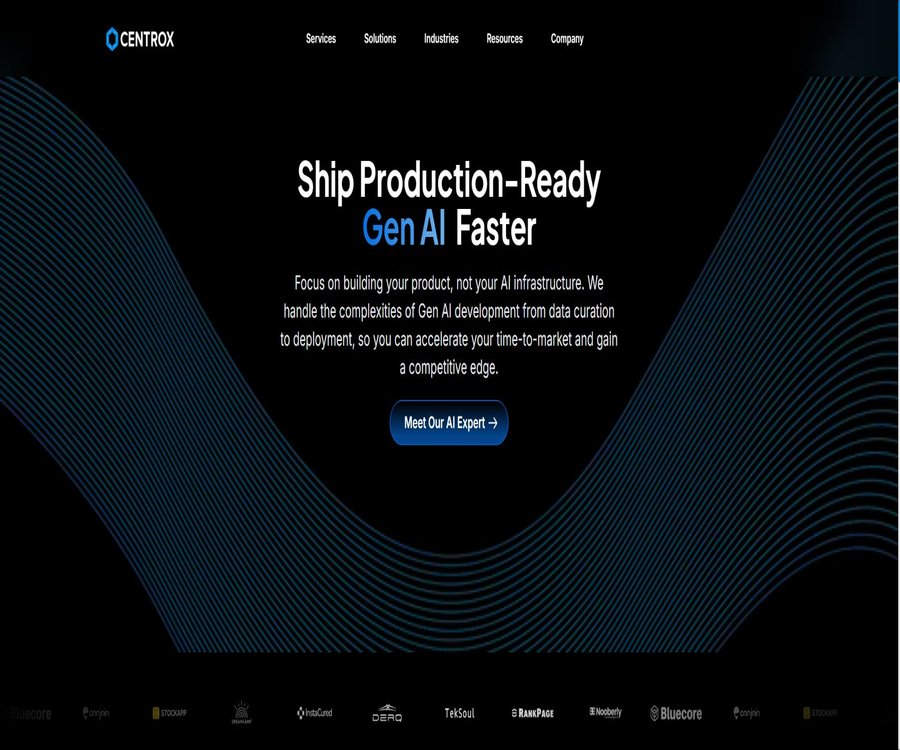
Centrox AI
Centrox AI, an intelligent tool focused on AI programming.
Tags:AI programming toolsWhat is Centrox AI?
Centrox AI is a brand under Centrox Technologies, Inc. that specializes in the development and consultation of generative AI solutions; it offers services that cover everything from data preparation to model deployment and ongoing maintenance. It is aimed at companies, startups, and technical teams that need to create custom AI products or improve their internal processes.
This is not a personal tool that allows one to create applications simply by entering some prompts; nor does it offer a centralized backend for monthly subscriptions. Customers must first submit their business requirements, after which the team will assess the scope, timeline, required personnel, budget, and infrastructure, and then work together on a project basis.
A one-sentence summary
Centrox AI can act as an external AI engineering team, assisting companies in developing custom LLMs, RAG knowledge systems, chatbots, agents, carrying out data annotation, conducting model evaluation, handling deployment and scaling, as well as managing LLMOps.
Main services
Custom LLM development
The team designs model solutions based on domain-specific terminology, business objectives, and data conditions; pre-trained models can be used, along with techniques such as fine-tuning, distillation, quantization, or more advanced custom development. The typical workflow outlined on the official website includes discovery, blueprint creation, data preparation, iterative training, deployment, and ongoing support.
Model fine-tuning and optimization
Fine-tuning services are used to adapt existing models to industry-specific language, particular tasks, and brand expressions, while optimization focuses on accuracy, inference latency, memory usage, throughput, and cost. The need for fine-tuning should be determined through comparisons using RAG, prompt engineering, and baseline experiments; it cannot be assumed that the more training that is done, the better.
Enterprise RAG development
The corporate RAG project integrates PDFs, databases, CRM systems, APIs, and internal systems into a retrieval pipeline, and then uses vector search, hybrid retrieval, and reordering to provide context. The goal is to ensure that answers are based on the company’s own data and can be traced back to specific sources, rather than relying solely on general knowledge contained in model parameters.
Custom chatbots and AI agents
Centrox enables the creation of chatbots designed for customers or employees, as well as the development of intelligent workflow agents that can call various tools, carry out tasks, and integrate with existing systems. Specific permissions, manual approval processes, recovery mechanisms in case of failures, and operation auditing must be defined during the planning stage.
Data annotation and quality assurance
Data services include AI-assisted annotation, manual review, data cleaning, verification, and consistency checks; they can be used for training, fine-tuning, and evaluating datasets. Projects should define in advance labeling standards, sampling ratios, procedures for handling disputes, user permissions, and acceptance criteria.
RLHF and human feedback training
The official website lists reinforcement learning services that rely on human feedback to improve the behavior of models through preferences, evaluations, or feedback. The use of RLHF depends on factors such as the volume of data, the risk associated with the task, and the costs involved; many corporate projects start by employing supervised fine-tuning or offline evaluation first.
Model evaluation
Evaluation services are used to establish performance metrics, test sets, and visualizations, in order to identify issues related to accuracy, hallucinations, biases, latency, and costs. Industries with high risks also need to include security, privacy, fairness, and refusal behaviors as part of the independent validation process.
Deployment, Scaling, and LLMOps
Centrox can help with cloud environments, model services, pipelines, monitoring, version control, prompt management, and continuous optimization. LLMOps focuses on monitoring output quality, prompt drift, latency, token costs, model changes, and production failures.
Comparison of service capabilities
| Service direction | Main inputs | Typical delivery | Suitable questions | Key acceptance criteria |
|---|---|---|---|---|
| Data annotation and verification | Original text, images, business specifications | Label datasets, rules, and quality inspection reports | Lack of reliable training or evaluation data | Consistency, random sampling, error rate, and traceability |
| Custom LLMs and fine-tuning | Domain data, tasks, and baseline models | Models, adapters, training processes, and evaluation | General models do not understand specialized tasks. | Quality, latency, cost, security, and maintainability |
| Corporate RAG | Documents, databases, CRM, and APIs | Systems for ingestion, indexing, retrieval, answering, and citation | Knowledge is often updated or requires a source for reference. | Recall, accuracy, permissions, timeliness, and correctness of references |
| Chatbots and agents | Dialogue processes, tools, and business policies | Interactive applications, tool calls, and approval processes | Customer service, employee assistants, and process automation | Task completion rate, overstepping of authority, failure recovery, and manual takeover |
| Evaluation and LLMOps | Models, prompts, logs, and SLOs | Testing frameworks, monitoring, versioning, and cost management | The product is available on the market, but it lacks controllable operations. | Regression, observability, alerts, drift, and costs |
Project collaboration process
- Submit the business objectives, existing systems, data types, user base size, risks, and desired timeline for deployment.
- Conduct requirement analysis with consultants to identify the areas that truly require AI, as well as the available data and non-AI alternatives.
- Sign a confidentiality agreement and define the classification, access, transmission, retention of data, as well as the boundaries related to intellectual property rights.
- The project team develops the technical solution, milestones, staffing plan, budget, dependencies, and acceptance criteria.
- First, develop a small-scale prototype or a proof of concept, and compare it with the baseline approach using real, representative data.
- Based on the evaluation results, the data, search functions, prompts, models, tools, and user experience are improved.
- Complete security testing, performance testing, business acceptance, and preparation for deployment, before installing it in the designated environment.
- After going live, monitor quality, latency, costs, drift, and security incidents, and continuously optimize following the change management process.
How to prepare for the first consultation
- Use a one-page description to outline the user, the pain points, the current process, the desired outcomes, and the risks that cannot be tolerated.
- Prepare a small number of anonymized representative samples; do not upload confidential client data or regulated data in the initial form.
- List the existing databases, APIs, cloud platforms, identity systems, and software that must be integrated.
- Define quantifiable success metrics, such as accuracy, processing time, labor savings, delays, and per-unit cost.
- Explain the expected number of users, concurrency levels, data growth, languages, regions, and regulatory requirements.
- Inquire about who is responsible for the deliverable source code, models, data, documentation, testing, deployment, training, and ongoing maintenance.
- It is required to include assumptions, exclusions, third-party costs, and the acceptance process in the project plan.
Steps for implementing RAG in enterprises
- Inventory the knowledge sources, permissions, update frequency, format, duplicate content, and responsible persons for the materials.
- Design segmentation, metadata, embedding, vector databases, keyword retrieval, and reordering strategies.
- Implement permission filtering to ensure that the search results comply with the segregation by employees, departments, customers, and regions.
- A gold test set is created using real-world problems, and retrieval recall, citation, and the final answer are measured respectively.
- Set responses, alerts, and manual processing for missed, expired, conflicting, and malicious documents.
- After integrating the application, monitor issue distribution, latency, model costs, user feedback, and permission events.
- Establish a continuous process for document updates, re-indexing, model upgrades, and regression testing.
Which customers are suitable?
- Startups that already have a product roadmap but lack a complete AI engineering team.
- Organizations that wish to integrate internal documents, databases, and business systems with their corporate knowledge assistants.
- Large and medium-sized enterprises that need customized customer service robots, business intelligence agents, or process automation.
- Teams in the healthcare, finance, retail, and real estate sectors that possess specialized data but have inadequate performance with generic models.
- Model development teams that require data annotation, human feedback, and independent quality verification.
- AI product teams whose models are already in use but lack monitoring, version control, evaluation, and cost management.
- Organizations that require cloud deployment, a private environment, or technologies that can be integrated deeply with existing infrastructure.
Typical use cases
- Establish an internal knowledge Q&A system based on corporate documents, databases, and CRM.
- AI assistants that develop callable tools for customer service, sales, operations, or employee support.
- Fine-tune industry models, quantify them, and optimize inference processes in order to reduce latency and infrastructure costs.
- Develop solutions for areas such as clinical document support, financial risk analysis, or real estate information generation.
- Automated labeling of clothing and e-commerce product information, with manual team verification for quality control.
- Set up pipelines for LLM evaluation, prompt versioning, monitoring, alerting, and regression testing.
- Deploy experimental AI prototypes as production systems that include mechanisms for authorization, auditing, scaling, and maintenance.
Industry solutions
| Industry | Direction of content display on the official website | Actionable tasks | Special risks |
|---|---|---|---|
| Healthcare | Clinical texts, health advice, and psychological support | Document assistance, knowledge retrieval, and patient services | Medical safety, privacy, errors, and human professional review |
| Fintech | Fraud detection, personalized recommendations, and customer service | Risk indicators, document analysis, and process automation | Explanatory aspects, regulation, investment boundaries, and data isolation |
| Retail and Fashion | Clothing labeling, design, and recommendations | Product data, search, content, and measurement | Size errors, copyright issues, biases, and return costs |
| Real estate | Description, recommendations, analysis, and virtual experiences | List content, customer matching, and internal assistant | Fair housing, factual errors, image authenticity, and compliance |
These are the capabilities and application areas presented on the official website; they do not mean that each solution is a ready-to-use standard product. The purchaser needs to determine whether there is already a demonstrable version of the chosen solution, whether it requires further development, and who will be responsible for ensuring compliance with industry regulations.
Technology stack and deployment options
| Hierarchy | The representative technologies listed on the official website | Primary uses | Key selection points |
|---|---|---|---|
| Base model | Llama, Qwen, Falcon, GPT, Claude and Mistral | Generation, reasoning, fine-tuning, and multi-model selection | Licensing, data policies, quality, region, and cost |
| Development framework | PyTorch, TensorFlow, and Hugging Face Transformers | Training, fine-tuning, and model engineering | Team maintenance capabilities and version support |
| RAG and agents | LangChain, LlamaIndex, and Haystack | Orchestration, retrieval, and tool workflows | Observability, locking risks, and error handling |
| Vector database | Pinecone, Weaviate, FAISS, and Milvus | Embedded retrieval and knowledge indexing | Hosting method, permissions, scale, and cost |
| MLOps and monitoring | MLflow, Kubeflow, Weights & Biases, LangSmith, and others | Experiments, versions, evaluations, and production monitoring | Data streams, licenses, and supplier boundaries |
| Reasoning | vLLM, TensorRT-LLM, and Hugging Face TGI | High-performance model service | Hardware, concurrency, quantization, and compatibility |
| Clouds and platforms | AWS, Azure, and Google Cloud | Training, storage, deployment, and scaling | Region, account ownership, security, and ongoing costs |
| Interfaces and data | REST, GraphQL, Snowflake, BigQuery, and Databricks | Business system integration and data pipelines | Authentication, data contracts, auditing, and change management |
Product advantages
- It covers data, models, applications, evaluation, deployment, and operation & maintenance, and is suitable for customers who need a complete delivery pipeline.
- It also offers RAG, fine-tuning, and agent solutions, allowing users to choose the appropriate technology based on their specific needs, rather than being forced to use just one product.
- The technology stack includes open-source models, commercial APIs, cloud platforms, and self-hosted inference, which can be combined depending on the specific use case.
- The project process emphasizes customer involvement, phase milestones, performance metrics, and post-launch maintenance.
- The official website offers categories such as healthcare, finance, retail, fashion, and real estate, to facilitate discussions on specific industry requirements.
- An NDA can be signed and discussions on data governance can take place; this approach is suitable for the procurement processes of companies that work with proprietary information.
Usage restrictions and precautions
- The service does not offer any standard packages, fixed delivery times, or uniform SLAs; costs and timelines must be quoted on a case-by-case basis.
- The models and tools listed on the official website represent the available technology stack; it is not guaranteed that each project will make use of them or have the corresponding official partnership credentials.
- The success of custom projects depends heavily on data quality, business involvement, the design for acceptance, and subsequent maintenance; the supplier cannot guarantee success unilaterally.
- Models, the cloud, vector databases, and monitoring tools can generate ongoing third-party costs, which should be estimated separately from the development costs.
- Applications related to medical care, finance, and psychological support carry high risks; therefore, they require professional oversight, clear definition of responsibilities, and enhanced security procedures.
- Companies should clarify the ownership of the source code, model weights, training data, annotations, prompts, infrastructure, and derived outputs.
- The website does not disclose complete information regarding security certifications, penetration testing, sub-processors, or the locations where data is stored; therefore, further due diligence is required when making purchases.
- “Free strategy consulting” does not mean free development, trial accounts, or cost-free concept validation; it cannot be labeled as a free SaaS service.
Prices and quotation methods
As of August 21, 2026, Centrox AI has not announced any standard packages based on monthly usage, number of seats, or volume of calls. The official website offers free consultations regarding strategies or technical issues; the cost of a project is determined after assessing the requirements, technical constraints, timeline, and size of the team.
| Project type | Public price | Main pricing factors | Common external costs | It should be confirmed before quoting. |
|---|---|---|---|---|
| Data annotation and verification | Custom quote | Volume of data, difficulty level, language, review tier, and time limit | Labeling platforms, storage, and security environments | Unit price criteria, rework, sampling inspections, and acceptance |
| RAG or chatbot | Custom quote | Data sources, connectors, permissions, interfaces, and evaluations | Model API, vector database, cloud, and monitoring | Scope, References, Concurrency, SLA, and Maintenance |
| Fine-tune or customize LLMs | Custom quote | Model size, data, GPU, number of experiments, and deployment | Computing power, model licenses, and storage | Weight assignment, reproduction, baseline, and security testing |
| Agents and workflows | Custom quote | Number of tools, complexity of processes, approvals, and system integration | Third-party SaaS, API, and communication costs | Permissions, manual takeover, auditing, and responsibility in case of failures |
| LLMOps and ongoing support | Custom quote | Environment, number of models, traffic, alerts, and service level | Cloud, logging, evaluation, and monitoring platform | Monthly services, responses, changes, and exit |
The official website indicates that the typical time frame for customizing an LLM is 3 to 6 months, but the actual time required varies depending on the complexity and the preparation of the data. A formal quote should take into account one-time delivery, usage by third parties, maintenance, retraining, cloud resources, and any changes that fall outside the scope originally agreed upon.
Purchase and acceptance checklist
- It is requested to provide architectures, examples, or reference projects that are similar to one’s own scenario, rather than just looking at general demonstrations.
- Break down functions, data, models, interfaces, performance, security, documentation, and training into verifiable milestones.
- Define offline test sets and production SLOs, to avoid relying solely on the subjective judgment that \"it works well\" as a criterion for acceptance.
- It is necessary to determine who should have control over the project’s code repository, cloud accounts, domain names, keys, and monitoring systems.
- List all third-party services, licenses, estimated monthly fees, price increases, and alternative solutions.
- Provisions for data deletion, backup, employee departures, subcontractors, incident notification, and audit rights.
- Specify warranty for defects, ongoing support, model drift, upgrades, termination, and knowledge transfer.
Data security and privacy
The official website states that transmission and static encryption, access control, secure storage, and isolated environments will be used; furthermore, NDAs can be signed and the solutions can be adapted to meet specific data governance requirements. The page dedicated to custom LLMs also mentions secure cloud platforms such as AWS and Azure, as well as practices related to GDPR.
These are statements provided by the service provider; they do not constitute proof that the said solutions are suitable for each specific project, nor do they represent any contractual commitments in that regard. Clients should seek more solid evidence through security questionnaires, architecture reviews, DPA agreements, lists of sub-processors, penetration tests, and contract terms.
Highly sensitive data items
- Complete classification, minimization, masking, and an assessment of the legal basis for processing before submitting the actual data.
- Utilize customer-controlled cloud accounts, keys, and network boundaries to restrict access by supplier personnel.
- Isolated environments are created for development, testing, and production, to prevent production data from being copied arbitrarily to experimental systems.
- Track the complete flow of recorded data into annotation, model APIs, vector databases, logs, and backups.
- Enhance professional compliance and security audits for data in the healthcare, financial, and minors’ sectors.
- After the project is completed, verify that the data, temporary copies, accounts, keys, and backups are deleted or transferred.
APIs, SDKs, and open-source status
Centrox can develop REST or GraphQL interfaces for clients’ systems, and integrate business model APIs, databases, and enterprise platforms. This represents its capability to deliver customized projects; it is not a unified API that Centrox makes available to the public, allowing users to obtain keys on their own and be charged based on the number of calls made.
As of the time of verification, no official GitHub organization, public SDKs, or open-source licenses for Centrox products were found linked on the official website. The website mentions that the team is involved in the open-source community and uses various open-source technologies, but this does not allow its custom services, client projects, or internal tools to be labeled as open source.
Supported platforms and delivery environments
| Environment | Support methods | Suitable scenarios | Confirmation is needed. |
|---|---|---|---|
| AWS | Custom deployment | Managed training, inference, data, and monitoring | Account ownership, region, network, and costs |
| Microsoft Azure | Custom deployment | Integration of enterprise identity, data, and model services | Tenants, compliance, keys, and quotas |
| Google Cloud | Custom deployment | Data, training, inference, and analysis | Regions, IAM, Logs, and Budgets |
| Customer’s current environment | Evaluate by project | Integration with existing Kubernetes, databases, and CI/CD tools | Access, compatibility, operation and maintenance, and responsibility boundaries |
| Web and mobile apps | It can be used as a customized frontend. | Chatbots, knowledge assistants, and industry applications | Whether it includes design, store launch, and ongoing maintenance |
| Local or private environment | It needs to be confirmed separately. | High-security or data sovereignty projects | Hardware, model licenses, updates, and SLA |
Basic information
| Project | Information |
|---|---|
| Brand name | Centrox AI |
| Company name | Centrox Technologies, Inc. |
| History of establishment | The timeline on the official website starts in 2018. |
| Tool type | Custom development of generative AI, data, models, applications, and LLMOps services |
| Key customers | Enterprises, startups, AI products, and R&D teams |
| Main services | Custom LLMs, fine-tuning, RAG, agents, data labeling, evaluation, deployment, and operation and maintenance |
| Price pattern | Free initial consultation, customized quotes for projects |
| Self-service free version | None |
| Primary delivery platform | AWS, Azure, Google Cloud, and customer environments |
| Public API | No findings were detected. |
| Official SDK | No findings were detected. |
| Official GitHub | No findings were detected. |
| Is it open source? | Company services and platforms should not be labeled as open source. |
Recommendation score
Its rating is 4.1 out of 5 points. Centrox AI offers a comprehensive range of services, making it suitable for organizations that need integrated solutions that cover everything from data and models to production and maintenance, and whose internal teams are not capable of handling all these tasks on their own.
The main shortcomings are limited public pricing, standard SLAs, security certifications, public APIs, and open-source information; the quality of procurement depends on the specific team, contract terms, and acceptance processes. It is recommended to start with a well-defined paid pilot project, rather than outsourcing the entire critical system at once.
Frequently Asked Questions
Is Centrox AI an online AI tool?
Not really. It is a company that offers custom development and consulting services in the field of generative AI; clients need to communicate their requirements in order to work together on projects.
Is Centrox AI free?
The official website offers free strategic or technical advice, but there is no free self-service development platform. Quotations must be requested separately for models, RAG, agents, annotation services, and project deployment.
How long does a project usually take?
The official website gives a typical time frame of 3 to 6 months, using the development of custom LLMs as an example. The time required for developing RAG prototypes, carrying out data annotation, or creating a fully functional production system varies depending on the scope, the amount of data involved, and the complexity of integration.
Is it necessary to train a large model from scratch?
Not necessarily. For a project, one can choose RAG, prompt engineering, fine-tuning, open-source models, commercial APIs, or a combination of these options; the choice should be based on considerations such as quality, cost, security, and maintenance requirements.
Can it be deployed on the customer’s own cloud?
The official website lists AWS, Azure, and Google Cloud as part of the technical stack, emphasizing integration with existing infrastructure. Whether customer accounts, virtual private networks, or local environments will be used must be determined as part of the solution design.
Will you sign an NDA?
The official website states that confidentiality will be ensured through an NDA when familiarizing oneself with the project, and that it is willing to comply with data governance requirements. Customers still need to review the NDA, DPA, intellectual property provisions, and subcontracting terms.
Are public APIs available?
No unified public API products or self-service key consoles were found. Centrox can be used to develop and integrate APIs within customer projects, but this is on a custom basis.
Is Centrox AI open source?
It cannot be marked in this way. The company claims to use and be part of the open-source ecosystem, but no official open-source repositories or licenses for its service platforms or products have been found.
Is it suitable for individual users?
It is generally not suitable for individuals who only want to generate text or images. It is more appropriate for organizations that have budget, data, business processes, and objectives related to production and delivery.
What needs to be confirmed before signing the contract?
Priority should be given to confirming quantifiable acceptance criteria, the ownership of the project team, data, and source code, third-party costs, security responsibilities, the scope of maintenance, and procedures for handover upon completion. The price only makes sense when it is compared against these aspects.
Summary
Centrox AI is positioned as a partner for generative AI development, rather than a general-purpose chatbot or low-code platform. It covers areas such as data, models, RAG, agents, evaluation, deployment, and LLMOps, and is suitable for enterprises that require production-grade solutions.
When choosing such services, it is not sufficient to focus on technical terms; what truly determines the value are the definition of the problems, data quality, the engineering team, the acceptance process, and the overall long-term cost. It is easier to manage risks by first testing the cooperation approach and relevant metrics through small-scale pilots, before expanding the scale of the project.
Tools similar to Centrox AI



 Guigong Network Security Registration No. 45132202000164