






Bria AI
Bria AI, an intelligent tool focused on AI programming.
Tags:AI programming toolsA one-sentence summary
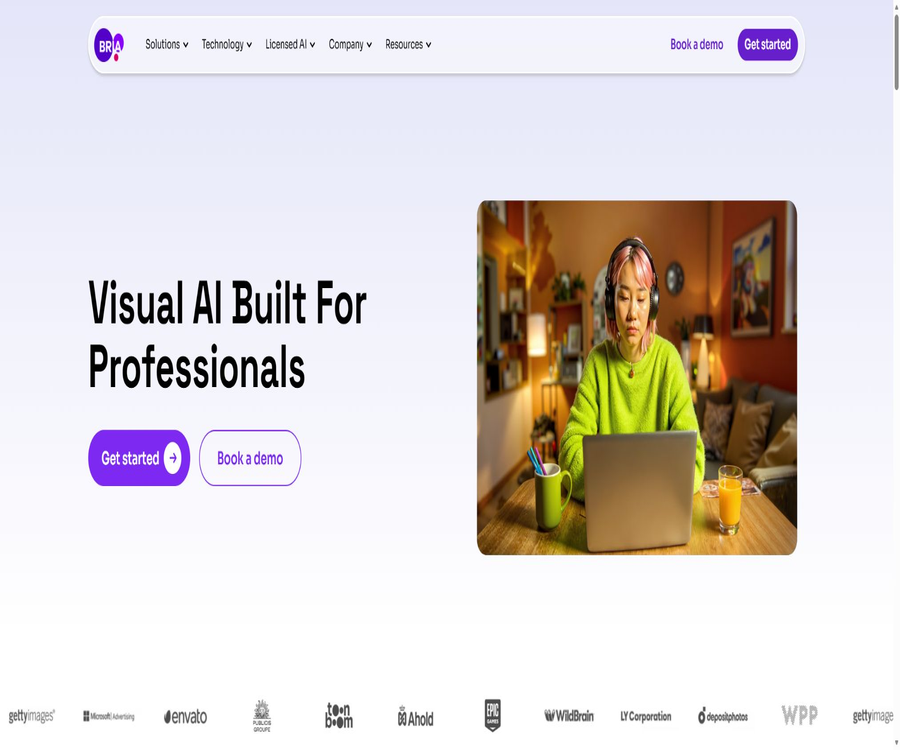
Bria AI is a visual generation platform designed for professional creative work and enterprise product integration; it enables controlled image creation, editing, as well as processing of product images and videos through Web, API, Python SDK, MCP, and design tools. Its key differentiators are licensed training data, attribution information, and guarantees for commercial use.
Tool Introduction
Bria is operated by Bria Artificial Intelligence Ltd., and its products are intended for teams in the fields of platform technology, marketing and advertising, e-commerce retail, media and entertainment, as well as gaming. It offers not only an online creation interface but also visual PaaS, models, APIs, SDKs, ComfyUI nodes, as well as options for enterprise deployment.
The current core generation models are part of the Fibo series; they emphasize the use of natural language or structured JSON to describe lighting, cameras, composition, objects, and colors. Companies can also take advantage of functions such as image and video editing, creation of product images, ad generation, Tailored Generation, and brand-specific models.
Core products and technologies
| Products or technologies | Positioning | Key capabilities | Access method | Suitable for users |
|---|---|---|---|---|
| Fibo | Controllable text-to-image generation model | Short prompts, structured prompts, generation and refinement | Platforms, APIs, models, and ComfyUI | Developers and professional creative teams |
| Fibo Lite | Low-cost image generation | Services that offer a lower price per transaction | API | High-frequency batch content |
| Fibo Edit | Imperative image editing | Modify the visuals according to the text requirements. | APIs and SDKs | Product and design workflows |
| Media Suite | Universal visual editing | Remove background, generate background, erase, enlarge image, and improve resolution | Web, API, and plugins | Content creation and material processing |
| Product Shots | E-commerce product images | Scene diagrams, image masking, shadows, and product embedding | API and enterprise solutions | E-commerce, retail, and advertising |
| Tailored Generation | Custom visual models | Maintain visual consistency for brands, individuals, or products | Training, APIs, and enterprise deployment | Companies that possess legitimate brand assets |
| VGL | Visual Generative Language | Precisely describe visual parameters using structured JSON. | APIs, SDKs, and proxy workflows | Teams that need verifiable and version-controlled processes |
Main functions
Fibo image generation
Fibo can expand short prompts into structured descriptions that include details such as lighting, camera settings, composition, depth of field, colors, and object relationships, using these to generate images. Users can also submit detailed JSON data, which enables programmed verification, comparison of different versions, and the ability to modify only specific parameters.
Structured prompts and VGL
VGL represents visual intentions as structured data, rather than relying entirely on natural language instructions. The development team can review or compare the specifications in the code repository, and make targeted changes to elements such as lighting, perspective, or background.
Image editing
The platform offers functions such as Fibo Edit, background removal, background generation, Eraser, Gen Fill, image expansion, and resolution enhancement. The quality of the editing results depends on the edges of the subject, any obstructions, the input resolution, and the clarity of the instructions; it is therefore necessary to conduct sample tests on portraits, text, and complex products.
Video editing
The video processing tools include background removal, background replacement, green screen usage, stream-based background removal, resolution enhancement, and video erasure. Most of these video functions are charged based on the number of seconds of processing required; for long video files, it is advisable to first extract short segments to assess quality and costs.
Generation of product images
The Product Shot feature allows for the creation of lifestyle scenarios based on text or reference images, as well as for image extraction of the product, addition of shadows, and integration of other elements. Brands should define the product’s shape, packaging text, logo, colors, and dimensions to prevent any changes to the actual product during the generation process.
Ad generation
The Ads Generation API is used to create advertising visuals on a large scale while maintaining brand consistency. Before using it, it is necessary to establish templates, target audiences, channel specifications, legal text, and implement manual approval processes; the model should not be allowed to decide all promotional statements on its own.
Tailored Generation
Companies can use visual materials for which they hold rights to train or fine-tune custom models, thereby ensuring that the style of characters, products, or brands remains consistent across various outputs. By providing the training data, it implies that the customer possesses the relevant rights; personal data and unauthorized portraits should not be uploaded directly.
Data attribution and Birth Certificate
Bria emphasizes that all training data comes from commercially licensed sources, and an attribution engine is used to record the impact of the data owners on the generated results. The enterprise packages also include Visual Birth Certificates and copyrightability reports for each image, in order to document the background related to their creation and rights.
Content authenticity marker
Security documents list C2PA image markers, and metadata is used to support tracking of the content’s origins and the process by which it was created. Metadata can be lost during compression, screenshotting, or processing on third-party platforms; therefore, the issuer must still retain the original records.
Input and output auditing
APIs can scan input and output visuals using content moderation parameters, covering categories such as explicit content, violence, disturbing images, and hate symbols. The moderation systems may make mistakes or fail to detect certain issues; therefore, companies should apply their own rules and conduct manual reviews depending on the specific situation.
Multiple deployment options
Bria Cloud can be used either free of charge or on a pay-as-you-go basis; for enterprise solutions, it is possible to choose between Bria Cloud, an in-house cloud infrastructure, AWS or Azure BYOC options, as well as local deployment and isolated environments. Only when the corresponding deployment is actually purchased can input and output data remain entirely within the customer’s environment.
Asynchronous tasks and Webhooks
The V2 API handles requests asynchronously by default; after a request is submitted, it returns a task identifier and a status address. The client can use polling or Webhooks to receive the results. The official Python client supports HMAC-SHA256 signature verification, and it is necessary to verify the signatures before processing the callbacks in a production environment.
The complete process from demand to production
- First, determine the visual task, output channel, size, brand guidelines, allowable variations, and acceptance criteria.
- Select Fibo Generation, Fibo Edit, Media Suite, Product Shots, or the video interface.
- Register on the platform to obtain an API Token, and use the free quota to create a minimal test sample.
- Test quality, review processes, and failure scenarios using real but authorized images, prompts, and edge cases.
- When stable control is required, the prompts should be converted to VGL or structured JSON and included in version control.
- Verify that the business plan, compensation limits, rates, storage options, and deployment methods are appropriate in light of the project’s risks.
- Supports asynchronous status, Webhook signing, retry, timeout, idempotency, and usage monitoring.
- Conduct reviews on the output regarding product accuracy, brand issues, copyright matters, as well as text and content safety.
- Launch with a low data volume, while retaining input data, model versions, parameters, results, and approval records.
- Increase throughput after evaluating quality and costs, and regularly retest the model as well as make changes to the interfaces.
API Getting Started Tutorial
- Create a Bria platform account and generate a dedicated API Token in the console.
- Store the Token in the server’s key management system, without including it in the browser code or in public repositories.
- Select a low-risk task, such as background removal, and prepare test images for which processing is permitted.
- Submit the image URL or the Base64 encoded content without any data header, as specified in the document.
- Record the identifier of the returned task, and use the status service to wait for it to complete or to detect any errors.
- After downloading the result, verify the transparent edges, color, size, and expiration date of the file.
- For rate-limiting responses, use exponential backoff instead of attempting retries immediately indefinitely.
- Set limits for one-time costs, per user, per project, and daily costs, before integrating them into the actual business operations.
Python SDK integration process
- Install the official bria-client package in Python 3.10 or later environments.
- API tokens are provided through environment variables or a key system, so that credentials are not hardcoded.
- Simple scripts use synchronous clients, while high-concurrency applications use asynchronous clients.
- Short tasks can wait for their results directly, while videos and batch processing require polling after submission or receiving a Webhook.
- Local videos are first uploaded through the SDK; note that the pre-signed file is valid for approximately 24 hours.
- Establish clear exception handling for timeout, rate limiting, unknown states, and failed results.
- The Webhook receiver verifies the timestamp, identifier, and HMAC signature, then places the retry task in the queue.
- Record the model, endpoints, input summary, costs, and output location to avoid duplicate charges.
E-commerce product image workflow
- Prepare front, side, and detailed images of the products that have undergone color calibration, and verify the rights to those images.
- Use Product Cut Out to create a clean subject, and check for transparent edges and fine details.
- Select a Lifestyle scenario driven by text or reference images, and lock in the elements that are constant for the brand.
- Generate background, shadows, proportions, and safe cropping areas as required by the channel.
- Check each package individually for the text, logo, color, components, quantity, and material.
- Use local editing for the inaccurate areas; avoid re-creating the entire image repeatedly, as this can cause deviations in the product.
- It can be included in ads, detail pages, or catalogs only after approval by the person in charge of the brand or product.
- Save the original image, parameters, model version, and approval records to enable reproduction and reversal.
Which users are it suitable for
- Platform and software development teams: integrate visual capabilities into products through APIs, SDKs, or MCPs.
- Marketing and Advertising Team: Mass production of campaign visuals in accordance with brand guidelines.
- E-commerce and retail companies: creating product scenarios, image masking, shadows, and multi-channel content.
- Media, entertainment, and gaming teams: deal with a large volume of images, videos, and repeatable visual standards.
- Design and creative technicians: Integrated into Figma, Photoshop, ComfyUI, or DCC workflows.
- Corporate compliance and legal teams: Visual AI that requires data licensing, attribution, and compensation provisions.
- Research and non-commercial developers: Use the public model source code and weights for testing.
- Companies that possess legitimate brand assets: train dedicated models and deploy them in controlled environments.
Typical use cases
- In-app image generation: Provides controlled text-to-image creation for designs, content, or creator products.
- Batch e-commerce catalog: Generates various scenarios, backgrounds, and proportions for the same product.
- Ad variants: Generate channel-specific versions while maintaining the accuracy of the brand and product.
- Automatic background removal: Removes the transparent background from products, portraits, game assets, and advertising materials.
- Video virtual background: Remove, replace, or process video backgrounds in a streaming manner.
- Local image editing: erasing objects, creating fill, expanding the image, and improving resolution.
- Brand-specific generation: Train consistent characters, products, or visual styles using authorized data.
- AI agent visual tools: capabilities for generation and editing are accessed via MCP or Skills.
Product advantages
- Training data is primarily sourced from commercial licensing channels, and the information regarding rights and attribution is clearer than that in black-box data.
- VGL and JSON native Fibo are suitable for programmed control, validation, and version comparison.
- It covers generation, editing, product images, videos, advertising, and custom training all at once.
- The API offers a fixed price per function, and the free quota is sufficient for carrying out initial technical testing.
- It offers a Python SDK, MCP, Skills, ComfyUI, as well as various integration options for design and DCC tools.
- Asynchronous tasks, Webhooks, and enterprise-level throughput support scalable production.
- Companies can choose to use their own cloud, on-premises solutions, or isolated deployment methods to meet higher demands regarding data sovereignty.
- GitHub makes models, SDKs, nodes, and integration examples available publicly, to facilitate evaluation by developers.
Usage restrictions and risks
- 100 free generations constitute a one-time trial quota; it is not a permanent free plan that is automatically renewed on a monthly basis.
- Pay-as-you-go commercial protection has limits; only enterprise contracts provide unlimited IP compensation.
- The free license for the FIBO and RMBG open-source models is intended only for non-commercial use; commercial deployment requires the purchase of additional rights.
- Model self-hosting does not entail automatic acquisition of commercial licenses, compensation, support, or subsequent updates.
- The information provided on different pages of the official website regarding “compensation for all outputs” varies, as does the pricing structure shown on those pages; the contract shall prevail in such cases.
- AI may still generate incorrect text, distorted products, similar compositions, or content that does not conform to the brand’s standards.
- The fact that training data is licensed does not exempt the user from responsibility regarding the input materials, trademarks, individuals, and the final use of such data.
- Content review may lead to misjudgments or omissions, and regulated as well as publicly shared content requires manual approval.
- Videos are charged on a per-second basis, and failures, retries, large files, and batch tasks can quickly increase costs.
- The publicly displayed pricing and the plan names specified in the API documentation do not always match; the actual rate limits need to be confirmed within the account.
- The free and pay-as-you-go options are available only for cloud processing; on-premises, private clouds, and isolated environments fall under the enterprise’s own capabilities.
- The Pilot license is valid for a maximum of 90 days and is intended solely for internal evaluation; the results of this pilot project cannot be used for commercial purposes outside of the organization.
Price plans
The following are the current prices on the Bria official website as of August 20, 2026. The Free version allows 100 generations without the need for a credit card; the Pay-as-you-go option charges based on actual API usage; the Enterprise version offers customized contracts along with enhanced deployment capabilities, governance, and better security measures.
| Plan | Price | Limit and throughput | Business and Deployment | Support | Suitable for users |
|---|---|---|---|---|---|
| Free | $ | 100 generations; 10 requests per minute | Cloud; used for exploration | Discord community | Individual testing and technical assessment |
| Pay-as-you-go | Starting at $0.018 per transaction | There is no fixed upper limit on generation; 60 requests per minute. | In the cloud; standard compensation with a maximum limit. | Standard technical support | Development and medium-scale production |
| Enterprise | Custom quote | Customized rates and dedicated performance capacity | Cloud, proprietary cloud, or on-premises; open model commercial rights and unlimited IP compensation provisions | Dedicated solution engineer | High throughput and regulated enterprises |
| Pilot | By order | Up to 90 days | For internal use only; not allowed for external distribution or commercial use. | In accordance with the pilot agreement | Companies preparing to enter long-term contracts |
The unlimited IP compensation offered on the Enterprise page is subject to contractual restrictions; the applicable products, regions, claim procedures, and exclusions must be checked in the official order. The maximum amount of compensation based on usage tiers is also specified in the agreement, and it is not possible to determine this amount solely by referring to the text on the website.
Prices for Image and Product Image APIs
| Category | API capabilities | Current unit price | Billing unit | Primary uses |
|---|---|---|---|---|
| Image generation | Fibo | 0.03 dollars | Each one | Highly controllable text-to-image generation |
| Image generation | Fibo Lite | 0.02 dollars | Each one | Low-cost mass generation |
| Suggest structured format | Fibo Structured Prompt | 0.02 dollars | Each time it is called | Generate or convert VGL/JSON prompts |
| Image editing | Fibo Edit | 0.03 dollars | Each one | Imperative editing |
| Image editing | Background Removal | 0.018 dollars | Each one | Remove background |
| Image editing | Background Generation | 0.03 dollars | Each one | Generate a new background |
| Image editing | Eraser | 0.02 dollars | Each one | Remove object |
| Image editing | Gen Fill | 0.03 dollars | Each one | Generate padding |
| Image editing | Image Expansion | 0.02 dollars | Each one | Expand canvas |
| Image editing | Increase Resolution | 0.02 dollars | Each one | Increase resolution |
| Product image | Lifestyle by Text | 0.03 dollars | Each one | Scenario of generating products from text |
| Product image | Lifestyle by Image | 0.03 dollars | Each one | Generate product scenarios with reference to diagrams. |
| Product image | Product Cut Out | 0.018 dollars | Each one | Product masking |
| Product image | Product Shadow | 0.018 dollars | Each one | Generate product shadows |
| Product image | Product Embedding | 0.03 dollars | Each one | Embed products in scenarios |
Video API pricing
| Ability | Current unit price | Billing unit | 10 minutes of theoretical fee | Precautions |
|---|---|---|---|---|
| Video Remove Background | 0.0225 dollars | per second | 13.50 dollars | First, test the edges and occlusions. |
| Video Replace Background | 0.0225 dollars | per second | 13.50 dollars | Background consistency must be verified. |
| Video Green Screen | 0.0225 dollars | per second | 13.50 dollars | Check for green overflow and fine hairs. |
| Streaming Video Remove Background | 0.0225 dollars | per second | 13.50 dollars | The cost of real-time architectures also needs to be taken into account. |
| Video Increase Resolution | 0.02 dollars | per second | 12.00 dollars | The output quality is limited by the original footage. |
| Video Eraser | 0.045 dollars | per second | $ | Complex moving objects have the highest cost. |
The theoretical cost is calculated by multiplying 600 seconds by the public unit price; it does not include costs related to retry attempts in case of failures, additional storage, transmission, taxes, nor support from third-party platforms or companies. Before carrying out batch processing, it is necessary to determine the actual success rate and the average cost per retry based on short videos.
Request rate and task mode
On the current pricing page, the plan options are listed as Free, Pay-as-you-go, and Enterprise; the API overview still uses names such as Free Trial, Starter, Pro, and Enterprise. The basic limits specified in the documentation are 10, 60, and 1,000 requests per minute per endpoint, while the Enterprise page indicates that the rate can be customized, with the console and order details serving as the final reference.
| Document tags | Public restrictions | The price page corresponds approximately to it. | Queue or performance | Suggestions |
|---|---|---|---|---|
| Free Trial | 10 requests/minute/endpoint | Free | Queueing delay | For testing only |
| Starter | 60 requests per minute per endpoint | Pay-as-you-go | Priority queue | Implement throttling and backoff. |
| Pro and Enterprise | 1,000 requests per minute per endpoint for documents | Enterprise or the old solution | High throughput | Confirm with the authorities before going live. |
| Enterprise customization | By order | Enterprise | Dedicated performance capacity is optional. | Conduct concurrency and capacity testing |
Access method
| Method | Current status | Primary uses | Open-source license | Precautions |
|---|---|---|---|---|
| REST API | Complete document | Create, edit videos, product images, ads, and track attribution. | Business services | Billing based on plan and throttling |
| Python SDK | Provide | Synchronous, asynchronous, polling, Webhook, and uploading | MIT Code License | An API token that requires payment is still needed. |
| MCP Server | Provide | Allow AI agents to discover and utilize visual capabilities. | Connect to business APIs | Limiting tool permissions and costs |
| Bria Skill | Public on GitHub | Generate and edit images in the encoding proxy. | Warehouse permits need to be checked item by item. | Does not include free commercial APIs |
| ComfyUI Nodes | Provide | Calling the Bria API or models within a node workflow | The warehouse is available to the public; model rights are handled separately. | Distinguish between API nodes and local models |
| Figma and design plugins | Listed on the official website | Using visual skills to become familiar with the interface | Integration of business platforms | The specific prices and permissions depend on the plan. |
| iFrame | Listed on the official website | Embed Bria experience | Business services | Identity and access control are required. |
Data privacy and security
The privacy policy applies to Bria Artificial Intelligence Ltd., which is responsible for handling personal data related to the use of accounts, websites, services, and APIs. Customer content should not contain any personal data; before uploading images or training data, companies must conduct assessments regarding privacy, portrait rights, and legal considerations.
The terms and conditions state that the customer retains ownership of its Customer Content; Bria processes this content only to the extent necessary to provide and improve the use of its products. Unless the customer gives written consent for specific training or fine-tuning, its Customer Content will not be used to train generation models. When custom training is required, the provision of the relevant data itself constitutes the necessary authorization.
The official website states that the system meets SOC 2 Type II and ISO 27001 standards, and it highlights the measures related to encryption of data both in transit and at rest, as well as the compliance requirements outlined by GDPR and the EU’s AI Act. These certifications and compliance statements do not imply that every specific implementation by customers will automatically meet these requirements; it is still necessary to verify the scope of the report, the applicable region, and who is responsible for oversight.
- Do not upload unauthorized facial images, private photos, trade secrets, or customer personal data.
- API Tokens are stored only in the server-side key system, and are created separately for each environment and application.
- For sensitive corporate projects, BYOC, on-premises, or isolated deployment should be given priority over cloud deployment as the default option.
- Before training a custom model, create a list of data, obtain proof of ownership, and establish mechanisms for deletion and withdrawal.
- Verify signatures and timestamps for Webhooks, as well as prevent replay and duplicate processing.
- Evidence such as audit records, attribution data, C2PA information, and generation parameters is retained for the output.
- Add compliance checks for faces, trademarks, text, products, and industries based on the content type.
- At the end of an account or project, it is necessary to confirm the deletion of input data, output data, training data, cache, and backups.
Boundaries of commercial rights and compensation
The free trial is intended for evaluation purposes; the Pilot agreement specifies that internal evaluations can last no more than 90 days, and commercial use, as well as external publication or distribution, are not allowed. For official commercial use, it is necessary to obtain the necessary rights under the pay-as-you-go online terms or through an Enterprise order.
The Pay-as-you-go option provides standard compensation with a set limit, while the Enterprise option offers unlimited IP compensation along with rights to use the open model for commercial purposes. However, compensation does not mean that there will be no disputes; the customer is still responsible for any input provided, prohibited content, trademarks, public figures, and any use that goes beyond the permitted limits.
GitHub, SDKs, and open-source status
Bria has a GitHub organization that is certified by its official website, and it makes available repositories for FIBO, RMBG-2.0, the Python client, ComfyUI nodes, Skill, as well as OBS and DCC tools. The licensing terms for these different repositories vary, so it’s not possible to describe the entire product using just the label “open source”.
| object | Public status | Licensing or business boundaries | Correct understanding |
|---|---|---|---|
| Bria Cloud Platform and API | Commercial closed-source services | Under Free, Pay-as-you-go, or Enterprise terms | It is not possible to build a complete platform from public repositories. |
| FIBO source code and weights | Available publicly | License for non-commercial use; for commercial use, contact Bria. | It is not a permissive commercial open-source model. |
| RMBG-2.0 | Source-available | CC BY-NC 4.0; commercial use requires a license. | Publicly available code does not mean it can be used for commercial purposes free of charge. |
| bria-client Python SDK | Open source | MIT License | The SDK code is available, but the API services are still subject to charging. |
| Nuke and Houdini tools | Public warehouse | Some warehouses show MIT. | Check the LICENSE for each warehouse. |
| OBS background removal tool | Public warehouse | The current list shows GPL-3.0 | Follow the GPL when distributing modifications. |
| ComfyUI API nodes | Public warehouse | Connect to the Bria API | The open-source nature of the nodes does not confer any commercial rights on the model. |
Bria describes some of these models as Open Commercial Source or open models, but the official repository specifies that the right to use them freely is limited to non-commercial purposes. When choosing to use a model for commercial purposes, to host it oneself, to modify it, or to redistribute it, it is necessary to follow the specific LICENSE terms of that model as well as the requirements outlined in the corporate order.
Basic information
| field | Content |
|---|---|
| Tool name | Bria AI |
| Operating entity | Bria Artificial Intelligence Ltd. |
| Tool type | Platform for creating, editing, and managing corporate visuals and models |
| Core model | Fibo, Fibo Lite, Fibo Edit and the RMBG series |
| Key capabilities | Image generation and editing, product images, videos, ads, and custom models |
| Price pattern | 100 free trials, pay-as-you-go options, and Enterprise customization |
| API | Provide |
| Python SDK | Available under the MIT license. |
| MCP and Skill | Provide |
| Official GitHub | Yes, multiple models and integrated repositories are available publicly. |
| Is the platform completely open source? | No |
| Model in open state | Some of the source code and weights are made public; the licensing is primarily non-commercial. |
| Deployment | Bria Cloud; enterprises can choose BYOC, on-premises, and isolated environments. |
| Chinese support | It is suggested that multiple languages can be used; the quality of Chinese output needs to be tested in practice. |
| Security and Governance | The official website states compliance with SOC 2 Type II, ISO 27001, GDPR, and the EU AI Act regulations. |
Recommendation score
Its rating is 4.6 out of 5 points. Bria combines licensed training data, structured visual control, attribution, generative editing, product images, videos, and various development interfaces; it also offers greater transparency in pricing and more options for enterprise deployment compared to many tools that only provide web content generation.
The deductions are mainly due to the complexity of the model and platform licensing structures, the fact that full compensation is specified in corporate contracts, inconsistencies between document plan names and current price labels, and the need for thorough manual inspection of products and characters visually.
Frequently Asked Questions
What is Bria AI?
It is a visual generation platform designed for professional teams and developers, offering capabilities for controlled image creation and editing, as well as the generation of product images, videos, custom models, and enterprise-level deployment.
Is Bria AI free?
There are 100 free API calls or generations available, and no credit card is required. Once those are used up, one can opt for pay-as-you-go pricing or purchase an enterprise plan; it isn’t a permanently free quota that gets renewed on a monthly basis.
How much does it cost to generate on demand?
The minimum price is $0.018 per item. Fibo costs $0.03 per item, while Fibo Lite costs $0.02 per item; different pricing applies for editing services, product images, and video processing.
What is Fibo?
Fibo is Bria’s native JSON-based image generation model that offers fine-grained control over elements such as lighting, camera settings, composition, colors, and objects; it also supports short prompts, detailed specifications, and reference images for inspiration.
What is VGL?
VGL is Visual Generative Language; it represents visual requirements in a structured manner, enabling programs to verify, compare, and make partial modifications to the generation specifications.
Can product images be generated?
Yes, it supports product scenarios, image masking, shadows, and scene integration. The final image still needs to be checked for its packaging, logo, colors, structure, and the authenticity of the promotional content.
Does it support videos?
It supports functions such as video background removal, background replacement, green screen usage, resolution improvement, and content erasure; most of these services are charged based on the actual number of seconds used.
Are APIs and Python SDKs available?
It provides a complete API as well as the official bria-client Python SDK. This SDK supports synchronous and asynchronous operations, polling, Webhook signing, and video uploading; its code is licensed under the MIT license.
Is MCP supported?
It supports MCP Server and Bria Skills for encoding proxies, enabling proxies to discover and utilize capabilities for generation and editing. When using it, it is necessary to limit the tokens, the range of available tools, and the associated costs.
What is the API throttling limit?
For Free plans, the rate is 10 requests per minute per endpoint; for the pay-as-you-go option it is 60 requests per minute per endpoint. For Pro and Enterprise plans, the rate is 1,000 requests per minute per endpoint. However, the current Enterprise pricing page indicates that customization is possible. The actual rate depends on the account and order details.
Can the output be used for commercial purposes?
Commercial rights can be provided on a pay-as-you-go basis or under corporate terms; the free and Pilot versions cannot necessarily be used for commercial purposes. The limits on compensation and the exclusions also vary depending on the plan chosen.
Will Bria use customer content to train the model?
The terms for enterprises and Pilot states that this will not happen, unless the customer gives explicit written consent for specific training or fine-tuning projects and provides the necessary materials; the customer must still ensure that they have the rights to provide such materials.
Is Bria AI open source?
The platform is not entirely open source. The developers have made several models, SDKs, and tool repositories available publicly, but the free licenses for FIBO and RMBG are intended solely for non-commercial use; commercial deployment requires separate authorization.
Can FIBO be used commercially for free locally?
It cannot be understood in that way. The source code and weights can be used for non-commercial purposes; for commercial use, it is necessary to contact Bria to obtain the appropriate license or a corporate solution.
Can enterprises deploy it locally?
It is possible to negotiate BYOC, on-premises, or isolated environments; this is part of the Enterprise capabilities. The actual hardware, models, updates, support, and data boundaries must be specified in the order.
Tools similar to Bria AI



 Guigong Network Security Registration No. 45132202000164