






BotGauge
BotGauge, an intelligent tool focused on AI programming
Tags:AI programming toolsA one-sentence summary
BotGauge is a hosted testing service that falls under the category of Autonomous QA as a Solution; it involves AI agents generating, executing, and repairing tests, with domain-specific QA experts then verifying the coverage and identifying any defects, thereby helping engineering teams to integrate continuous testing into their development and deployment processes.
Tool Introduction
BotGauge AI Inc. offers autonomous QA services for software teams that need to carry out rapid iterations, covering functional, interface, API, integration, regression, and end-to-end testing. After customers provide product requirements, user workflows, screenshots, designs, or demonstration videos, the platform works together with specialized FDE teams to create test suites.
It currently focuses on \"delivering results\" rather than selling self-service testing tools: BotGauge is responsible for testing creation, execution, maintenance, fault analysis, and reporting, while the client provides the testing environment, business context, and acceptance criteria. This approach is more similar to continuous managed QA rather than simply purchasing a no-code testing editor.
Current product positioning
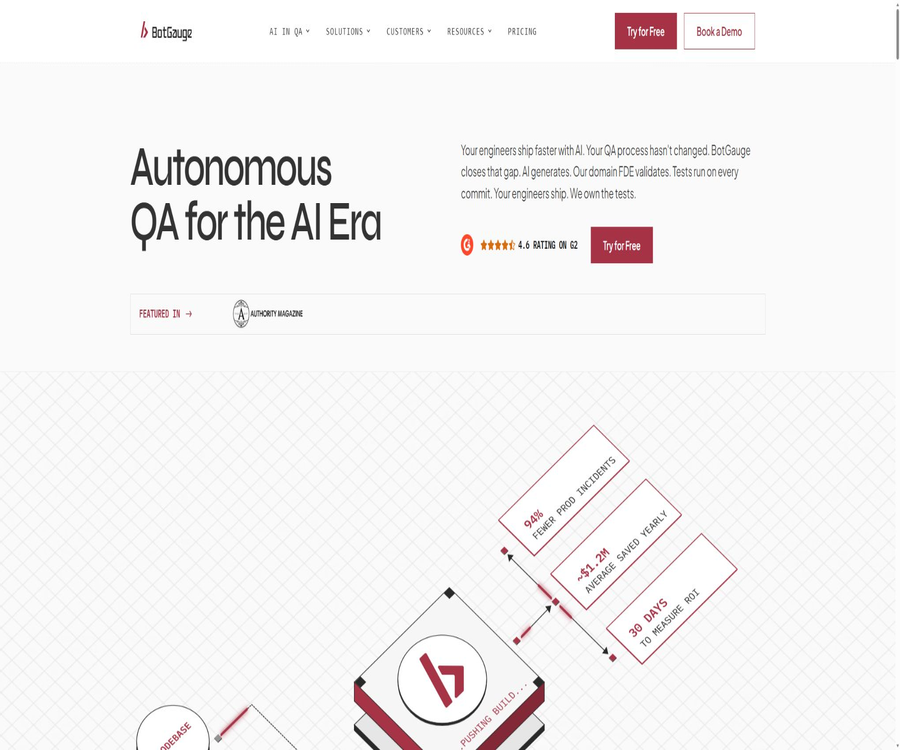
The official website refers to these products as Autonomous QA for the AI Era and AQaaS; the goal is to ensure that code generated by AI undergoes continuous verification every time it is submitted. This service is built up from test agents, infrastructure for automatic execution, self-healing mechanisms, and human experts in the relevant field.
The old version of the official website focused on concurrent sessions and self-service package options; the current page now presents two outcome-based solutions: Launch and Scale. The menu should reflect the current offerings of hosting services, and it is no longer appropriate to use the old Starter, AI Foundation, or Advanced AI packages.
Main functions
Read product information
BotGauge can accept PRDs, user stories, UX flows, screenshots, design documents, and demonstration videos, which help in understanding the product’s functions and the key user journeys. The more complete the information provided, the easier it is to create tests that cover the actual business rules and abnormal scenarios.
AI-generated test cases
The testing proxy converts the product context into structured test cases that cover the interface, functions, APIs, and integration layer. The official website states that there is no need for customers to maintain the automation scripts, but they still need to define the requirements, the environment, and the expected results.
Verification by domain experts
Each test suite is reviewed by domain experts in FDE or QA to determine whether the tests reflect the actual business intentions, thereby reducing error scenarios and false positives resulting from purely AI-generated tests. Manual verification is a key difference between BotGauge and fully self-service AI testing tools.
Continuous execution and parallel running
Tests can be integrated into processes such as code submission, pull requests, building, and deployment, and they run automatically whenever changes occur. The official website promotes this service by highlighting its unlimited number of executions and high parallel processing capacity; however, specific constraints regarding concurrency, queues, and fair usage must be specified in the order.
Self-healing test
The self-healing agent identifies changes in interface elements or processes based on the context, and attempts to update the relevant tests. Changes with low confidence levels should be verified by experts, to prevent the system from mistakenly fixing real functional issues as if they had been resolved.
Root cause analysis and defect reporting
In the event of a failure, the platform can use execution logs, screenshots, videos, and runtime context to generate an analysis of the root causes as well as a detailed report on the defect. These reports can be integrated into the team’s existing tools for defect management and communication, thereby reducing the time engineers need to collect information again.
Coverage analysis and test management
The team can view test suites, their status, execution history, and coverage levels, and sort them by function, priority, or risk management criteria. The product also allows tests to be exported or migrated; the export format and availability after termination must be specified in the contract.
BotGauge MCP
BotGauge MCP integrates functions such as creation, browsing, batch modification, execution, failure investigation, override viewing, and defect reporting into AI assistants that support MCP. As of this verification, these functions are still marked as Beta, and it is necessary to contact the team to enable them.
Complete workflow
- Define the product scope, key processes, release frequency, testing environment, and quality objectives with the BotGauge team.
- Provide PRDs, user stories, designs, screenshots, demonstration videos, interface specifications, and existing test materials.
- Connect only to testing or pre-release environments, and prepare anonymized, resettable non-production test data.
- AI agents map the product process and generate UIs, features, APIs, and candidate integration tests.
- The FDE team in this domain reviews the test steps, expected results, abnormal scenarios, and business risks.
- Connect the testing to the code repository, CI/CD, defect management, and communication tools.
- It runs on each submission or release, self-heals changes, and converts failures into executable defect reports.
- Regularly review coverage, false positives, missed tests, and product changes, and update the testing scope and acceptance criteria.
30-day pilot process
- Select one to three test processes that have a high impact on revenue or users and are easy to isolate.
- Create separate pilot environments and synthetic test accounts, without copying real customer or production databases.
- Provide BotGauge with requirements, processes, interfaces, and failure criteria, and confirm the scope of authorization.
- Have the team generate and manually verify the initial set of tests, reviewing each scenario involving normal operations, abnormal conditions, and permission issues.
- Track coverage, execution time, false positives, false negatives, self-healing accuracy, and engineering effort within 30 days.
- Verify that the permissions for Git repositories, CI systems, defect tracking platforms, and notification channels comply with the principle of minimization.
- Compare the ongoing usage cost with the total cost of internal QA, code frameworks, or other hosting services.
- Before the end of the pilot phase, confirm in writing the official price, SLA terms, data deletion procedures, export options, and termination arrangements.
MCP access process
- Contact BotGauge to request MCP Beta, and confirm the account, project, tool scope, and data boundaries.
- Select an AI client that supports MCP, and create separate credentials with minimal permissions for the testing environment.
- Initially, only browsing for testing and reading results will be available, to verify identity, ensure project isolation, and maintain audit logs.
- Testing involves generating use cases from PRDs; batch modifications or execution of the suite are allowed only after manual verification.
- Clear user confirmation, environment allowlists, and limits on the number of times actions such as execution, modification, and defect creation can be performed are in place.
- Check whether the failure logs, screenshots, and reports return keys or actual user data to the chat.
- Log tool calls and the users who carry them out; regularly rotate credentials and shut down clients that are no longer in use.
Which teams are suitable?
- Highly iterative SaaS teams: frequent releases but insufficient automated QA resources.
- AI programming team: Aims to establish ongoing regression testing and quality standards for AI-generated code.
- Startups: They need to cover key processes quickly and do not want to hire a full team dedicated to test automation right away.
- Growth-oriented engineering organization: already has CI/CD, defect management, and code repositories, and wishes to add a managed testing layer.
- E-commerce and fintech products: The key transaction processes are complex, requiring joint verification of functions, user interfaces, and APIs.
- HealthTech and regulated teams: They require data isolation, auditing, and security measures, but still need to carry out their own compliance assessments.
- Product Manager: I hope to generate reviewable acceptance and regression tests based on the PRD and user workflows.
- Developer: Wants to be able to run tests directly when submitting code or using an AI assistant, and to identify the root causes.
Typical use cases
- Release regression detection: Key user journeys are automatically executed with each code submission to prevent obvious regressions.
- Payment process testing: It verifies the interface, APIs, third-party callbacks, and error conditions simultaneously.
- Permission testing: Covers access control under different roles, login statuses, and boundary conditions.
- New feature validation: Tests are generated based on PRDs, designs, and user stories, and then submitted to domain experts for review.
- Cross-browser verification: Test different combinations of browsers and operating systems within the Scale approach.
- API regression: Generate normal, abnormal, and integration tests in accordance with the interface specifications and business processes.
- Defect diversion: Use root cause analysis to distinguish between product issues, environmental problems, and unstable tests.
- AI development loop: Conduct tests in Cursor, Claude, Windsurf, or other MCP clients.
Product advantages
- Combine AI-driven testing with verification by domain experts to reduce issues arising from unreviewed model outputs.
- It covers the entire testing lifecycle, including requirement understanding, use case generation, execution, self-healing, analysis, and reporting.
- Based on the test results and the delivery approach adopted, customers are not required to maintain a large number of scripts or operating infrastructure on their own.
- It supports UI, functional, API, and integration testing, and is suitable for cross-layer user workflows.
- It can be connected to code repositories, CI/CD tools, defect management systems, and communication tools, thereby reducing the need to switch between different workflows.
- The current solution promotes unlimited execution instances, and supports parallel operation as well as continuous triggering.
- MCP Beta enables engineers and product teams to operate test processes using natural language.
- The official website indicates SOC 2 Type II; companies can request the audit report and a list of the control areas in question.
Usage restrictions and risks
- BotGauge is a hosted service rather than a fully self-service framework, meaning customers have limited direct control over the infrastructure used for testing and execution.
- There is currently no fixed public price; billing is based on the test cases and their results, and a sales assessment is required, making it difficult to compare budgets promptly.
- The claims on the official website regarding coverage speed, zero maintenance, and no instability are marketing promises that must be verified through pilot projects and contractual evaluations.
- Self-healing may conceal the actual changes in the product; repairs with low confidence levels and critical processes should be subject to manual review.
- Test inputs, screenshots, logs, and videos may contain sensitive information, and the uploading of production data is strictly prohibited.
- The privacy policy states that customer information may be used for deep learning purposes to improve services; companies must establish criteria regarding its use, as well as mechanisms for isolation and withdrawal.
- The privacy policy still refers to the service as Autify, indicating that old names or template remnants are present in the legal text.
- MCP is still in Beta phase; its interfaces, tools, permissions, stability, and pricing may change.
- The product does not provide public, complete API or SDK documentation; the extent of custom integration needs to be determined during the implementation phase.
- There are over 60 integrations in total, and these are presented as a unified package; however, not all of them offer the same set of functions, two-way synchronization, or the same level of support.
- The free trial also provides access to a testing environment, and isolated accounts, minimal permissions, and anonymized data should be used.
- Managed QA cannot replace all the responsibilities associated with security testing, performance testing, accessibility audits, and professional compliance assessments.
Prices and packages
As of August 20, 2026, BotGauge’s current pricing page offers two pricing options: Launch and Scale; no specific price in dollars is listed. The older version of the website as well as previous official blogs did provide examples of monthly fees or charges based on concurrent usage, but these should not be considered as current pricing figures.
| Plan | Current price | Billing method | Primary interests | Suitable for teams |
|---|---|---|---|---|
| 30-day pilot | The official website states it’s free. | Pilot project | Verify coverage, execution, and reporting in the testing environment of real-world applications | Teams that wish to verify the effects first |
| Launch | Contact sales | By test case or delivery result | AI-generated, expert-verified, comprehensive coverage, UI/API/integration testing, unlimited executions, self-healing, and reporting | Startups and key processes on a smaller scale |
| Scale | Custom quote | Based on requirements and outcomes | All Launch capabilities, cross-browser and cross-platform support, CI/CD, PR code review, AI debugger, and a dedicated success manager | Growth-oriented and corporate teams |
The website’s FAQ states that subscriptions can be canceled at any time without any cancellation fee; after cancellation, no charges will apply for subsequent periods, though the fee for the current period will still be due. Payment is accepted via credit cards, while larger amounts or corporate plans can be settled through bank transfer.
When making purchases, it is necessary to clearly define the test cases, as BotGauge considers the entire active user workflow as a single test case. It is also important to determine how costs are calculated for new workflows, the number of changes made, concurrency levels, the environment used, browsers, support services, manual labor required, and tasks that fall outside the scope defined.
Comparison of Launch and Scale
| Ability | Launch | Scale |
|---|---|---|
| AI-generated testing | Includes | Includes |
| Verified by QA experts | Includes | Includes |
| Coverage of features, UI, APIs, and integrations | Includes | Includes |
| Test execution | The page states that there is no limit on the number of times. | The page states that there is no limit on the number of times. |
| Self-healing test | Includes | Includes |
| Defect report | Includes | Includes |
| Support | Slack and email are available 24/7. | Phone expert support and a dedicated success manager |
| Cross-browser and cross-operating system compatibility | It is not explicitly listed in the plan. | List |
| CI/CD integration | Confirmation of the quote is required. | List explicitly |
| PR code review and intelligent execution | Not listed | List |
| SOC 2 Type II | Platform-level declaration; the scope needs to be confirmed. | The plan clearly emphasizes this. |
| Price | According to the test cases, the amount is not disclosed. | Custom quote |
Supported test types
| Test type | Support status | Main inputs | Output |
|---|---|---|---|
| Functional testing | Support | PRD, user workflows, and business rules | Executable use cases, results, and defects |
| UI testing | Support | Interface, screenshots, design, and demonstration videos | Cross-page workflows, screenshots, and recordings |
| API testing | Support | Interface specifications, requirements, and business processes | Normal, abnormal, and integrated verification |
| Integration testing | Support | Cross-system processes and third-party dependencies | End-to-end status and failure context |
| Regression testing | Support | Changes to existing kits and code | The regression results for each submission or release |
| Cross-browser testing | Scale is listed explicitly. | Browser and operating system matrix | Compatibility results |
| Mobile testing | Some blogs mention it | The specific scope, whether it relates to native or mobile web, needs to be determined. | It is not possible to override all devices by default. |
| Performance and security testing | It has not been specified as a core component of the plan. | It needs to be confirmed separately. | Do not use functional testing as a substitute for professional evaluation. |
Integration and delivery methods
The official website lists common integrations such as Jira, Linear, Slack, GitHub, GitLab, ClickUp, Postman, Discord, TestRail, Zephyr, and Xray, stating that a total of over 60 tools are supported. The specific capabilities of the connectors, as well as the fields and directions involved, depend on the project.
| Integrated categories | Public examples | Primary uses | Key points for verification |
|---|---|---|---|
| Code and CI | GitHub, GitLab, Jenkins, CircleCI | Submission triggering, status, and quality checks | Warehouse permissions, branches, and failure behaviors |
| Defect management | Jira, Linear, ClickUp | Automated creation and updating of defects | Field mapping, deduplication, and attachments |
| Test management | TestRail, Zephyr, Xray | Synchronization use cases, execution, and results | Two-way synchronization and history retention |
| Interface tools | Postman | Interface documentation and API testing process | Key, environment, and collection permissions |
| Communication and collaboration | Slack, Teams, Discord, email | Alerts, support, and notification delivery | Sensitive logs and channel range |
| AI client | Claude, Cursor, Windsurf, GitHub Copilot, and others | Manage testing through MCP | Beta permissions, confirmation, and auditing |
Data security and privacy
The current privacy policy requires customers to use only test environments and non-production data, and prohibits them from uploading, processing, or storing any real, confidential, or personally identifiable information. Customers are responsible for ensuring that their test accounts and data are anonymized and isolated.
The platform collects information related to registration, company details, contact information, billing data, logs, devices, access history, as well as information provided voluntarily by users. The policy states that customer information may be combined with usage data to improve services through deep learning, but it specifies that this data will not be merged with that of other customers.
The service name on the privacy page is still listed as Autify, while the company name is indicated as BotGauge AI Inc. This is likely due to outdated templates or unresolved legal documents; the contracting parties should verify that the current service, company name, sub-processors, and data processing agreements are all consistent.
- Only connect to testing or preview environments; uploading data from production databases or real customer information is prohibited.
- Synthetic accounts, virtual orders, and resettable data are used for testing, with automatic cleanup afterward.
- Grant minimum-privilege credentials separately for the code repository, CI, defect tracking platform, and MCP.
- Check screenshots, videos, logs, and error messages to prevent tokens and personal information from being recorded.
- Ask the supplier for information on the scope of the SOC 2 report, the audit period, any exceptions, and the bridging letter.
- Provide written confirmation regarding customer data training, model suppliers, manual access, and retention and deletion rules.
- Export the test assets before the contract ends, and verify the process for deleting accounts, backups, and third-party copies.
Pilot acceptance criteria
| Indicators | Suggested measurement method | Common mistakes to avoid |
|---|---|---|
| Coverage of key processes | Testing based on business processes and risk mapping | Only the number of use cases is counted. |
| Defect detection rate | Record true defects, false positives, and false negatives. | Treat all failures as product defects. |
| Self-healing accuracy rate | Manual random checks trigger automatic modifications each time. | Only consider the final pass rate. |
| Execution feedback time | Time from submission to a actionable report | Only consider the speed of a single test. |
| Maintenance investment | Track the working hours of both customers and suppliers. | Ignore requirement clarification and environment maintenance. |
| Integrated reliability | Test recurring events, failed retry attempts, and permissions. | Only verify that the first connection is successful. |
| Data compliance | Check inputs, logs, screenshots, and deletion evidence. | Only view website badges |
| Total cost of ownership | Includes subscription, implementation, internal coordination, and additional costs beyond the scope. | Only compare monthly fees. |
APIs, MCP, and developer capabilities
The terms of service define the API and allow for the use of certain services through third-party integrations; however, the official website does not provide a complete REST reference, information on authentication, rate limits, a developer console, or general SDKs. The enterprise interfaces must be specified in the order and implementation documents.
BotGauge MCP is currently the most straightforward entry point for developers; it allows them to create, view, modify, and run tests using compatible AI clients, investigate failures, and check coverage levels. It is still in beta version, and to use it one must contact the team rather than downloading and installing it publicly to start using it right away.
| Development capability | Current status | Primary uses | Restrictions |
|---|---|---|---|
| Project API | Terms and integrations are present. | Connection testing and third-party systems | No complete public references or rate tables available. |
| BotGauge MCP | Beta | Manage the test lifecycle in AI assistants | It is necessary to get in touch to enable it. |
| CI/CD connection | Support | Automatically executed during submission and publishing | The specific platform and solution need to be confirmed. |
| Webhook | The available public information does not provide a complete explanation. | May be used for event integration | One cannot assume events and retry on their own. |
| Official SDK | No findings were detected. | No public language packs available. | MCP and integration are not the same as SDK. |
| Test export | The official website states that it is possible to export or migrate it. | Reduce locking | The format and executability must be confirmed through a contract. |
Open-source status
BotGauge is a proprietary commercial service; its terms of service prohibit reverse engineering, decompilation, disassembly, scraping, and competitive use. The official website does not provide the source code for the core testing agents, execution engine, or MCP service.
No publicly available GitHub repositories that have been authenticated by the official website, nor any official open-source SDKs, were found. The support for GitHub integration merely means that it is possible to connect to code repositories and development processes; it does not imply that BotGauge itself is an open-source project.
Basic information
| field | Content |
|---|---|
| Tool name | BotGauge |
| Development company | BotGauge AI Inc. |
| Tool type | Self-service QA, AI-driven test automation, and managed testing services |
| Delivery model | Autonomous QA as a Solution |
| Core competencies | Test generation, expert verification, execution, self-healing, root cause analysis, and reporting |
| Testing scope | Functions, UI, APIs, integration, regression, and end-to-end testing |
| Enter | PRD, user stories, designs, screenshots, demonstration videos, and API documentation |
| Current package | Launch and Scale |
| Price pattern | Charging is based on test cases or results; for the amount, please contact sales. |
| pilot | The official website offers a 30-day free trial period as well as a free option for reporting defects. |
| API | Project integration is available; the complete developer API is not publicly disclosed. |
| MCP | Beta version available |
| Official SDK | No findings were detected. |
| Official GitHub | No warehouse for certified products was found. |
| Is it open source? | Not open source |
| Chinese support | The official website is primarily in English; Chinese language support and testing capabilities require confirmation by the sales team. |
| Safety | The official website indicates SOC 2 Type II; the specific scope requires a report to be obtained. |
| Data limitations | Only test environments and non-production data are allowed; PII must not be uploaded. |
Recommendation score
The recommendation score is 4.1 out of 5 points. BotGauge combines AI testing agents, domain experts, continuous execution capabilities, self-healing functions, and engineering integration to offer a comprehensive managed QA service – ideal for teams that want to quickly establish coverage for critical processes without having to build all the infrastructure themselves.
The deductions are due to the fact that the current price is not made public, MCP is still in beta version, there are insufficient public APIs and SDKs, and the privacy policy contains references to the old name of Autify as well as statements regarding its use for training purposes. Companies should verify the claims made regarding these aspects through a 30-day trial period, as well as by examining SOC 2 documents and contracts.
Frequently Asked Questions
What is BotGauge?
It is an autonomous QA hosting service in which AI agents generate, execute, and maintain tests, while domain testing experts verify the coverage and identify defects.
Is BotGauge a platform or a service?
The current focus is on managed services. Customers can use the platform and its integrations, but the BotGauge team is responsible for the end-to-end testing process as well as the delivery of results.
Do I need to write the test scripts myself?
The official website states that customers do not need to write or maintain scripts; the AI and FDE teams are responsible for generating and maintaining them. Customers still need to provide the requirements, testing environment, business rules, and acceptance criteria.
Which tests are supported?
The main supported functions include UI, APIs, integration, regression, and end-to-end testing. The specific scope of tests related to mobility, performance, security, and special compliance requirements must be determined separately.
How does BotGauge charge?
Currently, billing is based on test cases or delivery of results; neither Launch nor Scale offers fixed pricing. The final cost depends on the processes involved, the scope of work, the environment, as well as requirements regarding integration and support.
Is there a free version?
There is no publicly available permanent free self-service version; the official website offers a 30-day free trial period as well as a mechanism for reporting defects for free. The scope of the trial, the requirements to qualify for it, and the conditions for transitioning to the full version need to be confirmed.
Can it be canceled at any time?
According to the FAQ regarding current prices, cancellation is possible at any time without any fees; however, a charge will still be applied for the current billing cycle, while no further charges will be incurred for subsequent cycles. For corporate orders, the terms outlined in the signed contract shall apply.
What is a self-healing test?
When interface elements or processes change, the system attempts to update the tests based on the context. Critical processes should have their self-healing records reviewed to prevent genuine regressions from being mistaken for normal changes.
Will the tests be run every time a submission is made?
It can be connected to CI/CD systems, and triggered upon submitting, pulling requests, building, or publishing. The specific triggering conditions and blocking policies are determined by the project configuration.
What can BotGauge MCP do?
It allows for the creation, viewing, batch modification, and execution of tests in compatible AI assistants; it can also help diagnose failures, examine coverage levels, and generate defect reports. It is still in beta version at present.
Which clients does MCP support?
The official website lists compatible environments such as Claude, Cursor, Windsurf, GitHub Copilot, VS Code, Amp, and IntelliJ IDEA; it also states that they can be integrated with other MCP clients.
Can production data be used?
It is not allowed. The privacy policy explicitly requires the use of only test environments and non-production data, and prohibits the uploading of any real, confidential, or personally identifiable information.
Will customer data be used for training?
The privacy policy states that customer information and usage data may be combined for use in deep learning aimed at improving services, but such data is not merged with other customers’ data. Companies should define through contracts the specific fields, models, measures for isolation, as well as the procedures for withdrawing consent and deleting data.
Why is Autify mentioned in the privacy policy?
The company behind this page is BotGauge AI Inc., but the name of the service is still listed as Autify; this is likely due to an old template or because the legal documents have not been updated. Before signing a contract, it is necessary to ask the authorities for clarification and to obtain documents that are appropriate for the current service.
Are public APIs or SDKs available?
No complete public API documentation, entry points for developer keys, or official SDKs in any language were found. Project-specific APIs and integration capabilities must be obtained through the sales and implementation teams.
Is BotGauge open source?
It is not open source. The integration with GitHub, the MCP protocol, and the ability to export test results do not mean that the source code of the core proxy or execution platform is made available to the public.
What should be focused on during the 30-day pilot?
The focus is on verifying coverage of key processes, actual defects, false positives, false negatives, the accuracy of self-healing mechanisms, feedback time, maintenance efforts required, integration permissions, data processing, and the overall cost.
Tools similar to BotGauge



 Guigong Network Security Registration No. 45132202000164